

The Adoption Numbers — Where Generative AI for Business Actually Is
Deloitte surveyed 3,235 senior leaders for their 2026 State of AI in the Enterprise report — board members, C-suite, presidents, vice presidents, and directors across organisations on the leading edge of AI adoption — and found that organisations “stand at the untapped edge of AI's true potential.” That framing is precise. Because the adoption numbers tell a story of remarkable reach, and the impact numbers tell a story of remarkable underperformance. Understanding both is the prerequisite for making sound generative AI decisions for your business in 2026.
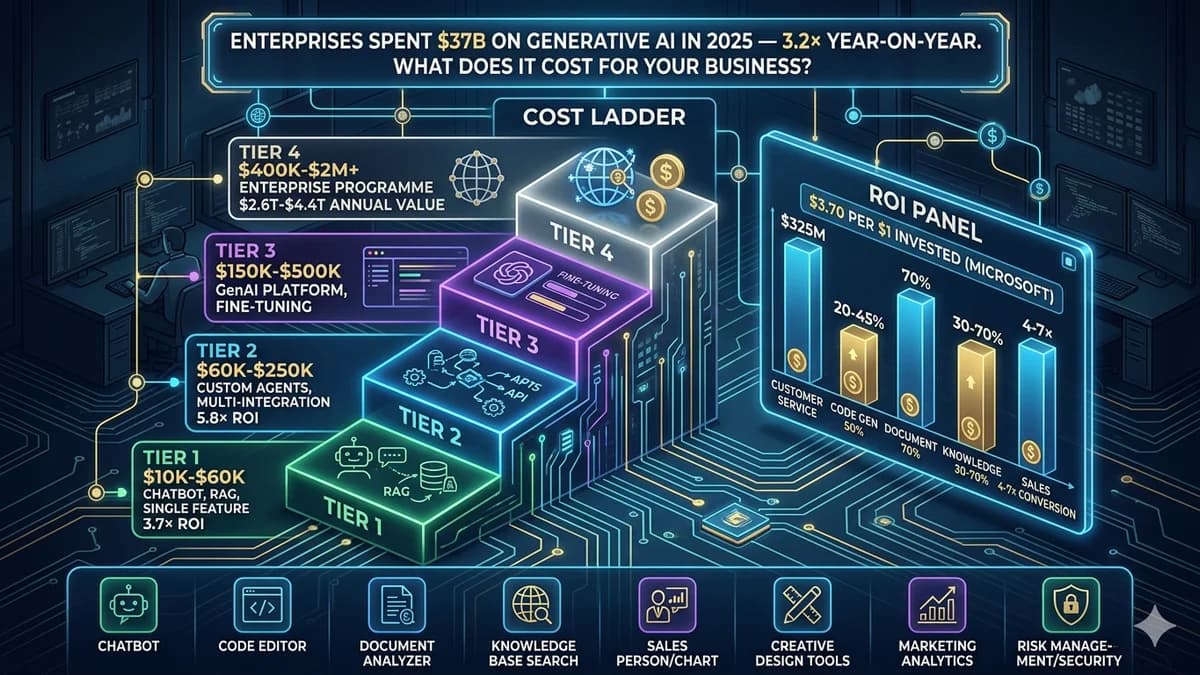
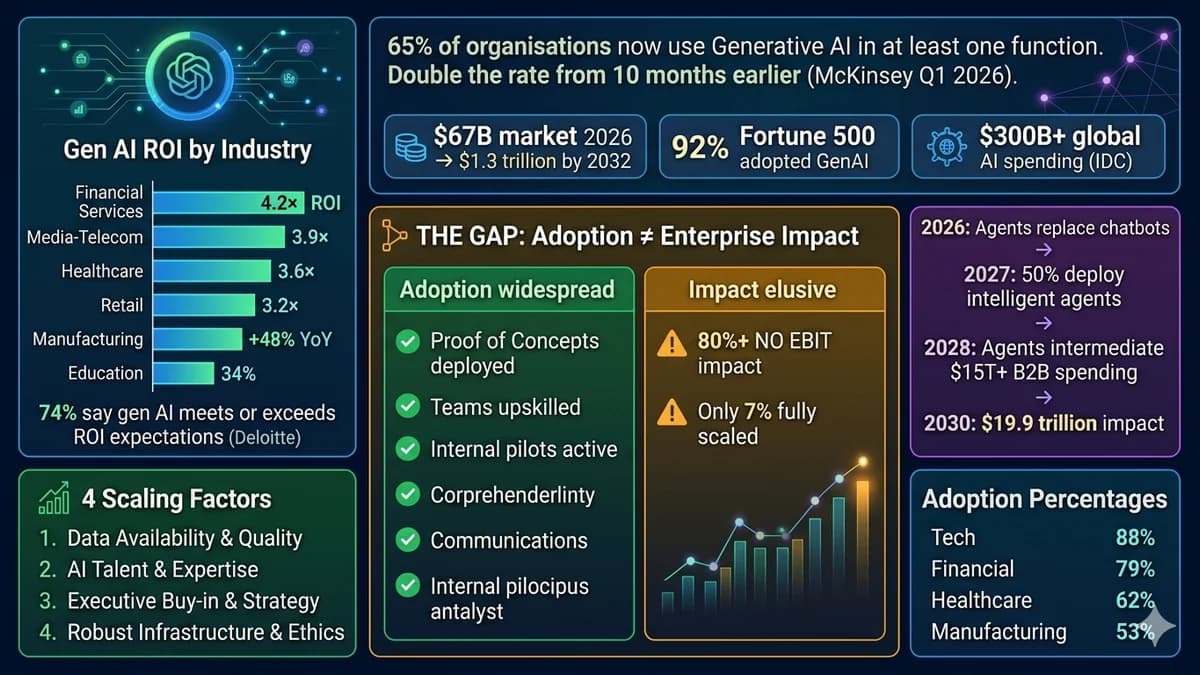
The reach is real and accelerating. 65% of organisations now use generative AI in at least one business function — double the rate from just 10 months earlier, according to McKinsey's Q1 2026 Global AI Survey. 72% of enterprises have at least one AI workload in production, up from 55% in 2024 and 20% in 2020. 92% of Fortune 500 companies have adopted generative AI, including Coca-Cola, Walmart, Apple, General Electric, and Amazon. The generative AI market is valued at $67 billion in 2026 and is projected by Bloomberg Intelligence to reach $1.3 trillion by 2032 at a 46.47% CAGR. Global AI spending surpasses $300 billion in 2026 across software, hardware, and services (IDC). This is not a niche trend or an experimental technology. Generative AI for business is infrastructure.
The ROI Contradiction — The Most Important Number in Enterprise AI
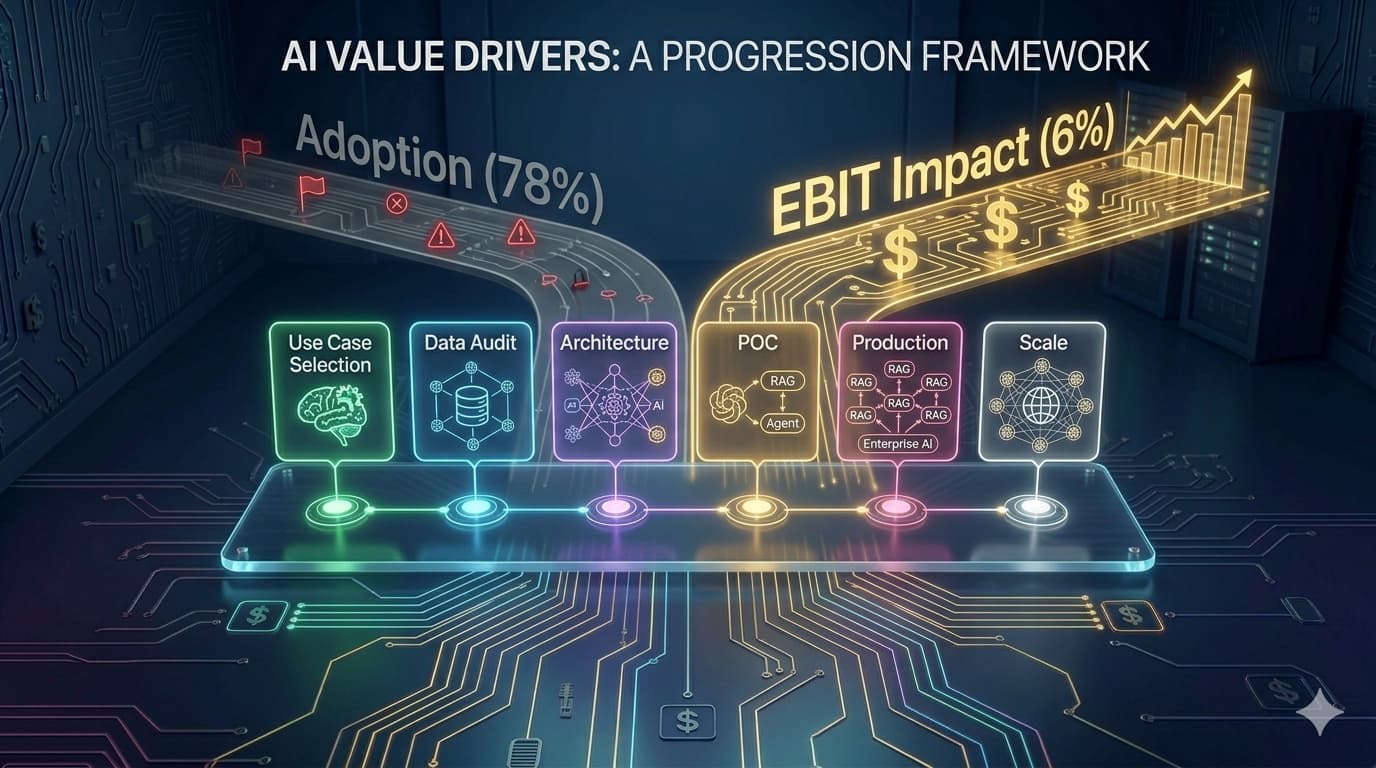
The most revealing number in the 2026 state of generative AI for business is not the adoption rate. It is the gap between two simultaneously true statistics: more than 80% of organisations report no tangible effect on enterprise-level EBIT from their gen AI investments — and financial services firms are documenting 4.2× ROI. Both numbers are real. Both come from the same research period. Understanding what produces the gap is more valuable than either number in isolation.
- 65% of organisations using gen AI in one function
- 92% of Fortune 500 have adopted generative AI
- 4.2× ROI in financial services; 3.9× in media/telecom
- 66% of organisations report productivity and efficiency gains (Deloitte)
- 74% of companies say gen AI meets or exceeds ROI expectations
- $300 billion global AI spending in 2026
- 38% of knowledge workers use gen AI daily
- 80%+ report no tangible effect on enterprise-level EBIT
- Only 7% have fully scaled AI across their enterprise
- 62% stuck in experimentation/pilot phase
- Revenue growth: only 20% achieving it (74% aspiring to it)
- Scaling to strong ROI takes 6-12 months or longer
- 42% believe their strategy is highly prepared — far fewer on infrastructure, data, talent
- Most organisations running isolated pilots, not cross-functional programmes
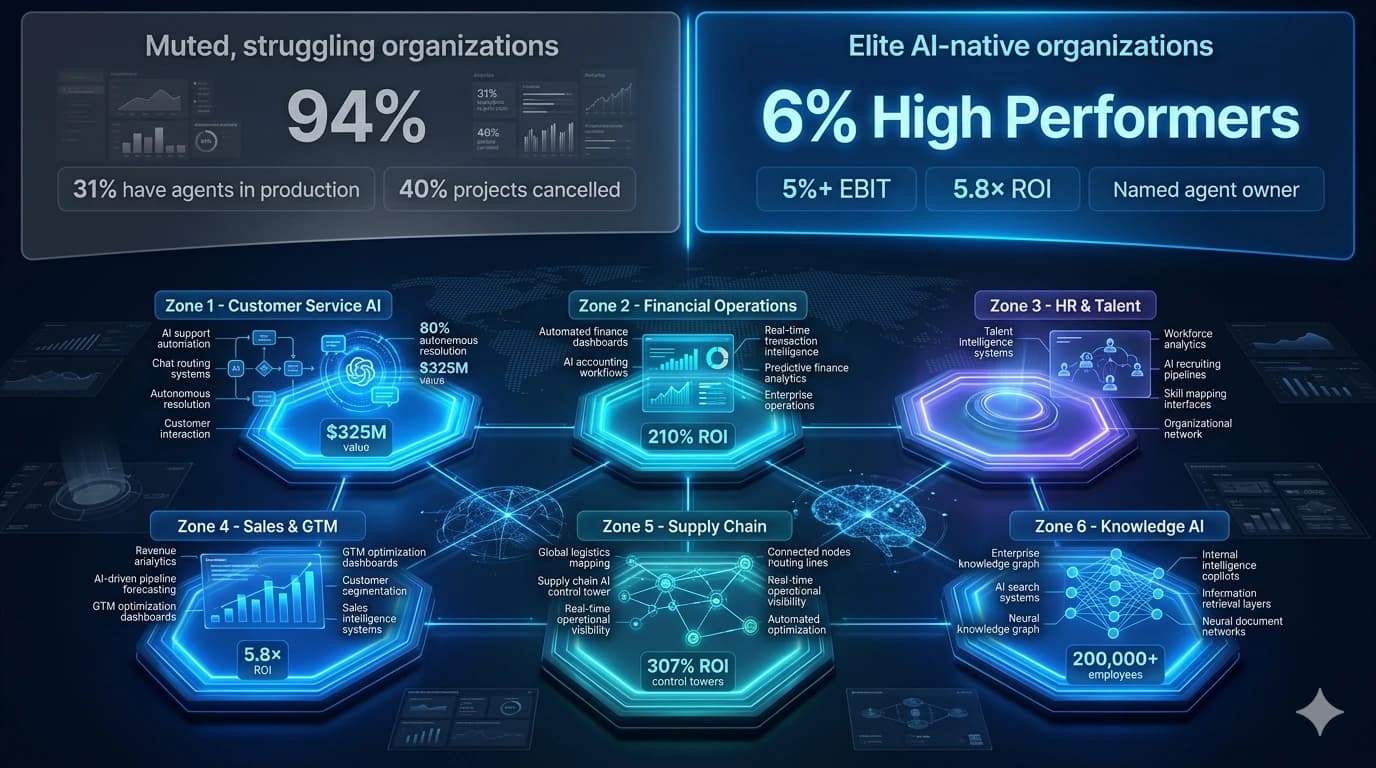
The resolution to the contradiction is in the deployment pattern. McKinsey's State of AI research shows that companies deploying gen AI across three or more business functions capture disproportionate enterprise-level value compared to those running isolated pilots. The EBIT impact requires cross-functional scale — a single AI application in marketing does not move enterprise profitability. Three AI applications across marketing, customer service, and finance operations, connected by shared data infrastructure and consistent governance, begin to produce measurable EBIT effects. This is the distinction between the 7% that are scaling and the 93% that are experimenting.
“Success hinges on the ability to move boldly from ambition to activation.” Deloitte's 2026 State of AI in the Enterprise report, based on 3,235 senior leader interviews, identifies the central challenge: not adopting gen AI but scaling it. “Revenue growth largely remains an aspiration, with 74% of organisations hoping to grow revenue through their AI initiatives in the future compared to just 20% that are already doing so.” The gap between aspiration and activation is where most enterprise AI programmes live in 2026.
Generative AI ROI by Industry — Who Is Capturing Value and Where
| Industry | Adoption Rate | Documented ROI/Impact | Primary Use Cases |
|---|---|---|---|
| Technology / Software | Highest adoption rate. AI coding tools (92% of tech leaders daily). Significant developer productivity gains. | Software development, product management, customer success, sales automation | |
| Financial Services | 4.2× ROI — highest across all industries. Average $3,200/employee in AI spend (2.6× cross-industry average). | Credit assessment, fraud detection, customer service, document processing, compliance reporting | |
| Media / Telecommunications | 3.9× ROI. Content generation, personalisation at scale, churn prediction. | Content creation, customer personalisation, network optimisation, churn prediction | |
| Healthcare | Rapid growth driven by clinical decision support. Gen AI could unlock $1 trillion in healthcare improvements (McKinsey). Medical imaging AI publications 2.7× in 2 years. | Clinical decision support, medical imaging, administrative automation, drug discovery | |
| Retail / E-commerce | Personalisation: 5-15% revenue boost. Customer acquisition costs reduced 50%. Demand forecasting, inventory optimisation. Gen AI in ecommerce forecast $2.1B by 2032. | Demand forecasting, personalisation, inventory optimisation, chatbots, content creation | |
| Manufacturing | +48% YoY AI spending growth. Predictive maintenance reduces equipment downtime 45% and maintenance costs 25%. AI-driven quality control. | Predictive maintenance, quality control, supply chain optimisation, autonomous robotics | |
| Education | Lowest adoption rate across major industries. Budget limitations and regulatory constraints. Personalised learning is the high-potential use case. | Personalised learning, administrative automation, content generation, research assistance |
In which of these industries does your business operate — and how does your current gen AI investment compare to what your sector's high performers are doing? Automely maps this in a free strategy session.
Free 45-minute generative AI strategy consultation. We assess your current position against the Deloitte, McKinsey, and industry benchmarks and recommend the cross-functional deployment path that moves you from pilot purgatory to measurable EBIT impact.
Where Generative AI for Business Actually Delivers — Function by Function
Customer Service
Highest-impact business function. AI reduces call center volumes and operational costs by 23.5% (IBM). 56% of customer support interactions will involve agentic AI by mid-2026 (Cisco). 83% of organisations see improved chatbots as the top gen AI application.
IT Operations and Software Development
IT fastest-growing adoption function (27% to 36% in 6 months). 92% of tech leaders use AI coding tools daily. PR review time 9.6 days → 2.4 days. Agents handle service-desk, access provisioning, and monitoring automatically.
Marketing and Sales
Gen AI reduces customer acquisition costs by up to 50% through personalisation. Boosts revenues 5-15%. Increases marketing ROI 10-30% (McKinsey). 48% of enterprises use AI in marketing. AI-assisted sales teams close 23% more deals.
Finance and Operations
Invoice processing cost: $40/invoice manual → $3.50 automated. Finance teams reduce processing time 65% and eliminate 88% of data entry errors. AI accelerates close processes 30-50%. Fraud detection and compliance monitoring continuously active.
HR and Talent Operations
AI can reduce HR costs by 15-20% (McKinsey). Employee onboarding: 18 hours per hire → 30 minutes automated. AI recruitment screening reduces cost per hire 30%. Talent retention analytics flag risk before attrition occurs.
Research, Knowledge Management and R&D
Gen AI accelerates R&D by 20-80% depending on sector (McKinsey). AI drug discovery publications more than doubled in 2 years. Deep research agents handle information synthesis and analysis. Meeting intelligence captures and tracks action items automatically.
4 Factors That Separate the 7% Scaling Successfully from the 93% Stuck in Pilots
The research from Deloitte, McKinsey, and EY on what separates organisations capturing enterprise-level value from gen AI converges on four consistent factors. They are not technology factors. They are organisational, investment, and governance factors — which is precisely why the technology access becoming increasingly commoditised does not automatically close the gap.
McKinsey's State of AI research shows clearly that companies deploying generative AI across three or more business functions capture disproportionate enterprise-level value compared to those running isolated pilots. The 80%+ reporting no EBIT impact are predominantly running AI in one or two functions in isolation. The compounding effect of gen AI across connected functions — where customer intelligence feeds marketing personalisation, which feeds sales qualification, which feeds customer service — produces enterprise-level impact. Individual function deployments produce function-level productivity gains. Cross-functional deployments produce enterprise-level business impact.
The practical implication: sequencing matters. Start in the highest-ROI function for your business (customer service or finance for most organisations). But plan the cross-functional roadmap from day one, not as an afterthought when the first deployment is complete.
EY's research establishes a clear investment threshold: organisations allocating more than 5% of their IT budget to AI see 70-75% of projects yield positive results, compared to only 50-55% for minimal spenders. The investment gap creates a compounding performance gap — higher-investment organisations build better data pipelines, attract better AI talent, and iterate faster on deployment quality. Financial services firms spend an average of $3,200 per employee on AI — 2.6× the cross-industry average — and document the highest ROI. The correlation between investment level and outcome is consistent across EY's research cohort.
The average enterprise investment in gen AI reached $110 million in 2024. 65% of enterprises increased their AI budgets in 2026, with a median increase of 22% year-over-year. 92% of companies plan to increase their AI budgets over the next three years. The organisations that are scaling are investing above the threshold that produces reliable positive results.
McKinsey's State of AI research identifies senior leadership ownership as the single highest-correlation factor with AI high performance: high performers are three times more likely than their peers to have senior leaders who strongly demonstrate ownership and commitment to their AI initiatives. This is not passive endorsement — it is active role modelling of AI use, defined processes for how and when model outputs need human validation, and AI performance tracking embedded in business KPIs rather than treated as a separate technology metric.
Deloitte's research reinforces this: “Enterprises where senior leadership actively shapes AI governance achieve significantly greater business value than those delegating the work to technical teams alone. True governance makes oversight everyone's role, embedding it into performance rubrics so that as AI handles more tasks, humans take on active oversight.” The organisations that fail to achieve EBIT impact despite substantial AI investment are disproportionately those where AI ownership has been delegated to IT rather than owned at the board and executive level.
Deloitte's 2026 survey finds a troubling gap: 42% of organisations believe their strategy is highly prepared for AI adoption — but far fewer feel prepared in terms of infrastructure, data quality, risk management, and talent. The order matters. Scaling gen AI on poor data infrastructure produces unreliable outputs at scale. Scaling without governance frameworks produces compliance liability as the EU AI Act becomes fully applicable in August 2026. Scaling without talent to maintain, evaluate, and improve AI systems produces performance degradation over time.
Organisations that invest in data readiness — cleaning and structuring their proprietary data, building reliable data pipelines, and establishing data quality standards — before deploying gen AI at scale achieve significantly better outcomes than those that deploy on whatever data is available and address quality issues later. As Boomi's CPO stated: “Those who invest early in grounding AI on their unique data and workflows will create models that are strategic assets, not just tools.”
What Comes Next for Generative AI for Business — The 2026-2030 Outlook
The next phase of generative AI for business is already visible in the 2026 data: agents are replacing chatbots, cross-functional deployment is replacing isolated pilots, and the economic stakes of the gap between leaders and laggards are rising with each quarter. The organisations building agentic AI capabilities now are building the operational infrastructure that the $19.9 trillion cumulative economic impact of gen AI by 2030 will flow through.
Agentic AI Replaces Chatbots as the Primary Gen AI Interface
Gartner projects 40% of enterprise applications will embed AI agents by end of 2026, up from less than 5% in 2025. Cisco projects 56% of customer support interactions will involve agentic AI by mid-2026. The shift from text prompts to autonomous action is the defining 2026 transition. 23% of organisations are already scaling agentic AI in at least one function; 39% are experimenting. The companies building agentic capabilities now are setting the competitive baseline.
50% of Gen AI Companies Deploy Intelligent Agents — Deloitte Forecast
Deloitte forecasts that 50% of gen AI-using companies will deploy intelligent agents by 2027. This represents the mainstream crossing point — moving from agentic AI as advanced capability to agentic AI as standard business infrastructure. Organisations that have not built the agent orchestration foundations in 2026 will face increasingly expensive catch-up investments in 2027 as the market establishes the new baseline.
AI Agents Intermediate $15+ Trillion in B2B Spending — Gartner
Gartner projects AI agents will intermediate more than $15 trillion in B2B spending by 2028 — meaning AI agents will be the primary interface through which business purchasing, contracting, and service delivery occurs in many categories. This is not an incremental change to existing workflows. It is a restructuring of how B2B commerce operates. The organisations with agent-callable proprietary APIs will be the ones capable of participating in this agent-intermediated commerce layer.
$19.9 Trillion Cumulative Economic Impact — Flowing to the Early Builders
The cumulative economic impact of generative AI adoption is projected to reach $19.9 trillion by 2030 (various analyst sources). McKinsey estimates gen AI could unlock $2.6 trillion to $4.4 trillion in annual economic value across business use cases. The research is consistent on who captures this value: “the value flows primarily to the companies building agentic capabilities now, not the ones planning to start later.” The generative AI market itself reaches $356.1 billion by 2030 (46.47% CAGR from 2024) and $1.3 trillion by 2032 (Bloomberg).
The throughline from current adoption to the 2030 economic horizon is straightforward: the organisations capturing value from gen AI in 2026 are those deploying across three or more functions, investing above the 5% IT budget threshold, with senior leadership ownership and governance built in from the start. The same organisations will be disproportionately positioned to capture the $15 trillion B2B agent economy in 2028 and the cumulative $19.9 trillion by 2030 — because they will have the data infrastructure, the agent orchestration capabilities, and the organisational AI fluency that late movers cannot acquire quickly.
For the strategic context on what to build now to position for this trajectory, see our guide to the future of AI development priorities for 2026 and our AI trends 2026 signal-to-noise analysis.
Where does your organisation sit on the adoption-to-impact spectrum — and what is the specific cross-functional deployment path that moves you from isolated pilot to measurable EBIT impact? Automely builds the AI systems that make that transition.
Free 45-minute generative AI strategy consultation. We assess your current AI investment, benchmark against the Deloitte/McKinsey scaling factors, and recommend the deployment sequence that produces enterprise-level ROI for your specific business context.