

The Hype-Reality Gap Has Never Been Wider — or More Consequential
Most AI trend coverage in 2026 operates in one of two modes: breathless optimism that treats every model release as a civilisation-altering event, or cynical dismissal that refuses to acknowledge genuine progress. Neither serves the business leader trying to make rational decisions about AI investment, implementation, or strategy.
The honest picture is more interesting and more nuanced than either camp acknowledges. Agentic AI is genuinely entering production at scale for the first time — with documented ROI in specific, well-governed applications. Multimodal models have improved faster in twelve months than most researchers predicted over five years. The competition between AI labs has begun to commoditise base model performance, shifting competitive advantage toward systems integration. These are real developments with real business implications.
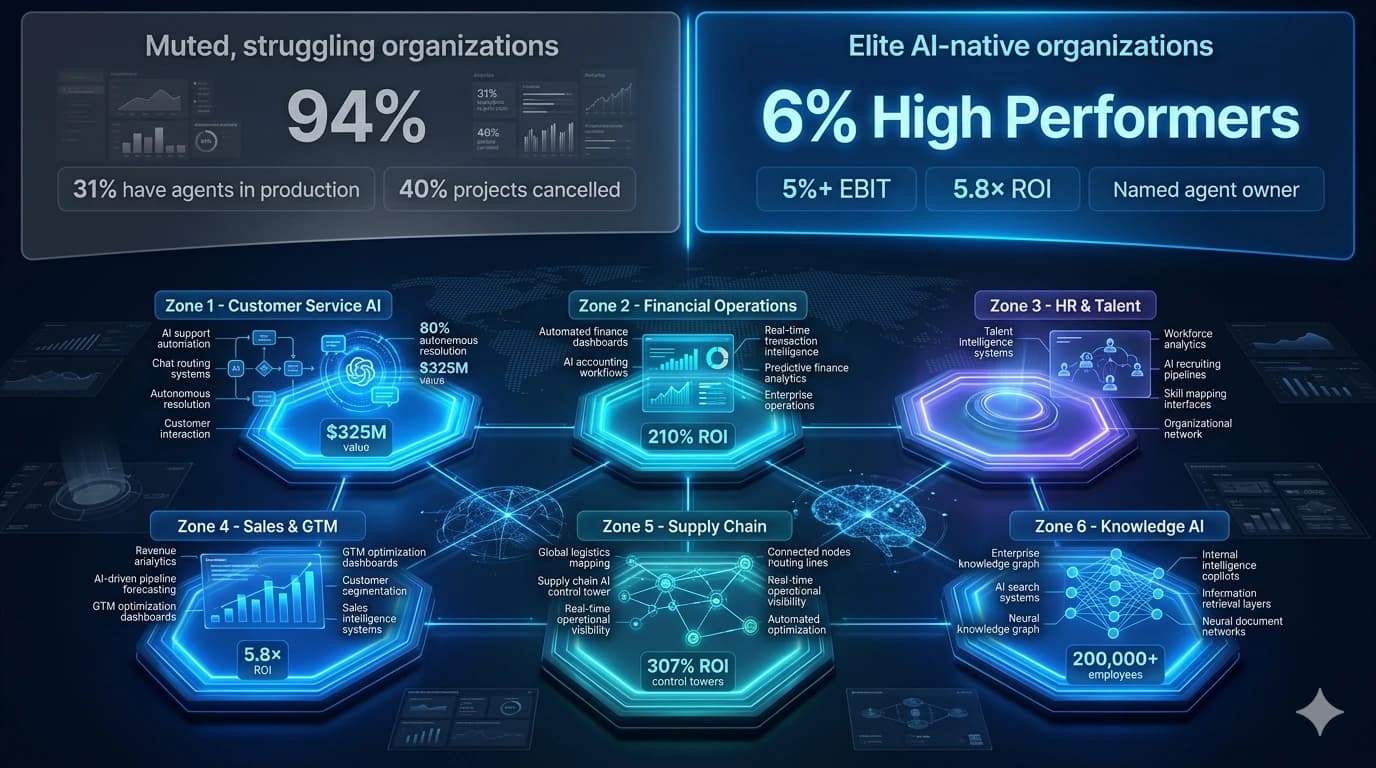
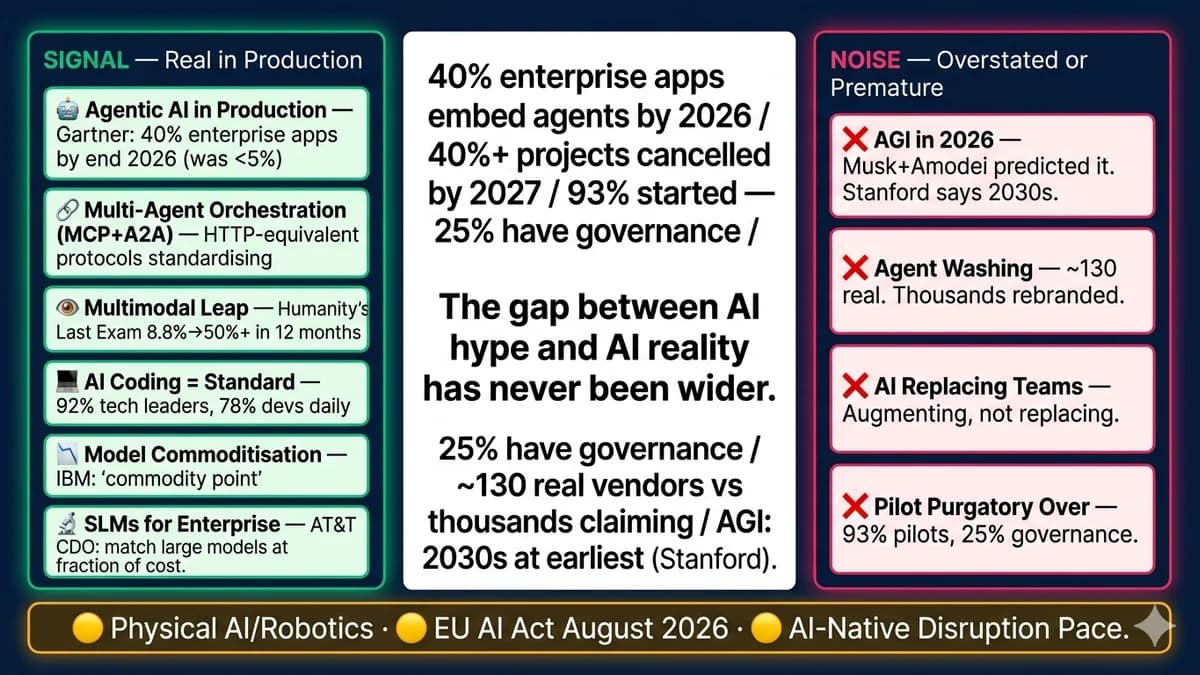
At the same time: AGI is not arriving this year regardless of what any CEO predicted. Agent washing is epidemic — Gartner estimates only around 130 legitimate agentic AI vendors in a market claiming thousands. And 93% of organisations have started AI pilots while fewer than 25% have formalised AI governance, meaning Gartner’s warning that over 40% of agentic AI projects will be cancelled by 2027 is not a pessimistic fringe view. It is the most likely outcome for most current deployments.
This guide applies one standard to each AI trend: what does the evidence actually say, and what is the practical business implication? The classification is sharp to be useful — every “real” trend has hype components, and every “still hype” claim rests on genuine underlying technology. The goal is to separate signal from noise with enough precision to make better decisions.
6 AI Trends That Are Actually Happening in 2026
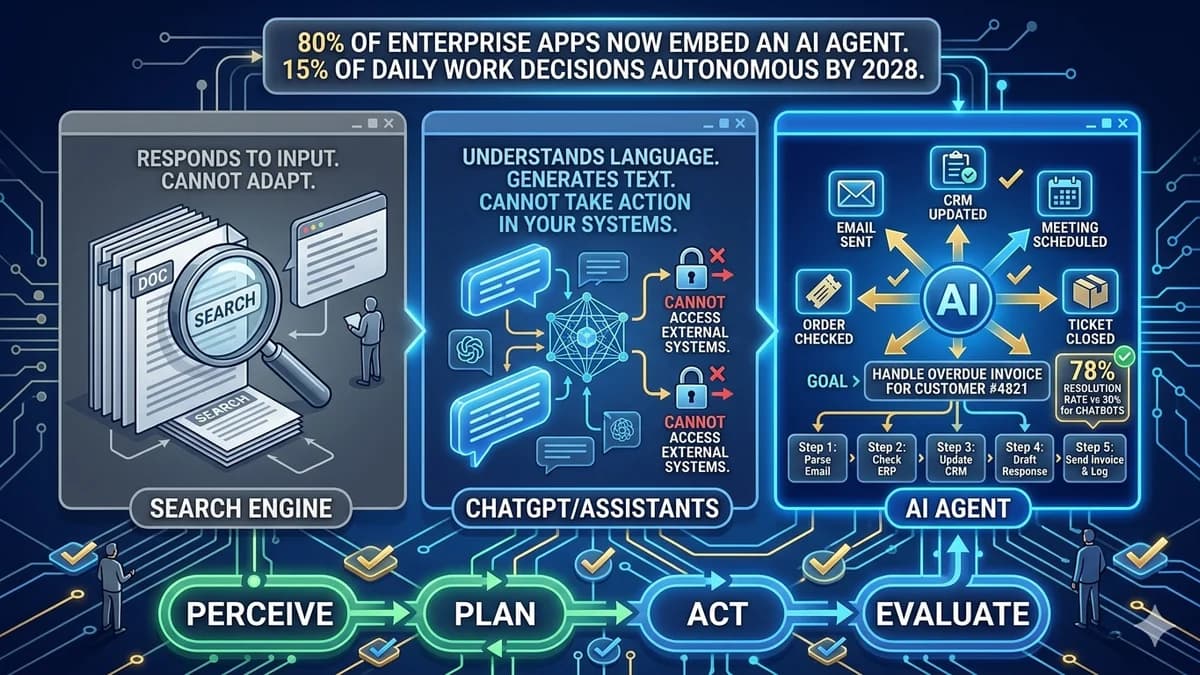
The shift from AI as a content generation tool to AI as a system that can perceive context, plan multi-step actions, use external tools, and execute without constant human direction is not a prediction. It is happening in production. Gartner projects 40% of enterprise applications will embed AI agents by end of 2026 — up from less than 5% in 2025. The AI agent market is tracking from $7.84 billion in 2025 toward $52.62 billion by 2030 at a 46.3% CAGR. PwC’s AI Agent Survey shows 35% of organisations report broad adoption and 17% have fully implemented agents company-wide.
Documented production results from Gartner and Forrester analysis: customer service agents saving teams 40+ hours monthly, finance and operations automation accelerating close processes by 30-50%, and sales and marketing agents producing 2-3x improvements in pipeline velocity. These are measured outcomes from current deployments, not projected ones.
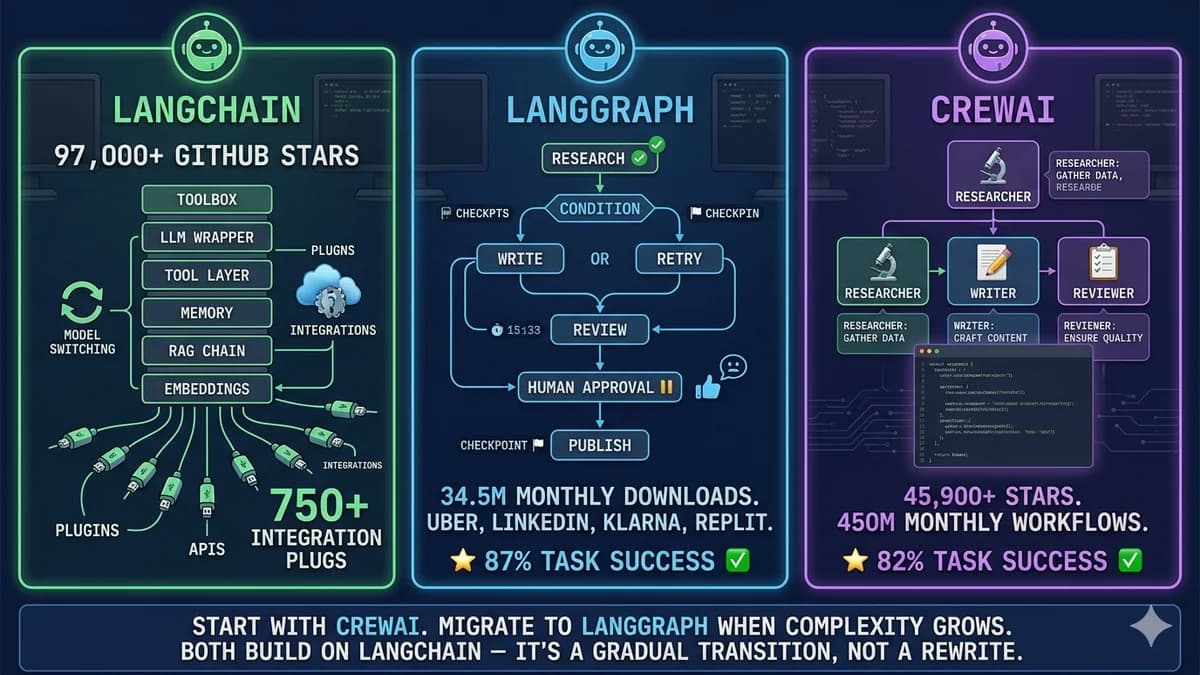
Just as monolithic software gave way to distributed microservices architectures, single all-purpose AI agents are being replaced by orchestrated teams of specialised agents. One agent qualifies leads. Another drafts personalised outreach. A third validates compliance requirements. They share context and hand off work without human intervention at each stage. AWS and IBM compare the current orchestration layer evolution to what Kubernetes did for container management — critical infrastructure that enables everything above it to scale.
The enabling protocols have arrived. Anthropic’s Model Context Protocol (MCP) — which saw broad adoption throughout 2025 — standardises how agents connect to external tools, databases, and APIs, transforming custom integration work into plug-and-play connectivity. Google’s Agent-to-Agent Protocol (A2A) defines how agents from different vendors communicate. These are the HTTP-equivalent standards for the agentic web. Both Gartner and Forrester identify 2026 as the breakthrough year for multi-agent systems in production enterprise environments.
The Humanity’s Last Exam benchmark — questions contributed by subject-matter experts representing the hardest problems in their fields — provides the most credible single data point for tracking AI capability improvement. The top-ranking model (OpenAI’s o1) correctly answered 8.8% in the 2025 Stanford AI Index. By April 2026, the best-scoring models including Claude Opus 4.6 and Google Gemini 3.1 Pro top 50% — a nearly sixfold improvement in benchmark accuracy within twelve months.
Multimodal models now understand and generate across text, images, audio, and video simultaneously with increasing coherence. AI drug discovery publications have more than doubled in two years. Multimodal biomedical AI publications are 2.7x what they were two years ago. IBM Fellow Aaron Baughman describes the direction: these models will perceive and act in a world much more like a human — bridging language, vision, and action together.
AI coding assistance has moved from early-adopter novelty to standard professional practice faster than any previous software development tool category. 92% of technology leaders now use AI-assisted coding tools in their work. 78% of developers use them daily. GitHub AI-related projects have reached 5.58 million — a fivefold increase since 2020 and a 23.7% increase from 2024 alone. The tools have moved beyond suggestion-based autocomplete to agentic coding systems — Claude Code, GitHub Copilot Agent mode, Cursor — that implement entire features, refactor codebases, and manage multi-file changes from natural language instructions.
For the first time in the large language model era, the quality gap between top models is narrowing to the point where base model selection is becoming less strategically significant than deployment quality, data integration, and workflow design. IBM Chief AI Architect Gabe Goodhart states it directly: we’re going to hit a bit of a commodity point on AI models. The open-source ecosystem — DeepSeek, Llama 4, Mistral Large 2, IBM Granite — is achieving results competitive with closed commercial models across many benchmark categories. TechCrunch’s 2026 AI forecast describes the shift: from brute-force scaling to researching new architectures, from flashy demos to targeted deployments.
AT&T Chief Data Officer Andy Markus: fine-tuned SLMs will be the big trend and become a staple used by mature AI enterprises in 2026, as the cost and performance advantages will drive usage over out-of-the-box LLMs. The argument is straightforward: a domain-specific SLM fine-tuned on a company’s own data and documentation can match or exceed a large general model’s accuracy for that company’s specific tasks — at a fraction of the cost and with better latency. IBM’s AI research team predicts smaller reasoning models that are multimodal and easier to tune for specific domains as the 2026 enterprise direction. Smaller models are also deployable on edge devices, opening AI deployment to environments where cloud latency or data privacy concerns make API calls impractical.
4 AI Claims That Are Still Mostly Hype in 2026
Each "hype" classification below refers to the specific claim as typically stated by vendors, media, and excited practitioners — not to the underlying technology itself. The underlying technology is often real and advancing. The specific claim about what it means right now, for most organisations, in production, is the hype.
Elon Musk and Anthropic CEO Dario Amodei both predicted AGI — AI with broadly human-level cognitive abilities — by 2025-2026. These predictions have not materialised, and the research community’s consensus has moved in the opposite direction. The Stanford AI Index and the broader AI research community now place AGI in the 2030s at the earliest, with 50% probability of key milestones by 2028. Benchmark improvements are real — the Humanity’s Last Exam jump from 8.8% to 50%+ is genuinely remarkable — but benchmark performance on specific academic tasks is categorically different from general intelligence. The Stanford AI Index specifically notes that current models remain remarkably bad at some common tasks, like reading clocks and understanding calendars.
There is also a structural problem with AGI predictions from people who lead AI companies: significant commercial incentive exists for you to believe AGI is imminent. This does not mean they are dishonest — it means the incentive structure should inform how you weight their predictions.
Agent washing — vendors rebranding existing automation tools, chatbots, and rule-based systems as AI agents — is at epidemic scale in 2026. Gartner estimates only around 130 legitimate agentic AI vendors exist in a market where thousands of companies are making agent claims. The distinction matters operationally: a genuine AI agent can perceive context, reason about novel situations, adapt its approach based on feedback, and take action through tool use. A rebranded chatbot cannot. A workflow automation tool with an AI prefix cannot. The economic incentive to make agent claims is enormous — enterprise AI budgets are large and growing rapidly. Due diligence responsibility falls entirely on the buyer.
The 2024-2025 wave of predictions about AI replacing entire categories of knowledge workers has not materialised in the way described. AI is profoundly augmenting professional work — the 92% developer coding tool adoption figure, the documented productivity gains in finance and customer service — but the replacement of professional judgment, relationship expertise, and contextual business knowledge has not happened and is not happening. TechCrunch, citing Katanforoosh of Workera, describes 2026 as the year of the humans: AI handles the repetitive and analytical layers, freeing professionals for contextual, relational, and judgment-intensive work. The most successful AI deployments in 2026 are co-pilot models, not autopilot models. AI-empowered teams consistently outperform both unassisted teams and fully automated systems.
The headline narrative that enterprise AI adoption is now mainstream is contradicted by the same data used to support it. Yes, 93% of businesses have started AI pilot projects. But fewer than 25% have formalised AI governance. Most organisations have fragmented tools, outdated data pipelines, no clear framework for evaluating which pilots should scale, and no defined success metrics for current experiments. TechCrunch describes the state accurately: pilot purgatory. Gartner’s 40%+ project cancellation rate projection by 2027 is not pessimistic fringe analysis — it reflects the gap between wide experimentation and disciplined execution.
Building AI capabilities in 2026 and want to avoid the 40% cancellation rate? Automely helps organisations move from pilot purgatory to production-ready AI with governed, measurable deployments.
Free 45-minute consultation. We assess your AI readiness, identify where agentic AI creates the highest-value deployment opportunity, and map the governance framework that separates successful deployments from cancelled ones.
3 Emerging AI Trends to Watch in 2026-2027
IBM’s Peter Staar predicts 2026 will mark a shift in AI research priorities toward physical AI — systems that learn how things move and interact in three-dimensional space to make predictions and take physical actions. Yann LeCun left Meta to start his own world model lab and is seeking a $5 billion valuation. Google DeepMind’s Genie model builds real-time interactive general-purpose world models. Forrester specifically highlights physical AI — agents that coordinate robots, sensors, and supply chain systems in real time — as an area to watch closely. This is currently primarily a research-and-early-pilot trend, not a mainstream production technology. But the directional signal is clear and the major labs are heavily investing.
The EU AI Act becomes fully applicable in August 2026, creating binding compliance requirements for high-risk AI systems used in or affecting EU markets. Companies serving EU markets face compliance requirements that many are significantly underestimating. Forrester predicts 60% of Fortune 100 companies will appoint AI governance heads in response. High-risk AI systems — those used in hiring, credit decisions, healthcare, critical infrastructure, biometric identification, and law enforcement — face strict requirements: transparency obligations, mandatory human oversight mechanisms, risk management documentation, data quality standards, and conformity assessments. All AI systems face minimum transparency requirements. The countdown to August has already started.
A structural shift in how quickly AI-native companies can reach scale is becoming visible and will accelerate. What took SaaS companies 5-10 years ($100M ARR) is happening in 1-2 years for AI-native startups — with 50+ businesses expected to reach $250M ARR by end of 2026. This is partly AI tooling reducing marginal software development cost, partly agentic AI enabling small teams to operate with the operational leverage of much larger organisations, and partly a market hungry for specific AI-enabled capabilities. The competitive threat from AI-native entrants in specific verticals is likely to materialise faster than any previous technology disruption cycle in recent history.
The 2026 AI Landscape — Summary and Business Decisions
| Trend / Claim | Verdict | Key Evidence | Business Action |
|---|---|---|---|
| Agentic AI in production | Real | Gartner: 40% enterprise apps, end 2026. $7.84B → $52.62B. | Start governed pilots. Build orchestration foundations. |
| Multi-agent orchestration (MCP / A2A) | Real | MCP broadly adopted 2025. A2A in active deployment. | Use MCP-compatible tooling. Invest in orchestration now. |
| Multimodal performance leap | Real | Humanity’s Last Exam: 8.8% to 50%+ in 12 months. | Evaluate for document and image processing workflows. |
| AI coding = standard practice | Real | 92% tech leaders, 78% devs daily. 5.58M GitHub projects. | Adopt agentic coding tools across engineering. |
| Model commoditisation | Real | IBM: commodity point. Open source competitive. | Invest in data quality and deployment — not model selection. |
| SLMs for enterprise domains | Real | AT&T CDO: SLMs match large models at fraction of cost. | Evaluate domain-specific fine-tuning if data-rich. |
| AGI arriving 2026 | Hype | Stanford: 2030s. Models still fail common tasks. | Ignore AGI timelines. Plan for capability improvements. |
| Market full of real AI agents | Hype | Gartner: ~130 legitimate vendors in market of thousands. | Demand live demonstrations of adaptive behaviour. |
| AI replacing professional teams | Hype | 2026 is the year of humans — augmentation, not replacement. | Frame as capability amplification. Co-pilot models win. |
| Most orgs past pilot purgatory | Hype | 93% pilots; 25% governance; 40%+ projects cancelled. | Governance and metrics before more pilots. |
| Physical AI / robotics | Watch | IBM, LeCun lab, DeepMind Genie, Forrester flagging. | Track. Evaluate pilots in 18-24 months. |
| EU AI Act (August 2026) | Watch | Fully applicable August 2026. 60% Fortune 100 acting. | Classify AI systems now. Build compliance before August. |
| AI-native disruption pace | Watch | $100M ARR in 1-2 years vs 5-10 for SaaS. 50+ by end 2026. | Monitor your vertical for AI-native entrants. |
The practical conclusion for 2026: the AI trends that produce measurable business outcomes — agentic AI in specific governed applications, AI coding assistance, domain-specific SLMs, orchestration platforms — are real enough to act on now. The claims that do not produce near-term measurable outcomes — AGI, autonomous team replacement, most vendor agent claims — should be filtered from planning decisions until the evidence changes. The emerging trends — physical AI, EU compliance, AI-native competition — should be tracked and monitored without premature commitment.
The fundamental business question in 2026 is not whether to adopt AI. It is which AI applications in our specific context have documented ROI, and how do we govern them rigorously enough to be in the 60% that succeeds rather than the 40% that cancels?
For the practical implementation context — which AI applications produce measurable ROI in business operations — see our business process automation case studies and our guide to RPA vs AI automation.
Translating these AI trends into specific deployment decisions for your business — which agents to build, which vendor claims to reject, and how to establish the governance that avoids the 40% failure rate?
Free 45-minute AI strategy consultation. We map where the genuine 2026 AI signal applies to your specific business context and what production-ready implementation looks like for your industry and scale.