


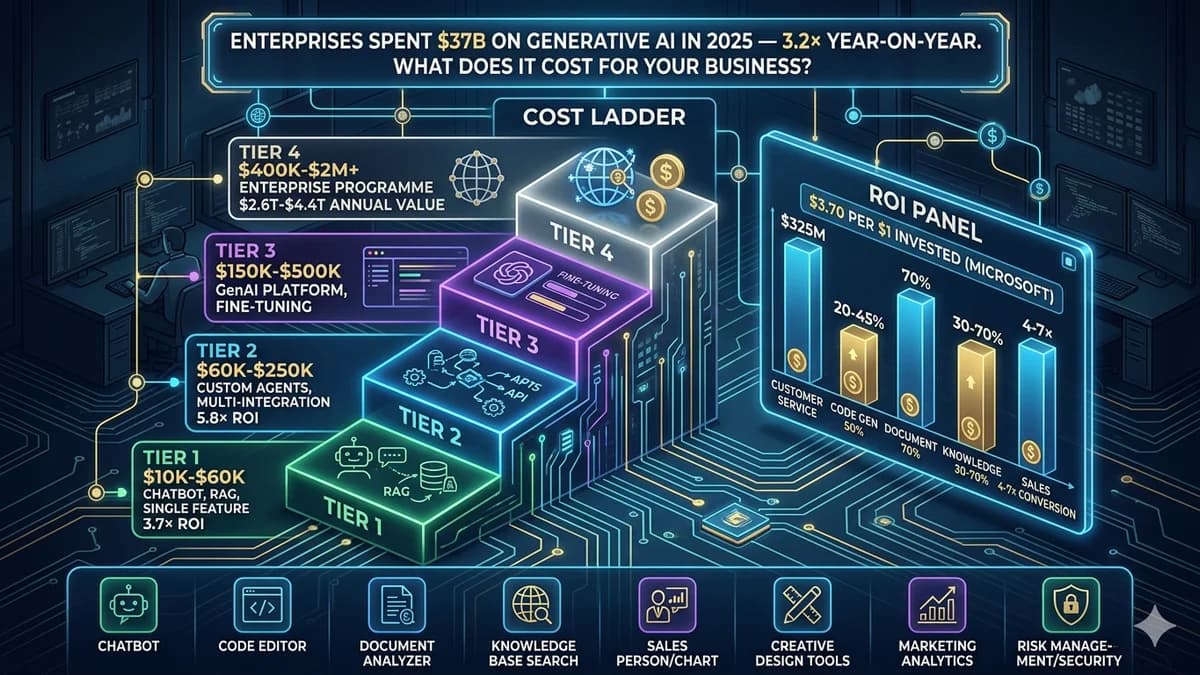
The Market Context — Why Generative AI Development Is No Longer Optional
Enterprises spent $37 billion on generative AI in 2025 — a 3.2× increase from $11.5 billion in 2024. That growth rate — from 6% of the global software market to mainstream enterprise spend — reflects a clear shift: generative AI has moved from experimental pilots into the production budget. McKinsey estimates generative AI will add $2.6-4.4 trillion in annual economic value across industries. 88% of organisations now use AI in at least one business function. The question facing most business leaders is no longer whether to invest in generative AI development — it is which use case generates the fastest ROI, what it actually costs, and what generative AI can realistically do for their specific business.
But when a business owner or CFO asks "how much do generative AI development services cost?" — they hear quotes ranging from $5,000 to over $1 million, often from the same week's conversations with different vendors. The reason: vendors quote for fundamentally different tiers of generative AI work without making the tier explicit. This guide makes the tiers explicit, maps real ROI benchmarks to each tier, surfaces the hidden costs that cause most budget overruns, and gives you the 5-question test that determines which tier your project actually needs.
The 4-Tier Generative AI Development Cost Framework
The reason you receive wildly different quotes for generative AI development is that vendors frequently quote for different tiers without clarifying which tier your project requires. The framework below maps real-world generative AI development scope to four tiers — by price range, timeline, team size, and the specific application types that match each tier. Use it to validate that the quotes you receive correspond to the tier your business case actually needs.
Simple MVP / Single-Use-Case AI
What's included
- LLM API integration (OpenAI, Anthropic, Gemini)
- Single knowledge base or data source
- Basic chat or API interface
- Prompt engineering and quality testing
- RAG setup if knowledge retrieval required
Best for
- First generative AI deployment
- MVP to validate business case
- Customer service chatbot on existing FAQ
- Internal knowledge assistant
- Single AI feature added to existing product
Custom Agents / Multi-Integration AI
What's included
- Custom agent architecture (LangGraph/CrewAI)
- Multi-source data integration (CRM, ERP, helpdesk)
- Role-based access controls
- LangSmith observability and monitoring
- Quality evaluation pipeline
- Scalable infrastructure design
Best for
- Customer service AI with action capabilities
- Multi-source RAG with document management
- AI features in an existing SaaS product
- Sales AI with CRM integration
- Compliance monitoring systems
Advanced Generative AI Platform
What's included
- Domain-specific model fine-tuning
- Multi-modal capabilities (text + image + audio)
- Enterprise security architecture (RBAC, encryption, audit)
- MLOps pipeline for ongoing model management
- Advanced evaluation and red-teaming
- Regulatory compliance design
Best for
- Healthcare AI with HIPAA compliance
- Legal AI with document analysis at scale
- Financial AI with model risk governance
- SaaS products where AI is the core differentiator
- Multi-agent orchestration platforms
Enterprise AI Programme / Custom LLM
What's included
- Custom large language model training
- Proprietary dataset curation and governance
- Enterprise-wide AI platform and tooling
- Dedicated AI team and MLOps infrastructure
- Multi-year programme management
Best for
- JPMorgan-scale internal productivity AI (200K+ users)
- Banks and insurers with proprietary data at scale
- Organisations building AI as core IP
- Defence, intelligence, sovereign AI contexts
Start at the lowest tier that delivers real business value for your specific use case — then expand. A Tier 1 RAG system that solves a specific knowledge retrieval problem costs 80-90% less than a Tier 3 platform, ships in weeks rather than months, and validates the ROI before your organisation commits to larger investment. Pre-trained model APIs (OpenAI, Anthropic, Google) save 60-70% compared to training models from scratch. The $400K-$2M Tier 4 range is for organisations that have already built institutional AI capability, validated use cases at smaller tiers, and have specific reasons (proprietary data, regulatory, competitive IP) that justify custom model training.
What Actually Drives the Cost Difference
Four variables account for the majority of generative AI development cost variation. Understanding them helps you engage vendors with a specific scope rather than receiving generic quotes that do not reflect your actual requirements.
- Model strategy — API vs fine-tuning vs training from scratch. Using a pre-trained model API (calling GPT-4o, Claude, or Gemini via REST) is dramatically cheaper than fine-tuning (retraining the model on your data) or training from scratch. APIs cost $0.001-$0.015 per 1,000 tokens in inference; training costs can reach $200,000-$500,000 per training run for large models. For 90% of business applications, pre-trained model APIs deliver the required capability at a fraction of the cost of custom training. Choose custom training only when your specific domain data is genuinely not represented in any pre-trained model — which is rare outside of highly specialised scientific or proprietary domains.
- Data readiness — how clean, structured, and accessible your data is. Data preparation consistently accounts for 30-40% of generative AI project cost — and it is the variable most consistently underestimated. If your knowledge base consists of thousands of PDFs in inconsistent formats, your support ticket history lives in three different systems, or your internal documents have never been digitised, the data preparation work before any AI development begins is significant. Businesses with clean, accessible, well-structured data in a single system can save 20-40% compared to businesses starting from fragmented legacy data.
- Integration complexity — how many existing systems the AI needs to connect to. A standalone AI chatbot with its own knowledge base has minimal integration complexity. An AI agent that needs to read CRM records, update support tickets, process payments, query inventory systems, and send email notifications through your existing platforms has substantial integration complexity — often exceeding the AI development cost itself. Every API integration, every authentication mechanism, every data schema that does not match your expectation adds engineering time and testing cycles.
- Compliance and governance requirements. In regulated industries — healthcare (HIPAA), financial services (SR 11-7, EU AI Act), legal (professional liability) — the compliance architecture adds 20-40% to development cost. Audit trails, role-based access controls, model risk documentation, bias testing, and regulatory approval processes all require dedicated engineering and legal review time. Factor this in at the scoping stage, not after launch.
ROI by Generative AI Application Type — The Honest Benchmarks
The fastest path from generative AI development spend to measurable ROI depends primarily on application type. The table below maps the nine highest-ROI generative AI application categories to their typical tier, the documented ROI benchmarks from production deployments, and the realistic time-to-ROI horizon — so you can choose which use case to tackle first based on outcomes that have actually been measured in the field.
| Application Type | Typical Tier | Documented ROI / Outcome | Time to ROI |
|---|---|---|---|
| Customer Service AI (RAG chatbot + agent assist) | 1-2 | $325M annualised value (ServiceNow); 210% ROI 3 years; 80% autonomous handling | 3-6 months payback |
| Knowledge Assistant / Internal RAG | 1-2 | 30-70% efficiency gains in knowledge-heavy workflows; legal: 85% research time reduction | 4-8 months payback |
| Content Generation (blog, product copy, social) | 1 | 3-5× content production velocity; 20-40% reduced cost per content piece | 1-3 months |
| Code Generation / Developer AI | 1-2 | 20-45% developer productivity improvement; GitHub Copilot benchmark widely cited | Immediate at adoption |
| Document Processing / Analysis | 1-2 | 70% time savings (Epic/Suki); JPMorgan COiN: 360,000 hours saved annually; $34K RAG → 4-month payback | 2-6 months payback |
| Sales AI (lead scoring, outreach, pipeline intelligence) | 2 | SDR agents: 3.4-month payback; 4-7× conversion rate improvements in agentic deployments | 3-5 months |
| AI Product Features (SaaS summarisation, search, copilot) | 1-2 | $3.70 ROI per $1 (Microsoft); AI-native SaaS achieves higher ARPU and retention | 6-14 months at scale |
| Compliance / Regulatory AI | 2-3 | 19% compliance cost reduction; $34K legal RAG paid back in 4 months; audit trail generation | 4-12 months |
| Predictive Analytics (churn, fraud, demand forecasting) | 2-3 | 87% demand forecast accuracy; 80% fraud false positive reduction; SMBC: 400% ROI on AutoML | 6-18 months |
The fastest ROI in generative AI development comes consistently from high-volume, repetitive workflows where the automation compound effect is largest — customer service, document processing, and content generation. These use cases involve clear inputs, clear outputs, measurable time savings, and large enough volume that even modest per-interaction efficiency gains accumulate into significant annual value. More ambitious use cases — autonomous AI agents for complex decision-making, custom model training — follow once the organisation has built data infrastructure, domain knowledge, and governance frameworks on smaller deployments.
Which application type delivers the fastest ROI for your specific business volume and workflow?
Automely scopes generative AI development projects with a use case and ROI projection before any cost commitment. Free 45-minute strategy session.
The Hidden Costs That Cause Most Budget Surprises
The headline tier price almost never represents the full generative AI total cost of ownership. The five line items below are the ones that most consistently appear post-launch — and the ones vendors most consistently under-quote or omit at scoping time. Build them into your estimate from week one, and request a separate line-item figure for each from any development partner you evaluate.
Inference Costs at Scale — The LLM API Bill That Grows With Users
Every call to an LLM API costs money: $0.001–$0.015 per 1,000 tokens depending on model and provider. In a pilot with 50 users making 10 queries per day, this is negligible. At 50,000 active users, it becomes $20,000–$112,500 per month depending on model choice — without careful cost architecture. The 500-1,000% LLM cost overrun documented at scale is not rare — it is the modal outcome for teams that did not model per-user LLM costs before launch. Model routing (using cheap models for simple tasks, premium models for complex tasks) reduces this by 50-70%. Token caching reduces it by a further 20-40%.
Data Preparation — The 30-40% of Budget Nobody Advertises
Cleaning, structuring, labelling, and organising existing data for generative AI use typically adds 30-40% to project cost — and vendors rarely highlight this in initial quotes because it depends entirely on your data's current state. If your knowledge base consists of thousands of inconsistently formatted PDFs, if your support ticket history is across three disconnected platforms, or if your internal documentation has never been audited for accuracy or currency, the data preparation work before any AI development begins is substantial. Build this into your scoping estimate.
Ongoing Model Maintenance — The 15-20% Annual Recurring Cost
Generative AI outputs degrade over time as data drifts — your knowledge base changes, your product evolves, the LLM underlying your system releases a new version. Monitoring output quality, retraining where needed, updating knowledge bases, and managing the model lifecycle is a recurring operational cost that typically runs 15-20% of build cost annually. RAG systems are easier to maintain (update the knowledge base, not the model). Fine-tuned models require periodic retraining as domain data evolves. Plan for ongoing maintenance costs in your total cost of ownership model.
Integration Work — Often the Largest Hidden Line Item
Connecting a generative AI system to your existing CRM, ERP, helpdesk, email, and data systems is frequently more complex and more expensive than the AI development itself. Every API integration requires authentication implementation, error handling, schema mapping, and testing across edge cases. A standalone AI chatbot has minimal integration complexity. An AI agent that orchestrates across five existing systems can double the total project cost compared to the AI-only estimate. Always request a separate integration scope estimate from your development partner — not bundled into a single AI build estimate.
Security, Compliance, and Audit Infrastructure
In regulated industries, or for any AI system that processes personal data, the security and compliance architecture is not optional overhead — it is a deployment prerequisite. RBAC (role-based access controls), encryption at rest and in transit, audit logging, GDPR Article 22 human-in-the-loop requirements, and EU AI Act conformity assessment documentation all require dedicated engineering time. In healthcare, financial services, and legal contexts, add 20-40% to base project costs for compliance architecture. Without it, you cannot deploy to production in regulated contexts regardless of how well the AI itself performs.
The 5-Question Test — Which Tier Does Your Project Actually Need?
The five questions below map your specific business situation to the tier your generative AI development project actually needs. Answer honestly. Most organisations significantly over-estimate the tier they need on their first deployment — and the over-engineering is what stalls budgets, delays outcomes, and burns credibility for follow-on AI investments.
Is this your first generative AI deployment?
If yes, start with Tier 1 regardless of your eventual ambition. Validate the technology's fit with your specific workflows, your team's capacity to maintain it, and the business outcome metric you are targeting — before committing to higher tiers. The failure pattern that stalls AI programmes is Tier 4 investment before Tier 1 learnings.
Does the AI need to take actions — or just answer questions?
If your AI only needs to retrieve information and generate responses (answer questions, summarise documents, draft text), Tier 1 covers it. If it needs to take actions — create tickets, update records, trigger workflows, process transactions — you need Tier 2+ with agentic architecture, integration design, and action guardrails.
How many existing systems does the AI need to connect to?
Zero to one integration: Tier 1. Two to four integrations: Tier 2. Five or more integrations across production systems: Tier 2-3 depending on complexity. Each integration requires dedicated engineering time for API implementation, testing, and edge case handling — and these costs compound with each additional connected system.
Do you operate in a regulated industry?
Healthcare (HIPAA), financial services (EU AI Act, SR 11-7), legal (professional liability), and insurance (actuarial AI governance) all require compliance architecture that adds 20-40% to base costs and 2-6 months to deployment timelines. Budget for this explicitly and engage your legal and compliance teams in the project from week one — not after development is complete.
Is there a specific pre-trained model that cannot serve your domain, or do you have genuinely proprietary data that no existing model has seen?
If yes to either: Tier 3-4 fine-tuning or custom training may be justified. If no: use pre-trained model APIs. The cost of training models from scratch or fine-tuning at scale is substantial — justified for organisations with genuinely proprietary data that is unavailable in any existing model's training set, not justified for general business use cases where GPT-4o, Claude, or Gemini already have the domain knowledge required. Pre-trained APIs save 60-70% versus custom training for the vast majority of business applications.
In-House vs Outsourcing — The Build Model Decision
Once you know which tier your project needs, the next decision is who builds it. The three build-model paths below each map to different cost structures, speed profiles, and risk patterns. Most businesses that succeed at generative AI use the hybrid model — outsource the first build to an experienced partner, bring maintenance in-house as the team learns.
🏢 In-House AI Team
🌍 Outsourced Partner (US/UK)
⚡ Outsourced Partner (EU/Pakistan)
The 2026 talent reality: fewer than 15% of software engineers have hands-on generative AI production experience. Building an in-house AI team means competing against Google, Microsoft, and OpenAI for the same scarce pool of engineers — with compensation packages that include equity that most mid-market businesses cannot match. For Tier 1 and Tier 2 projects — the tier range where most businesses should start — outsourcing to an experienced generative AI development company delivers faster results at lower cost than attempting to hire in-house. Most businesses that succeed with generative AI use a hybrid model: outsource the build and first-year iteration to an experienced development partner, then gradually bring maintenance and expansion in-house as the team learns from the implementation.
Generative AI Development Services from Automely
Automely's generative AI development services cover Tier 1 through Tier 3 across all eight application types in this guide — RAG knowledge assistants, AI chatbots, custom agent development, LLM integration, SaaS AI features, content automation, document processing, compliance AI, and predictive analytics.
Every Automely generative AI engagement starts with a scoping session before any development commitment: use case definition, data readiness assessment, ROI projection, and transparent cost estimate mapped to the specific tier your project requires. We do not give generic quotes; we give line-item estimates for your specific scope. We do not propose Tier 3 solutions to problems that Tier 1 can solve — because over-engineering generative AI is as damaging to business ROI as under-engineering it.
Reference deployments: Lamblight — AI-powered SaaS product delivered from concept to 20,000+ users at $312K ARR (Tier 2 development). Cerebra Caribbean — conversational AI agent platform for Caribbean SMBs, 10,000+ autonomous conversations, 95% CSAT (Tier 2, now expanding to Tier 3). For the technical architecture of RAG systems, see our RAG system guide. For the orchestration layer that sits above generative AI at Tier 2+, see our AI agent framework comparison. For the broader rollout context — pilot to production — see our generative AI roadmap.
Automely builds custom generative AI systems — LLM integration, RAG pipelines, AI agent development, content generation engines, document automation, custom chatbots, and generative AI APIs. Generative AI projects start from $15,000. Book a free 45-minute consultation at cal.com/Automely.ai/45min.
Browse our case studies, read client testimonials, and explore our full AI services portfolio including AI agent development, AI chatbot solutions, and enterprise AI solutions.
Ready to get a transparent, line-item cost estimate for your specific generative AI use case — with ROI projection and tier mapping included?
Book a free 45-minute generative AI strategy session. Use case scoping, data readiness assessment, and cost estimate — before any development commitment.