

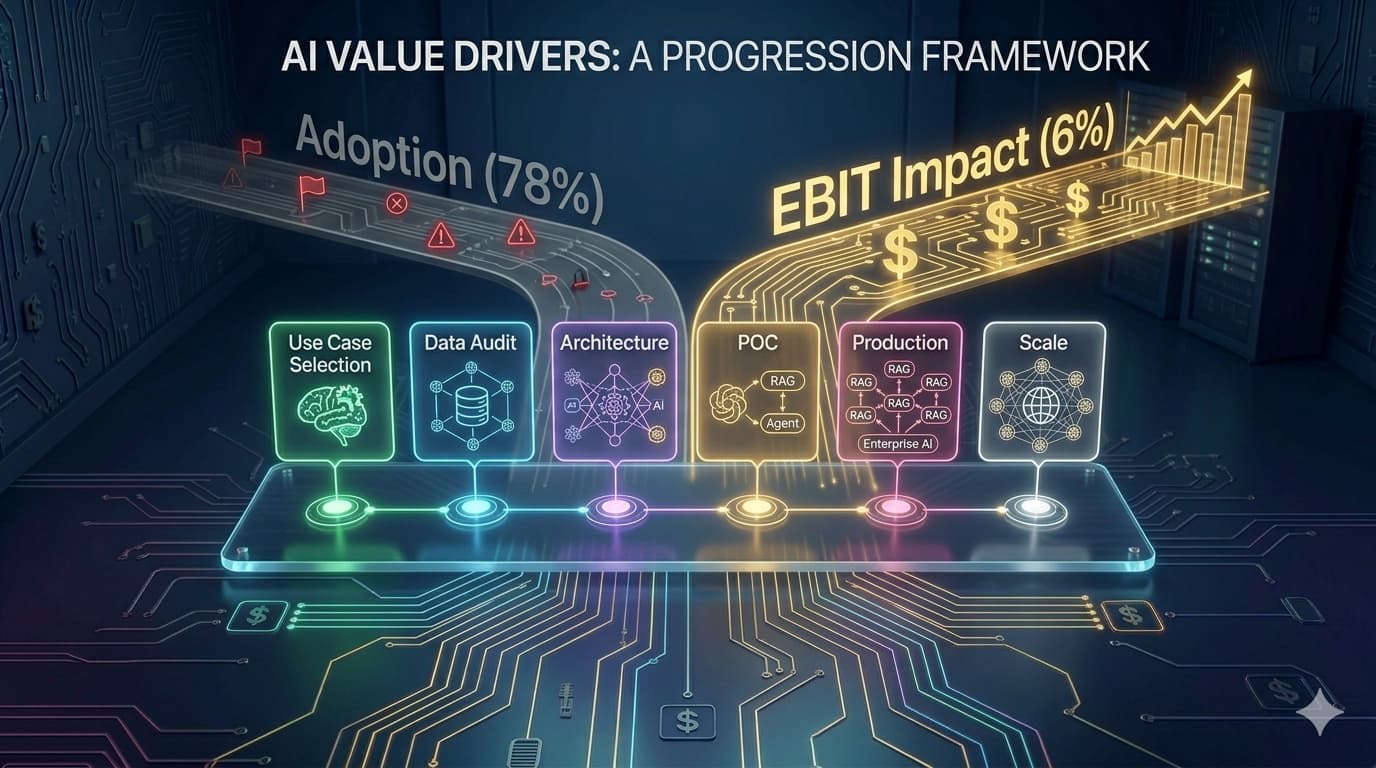
The McKinsey Global Institute's 2026 State of AI report lands with one of the sharpest numbers in the entire AI conversation: 78% of companies now use AI in at least one business function. Only 6% qualify as AI high performers generating measurable EBIT impact. That gap — between adoption and impact — is the most important problem in business AI today.
The 94% who are adopting without impact are not failing because they chose the wrong technology. They are failing because they skipped the steps between "we should do something with generative AI" and "we built and shipped a system that produces a specific, measurable business outcome." Those skipped steps are what this roadmap covers.
This is not a technology primer. It assumes you have heard enough about generative AI. It is a practical implementation guide: which use cases to choose, how to assess your readiness, what architecture decisions to make and when, what production deployment actually requires, and what mistakes to avoid at each phase.
Business leaders, product owners, and operations managers who have decided to implement generative AI and need a practical, honest framework for doing so — not a technology overview. The roadmap covers six phases from use case selection through scale, with specific decisions at each phase and the traps that cause projects to fail between phases.
The Adoption vs Impact Gap — Why 94% of Companies Miss Measurable Returns
The adoption-impact gap has three specific causes that show up consistently across organisations that have invested in generative AI without measurable returns:
They started with technology, not business problems. "We need to use generative AI" is not a business problem. "Our customer support team spends 40% of their time on responses to questions already answered in our documentation" is a business problem. Generative AI is a tool that addresses specific problem types — content generation, knowledge retrieval, document processing, conversation. Starting with the technology and searching for problems to apply it to consistently produces low-impact pilots.
They stopped at pilot. The most expensive step in any generative AI implementation is the distance between a working proof of concept and a production-grade system. A POC that answers 30 test questions correctly does not encounter malformed inputs, edge-case queries, or the AI API outage that happens at 2 AM. Organisations that treat a passing POC as the finish line deliver demos, not business outcomes. Production requires output validation, failure handling, cost controls, monitoring, and the iteration cycle that follows the first month of real user data.
They did not measure a baseline. If you implement generative AI for content creation without measuring how long content creation currently takes and how much it costs, you cannot verify whether the AI helped. Unmeasured outcomes cannot be optimised or defended. The 6% of high performers almost universally establish quantitative baselines before implementing — making every subsequent ROI claim verifiable.
What Generative AI Can Actually Do for a Business — Plainly
Before selecting a use case, it helps to understand the four distinct capability types of generative AI for business. Each addresses a different class of problem and points to different use cases and architecture choices.
✍️ Generate
Creates new text, code, or structured content from instructions. Marketing copy, sales emails, support responses, code, reports, summaries — consistent with brand voice at scale and at speed.
🔍 Retrieve & Answer
Answers questions grounded in your specific business knowledge using RAG. Customer-facing Q&A on product docs, internal knowledge search, contract clause retrieval, policy compliance checks.
📄 Analyse & Extract
Reads unstructured documents and extracts structured information. Invoice processing, contract analysis, application review, medical record extraction, compliance review at volume.
🔄 Transform
Converts content from one form to another. Translation, summarisation, reformatting, code migration, tone adaptation, content repurposing across channels from a single source piece.
Most high-impact business implementations of generative AI fall clearly into one of these four categories. The use case selection process becomes much clearer when you ask: "Which of these four capabilities most directly addresses the business problem we identified?"
Highest-ROI Generative AI Use Cases for Business in 2026
These use cases consistently deliver the highest return in the first year of generative AI for business deployment, based on the combination of high task volume, clear cost baseline, and direct measurability of the AI's impact.
| Use Case | Capability Type | Business Impact | First-Year ROI Potential |
|---|---|---|---|
| Customer support knowledge base | Retrieve & Answer | Deflects 55–75% of tier-1 queries; reduces response time from hours to seconds; consistent accuracy across channels | 200–400% |
| Content and marketing generation | Generate | Reduces content production time 60–80%; enables personalisation at scale; maintains brand voice consistency | 150–350% |
| Sales email personalisation at scale | Generate + Retrieve | Personalised outreach at 10x volume; AI researches prospect context per email; reply rates typically improve 30–50% | 250–500% |
| Document processing (invoices, contracts) | Analyse & Extract | Extracts structured data from unstructured documents at 90–97% accuracy; reduces manual data entry by 70–90% | 300–600% |
| Internal knowledge assistant | Retrieve & Answer | Reduces time employees spend searching for internal information by 40–60%; accelerates onboarding for new hires | 120–250% |
| Code generation and review assistance | Generate | Increases developer output 30–50%; reduces PR review time; improves code quality consistency across team | 100–200% |
| Report and insight generation | Transform + Generate | Automates recurring report production; generates narrative insights from data that would otherwise require analyst time | 100–180% |
The criteria for first use case selection are identical to the workflow automation readiness matrix: select the use case with the highest combination of volume, clear cost baseline, and data availability. The use case that produces the clearest measurable ROI is almost always the right first choice — not the most technically interesting one.
Want a use case assessment for your specific business?
Automely's discovery process identifies your highest-ROI generative AI use case, audits your data readiness, and produces a scoped implementation plan. Book a free 45-minute call.
The 6-Phase Generative AI Implementation Roadmap
This roadmap moves from business problem identification through production deployment and scale. Each phase has a specific output that gates entry to the next phase — skipping a phase does not accelerate the timeline, it creates the rework cost of the skipped phase later.
Use Case Selection and Baseline Measurement
Identify the specific business problem. Not "improve customer experience" — that is a direction, not a problem. "Our customer support team handles 800 tickets per week. 65% are questions already answered in our product documentation. Each ticket costs an average of $12 to handle manually. The annual cost of this category is $250,000." That is a problem with a measurable baseline.
Establish the baseline before any development begins: hours per week, cost per output, error rate, cycle time, and scaling ceiling. The baseline is what you measure the AI's impact against. Without it, your ROI claim is unverifiable and your project is undefendable to the business stakeholders who funded it.
- Which single use case generates the clearest measurable ROI and is data-ready?
- What is the quantified baseline for that use case?
- What measurable outcome defines success? (accuracy rate, cost per output, time saved?)
- Who owns the project from the business side and has authority to approve scope?
Data and Readiness Assessment
Generative AI is only as good as the data it has access to. For knowledge-retrieval use cases (RAG), this means auditing the quality, organisation, and coverage of your documentation. For generation use cases, it means auditing the examples and guidelines that will shape the model's output style. For extraction use cases, it means auditing the quality and consistency of the documents the model will process.
Critically, identify any data with regulatory implications: PII, health information, financial records, or legally privileged content. Sending any of these to a third-party AI API without a Data Processing Agreement may create compliance exposure. This assessment determines whether a public API deployment is appropriate or whether privacy-preserving approaches (on-premise models, data anonymisation, enterprise API agreements with DPAs) are required.
- Is our data quality sufficient, or does it require preparation time before development?
- Does any data have compliance implications that restrict third-party API use?
- Is our existing stack ready for AI integration, or does it require preparatory work?
- What is the data update frequency, and how will the AI system stay current?
Architecture Decision
The architecture decision determines the entire project scope, timeline, cost, and maintenance requirement. For most generative AI business implementations, the decision is between three approaches, ordered from simplest to most complex: (1) Foundation model API with prompt engineering only — fastest, cheapest, appropriate for generation and classification tasks where general model knowledge is sufficient; (2) Foundation model API plus RAG — adds your specific business knowledge, required for knowledge-retrieval use cases; (3) Fine-tuning — adapts a foundation model to your specific domain, required only when prompting plus RAG still underperforms after optimisation.
The IBM framework cited in our research emphasises a proof-of-concept scoring matrix at this stage — weighing revenue impact potential, technical complexity, and time to implementation. The right architecture is the simplest one that meets your performance requirements. See our detailed comparison in the AI model creation guide.
- Foundation model API only, RAG, or fine-tuning — which path fits the use case and data?
- Which foundation model (GPT-4o, Claude Sonnet, Gemini Pro) best fits the task requirements and cost model?
- Will this be a standalone service, an integration into an existing product, or both?
- What are the latency and reliability requirements, and how do they affect architecture choices?
Proof of Concept — Scoped and Accountable
A proof of concept that does not have defined acceptance criteria before it is built is not a POC — it is an experiment. Before any code is written, define: what percentage of test inputs must be answered correctly for the POC to pass? What is the test set (specific inputs representative of real production cases)? What is the latency threshold? What does failure look like and how is it handled?
Build the POC to a scope narrow enough to deliver in 2–4 weeks. A POC that takes 3 months is not a POC — it is a first version of production. Scope it to the minimum capability that can be evaluated against the acceptance criteria. The Orange Business framework we reviewed notes that POC results should directly inform the production architecture decision — a POC that passes its acceptance criteria validates the approach; a POC that fails informs what needs to change before production investment is justified.
- What are the specific, measurable acceptance criteria the POC must meet?
- What is the minimum viable scope that can be evaluated in 2–4 weeks?
- How will we test against real inputs rather than synthetic test cases?
- If the POC fails acceptance criteria, what changes in Phase 3 (architecture) or Phase 2 (data)?
Production Deployment
This is the phase that the 94% who do not see EBIT impact consistently skip or underscope. Production is not deploying the POC to a live URL. Production means: output validation layer (all AI outputs reviewed before they reach users or are written to systems); failure handling (timeouts, retries, circuit breakers, graceful degradation); cost controls (spend monitoring with alerts, caching, model routing for cost optimisation); observability (logging, hallucination monitoring, latency tracking, quality degradation alerts); and compliance controls (data handling, PII protection, audit trail where required).
Each of these adds development time that is easy to underscope because it is invisible — it does not change what the system does in the happy path. It determines what happens when the system is used by 10,000 real users with unexpected inputs, during an API outage, and when the knowledge base becomes stale. Budget for production hardening to take at least as long as the POC. See our AI integration guide for the full production requirement list.
- What is the output validation approach before any AI output reaches users or data systems?
- What is the fallback behaviour when the AI API is unavailable?
- Who monitors the system post-launch, and what triggers a review?
- How is the knowledge base updated as business information changes?
Measurement, Iteration, and Scale
The first four weeks of production deployment produce a quality of insight that months of pre-launch testing cannot: real users, with real inputs, in real contexts. This data reveals edge cases the test set did not cover, failure patterns that only emerge at scale, and quality gaps in the knowledge base that synthetic testing masked. Systematic collection and analysis of this data — weekly in the first month, bi-weekly thereafter — drives the iteration cycle that moves output quality from "acceptable" to "excellent."
Measure impact against the Phase 1 baseline at 30, 60, and 90 days. Calculate the actual achieved ROI against the projected ROI. Use the validated ROI from the first use case as the business case for the second. The organisations that join the 6% of AI high performers are not those who made the biggest initial investment — they are those who implemented systematically, measured rigorously, and expanded based on demonstrated results. For the full ROI calculation framework, see our AI development ROI guide.
- What does the 30-day performance data show versus the Phase 1 baseline?
- What conversation patterns or failure modes from real usage need knowledge base updates?
- Does the validated ROI from Use Case 1 justify expanding to Use Case 2? If so, which one?
- Should the second use case be built as an extension of the existing system or a parallel implementation?
Architecture Decision Framework — The Specific Choice at Phase 3
The architecture decision at Phase 3 is the most consequential technical decision in the roadmap. The right choice here determines whether you are building a system that is fast and maintainable or slow and expensive — and whether you are over-investing in complexity you do not need.
The decision framework follows a specific sequence of questions:
- Does the system need to answer questions using your specific business data? If yes — and this covers the majority of business generative AI use cases — the path is foundation model API plus RAG. Do not proceed to fine-tuning before building and evaluating a properly optimised RAG system. A well-built RAG system outperforms fine-tuning for knowledge retrieval tasks at a fraction of the cost and with significantly easier maintenance (update the documents, not the model).
- Does the system need to generate content in a specific style, voice, or format that prompt engineering cannot reliably produce? If RAG plus prompt engineering still fails to consistently produce the required output quality after thorough optimisation — fine-tuning is the next step. This requires labelled (input, ideal output) examples, an ML engineer to implement, and 4–12 additional weeks. It is not the first step.
- Are there data privacy requirements that prevent sending data to external APIs? If yes — on-premise model deployment (using open-weight models like Llama 3 or Mistral, served on your own infrastructure) or enterprise API agreements with DPAs may be required. This significantly increases infrastructure cost and complexity. It is the right choice when compliance requires it; it is not an appropriate first choice for privacy concerns that can be addressed through data anonymisation before API calls.
The generative AI architecture that is too simple for your requirements is the one you build beyond. The one that is too complex is the one you are stuck maintaining. Always start with the minimum architecture that meets your performance requirements, then add complexity only when production data demonstrates that simpler approaches are insufficient. More than half of all fine-tuning projects we have evaluated could have achieved acceptable performance with better RAG and prompt engineering — at 20% of the cost and 30% of the timeline.
5 Implementation Mistakes That Derail Generative AI Projects
Starting with technology rather than the business problem
"We should implement generative AI" produces experiments. "Our customer support handles 800 tickets/week, 65% of which are documentation questions costing $250K/year" produces a business case. The first question in any generative AI implementation must be: what specific, measurable business outcome are we trying to change? If the answer involves the word "AI" rather than a measurable outcome, start over with the framing.
Treating the POC as the product
A proof of concept that answers test questions correctly has passed a controlled test — not a production test. Production means real users with unexpected inputs, API outages at inconvenient times, malformed requests, adversarial queries, and quality degradation as the knowledge base becomes stale. Every project that launched a POC as production has generated support incidents, user complaints, and emergency remediation costs that a proper production hardening phase would have prevented.
Fine-tuning before optimising prompts and RAG
Fine-tuning is expensive, time-consuming, and produces a model that is harder to update than a well-configured foundation model deployment. In the overwhelming majority of cases, a properly optimised RAG system with a thoroughly engineered prompt architecture achieves 80–90% of what fine-tuning achieves. Always exhaust prompting and RAG optimisation before investing in fine-tuning. Any vendor who recommends fine-tuning as the first architecture step — without demonstrating that simpler approaches fail — is proposing the wrong solution.
No baseline measurement — making ROI unverifiable
If you do not know how much your current process costs, you cannot know whether the AI helped. "We feel like it's working better" is not a business outcome — it is an impression. Establish the baseline before any AI is introduced: hours per week, cost per output, error rate, cycle time. Measure the same metrics at 30, 60, and 90 days post-launch. The gap is your ROI. Without this discipline, generative AI becomes a permanent cost that generates permanent impressions rather than a verified investment.
Treating launch as the finish line
The first deployment is the beginning of the system's useful life, not the end of the project. Generative AI systems that are not actively maintained degrade: knowledge bases become stale, LLM API providers change pricing and deprecate models, usage patterns evolve in ways that reveal new edge cases, and output quality drifts in ways that monitoring catches but manual review misses. Build the maintenance plan — who, what frequency, what triggers a review — before launch. Treat maintenance budget as a project cost, not an afterthought.
Implementing Generative AI for Your Business with Automely
Automely's generative AI development service follows this exact roadmap — structured discovery (Phase 1–2), architecture recommendation (Phase 3), scoped POC with defined acceptance criteria (Phase 4), production-hardened deployment (Phase 5), and post-launch measurement and iteration support (Phase 6). We do not skip phases to deliver faster. We scope each phase accurately and do not move to the next until the current phase's output has been validated.
Our production track record includes Lamblight — a generative AI consumer application with 20,000+ active users generating $312K in ARR — built on a foundation model with custom RAG and a personalised voice generation layer. And Cerebra Caribbean — a multi-channel generative AI communication platform that has automated 10,000+ customer conversations at 95% CSAT for Caribbean businesses — built on a RAG knowledge system without any custom model training, because RAG was sufficient.
Both systems exist in Phase 6 — actively monitored, iteratively improved, and generating measurable business outcomes against the baselines established before development began. Browse our case studies, read client testimonials, and explore our full AI services portfolio including AI agent development, AI chatbot development, and AI integration services. If you have a specific use case in mind, our AI consulting service can produce a full roadmap document as a standalone deliverable before any development commitment.
Ready to move from adoption to measurable EBIT impact?
Book a free 45-minute discovery call. We will walk through the roadmap with your specific use case, assess your data readiness, and give you a scoped implementation plan — before you commit to anything.