

The 3× Gap — Why Most Organisations Are Failing to Scale AI
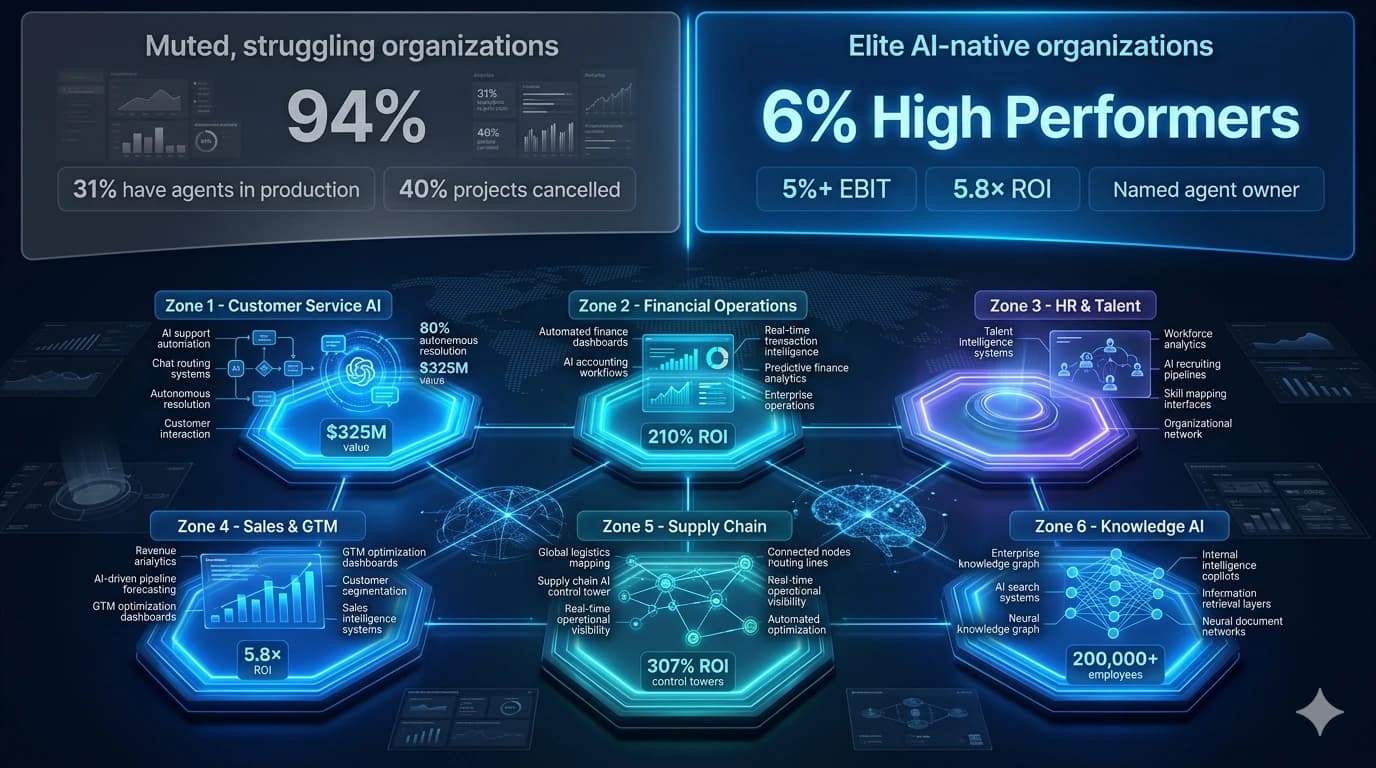
Nearly two-thirds of organisations are experimenting with AI agents. Fewer than one in four have successfully scaled them to production. That gap — between widespread experimentation and working production deployment — is the defining business challenge of artificial intelligence trends in 2026. And the McKinsey research that quantifies it contains the most important single finding in AI strategy this year: high-performing organisations are three times more likely to successfully scale AI agents than their peers. The differentiator is not the AI model they use. It is the willingness to redesign workflows rather than simply layering agents onto legacy processes.
Most businesses are making AI decisions based on what AI can do right now. The organisations closing the 3× gap are making decisions based on what AI is becoming — and what that implies for how they build products, design operations, treat data, and structure their technology architecture. This is not a predictions article. It is a building guide: 7 development priorities converging in the highest-performing AI organisations, with the evidence behind each and the specific building decision each implies.
7 AI Development Priorities for Businesses Building Toward Competitive Advantage
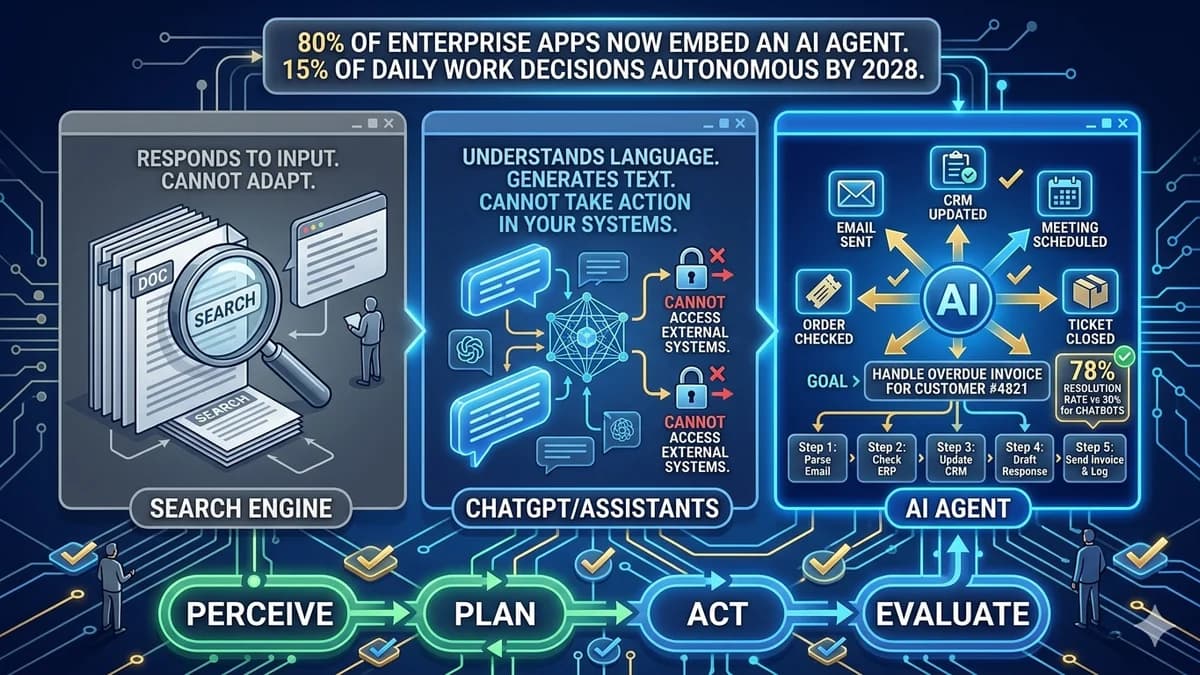
The transition from AI as a feature — a chatbot on a website, a suggestion in an IDE — to AI as a worker — an autonomous system that perceives context, plans sequences of actions, uses external tools, and executes without human direction at each step — is the central architectural shift of the AI development landscape in 2026. Gartner projects 40% of enterprise applications will embed AI agents by end of 2026. What this means for product and operations development: systems built with humans as the primary executor of workflows will require significant rearchitecting to take full advantage of agentic AI. Systems designed from the start with agents as the primary executor — with humans in oversight, exception handling, and high-judgment roles — will scale more efficiently.
Deloitte’s 2026 research on agentic AI strategy is direct: most agentic AI implementations are failing. The organisations finding success are those reimagining operations and managing agents as workers — not bolting AI capabilities onto structures designed for human execution. The distinction is between an organisation that gives an agent access to its existing customer support workflow vs an organisation that redesigns the customer support workflow from the ground up for agent execution, with human escalation paths designed at the appropriate decision thresholds.
As base AI models commoditise — IBM’s Chief AI Architect describes approaching “a commodity point” on model quality — the sustainable competitive advantage shifts from which model you use to the data that model is trained or grounded on. Commodity model access levels the playing field. Proprietary data creates a moat that cannot be purchased at commodity model prices. Boomi’s Chief Product and Technology Officer states this precisely: “Training and maintaining proprietary SLMs will become a key competitive edge for companies. Those who invest early in grounding AI on their unique data and workflows will create models that are not just tools, but strategic assets that reflect how their business truly runs.”
Precisely’s CEO adds the dimension that most organisations are missing: “Companies are pouring billions into AI infrastructure — but we’re only just starting to see some of these same companies think about the data that will sit in that infrastructure.” The companies that build their data strategy in 2026 will have a compounding advantage in 2028 and 2030. Customer interaction history, operational logs, domain-specific documents, institutional knowledge — these are accumulating assets. The organisation that systematically captures, structures, and makes this data accessible for AI training and grounding in 2026 will have a training dataset in 2028 that no competitor who started later can replicate.
The McKinsey finding that high-performing organisations are 3× more likely to scale AI agents — and that the key differentiator is workflow redesign rather than model sophistication — deserves its own building priority because it directly contradicts the way most organisations approach AI deployment. The default approach: deploy an AI agent into an existing workflow. An AI assistant for the support team. An AI coding tool for developers. An AI outreach tool for sales. These produce incremental improvement. They do not produce 3× scaling performance because the workflow itself was designed for human execution — with its assumptions, hand-off points, exception paths, and quality gates built around human decision-making cadence and human cognitive capabilities.
The redesign approach: map the current workflow, identify which steps require human judgment and which require human execution, then design a new workflow where AI executes the execution steps and humans own the judgment steps. This is a different workflow — not a faster version of the same one. The CIO.com perspective: “The future of engineering is not a fully automated, lights-out department; it’s a collaborative, synergistic ecosystem where human intuition and strategic oversight partner with AI speed and scale.” That ecosystem is designed, not evolved by accident.
Implementing one of these 7 priorities and want expert guidance on the building decisions — architecture design, data strategy, workflow redesign? Automely advises and builds.
Free 45-minute AI development consultation. We map your specific situation against these priorities and recommend the building sequence that produces the fastest durable ROI for your context.
The most specific and actionable piece of AI strategy advice from CIO-level practitioners in 2026 comes from InformationWeek’s enterprise AI predictions: “The strategic value for the enterprise lies not in building the agent’s brain, or the plumbing that connects it, but in defining and standardising the tools those agents use. The true competitive advantage will belong to the enterprises that have meticulously documented, secured and exposed their proprietary business logic and systems as high-quality, agent-callable APIs.” This is the technical manifestation of the proprietary data moat at the integration layer.
Most organisations’ proprietary business logic — their pricing rules, their risk assessment models, their customer eligibility criteria, their operational decision trees — is locked inside legacy systems with no programmatic access. AI agents cannot use what they cannot reach. The organisations that win the agentic era are those that systematically document their proprietary logic, expose it through well-designed APIs with appropriate authentication and rate limiting, and maintain this as a first-class engineering asset. Forrester separately predicts that half of enterprise ERP vendors will launch autonomous governance modules in 2026 — making proprietary API exposure an increasingly urgent priority as agent networks seek to interact with core business systems.
The cost of retrofitting governance into production AI systems that were built without it is significantly higher than building governance in from the start — across both engineering cost and regulatory risk. IBM’s research identifies this as a building imperative: “Both regulators and consumers ask organisations to explain how AI agents come to specific decisions. Organisations must design agents that can show their work, for even the most complex outputs.” This means building audit trails, explainability mechanisms, and human oversight controls into the architecture during development — not as post-launch additions.
The external pressure making this urgent: the EU AI Act becomes fully applicable in August 2026, creating binding requirements for high-risk AI systems that cannot be met by systems without governance architecture. Forrester predicts that half of enterprise ERP vendors will launch autonomous governance modules in 2026 as vendor compliance pressure propagates through supply chains. SAP, Microsoft, and Oracle are already investing heavily in governance infrastructure. The organisations building governance into their AI systems now will have a compliance-ready foundation. Those building without it will face remediation costs that Forrester describes as significantly affecting both development timelines and customer relationships.
As base models commoditise and the open-source AI ecosystem matures, organisations that have built their AI systems with single-vendor dependency face increasing architectural risk. IBM’s research is explicit: “Build sovereignty through modularity — architecting AI environments so workloads, data, and agents can shift among trusted regions and providers.” This is not just a cost-optimisation concern. It is a governance and continuity concern. Organisations that cannot move their AI workloads, agent implementations, and training data between providers are exposed to vendor pricing changes, capability gaps, and regulatory non-compliance as rules about data residency evolve.
The emergence of interoperability standards — Anthropic’s MCP for tool connectivity and Google’s A2A for agent-to-agent communication — creates the technical foundation for modular AI architectures. MachinelearningMastery describes the shift as moving “from building monolithic, proprietary agent systems to composing agents from standardised components.” This creates an economic parallel to the API economy that emerged from web services standardisation — a marketplace of interoperable agent tools and services that modular architectures can consume and swap. Organisations building modular AI architectures now position themselves to benefit from this marketplace as it matures.
The organisations achieving the highest AI performance are not the ones that have automated the most — they are the ones that have most deliberately designed the interface between human and AI work. CIO.com’s February 2026 assessment is direct: the question is not whether to invest in a proprietary AI platform or leverage third-party tools — it is “guided by a cold-eyed assessment of your core competencies and long-term goals, not just by the allure of the technology.” The same precision applies to workforce planning: what decisions and tasks should remain human, what should be AI-executed, and where is the escalation interface between them?
Deloitte’s 2026 agentic AI strategy research shows that while most enterprises have answers for technical implementation questions, “things get hazier” when they consider workforce makeup and operational priorities as agentic technology develops. TechCrunch describes 2026 as “the year of humans” — where AI handles the repetitive and analytical layers, freeing professionals for contextual, relational, and judgment-intensive work. The organisations that design this partnership deliberately — rather than letting it evolve ad hoc as AI capabilities expand — maintain both performance advantage and team cohesion as the AI development landscape shifts.
The Building Sequence — Which Priority First
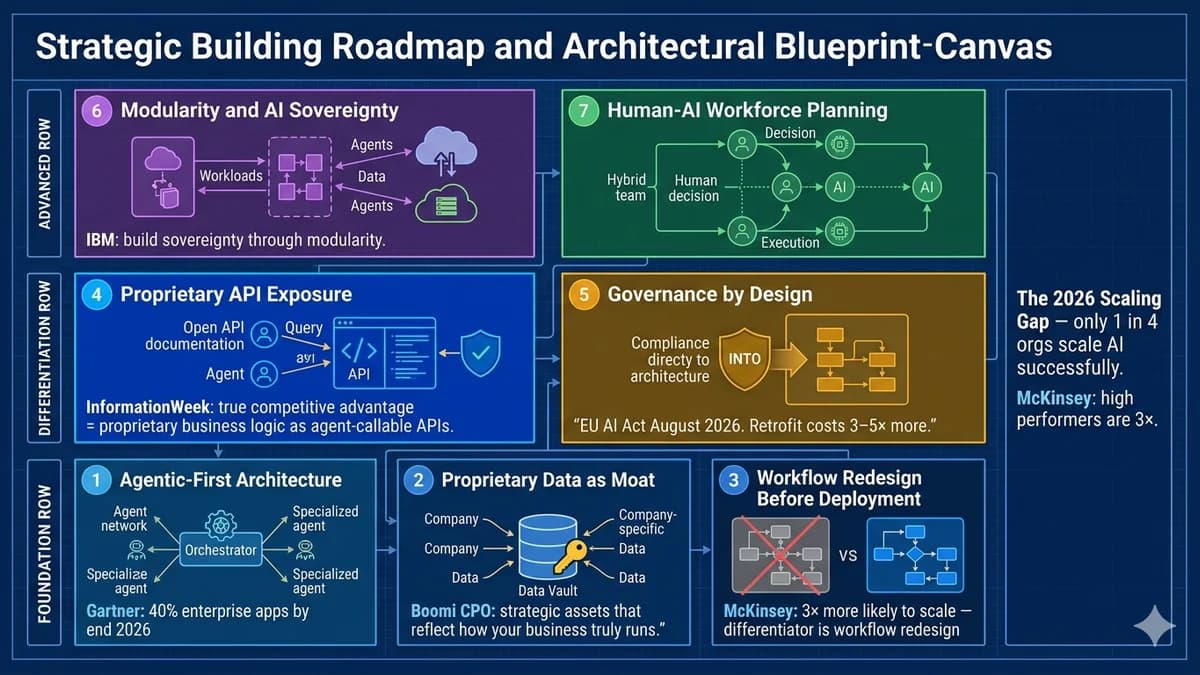
The seven priorities form a natural dependency sequence rather than a flat list of equal urgency. Priorities 1-3 are foundation — agentic-first architecture, proprietary data strategy, and workflow redesign. These are the decisions that shape every subsequent technical choice. Organisations that skip them and start with Priorities 4-7 consistently find that their API exposure, governance frameworks, and modularity decisions are working against an architectural foundation that was not designed for agent-first operation.
Priorities 4-5 — proprietary API exposure and governance by design — are differentiation-layer decisions that should be made concurrent with the first agent system deployment, not deferred to “once we scale.” The cost of retrofitting both is prohibitively high at scale. Priority 4 (API exposure) directly determines what agents can do in your specific competitive context. Priority 5 (governance) determines whether those agents are compliant and explainable when regulators and customers ask.
Priorities 6-7 — modularity and human-AI workforce planning — are advanced-layer decisions that compound in value over time. Modularity becomes increasingly important as the AI vendor landscape shifts and your AI architecture needs to evolve. Workforce planning becomes increasingly important as agent capabilities expand and the human-AI boundary needs periodic recalibration. Neither is an emergency in month one. Both are strategic requirements by month twelve.
25% of organisations experimenting with AI agents successfully scale to production. 75% do not. The 3× performance advantage of high-performing organisations comes from the same underlying building decisions these 7 priorities represent. The gap between the 25% and the 75% is not AI capability — the models are increasingly commodity. It is architecture, data strategy, workflow design, governance discipline, and workforce planning. These are decisions, not purchases. They can be made starting now.
How Automely Builds for These Priorities
Automely designs and builds AI systems with these seven priorities as explicit design criteria — not as after-the-fact additions. Our work with clients across the US, UK, and EU consistently starts with Priorities 1-3: architecture designed for agent execution, data strategy for proprietary grounding, and workflow redesign before agent deployment. The AI systems we build on these foundations perform at the level that puts organisations in the 25% that successfully scale, not the 75% that stay in pilot purgatory.
Our specific capabilities map directly to the priorities in this guide: agentic AI system design (Priority 1), custom AI model fine-tuning on proprietary data (Priority 2), process redesign consulting before automation (Priority 3), API development and integration (Priority 4), AI governance architecture (Priority 5), and modular AI system design (Priority 6).
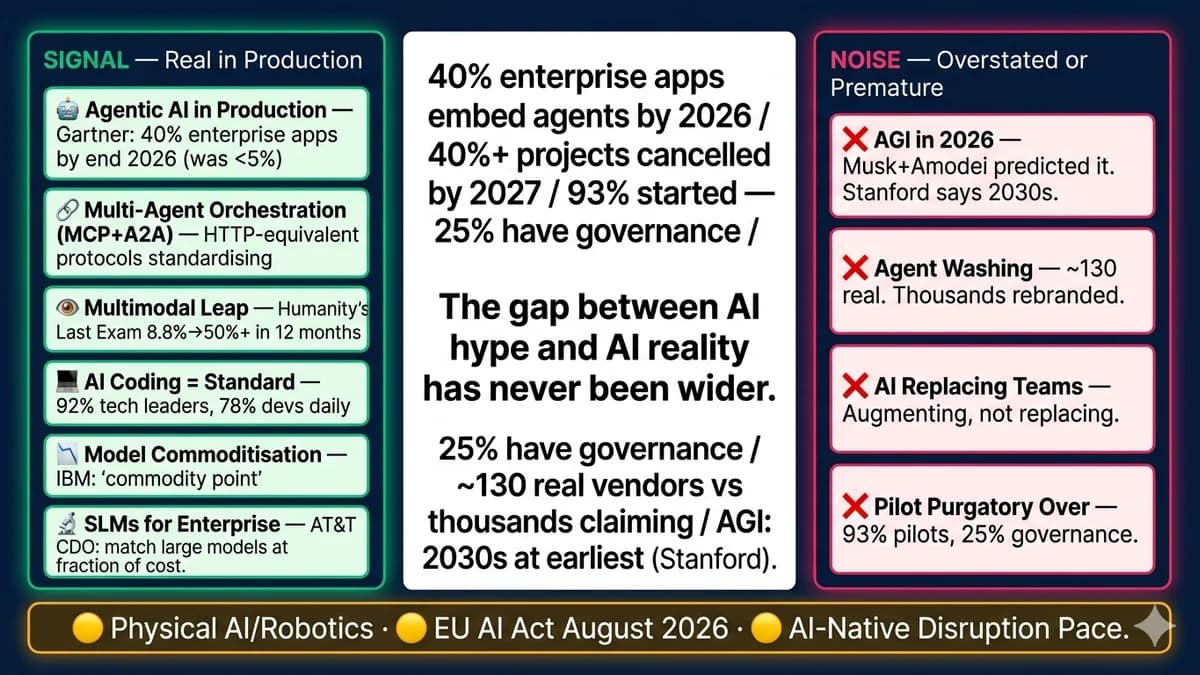
For the broader context on where AI development is heading, see our AI trends 2026 signal-to-noise analysis and our guide to what AI agents actually are and do in production.
Ready to build toward these 7 priorities — and want a partner who has already built production AI systems with agentic-first architecture, proprietary data grounding, and governance by design?
Free 45-minute AI development consultation. We assess where your organisation sits against these 7 priorities, identify the highest-value building decisions for your context, and recommend the implementation sequence.