

The 6% vs 94% Gap — Why Having AI and Winning With AI Are Completely Different
88% of large organisations now use AI in at least one business function — up from 78% a year ago. 80% of enterprise applications shipped or updated in Q1 2026 embed at least one AI agent. 62% of organisations are at least experimenting with AI agents. By any adoption metric, enterprise AI has crossed from emerging technology into standard operational expectation.
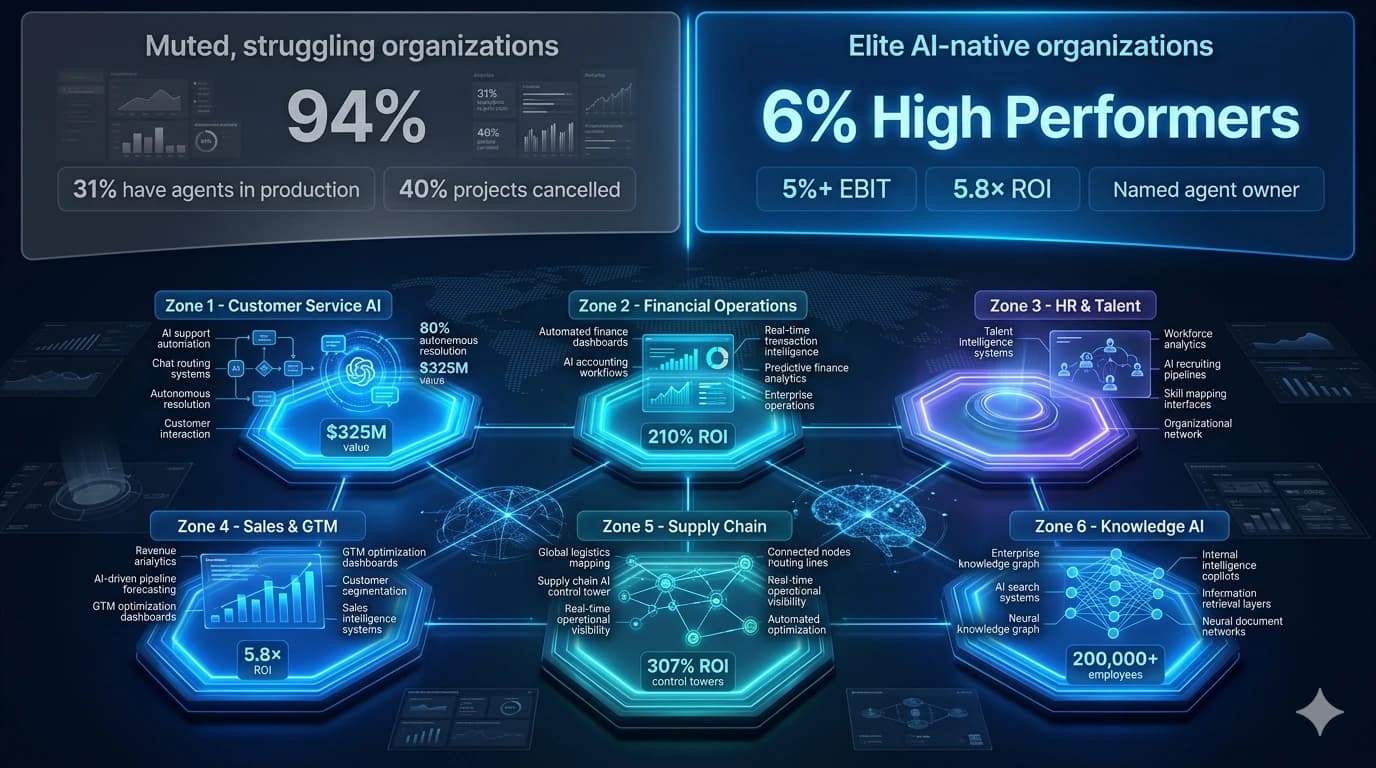
But adoption and impact are not the same metric. Only 6% of organisations qualify as AI high performers — defined by McKinsey as those where more than 5% of EBIT is directly attributable to AI. Only 25% of AI initiatives deliver expected ROI. Only 16% reach enterprise-wide scale. Gartner predicts that over 40% of agentic AI projects will be cancelled by the end of 2027 due to escalating costs, unclear business value, or inadequate risk controls. 64% of CEOs acknowledge that FOMO drives AI investment before they fully understand the value those technologies deliver.
This guide is not a list of enterprise AI platforms. It is a map of what the 6% are actually deploying across six enterprise functions — with verified ROI outcomes — and a specific analysis of what they do differently from the 94%. The gap between having AI and winning with AI is specific, documented, and closable.
The Production Gap — Most AI Is Still in Pilot
❌ The 94% — Still in Pilot
Using AI in at least one function. But only 31% have a single AI agent in production. Two-thirds have not begun scaling AI across the enterprise. 40% of their agentic AI projects are at risk of cancellation by 2027. Only 21% have mature AI governance.
✓ The 6% — High Performers
5%+ of EBIT attributable to AI. 3× more advanced in agent deployment. Invest >20% of digital budgets in AI. Redesign workflows around AI, not just add tools. Have a named "agent owner" with P&L accountability. Measure EBIT impact, not feature adoption.
The 6 Enterprise AI Deployment Categories With Verified Production ROI
Customer Service and Support Automation
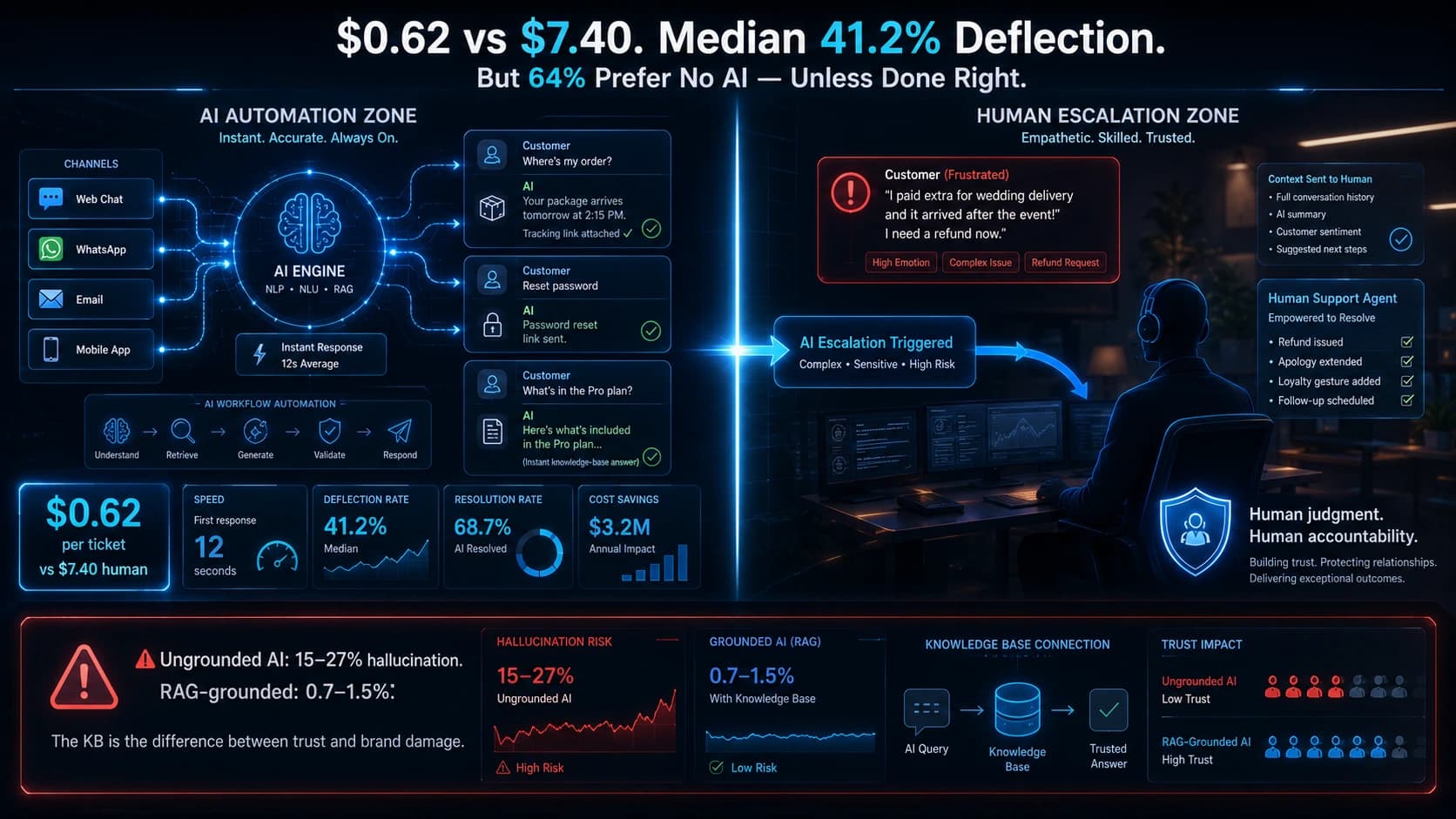
Customer service AI is the most widely deployed and most extensively documented enterprise AI function. ServiceNow documented 80% autonomous handling of customer support inquiries, 52% reduction in time needed for complex case resolution, and $325 million in annualised value. Forrester independently verified 210% ROI over three years with payback under 6 months. Bank of America's Erica virtual assistant has handled over 3 billion customer interactions at 98% success rate. The median payback period for customer service AI agents is 3.4 months — the fastest of any enterprise AI deployment category.
The deployment pattern that produces this ROI: AI resolves structured, high-volume requests autonomously; humans handle emotionally charged interactions, complex multi-cause failures, and high-stakes decisions above defined thresholds. The organisations reporting the strongest CSAT improvements are those that designed the escalation experience — seamless handoff from AI to human, full context preserved — with the same care as the automation itself.
- Autonomous resolution of Tier 1 queries — order status, account inquiries, standard policy questions
- RAG-grounded AI chatbots reducing hallucination to 0.7-1.5% vs 15-27% for ungrounded systems
- Agent assist — real-time suggested replies and knowledge retrieval for human agents
- Voice AI for phone support — handling structured inbound call intents autonomously
- Proactive outreach AI — identifying at-risk accounts and triggering resolution workflows
Financial Operations and Compliance Automation
Financial operations AI is the deployment category with the highest industry-vertical production rate — banking and insurance lead enterprise AI agent adoption at 47% in production. Visa's AI fraud system prevented over $40 billion in fraud across 320 billion transactions. PayPal's AI security blocks $500 million in fraud per quarter. JPMorgan's COiN platform processes 12,000 commercial credit agreements in seconds, saving 360,000 hours annually and generating $1.5 billion in annual business value. 89% of banks use AI for real-time regulatory compliance monitoring; AI has reduced compliance costs by an average of 19% across global financial institutions.
The key characteristic of financial operations AI deployments that reach production: they automate the documentation and reporting workflows before the decision workflows, building regulatory trust before expanding AI scope into decision-adjacent territory.
- Real-time fraud scoring — every transaction analysed against 500+ signals before settlement
- AML transaction monitoring — 80% reduction in false positives vs rule-based systems
- Automated regulatory report generation — CCAR, DFAST, Basel III, MiFID II
- Invoice and payment reconciliation — AI matching, exception flagging, automated posting
- Audit preparation — AI-assisted control testing documentation and evidence gathering
HR and Talent Intelligence
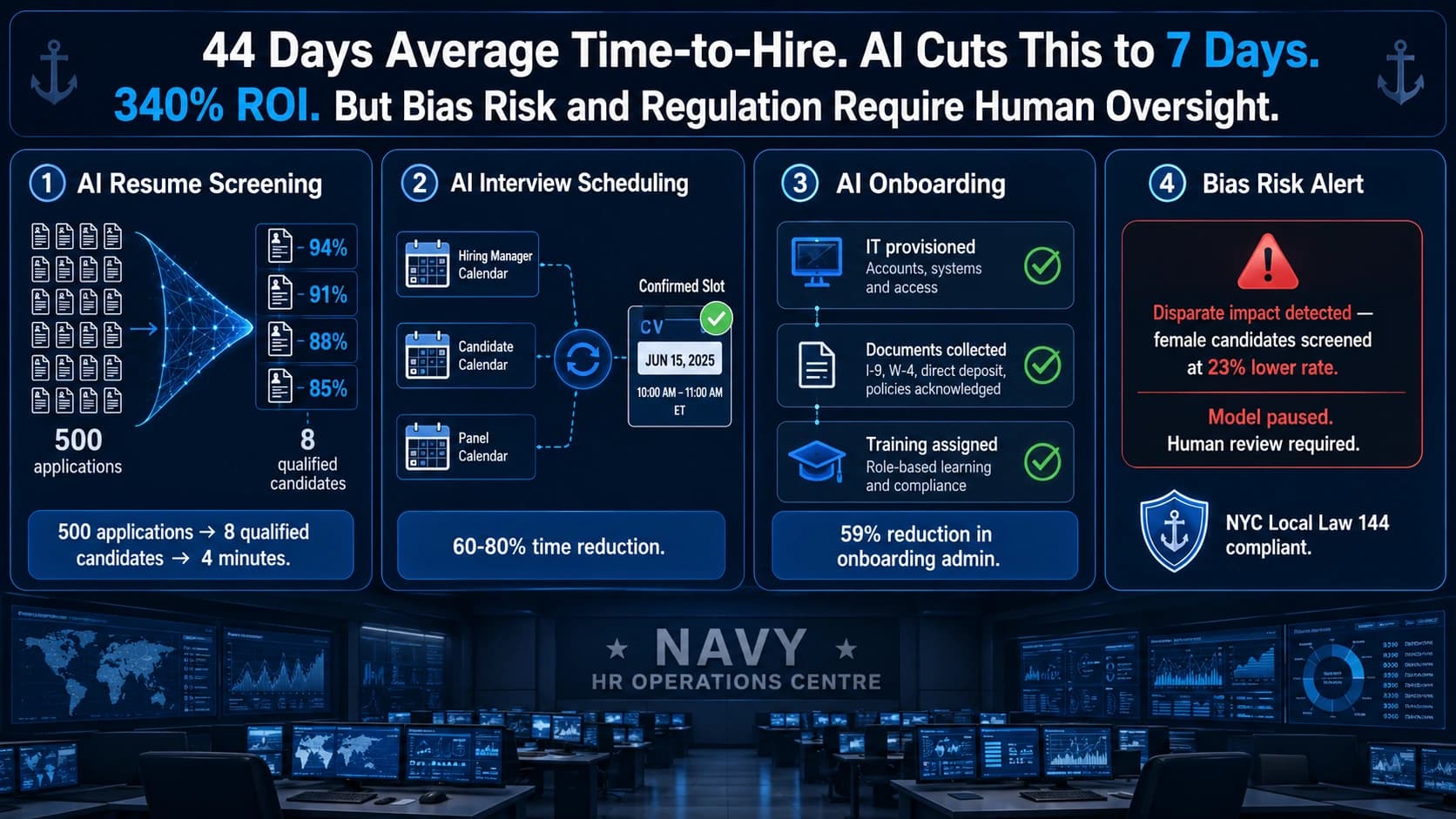
HR AI is the fourth most widely deployed enterprise AI function. AI-assisted screening reduces time-to-hire by 25-50% at enterprise scale. Chipotle's AI hiring assistant reduced employee turnover by 67% in pilot locations. Unilever's AI-assisted global hiring programme increased diversity in shortlisted candidates by 16% while reducing screening time by 75%. The governance imperative in HR AI is more pressing than in other functions: the EU AI Act classifies AI systems used in hiring and employment decisions as high-risk, requiring conformity assessment, bias testing, and human oversight mechanisms.
The Amazon 2018 recruiting AI failure — a system that systematically penalised CVs mentioning women's organisations, discovered only through retrospective audit — remains the cautionary case that HR AI governance requirements are designed to prevent. Organisations deploying HR AI without documented bias testing and human-in-the-loop decision requirements are building compliance risk, not just capability.
- CV screening and candidate scoring — AI ranking against job competency framework, human decision on shortlist
- Interview scheduling — fully automated multi-party calendar coordination
- Onboarding workflow automation — document collection, system provisioning, training assignment
- Workforce analytics — attrition risk prediction, skills gap identification, capacity planning
- Performance review support — AI-generated draft from goal tracking and peer feedback data
Sales and Go-to-Market AI
Sales and GTM AI has the fastest median payback of any enterprise AI deployment — SDR agents pay back in 3.4 months. AI analyses every account signal — intent data, technographic changes, firmographic shifts, job postings, news events — and surfaces the actions most likely to advance the opportunity, ranked by probability of conversion.
The highest-value enterprise GTM AI deployment is not AI that replaces sales reps — it is AI that makes each rep significantly more effective by eliminating research time, surfacing the right information at the right moment, and automating the administrative workflows that consume 40-60% of sales team time in most organisations. Revenue intelligence AI also enables accurate pipeline forecasting at a granularity that manual CRM updates cannot produce.
- AI lead scoring — ranking inbound and outbound leads by conversion probability and deal size
- AI SDR workflows — automated personalised outreach sequences at enterprise volume
- Meeting preparation AI — briefing documents generated from CRM + news + intent data
- Pipeline intelligence — multi-signal deal health scoring and next-action recommendations
- Revenue forecasting — AI-generated pipeline forecast from real-time engagement signals
Supply Chain and Operations AI
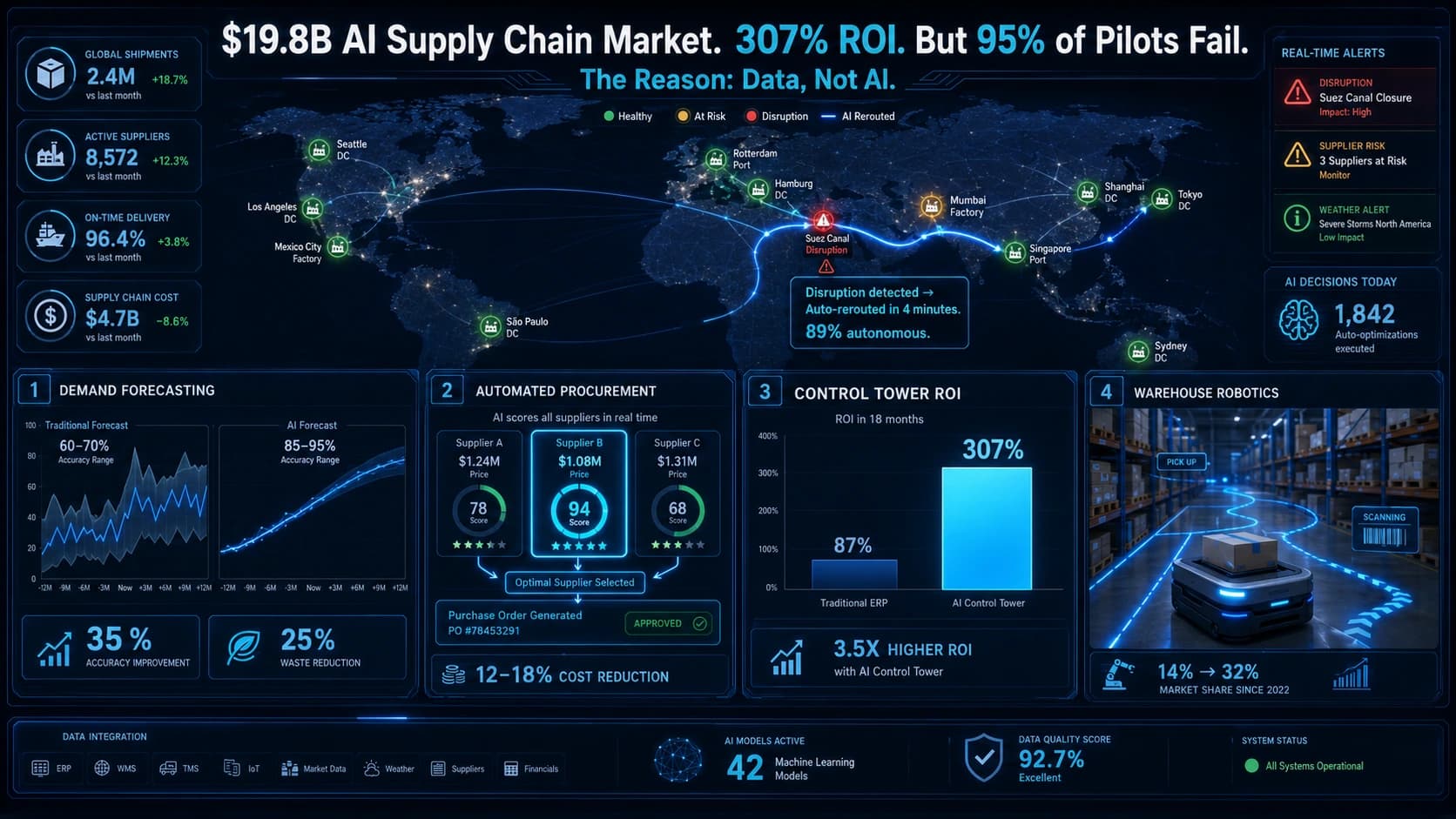
Supply chain AI is the enterprise function with the highest adoption in demand forecasting — 87% of enterprises use AI for demand forecasting, achieving 85-95% accuracy versus 60-70% for traditional statistical methods. AI-powered control towers deliver 307% ROI within 18 months versus 87% for traditional ERP dashboards. McKinsey identifies supply chain management as one of the top agentic AI use cases for high potential alongside customer support and knowledge management.
The supply chain AI function where the deployment gap is sharpest is procurement automation: AI that triggers purchase orders when inventory reaches replenishment thresholds, scores and selects suppliers, and manages contract compliance reduces procurement costs by 12-18%. But 95% of GenAI supply chain pilots fail to scale — the failure is data readiness, not technology. Supply chain AI requires clean, integrated data from ERP, WMS, TMS, and supplier portals; organisations without this integration layer cannot produce reliable AI outputs regardless of model sophistication.
- Demand forecasting — 85-95% accuracy from ML models combining 20+ signal types
- AI control towers — real-time disruption detection 2-3 weeks earlier than traditional monitoring
- Automated procurement — AI-triggered POs, supplier scoring, contract compliance monitoring
- Logistics optimisation — route planning, carrier selection, 30% carbon emissions reduction
- Inventory optimisation — dynamic safety stock calibration, 20-30% carrying cost reduction
Knowledge Management and Internal Productivity AI
Knowledge management and internal productivity AI is the most universally deployed enterprise AI function. JPMorgan's LLM Suite reaches 200,000+ employees and generates approximately $1.5 billion in annual business value, with 300+ use cases in production. Goldman Sachs GS AI Assistant reaches all 46,500 employees for document drafting, code generation, research summarisation, and knowledge retrieval. Worker access to AI rose 50% in 2025.
The strategic importance of internal productivity AI deployment first — before regulated client-facing AI — is the sequencing insight that separates organisations with production deployments from those still in pilot. Every major institution with verified ROI from enterprise AI deployed internal productivity tools at enterprise scale before attempting regulated use cases. This sequence builds AI literacy, creates institutional knowledge about what works in your specific operational context, and produces measurable productivity gains without regulatory approval burden.
- Enterprise LLM assistants — company-specific knowledge bases, policy retrieval, document drafting
- AI-powered internal search — natural language queries across all enterprise knowledge systems
- Meeting AI — automated action capture, summary generation, follow-up tracking
- Code generation — AI coding assistants improving developer velocity 10-20%
- Document processing — contract analysis, regulatory document extraction, research summarisation
Which of these 6 deployment categories is the highest-ROI first move for your organisation — and what does the data governance prerequisite look like?
Automely's enterprise AI consultation maps your deployment sequence, scopes the data requirements, and designs the governance architecture. Free 45-minute call.
What the 6% Do Differently — The Five Characteristics of Enterprise AI High Performers
McKinsey's analysis of AI high performers consistently identifies the same five organisational characteristics. These are not technology choices. The same LLM APIs and cloud platforms are available to all 100% of organisations. The difference is entirely in how organisations approach the deployment, governance, and organisational integration of AI systems.
Senior Leadership Actively Champions AI — Not Just Approves Budget
High performers are 3× more likely to have senior leaders who strongly agree they demonstrate active ownership of AI initiatives — role modelling AI tool usage, actively driving adoption, and setting AI-linked business outcome targets. Organisations where AI is delegated entirely to IT or a Centre of Excellence without line-of-business leadership engagement consistently underperform. The CEO, CFO, or relevant functional C-suite champion is the single strongest predictor of whether AI investment translates to EBIT impact or remains in pilot.
A Named "Agent Owner" Role With P&L Accountability
Organisations with a named "agent owner" — an individual accountable for the performance, cost, and business outcomes of AI agent deployments — have a 2.7× higher rate of converting AI pilots to production. Organisations without this role are over-represented in the 22% negative-ROI cohort. The agent owner is not a technical role; it is a business role. They define success metrics before deployment, hold the budget for AI operating costs, review performance data, and make decisions about expanding or shutting down agent programmes.
Invest More Than 20% of Digital Budget in AI — and Redesign Workflows Around It
McKinsey's high performers invest more than 20% of their digital budgets in AI. But the investment level alone is not the differentiator — the deployment approach is. High performers redesign workflows around AI rather than layering AI onto existing processes. Adding an AI tool to an existing workflow that was designed for human execution produces marginal gains. Redesigning the workflow from first principles — what would this process look like if AI were available from the start? — produces the structural efficiency gains that generate EBIT impact. Only 34% of surveyed organisations are truly reimagining the business rather than optimising at the margin.
Fix Data Governance Before Deploying AI
52% of organisations cite data quality as the biggest blocker to AI deployment. High performers treat data governance as a pre-condition for AI deployment, not a parallel workstream. They invest in data integration (connecting the source systems the AI needs to access), master data management (consistent entity definitions across systems), and data quality monitoring (alerting when AI-critical data degrades) before model development begins. The AI is never the bottleneck in enterprise deployments that fail — the data foundation is.
Measure EBIT Impact — Not Feature Adoption
The most common enterprise AI measurement failure: tracking AI feature adoption rather than business outcomes. Feature adoption metrics look successful even when the underlying business impact is zero. High performers define the specific business outcome metric before deployment — "reduce invoice processing cost from $X to $Y" or "increase pipeline conversion by Z%" — and track that metric monthly. IBM's 2025 CEO Study found that only 47% of IT leaders said their AI projects were profitable in 2024; the organisations measuring profitability from AI are the ones finding it.
Enterprise AI Governance — Why 21% Mature Governance Is the Sharpest Risk
Only 21% of organisations have a mature governance model for autonomous AI agents. This is the sharpest risk in enterprise AI deployments in 2026, because the regulatory environment is hardening at the same time as deployments are scaling. The organisations that cancel projects in 2027 are the ones that built without governance in 2025–2026.
| Requirement | What It Means in Practice | Who It Applies To |
|---|---|---|
| Audit Trails | Every autonomous AI action must be logged with the decision logic, data inputs, and outcome — reconstructable for regulatory review or internal audit | All autonomous AI agents making consequential decisions |
| Human-in-the-Loop Controls | Defined thresholds above which AI decisions require human approval — financial amounts, hiring decisions, medical determinations, customer communications above risk level | AI in credit, hiring, healthcare, customer-facing regulated contexts |
| EU AI Act Conformity Assessment | High-risk AI systems (credit scoring, hiring, healthcare, critical infrastructure) must complete conformity assessment documenting training data, validation methodology, and bias testing | EU-operating enterprises; deadline 2 August 2026 for high-risk categories |
| Model Risk Management (SR 11-7) | All AI models used in financial institution decisions require documented development, independent validation, and ongoing performance monitoring | US banks and regulated financial institutions |
| GDPR AI Processing | Article 22 requires meaningful human involvement or opt-out rights for solely automated decisions with significant personal effects; transparency about AI processing required | All enterprises processing EU personal data in AI systems |
| Kill Switch / Override Capability | All autonomous AI agents must have a documented and tested override mechanism — the ability to pause, roll back, or redirect agent actions without redeployment | All production agentic AI deployments; required for Gartner's responsible AI framework |
Gartner estimated in 2025 that only about 130 of the thousands of agentic AI vendors had real agentic capabilities. The majority were rebranding existing RPA tools, chatbots, or AI assistants as "agentic AI" without adding real autonomous planning and execution capability. Enterprises evaluating AI vendors should test specifically for: autonomous multi-step task execution (not just sequential scripted steps), genuine exception handling, tool use across multiple connected systems, and explainable decision logic. The governance requirement for explainability is now a vendor evaluation criterion, not just a regulatory obligation.
The 5-Step Deployment Sequence That Separates the 6% From the 94%
Define the specific business outcome before selecting the technology
The most common enterprise AI failure pattern: technology selection precedes business case definition. A vendor demo impresses an executive; a procurement decision follows; a use case is identified post-purchase to justify the spend. The 6% sequence is the reverse. Start with a specific, measurable, financially material business problem. Select technology that solves that specific problem. Define the measurement framework before procurement. The use case determines the technology; the technology never determines the use case.
Fix the data foundation before deploying AI
52% of AI failures cite data quality as the primary cause. Before any AI model is built, audit the data sources the AI will require: what systems hold the data, what format it is in, how complete it is, how current it is, and how it will be accessed by the AI in real time. Build the integration layer — API connections, data pipelines, master data alignment — before model development begins. The organisations in the 6% consistently describe their data governance work as the highest-leverage investment they made in their AI programme.
Deploy internal productivity AI first — build organisational AI capability before regulated use cases
Every major enterprise with verified AI ROI followed the same sequencing: internal productivity tools deployed at scale before regulated client-facing or high-stakes decision AI. This sequence builds AI literacy, creates institutional knowledge about your organisation's specific AI failure modes, generates measurable productivity gains that fund the more complex deployments, and builds the change management experience needed when operational workflows change around AI.
Assign a named agent owner before production deployment — not after
The agent owner is the single most actionable governance change an organisation can make. Define this role before any AI agent reaches production: name the individual accountable for the agent's business performance, operating cost, and compliance posture. Give them a budget, a P&L, and a mandate to shut down agents that are not performing. The 2.7× higher production-conversion rate for organisations with named agent owners reflects the accountability discipline this role creates.
Measure EBIT impact monthly — and shut down what does not work
Build the measurement framework before deployment: what is the specific business metric, what is the baseline, how will you measure it, and who is accountable for reporting it. Track EBIT impact monthly, not quarterly. The organisations in the 22% negative-ROI cohort consistently describe the same pattern: AI features were deployed, adoption was tracked, positive adoption metrics were reported, and nobody measured whether the adoption produced any business outcome. The 6% organisations shut down AI programmes that are not generating measurable business impact.
Building Enterprise AI Solutions with Automely
Automely's AI agent development, AI integration services, and AI consulting services serve mid-market and enterprise clients across the US, UK, and EU — building AI agent deployments, automation systems, and data governance architectures across all six deployment categories covered in this guide.
Automely's enterprise AI approach follows the exact 5-step sequence described above. Every engagement starts with the business outcome definition. Data governance assessment precedes model development. Internal productivity AI is our standard recommended first deployment for clients without prior enterprise AI experience. Agent owner roles are defined in the engagement structure before any production deployment is recommended. And we measure business outcomes from month one, not feature adoption.
Reference deployments: Lamblight (20,000+ users, $312K ARR — AI-powered product at scale), Cerebra Caribbean (10,000+ autonomous conversations, 95% CSAT — enterprise AI agent for Caribbean SMBs). For the HR AI deployment covered in Section 3, see our dedicated enterprise AI for HR guide. For supply chain AI deployment (Section 5), see our supply chain AI guide. For customer service AI deployment (Section 1), see our AI chatbot solutions guide.
Ready to move your enterprise AI investment from the 94% to the 6% — starting with the business outcome definition and data governance assessment that make scaling possible?
Book a free 45-minute enterprise AI strategy consultation. We map your deployment sequence, scope the data architecture, and define the governance requirements before any development commitment.