


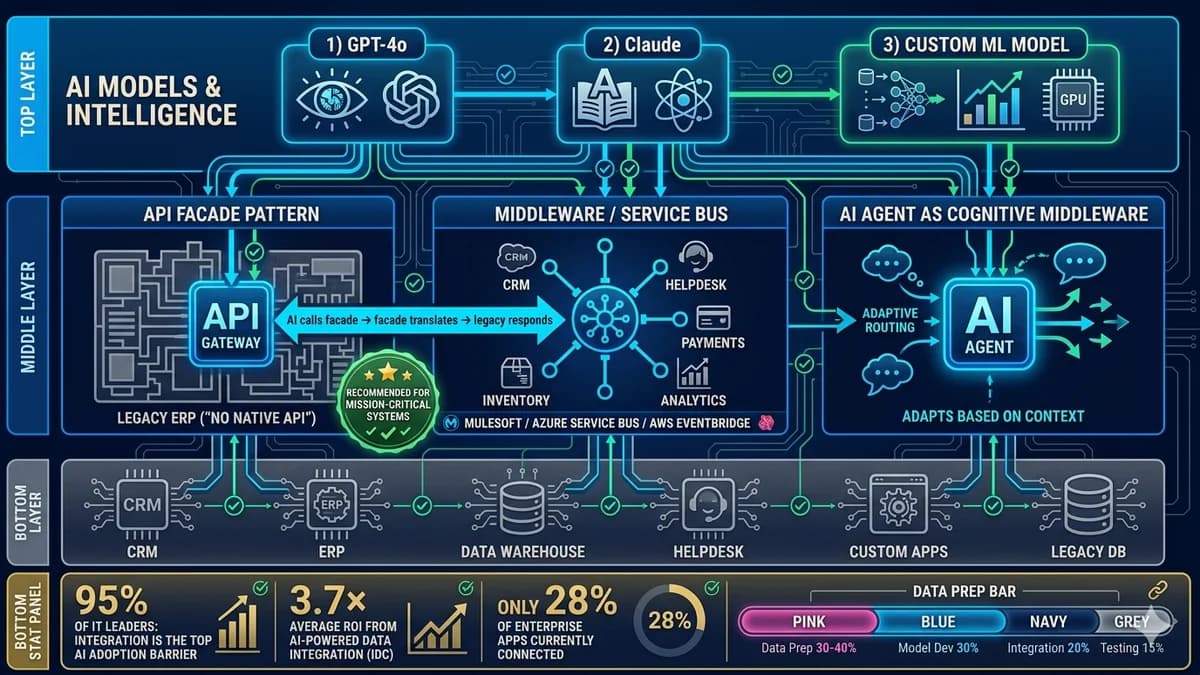
The Integration Gap — Why 95% of IT Leaders Are Blocked
Nine in ten organisations now use AI in at least one business function (McKinsey, 2025). Yet according to MuleSoft's Connectivity Benchmark Report, 95% of IT leaders cite integration issues as their primary AI adoption barrier — and only 28% of enterprise applications are effectively connected despite the majority of organisations running multiple AI models in production. The gap between AI capability and AI business impact is, in 2026, almost entirely an integration problem.
AI creates business value only when it can reach your data and act in your systems. A sophisticated language model running in isolation — unable to query your CRM, unable to update your order management system, unable to retrieve from your knowledge base — produces no operational ROI regardless of its intelligence. The companies extracting 10× ROI from AI are not running better models than the companies stuck at 2×. They have deeper, more complete integration connecting AI to every system where business value can be created.
This guide covers the three integration architectures, the five challenges that cause enterprise AI integration failures, the phased approach that avoids disruption, and the ROI benchmarks that justify the investment — for the CTO, engineering leader, or business owner evaluating AI integration services in 2026.
What AI Integration Services Actually Means
AI integration services are the technical expertise, methodologies, and implementation work required to connect AI capabilities to your existing enterprise systems — without replacing the systems that already work. This goes well beyond installing a plugin or adding an API key. It involves designing the integration layer (API facades, middleware, or AI agents), ensuring data compatibility and quality across connected systems, implementing security and compliance controls, and building sustainable bridges between modern AI models and infrastructure that may be decades old.
The distinction matters because most AI integration failures come from treating integration as the final step of an AI project rather than the foundational design decision. Teams build or select an AI model, deploy it, and then attempt to connect it to existing systems after the fact. The model's architecture, the data assumptions, and the output format are all locked before anyone has looked at what the connected systems actually require. The result is rework, brittle integrations, security gaps, and budgets that overrun by 60-80%.
Professional AI integration services work in the opposite sequence: systems assessment first, integration architecture design second, AI model selection and configuration third, phased deployment fourth. The integration layer determines what the AI can see and do. Getting it right at the start prevents every category of failure that emerges once a model is in production and connected systems are exposed to live load.
The Enterprise Systems AI Integrates With
Every meaningful AI integration connects to one or more of these operational systems. Understanding the characteristics of each — particularly the API availability, data format, and real-time access requirements — determines which integration architecture is appropriate and what the data preparation scope looks like before any model is deployed.
📊 CRM Systems
Customer records, interaction history, deal pipelines, contact data. AI integration enables personalised outreach, churn prediction, next-best-action recommendations, and automated lead scoring.
🏢 ERP Platforms
Inventory, procurement, financials, HR, supply chain. AI integration enables demand forecasting, anomaly detection, automated reporting, and process automation. Often the most complex integration due to legacy architecture.
🎫 Helpdesk and Support
Support tickets, customer conversations, knowledge base, SLA data. AI integration enables ticket triage and routing, automated resolution, agent assist, and CSAT prediction. High ROI, moderate integration complexity.
🗄️ Data Warehouses
Historical analytics data, aggregated business metrics, customer behaviour data. AI integration enables advanced predictive analytics, business intelligence automation, and real-time insight generation.
📦 Order and Commerce
Orders, inventory levels, shipping status, returns, product catalogue. AI integration enables intelligent chatbot resolution, demand forecasting, personalised recommendations, and automated fulfilment optimisation.
🏛️ Legacy Systems
Custom-built or decades-old systems without native APIs — mainframes, on-premise databases, proprietary platforms. Require API facade development or middleware before AI can connect. Highest integration complexity.
The 3 Integration Architectures — Choosing the Right Approach
Enterprise AI integration does not have a single universal pattern. The right architecture depends on system age, API availability, compliance requirements, and the operational risk tolerance of the organisation. Three primary approaches — and most production integrations use a combination of all three rather than picking one.
API Facade Pattern — Least Invasive
How it works
- A modern REST or GraphQL API wrapper is built on top of the legacy system
- The AI calls the facade — the facade calls the legacy system — results return to AI
- Legacy system core code is never modified — zero risk to existing functionality
- Authentication, rate limiting, and security are enforced at the facade layer
- New AI capabilities can be added without touching the underlying system
Best for
- Mission-critical systems that cannot tolerate downtime or regression risk
- Legacy ERP, mainframe, or custom platforms without native APIs
- Regulated industries requiring strict audit trails on system access
- Organisations with limited internal engineering capacity for legacy code changes
- First AI integration project — lower risk enables faster proof of value
Middleware and Service Bus — Multi-System Orchestration
How it works
- A dedicated integration platform (MuleSoft, Azure Service Bus, AWS EventBridge, SnapLogic) sits between AI models and business systems
- Handles protocol translation, data format conversion, authentication, and routing
- AI sends requests to the middleware layer — middleware routes to the correct system
- Events from business systems trigger AI actions in real time
- Central monitoring and observability across all AI system connections
Best for
- Organisations needing AI to work across 3+ existing systems simultaneously
- Real-time event-driven workflows (order placed → AI recommends → notification sent)
- Environments with heterogeneous data formats and protocols
- Enterprise programmes with multiple AI capabilities deployed in parallel
- When central governance, logging, and monitoring across all AI connections is required
AI Agent as Cognitive Middleware — Adaptive Intelligence
How it works
- An AI agent is deployed as the intelligent bridge between multiple enterprise systems
- Unlike rule-based middleware (fixed routing rules), the agent reasons about incoming data and determines the appropriate action across connected systems
- The agent can query multiple systems, synthesise information, and execute multi-step workflows autonomously
- Actions include: creating records, triggering workflows, sending communications, updating databases, and escalating to humans when thresholds are reached
Best for
- Complex workflows where the correct action depends on context across multiple data sources
- Customer service: agent queries CRM + order system + helpdesk and takes the contextually correct action
- Financial workflows: agent checks accounts, validates against rules, executes approved actions
- Operations where fixed middleware rules cannot handle the variability of real-world scenarios
- Organisations ready for the highest level of AI operational integration
Most enterprise AI integrations use the API facade pattern to expose legacy systems, middleware to orchestrate cross-system data flow, and AI agents to handle the intelligent decision-making that rule-based middleware cannot manage. Starting with Approach 1 (API facade) on one mission-critical system, then layering Approach 2 (middleware) for multi-system orchestration, then introducing Approach 3 (AI agents) for adaptive workflows — that sequence is how the highest-ROI enterprise AI deployments are actually built. Trying to start with Approach 3 directly almost always fails: agents cannot reason across systems they have no clean access to.
The Data Preparation Reality — 30-40% of Your Integration Budget
The most consistently underestimated cost in AI integration is data preparation — the work required to make your existing data usable by AI models before any model training or integration development begins. This is not optional and it cannot be compressed: AI models that receive poor-quality, inconsistent, or incomplete data produce poor-quality, inconsistent, or wrong outputs regardless of how sophisticated the model itself is.
The specific data challenges that drive up preparation costs in enterprise AI integration:
- Data silos without common identifiers. When a customer's data exists in your CRM (using customer ID format A), your helpdesk (account number format B), your billing system (email address as key), and your order system (order-based customer ID format C) — joining these records for a unified AI context requires significant data engineering before any AI model can be trained or deployed.
- Inconsistent data formats across legacy systems. Date formats, currency formats, address structures, status codes, and field naming conventions differ across every system in most enterprise environments. The middleware or integration layer must handle all these inconsistencies transparently before exposing unified data to AI models.
- Historical data that does not reflect current conditions. An AI model trained on 2022 customer data produces biased outputs for 2026 customers if product lines, pricing structures, customer demographics, or market conditions have changed significantly. Assessing temporal relevance of training data is a preparation step that affects model accuracy from day one.
- Missing or incomplete records. Most enterprise databases contain incomplete records — missing values, inconsistent entries, duplicate records, and outdated information accumulated over years of operation. Data cleaning and validation is required before AI models can consume this data without introducing systematic errors.
Any AI integration vendor that quotes a project cost before conducting a data quality assessment on your actual systems is not providing a reliable estimate. Legitimate AI integration services include a data readiness assessment as the first deliverable — before any architecture recommendation, before any model selection, before any project budget number. The data preparation scope is the variable that moves an AI integration from $40,000 to $200,000 on the same nominal use case. Any estimate produced without that information should be treated as a sales number, not an engineering number.
What does the data readiness picture look like across your existing systems — and how does it affect your actual AI integration scope and cost?
Automely starts every AI integration engagement with a systems and data assessment before any estimate. Free 45-minute session.
The 5 Challenges That Cause AI Integration Failures
These five challenges appear in nearly every enterprise AI integration that fails to reach production or that ships and underperforms its ROI projection. They are the predictable failure modes — and every one of them is preventable when identified in the systems assessment phase rather than discovered mid-build.
Legacy System Compatibility — 64% of Organisations Affected
Legacy infrastructure — mainframes, on-premise databases, custom-built systems from the 2000s and 2010s — was designed for batch processing and human-driven workflows, not real-time AI consumption. Many lack documented, accessible APIs. 64% of organisations report legacy system dependencies that consume 16+ hours of engineering time weekly just for maintenance. The solution is not replacement (expensive and disruptive) but API facade development: a modern access layer that exposes legacy functionality to AI systems without touching the core code. Organisations that modernise intelligently rather than aggressively — exposing what is needed, not rebuilding everything — are the ones that successfully scale AI across legacy ecosystems.
Data Quality and Governance — The Hidden Project Driver
Fragmented data sources, inconsistent data quality, limited real-time access, and absent data governance frameworks prevent AI models from producing reliable, trustworthy outputs. Organisations that skip data governance — defining what data AI can access, how it is validated, who is responsible for its accuracy, and how compliance requirements are met — face low trust in AI outputs, compliance exposure, and poor model performance that is blamed on model quality when the actual cause is data quality. Strong data engineering and governance are not optional components of AI integration. They are the foundational prerequisite.
Security and Compliance Requirements — Adding 20-40% to Integration Scope
Connecting AI to systems containing sensitive customer, financial, or health data introduces significant security and compliance obligations. Authentication and authorisation at every integration point, encryption of data in transit and at rest, data residency controls for GDPR and sovereign data requirements, audit trails for every AI system action, and compliance documentation for HIPAA, FCA, SOC 2, or ISO 27001 certifications — these requirements add 20-40% to AI integration scope for regulated industries. Integrations built without compliance architecture from the start require costly remediation. Build compliance in from day one, not retrofitted at deployment.
API Availability Gaps — Legacy Systems Without Native APIs
Many enterprise systems — particularly older ERP platforms, industry-specific software, and custom-built applications — do not expose documented, accessible REST APIs. Connecting AI to these systems requires one of three approaches: building an API facade (most common), using database-level integration (higher risk, requires careful governance), or deploying screen-scraping agents (fragile, maintenance-intensive). Each approach has a different cost profile and risk level. Identifying API availability gaps in the systems assessment phase prevents surprises that emerge mid-project when the integration team discovers the target system has no accessible API.
Organisational Resistance — The Non-Technical Barrier
The most technically elegant AI integration fails if the people who are expected to work alongside it do not trust or adopt it. Employees resist AI when they fear job displacement, distrust model outputs (especially when they have seen the model make mistakes), or feel AI is being imposed on workflows they have no input into. Deloitte (2026): the AI skills gap is the number one barrier cited, and the most common talent response — education rather than role redesign — suggests organisations are addressing symptoms rather than causes. Change management, role-specific training on working with AI outputs, transparent communication about what the AI does and does not decide, and early wins that demonstrate value without threatening jobs are the organisational prerequisites for integration success.
The Phased Approach — How to Integrate AI Without Disrupting Operations
The most reliable path to enterprise AI integration ROI is phased deployment: start with one high-impact, low-risk use case, validate business value, then expand. Big-bang AI transformation programmes that attempt to connect AI to every system simultaneously have lower success rates and higher disruption profiles than incremental programmes that prove value on a narrow scope first. This seven-phase sequence is how the AI integrations that ship and produce documented ROI are actually built.
Systems and Data Assessment
Map existing infrastructure: which systems exist, what APIs are available, what data they hold, what format it is in, and what data quality issues exist. This assessment determines the integration architecture, the data preparation scope, the compliance requirements, and the realistic project cost. Never skip this phase — it is the foundation that every subsequent decision rests on.
Define One High-Impact, Low-Risk Use Case
Select the first AI integration target based on: measurable business value (clear ROI metric), low operational risk (failure does not disrupt mission-critical workflows), reasonable integration complexity (2-3 systems, available APIs), and sufficient data quality (or manageable data preparation scope). Customer service ticket triage, demand forecasting on clean warehouse data, and lead scoring from CRM data are common first integrations — all produce measurable results within weeks of deployment.
Integration Architecture and Data Pipeline Design
Design the integration layer (API facade, middleware, or AI agent architecture based on assessment findings), build the data pipeline from source systems to AI model, implement authentication and security controls, and establish data governance policies. This phase creates the technical foundation that all AI capabilities will build on — investing in a clean, scalable architecture here pays dividends on every subsequent integration.
Data Preparation and Model Configuration
Clean, normalise, and validate data from connected systems. Build training datasets if custom model training is required. Configure pre-trained models (LLMs, prediction models) with your specific context, constraints, and output requirements. Validate model outputs against historical ground truth. This phase takes the time it takes — attempts to compress it produce models that fail in production.
Pilot Deployment — Shadow Mode First
Deploy the AI integration in shadow mode: the AI runs in parallel with the existing workflow, produces outputs, but those outputs are reviewed by humans before any action is taken. This validates real-world performance against live data before the AI takes operational responsibility. Shadow mode deployment is how you build organisational trust — teams can see the AI work, spot edge cases, and refine before go-live.
Production Rollout and Monitoring Setup
Gradual traffic rollout — starting with 10-20% of real operational volume — while monitoring AI output quality, system performance, and integration stability. Full rollout after validation at partial volume. Monitoring infrastructure includes: model output accuracy tracking, integration health dashboards, data pipeline observability, and alerting for anomalies or accuracy drops that trigger human review.
Measure, Validate, Expand
Measure ROI against the baseline established before deployment. Validate business impact against the use case success criteria defined in Phase 2. Use validated results to build the business case for the next integration use case. The compounding value of AI integration — where each new capability builds on the integration infrastructure established for the last one — accelerates ROI on every subsequent phase.
ROI Benchmarks — What Successful AI Integration Delivers
AI integration ROI is well documented across analyst research and enterprise case studies. The pattern is consistent: focused, well-integrated AI on a single high-value use case produces positive ROI within 6 months; enterprise integration programmes that connect AI across multiple operational systems compound to 3-10× ROI over the first 12-18 months. The numbers below are documented benchmarks — not vendor projections.
| Integration Type | Cost Range | Documented ROI Outcome | Payback Period |
|---|---|---|---|
| AI-Powered Data Integration (average) | $50K-$200K | 3.7× average ROI (IDC). Top performers: 10.3× through mature integration capabilities | 6-12 months |
| Integration Platform (Azure Integration Services) | Platform fee + implementation | 295% ROI over 3 years. $2.4M developer productivity. $3.2M incremental revenue. $654K cost reductions | 6 months |
| Customer Service AI Integration (helpdesk + CRM) | $30K-$120K | 80% autonomous query handling (ServiceNow). $325M annualised value at enterprise scale | 4-8 months |
| AI-Integrated Fraud Detection (financial systems) | $80K-$250K | 60% false positive reduction. $2M+ annual fraud prevented. ROI recouped in under 6 months | Under 6 months |
| Demand Forecasting Integration (ERP + analytics) | $40K-$150K | 15% inventory cost reduction. 10× ROI year 1 optimising stock across 200 locations | 4-8 months |
| AI Agent as Cognitive Middleware (multi-system) | $50K-$300K | Klarna: 700 agent equivalents, $40M profit improvement. Vodafone: 70% cost reduction per interaction | 6-18 months |
| Simple process automation (single system) | $20K-$80K | Focused use cases achieve positive ROI within 6 months. Deloitte: 66% of enterprises report efficiency gains | 3-6 months |
The consistent finding across Forrester, IDC, McKinsey, and Deloitte data: AI running in isolation produces minimal business impact regardless of model quality. AI deeply integrated into operational systems — where it accesses live data, acts on connected systems, and automates real workflows — produces the compounding ROI that justifies the investment. Integration depth, not model sophistication, is the primary determinant of enterprise AI ROI. Companies that achieve 10× ROI on AI are not using better models than companies achieving 2× — they have better integration.
AI Integration Services from Automely
Automely's AI integration services connect AI capabilities to existing CRM, ERP, helpdesk, data warehouse, e-commerce, and custom legacy systems for clients across the US, UK, and EU. Our integration work covers all three architectural approaches: API facade development for legacy systems without native APIs, middleware architecture using modern integration platforms, and AI agent deployment as cognitive middleware for complex multi-system workflows.
Every Automely AI integration engagement starts with a systems and data assessment — mapping existing infrastructure, API availability, data quality, and compliance requirements — before any integration architecture is recommended or any project cost is estimated. This is not a preliminary formality: the assessment determines whether your integration requires $40,000 or $200,000 in data preparation work, and that variable changes every other line in the project budget. Skipping it is the most expensive mistake in AI integration.
Reference: Cerebra Caribbean — AI chat and voice agent integrated with Caribbean SMB operational systems, 10,000+ autonomous interactions, 95% CSAT. For AI agents as the integration and operational intelligence layer, see our AI agent guide and AI agent development service. For enterprise-scale AI integration programmes across multiple functions, see our enterprise AI solutions guide and the broader AI integration with your existing software stack playbook.
Automely builds AI integration systems — CRM/ERP API connectors, middleware layers, no-disruption deployment patterns, legacy system bridges, custom integration adapters, and webhook-based AI workflows. AI integration projects start from $20,000. Book a free 45-minute consultation at cal.com/Automely.ai/45min.
Browse our case studies, read client testimonials, and explore our full AI services portfolio including AI integration, AI agent development, and enterprise AI solutions.
Ready to get your AI integration scoped with a systems assessment, architecture recommendation, and transparent cost estimate — before any development commitment?
Book a free 45-minute AI integration strategy session. Systems assessment, architecture design, and cost estimate in one call.