


What Machine Learning Development Services Actually Covers
Most businesses that commission machine learning development for the first time expect the process to resemble commissioning standard software development — requirements in, working system out. It does not. Machine learning projects have two distinct cost and complexity layers that conventional software projects do not: the data infrastructure layer and the model development layer. Both sit underneath the application layer that users ultimately see. And before either is built, your data has to be assessed.
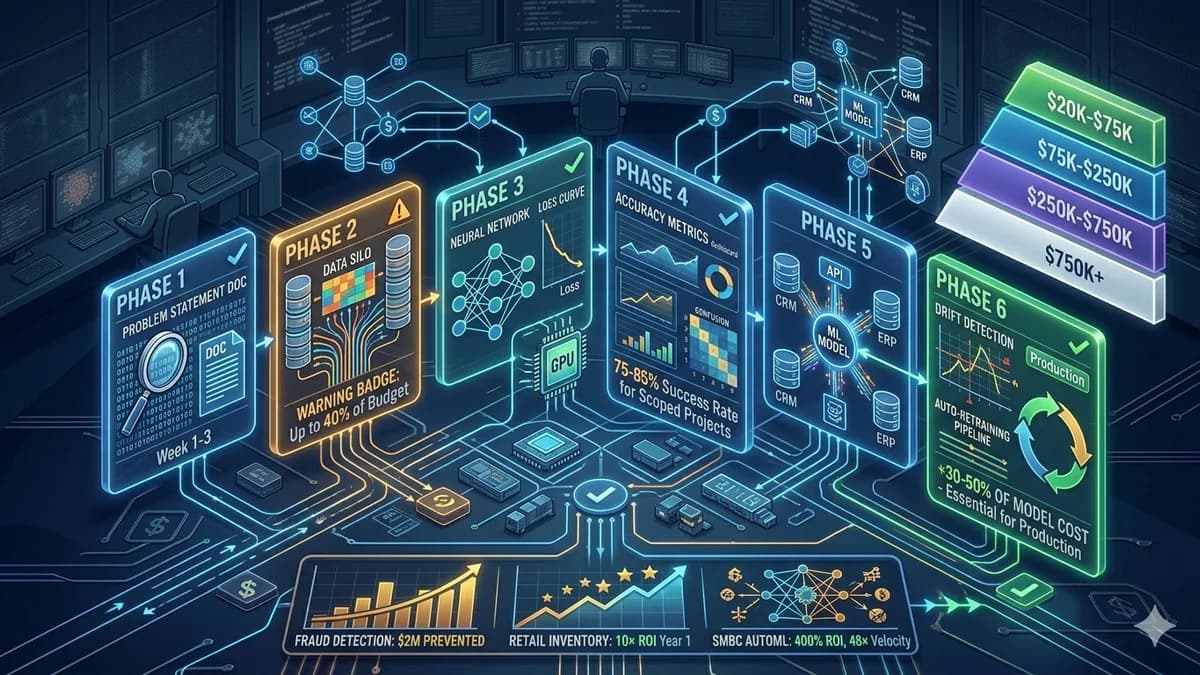
This is not a warning about ML complexity. It is preparation for the specific way an experienced ML development partner approaches a commission — and the specific questions they will ask before scoping any project. Understanding these upfront prevents the most expensive mistake in ML development: committing a full production budget before the data readiness is known. Up to 40% of an ML project budget goes to data preparation when data is unstructured, siloed, or unlabelled. That percentage is assessed in week one of any serious ML engagement — before model development begins.
Machine learning development services covers six primary application types, six development phases, four cost tiers, and an ongoing production infrastructure (MLOps) that adds 30-50% to model development cost but is what separates an ML model that works in a test environment from one that remains accurate in production. This guide explains all of them — for the business owner or CTO commissioning their first ML project or evaluating ML development partners for an established programme.
The 6 Primary ML Application Types — What Each Does and Where ROI Is Proven
The six ML application types below cover the overwhelming majority of production ML deployments. Each maps to a distinct class of business problem, a different data requirement, and a different cost band. Identify which one matches your use case before any vendor conversation — the application type drives the algorithm choice, the data preparation effort, and ultimately the tier your project belongs in.
📈 Predictive Analytics
Forecasting future outcomes from historical patterns — churn prediction, demand forecasting, lead scoring, credit risk, revenue projection. The most accessible ML application type: structured data, proven algorithms, measurable business outcomes.
🛡️ Anomaly Detection
Identifying unusual patterns in real-time data streams — fraud detection, network intrusion, equipment failure prediction, quality control. Particularly high ROI because ML-detected anomalies are caught earlier and at lower cost than manually-detected ones.
💬 Natural Language Processing (NLP)
Extracting meaning from text — sentiment analysis on customer reviews, document classification, entity extraction, contract analysis, automated summarisation, customer inquiry categorisation. Cost: $25K-$80K for NLP solutions.
👁️ Computer Vision
Analysing images and video — product quality control, medical imaging, retail shelf analytics, construction site monitoring, automated inspection. Requires labelled image datasets and GPU compute — the highest-cost ML type.
🎯 Recommendation Engines
Personalising content, product, or action recommendations based on user behaviour and similarity patterns — eCommerce, SaaS features, content platforms, search ranking. Requires user behaviour data and ongoing A/B testing infrastructure.
📊 Time Series Forecasting
Predicting time-dependent values — energy demand, inventory levels, financial time series, capacity planning, traffic forecasting. Combines ML with domain-specific signal engineering for highest accuracy on temporal data.
The 6 Phases of a Machine Learning Project — What Actually Happens
Understanding the ML project lifecycle prepares you for the vendor conversations, milestone reviews, and deliverable expectations that distinguish a well-run ML engagement from an expensive one. Each phase has specific inputs, outputs, and decision points that your team is expected to participate in — particularly Phase 1 (problem definition) and Phase 2 (data assessment), where the accuracy of the project scope and cost estimate is established.
Discovery and Problem Definition
What happens
- Business problem translated into a specific ML problem statement
- Success metric definition (accuracy threshold, false positive tolerance, revenue target)
- Data inventory: what data exists, where it lives, access mechanisms
- Initial feasibility assessment: is this problem solvable with available data?
- PoC scope definition and cost estimate
What you deliver
- Business requirements and operational context
- Access to relevant data systems for initial assessment
- Success criteria: what does good look like for your business?
- Stakeholder sign-off on problem framing before any development begins
Data Assessment and Preparation
What happens
- Data quality audit: completeness, consistency, accuracy, recency
- Missing value analysis and imputation strategy
- Data cleaning and normalisation
- Feature engineering: constructing ML-useful variables from raw data
- Data labelling (for supervised learning) if ground truth is missing
- Automated data pipeline construction for ongoing model training
Why it takes this long
- Raw business data is rarely ML-ready out of the box
- Messy or siloed data requires manual inspection and domain expertise
- Data labelling (classification labels, outcome annotations) is time-intensive
- This phase determines whether the original scope and cost estimate holds
Model Development and Training
What happens
- Algorithm selection based on problem type, data characteristics, and accuracy requirements
- Initial model training on prepared dataset
- Hyperparameter optimisation to maximise performance
- Cross-validation to estimate real-world performance on unseen data
- Baseline model comparison against simpler heuristics
What you receive
- Trained model with documented performance metrics
- Algorithm selection rationale and alternatives considered
- Performance against success criteria defined in Phase 1
- Go/no-go recommendation for production deployment
Evaluation and Validation
What happens
- Model performance tested on holdout data not seen during training
- Bias and fairness testing where applicable (hiring AI, credit scoring)
- Business metric translation: does accuracy threshold map to business value?
- Acceptance testing against production-equivalent data samples
Why this phase exists
- Training performance and real-world performance often differ significantly
- Regulated industries require documented validation evidence
- Business stakeholders need confidence before production rollout
- Phase 4 is when scope changes become most expensive — budget for iteration
Integration and Deployment
What happens
- ML model wrapped in REST API for consumption by existing systems
- Integration with existing data pipelines, CRM, ERP, or application layer
- Shadow mode deployment: model runs in parallel with current system, predictions logged but not acted on
- Gradual rollout and canary testing before full production switch
Common complexity sources
- Legacy system integration requires custom middleware and data format mapping
- Real-time inference requirements demand different infrastructure than batch ML
- Latency requirements (milliseconds for fraud detection vs minutes for demand forecasting)
- Cloud infrastructure: SageMaker, Azure ML, Vertex AI add 20-40% cost premium
MLOps — Monitoring and Production Maintenance
What MLOps covers
- Real-time model performance monitoring against production baseline
- Data drift detection (when real-world data diverges from training distribution)
- Automated retraining pipelines when drift triggers quality thresholds
- Model version control and rollback capability
- A/B testing infrastructure for model improvements
- Governance documentation for regulated industries
Why it is non-negotiable
- Without drift monitoring, ML models degrade to unusable accuracy within 6-18 months
- A model trained on 2023 customer behaviour produces wrong predictions by 2025
- Production failures without rollback capability mean manual fallback to pre-ML processes
- Regulated industries require documented model performance records
Data Readiness — The Variable That Determines Your Budget
Data quality is the single most important variable in any ML project — and the one most consistently underestimated at commissioning. When a vendor quotes an ML project without first assessing your actual data, their estimate is not reliable. The cost range difference between a client with clean, accessible, well-structured data and a client with fragmented legacy data across five systems is often $40,000-$100,000 on the same ML application type.
The specific data challenges that extend timelines and budgets:
- Unstructured data requiring extraction. Customer emails, PDF contracts, support tickets, and handwritten forms are valuable ML training data — but they require NLP preprocessing and structured extraction before they can be used as model inputs. Each unstructured data source adds 2-4 weeks to Phase 2.
- Data siloed across multiple systems without a common identifier. If your customer churn model needs data from your CRM, your billing system, your support helpdesk, and your product analytics — and these four systems have different customer ID formats — building the join layer is a significant data engineering project that typically happens before any ML work begins.
- Class imbalance. Fraud detection, rare disease diagnosis, and equipment failure prediction all suffer from severe class imbalance — 99% of transactions are legitimate, 99% of patients do not have the condition, 99% of equipment runs normally. Naive ML models learn to predict the majority class and appear accurate while being useless. Handling class imbalance requires specialised training techniques and adds cost.
- Missing or incomplete labels. For supervised ML (where the model learns from labelled examples), you need labelled historical data. If your historical outcomes were never recorded, are inconsistently recorded, or require expert annotation, the labelling effort adds cost and timeline proportional to dataset size and annotation complexity.
- Data that does not represent current conditions. A model trained on 2019-2022 customer behaviour produces biased predictions for 2026 customers if buying patterns, demographics, or competitive dynamics shifted significantly. Assessing temporal relevance of training data is a specific data assessment step.
If a machine learning development company quotes you a project cost before conducting a data assessment, treat that quote as a placeholder. Every legitimate ML development partner conducts a data readiness assessment in week one — reviewing actual data sources, quality, volume, and labelling status — and revises the project scope and cost estimate based on what they find. A quote without data assessment is a guess.
The 4-Tier Machine Learning Development Cost Table
The four tiers below map the machine learning development cost landscape in 2026 — from focused PoC engagements through to organisation-wide enterprise ML programmes. Each tier comes with a price band, a build timeline, a delivery scope, and the use cases the tier is designed to serve. Match your use case to the right tier before any vendor conversation.
Which ML tier fits your specific use case and data readiness? And what does your data assessment reveal about actual project cost?
Automely scopes ML projects with a data readiness assessment before any cost estimate. Free 45-minute ML strategy session.
MLOps — Why It Adds 30-50% and Why Skipping It Fails
MLOps (Machine Learning Operations) is the engineering discipline that takes a working ML model and makes it reliable, maintainable, and accurate in production over time. It is consistently the most underestimated cost category in first-time ML commissions — and consistently the failure mode of ML projects that hit technical metrics but fail to deliver business value after 12 months.
Model Performance Monitoring
Real-time tracking of model accuracy, precision, recall, and business-specific metrics against the production baseline. Alerts when performance drops below defined thresholds — the early warning system that prevents silent model failures.
Data Drift Detection
Monitoring the statistical distribution of incoming data against the training distribution. When real-world data diverges from training data (because customer behaviour shifts, economic conditions change, or product offerings evolve), model accuracy degrades. Drift detection identifies this before the business impact is felt.
Automated Retraining Pipelines
Rebuilding the model on fresh data when drift is detected or on a scheduled cadence. Manual retraining requires data science time every cycle. Automated pipelines trigger retraining, validate the new model, and deploy it without manual intervention — or escalate to human review when validation fails.
Model Versioning and Rollback
Version control for ML models — the ability to track which model version is in production, compare performance across versions, and roll back to a prior version if a new model underperforms in production. Without this, a failed model update requires emergency data science work to revert.
A/B Testing Infrastructure
Routing a percentage of production traffic to a new model version while the current version handles the rest — comparing business outcomes before full rollout. This is how production-grade ML teams validate improvements without risking full production accuracy degradation.
Model Governance and Audit Trails
Documenting training data lineage, model validation results, deployment decisions, and performance history for regulatory compliance. In financial services, healthcare, and insurance, the audit trail for ML model decisions is a legal requirement, not an optional feature.
A fraud detection model trained in January 2025 and deployed without drift monitoring produces degrading results by late 2025 as fraud patterns evolve. A demand forecasting model trained on pre-2024 supply chain data produces increasingly inaccurate forecasts as supplier lead times, consumer behaviour, and channel mix change. Without automated retraining, these models require expensive data science intervention every time accuracy degrades — which, in dynamic business environments, is every 6-12 months. MLOps converts this from a recurring emergency into a managed, automated process. The 30-50% MLOps cost addition pays back through the avoided cost of emergency model remediation and the sustained business value of an ML system that remains accurate over its operational life.
ML ROI by Application Type — Documented Business Outcomes
The ROI table below maps each ML application type to its typical cost tier, the documented production outcome, and a realistic time-to-ROI band. Use these benchmarks to sanity-check the projection any ML development partner delivers — and to identify the application type that delivers the fastest payback on your specific business context.
| ML Application | Typical Cost Tier | Documented Business Outcome | Time to ROI |
|---|---|---|---|
| Fraud Detection (Anomaly Detection) | Tier 2 | 60% reduction in false positives; $2M+ annual fraud losses prevented; ROI recouped under 6 months | Under 6 months |
| Demand / Inventory Forecasting | Tier 1-2 | 15% inventory cost reduction; 10× ROI year 1 optimising stock across 200 locations; 87% forecast accuracy | 4-8 months |
| Customer Churn Prediction | Tier 1-2 | Proactive intervention on high-probability churners; 15-25% churn rate reduction typical; measurable within 4-8 weeks go-live | 4-8 weeks |
| AutoML / ML Platform (Enterprise) | Tier 3-4 | SMBC: 400% ROI, 48× model development acceleration, 100+ models/year vs 2-5 previously | 6-18 months |
| Document Classification / NLP | Tier 1-2 | 70-80% reduction in manual document review time; contract analysis: 85% faster due diligence | 3-6 months |
| Recommendation Engine | Tier 2 | 10-30% increase in average order value; measurable uplift in click-through rate and session depth | 6-12 months |
| Predictive Maintenance | Tier 2 | 45% reduction in unplanned downtime; 25% maintenance cost reduction; avoided production line shutdowns | 6-12 months |
| Computer Vision QA | Tier 2-3 | 15-30% defect detection improvement vs manual inspection; significant reduction in QA labour cost | 6-18 months |
The 5-Question Scope Test — Before You Talk to Any ML Development Company
The five questions below map your specific business situation to the readiness, scope, and tier your ML project actually needs. Answer them honestly — they are the same questions a serious ML development partner will ask before providing any cost estimate, and answering them yourself first calibrates the vendor conversations that follow.
Can you define a specific, measurable business problem that ML could solve?
"We want to use AI" is not a problem statement. "We want to predict which of our 50,000 customers are likely to churn in the next 90 days so we can trigger targeted retention campaigns" is a problem statement. The specific outcome, the prediction horizon, the action to be taken, and the success metric (what churn rate reduction makes this worthwhile?) — these need to be defined before any ML development begins. If you cannot define these, start with a discovery workshop, not a development contract.
Do you have historical outcome data that reflects the thing you want to predict?
Supervised ML — the most common approach for business prediction problems — learns from labelled historical examples. To predict churn, you need historical records of customers who churned and customers who did not. To detect fraud, you need labelled transactions. If this historical data does not exist, is incomplete, or is inconsistently labelled, Phase 2 (data preparation) costs more and the achievable model accuracy is lower. Assess this before scoping your project.
Where does your data live and is it accessible?
The most expensive data architecture for ML is data spread across multiple systems without a common identifier and accessible only through manual export. Modern data warehouses (Snowflake, BigQuery, Redshift) with clean schemas and documented entity relationships make Phase 2 dramatically faster. Legacy databases with undocumented schemas, inconsistent data entry, and no centralised query layer make it dramatically slower. Your answer to this question is the primary input to any data readiness assessment.
What happens in your existing process for the use case ML would automate or augment?
ML development partners need to understand the current state — what decisions are being made, by whom, with what information, at what frequency, and with what downstream actions triggered. This operational context determines the integration requirements (Phase 5), the latency requirements (real-time fraud detection vs nightly demand forecasting), and the human-in-the-loop design (where ML augments rather than replaces human judgment for high-stakes decisions).
What accuracy threshold makes this ML investment worthwhile — and who owns the model after deployment?
Defining a success threshold before development is the single most important governance question in ML commissioning. If 75% prediction accuracy is enough to deliver business value, scoping toward 95% accuracy quadruples the development cost and timeline unnecessarily. If 95% is genuinely required (medical diagnosis, financial compliance), build that into the PoC scope and success criteria. Also: after the ML partner deploys the model, who maintains it? Does the partner provide ongoing MLOps, or does your internal team take over? The ongoing maintenance model should be defined at commissioning — not at go-live.
Machine Learning Development Services from Automely
Automely's machine learning development services cover all six primary ML application types — predictive analytics, anomaly detection, NLP, computer vision, recommendation engines, and time series forecasting — across Tier 1 PoC through Tier 3 multi-model platform engagements.
Every Automely ML engagement follows the same first-week protocol: data readiness assessment before project scoping. We review your actual data sources, query the data quality indicators, assess labelling availability, and map the integration architecture before providing a cost estimate. This is not a delay — it is what prevents the budget overruns and timeline failures that make ML projects expensive learning experiences rather than business investments.
We build full MLOps infrastructure into every production ML deployment — not as an optional add-on, but as a standard component of any ML system we ship to production. Drift monitoring, automated retraining pipelines, version control, and rollback capability are included in Tier 2+ scopes because they are what separates ML models that work for 18+ months from models that require expensive emergency remediation at the 12-month mark.
For the broader context of AI and generative AI alongside machine learning, see our generative AI development services guide. For the model-creation companion when your team is evaluating no-code through to custom paths, see how to create an AI model for your business. For the end-to-end development process around the ML layer, see how to develop AI software.
Automely builds production ML systems — predictive models, classification, recommendation engines, computer vision, NLP, MLOps pipelines, model monitoring, and data engineering. ML projects start from $15,000. Book a free 45-minute consultation at cal.com/Automely.ai/45min.
Browse our case studies, read client testimonials, and explore our full AI services portfolio including AI agent development, generative AI development, and enterprise AI solutions.
Ready to scope your ML project with a data readiness assessment, tier identification, and honest cost estimate — before any development commitment?
Book a free 45-minute ML strategy session. Data assessment, use case scoping, and cost estimate — with the accuracy that comes from reviewing actual data before quoting.