


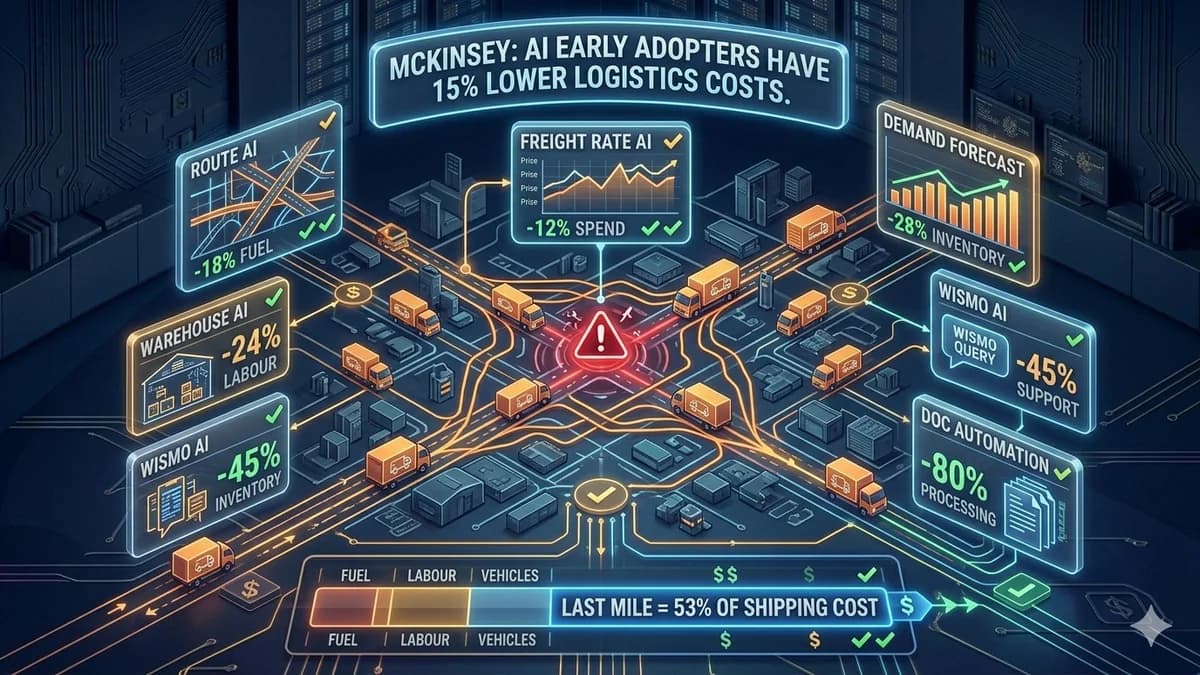
McKinsey research shows that AI early adopters in logistics have 15% lower logistics costs than their lagging competitors, with 35% improvement in inventory levels. A 2024 survey by Zogby Strategies found that 97% of manufacturing CEOs plan to use AI in operations within two years. Yet the number of logistics operations that have actually deployed AI across more than one function remains a fraction of those that say they intend to. The gap between intent and deployment is the competitive opportunity for logistics companies that move now.
This guide covers the six AI systems cutting the most cost in logistics operations in 2026 — route optimisation, freight rate AI, demand forecasting, warehouse automation, WISMO reduction, and freight document automation — with the specific ROI ranges, the data prerequisites, and the implementation sequence for a first-time logistics AI deployment. The question is not whether AI can reduce your logistics costs. The McKinsey and Oracle data answers that definitively. The question is where your cost structure makes the first AI investment generate the fastest return.
Where Logistics Costs Actually Live — The Case for Starting With Last Mile
Before selecting which AI use case to implement first, understand where your logistics cost actually lives. The cost structure of most freight and delivery operations follows the same approximate pattern, and the AI use case with the highest ROI is directly determined by which cost bucket is largest relative to the margin available to attack it.
Last-mile delivery's 53% share of total shipping cost is the most cited statistic in logistics — and the most important one for AI investment prioritisation. It is expensive for a fundamental reason: it is the most variable, most complex, and most labour-intensive segment of the delivery chain. Every delivery involves a different location, different access conditions, different customer behaviour, different traffic patterns, and a different time window. AI addresses this variability at every dimension — optimising the route, predicting the time window, rescheduling failures before they cost a second attempt, and communicating accurately with the customer throughout.
Start with the highest-cost operational problem that has an AI solution with a measurable baseline. For most delivery operations: route optimisation (fuel + overtime) or WISMO automation (customer service cost + failed delivery reattempts). For freight forwarders and 3PLs: freight rate optimisation. For distribution centres and warehouses: slotting and pick path AI. The sequence is determined by your cost structure, not by which AI system is most technically impressive.
The 6 AI Systems Cutting Logistics Costs in 2026
Logistics AI in 2026 spans six distinct system categories, each attacking a specific line item in the logistics P&L — fuel and overtime, freight spend, inventory carrying cost, warehouse labour, customer service overhead, and document processing. The systems are independently deployable, and most operations sequence them based on where their current cost gap is largest — starting with the system whose target cost consumes the largest share of revenue, then layering subsequent systems as data infrastructure and operational team trust in AI outputs mature.
🗺️ AI Route Optimisation
AI route optimisation calculates the optimal sequence and path for every delivery vehicle's daily route simultaneously, incorporating constraints that static planning software handles poorly: customer time windows, vehicle capacity and load configuration, driver hours of service regulations, real-time traffic conditions, weather, fuel cost by route, and the cost of failed delivery attempts at different stop positions. The AI does not plan routes once in the morning and fix them — it continuously recalculates as conditions change, rerouting around accidents, adding urgent deliveries to the nearest available driver, and adapting the sequence when a delivery takes longer than planned.
The financial impact compounds across fleet size. A 100-vehicle fleet with AI route optimisation that achieves 15% fuel savings at $0.40/km fuel cost over 200 daily kilometres per vehicle generates $1.2M in annual fuel savings alone — before driver overtime reduction, failed delivery cost reduction, and vehicle wear reduction are counted. For delivery-intensive operations, route optimisation AI is almost always the highest-ROI first AI investment.
- Daily route generation across full fleet simultaneously
- Real-time rerouting when traffic, accidents, or conditions change
- Driver-delivery matching based on skill, vehicle, and geographic efficiency
- Failed delivery prediction and proactive rescheduling
- Customer ETA updates pushed automatically when route changes
💰 AI Freight Rate and Carrier Selection
AI freight rate systems monitor real-time rates across carriers and lanes, compare spot rates against contract rates for each shipment, select the optimal carrier based on rate, transit time, and reliability score, and identify procurement timing opportunities when spot rates for predictable lanes dip below historical averages. For businesses shipping significant freight volume, this AI layer operates above the TMS — making carrier selection decisions dynamically rather than routing every shipment to contracted carriers regardless of current rate conditions.
AI also identifies rate anomalies that manual procurement teams miss — carriers whose rates have been consistently above market for specific lane-weight combinations, or seasonal rate patterns that allow forward booking at below-average spot rates. For freight-intensive operations (3PLs, e-commerce distribution, manufacturing logistics), AI freight rate optimisation typically generates 5–15% freight spend reduction without any change to service levels or volume.
- Real-time rate comparison across carrier panel for each shipment
- Contract vs spot rate analysis and routing decision
- Carrier reliability scoring integrated with rate selection
- Procurement timing signals for predictable freight lanes
- Rate anomaly alerts to procurement team
📊 AI Demand Forecasting and Inventory Optimisation
Logistics operations that hold inventory — distribution centres, 3PLs, fulfilment operations — carry significant working capital in safety stock that exists to buffer against forecast inaccuracy. AI demand forecasting reduces forecast error by analysing more signals more accurately than statistical models: historical sales patterns, seasonal variation, promotional calendars, local events, weather, economic indicators, and competitor activity. More accurate forecasts mean holding less safety stock while maintaining the same fill rate — reducing the working capital tied up in inventory while also reducing the storage, handling, and inventory loss costs associated with excess stock.
McKinsey's finding that AI early adopters in logistics see 35% improvement in inventory levels represents the compounding value of this accuracy improvement — less overstock and fewer stockouts simultaneously, which is the optimal inventory state that statistical forecasting methods consistently fail to achieve across large SKU portfolios and complex distribution networks.
- Multi-signal demand forecast by SKU by location
- Safety stock optimisation across distribution network
- Reorder point calculation with service level guarantees
- Seasonal and promotional demand uplift integration
- Supplier lead time risk modelling
🏭 AI Warehouse Automation
Warehouse labour is the largest variable cost in a distribution centre — and most of it is travel time, not pick time. A picker in a poorly slotted warehouse can spend 60–70% of their productive time walking between pick locations. AI slotting optimisation determines the optimal physical location for each SKU based on pick frequency, weight, co-pick patterns (which items are consistently ordered together), and seasonal demand rotation — reducing picker travel time 15–25% without any change in picker speed or effort.
For operations ready for physical automation, AI-coordinated autonomous mobile robots (AMRs) bring goods to picker stations rather than sending pickers to goods — achieving pick rates 2–4× higher than manual picking while reducing floor injury rates and fatigue-driven error rates. AI also optimises labour scheduling by forecasting daily order volume and matching staffing levels to actual demand, reducing overtime costs and temporary labour fees for operations where demand is variable but predictable.
- Dynamic SKU slotting optimisation based on pick patterns
- Pick path optimisation for each order or wave batch
- AMR fleet coordination for goods-to-person picking
- Labour demand forecasting and shift optimisation
- Inbound dock scheduling to minimise yard congestion
📞 WISMO Automation and Delivery Notification AI
"Where Is My Order" (WISMO) queries account for 40–70% of total inbound customer service contacts for delivery-dependent businesses. Each human-handled WISMO call costs $3–8 in agent time. At 500 calls per day, that is $550,000–$1,460,000 per year in customer service cost for a question that AI can answer in seconds. AI WISMO systems integrate with your OMS, TMS, and driver tracking to provide real-time shipment status answers — via chatbot, SMS, email, and voice — without human agent involvement.
The compounding benefit is in failed delivery reduction. An AI-driven delivery notification system that sends accurate ETAs with 2-hour windows, prompts customers to confirm receipt availability or reschedule before the attempt, and offers self-service rescheduling eliminates a significant fraction of the failed deliveries that trigger the most expensive WISMO follow-up calls. Oracle's research confirms that accurate AI-generated ETAs improve customer satisfaction significantly — and reduce the repeat inquiry calls that occur when initial ETAs prove inaccurate.
- Real-time order status queries across all channels (chat, SMS, email, voice)
- Proactive ETA notifications pushed before customers need to call
- Delivery confirmation or rescheduling prompts sent 24 hours before attempt
- Failed delivery analysis — which routes, drivers, and time windows have highest failure rates
- Carrier disruption alerts to customers when delays are detected
📄 Freight Document Automation
Freight operations generate enormous document volumes — bills of lading, customs declarations, proof of delivery, freight invoices, carrier contracts, packing lists, certificates of origin, and inspection reports. Manual document processing is slow, error-prone, and expensive: a single customs error on a cross-border shipment can result in significant delays and financial penalties. AI freight document automation extracts data from incoming documents regardless of format or carrier template, validates against the shipment record, flags discrepancies for human review, and routes clean documents for automatic processing.
For international freight operations, AI customs document preparation — generating accurate, consistent customs declarations from shipment data — reduces both the time required and the error rate that triggers customs holds. For domestic operations, AI proof-of-delivery processing captures and validates delivery confirmation from driver apps, customer signatures, and photo verification — eliminating the manual review step that delays invoice generation. Operations that implement freight document AI consistently report 70–85% reduction in document processing time and significant reduction in invoice disputes and customs delay costs.
- Multi-format document ingestion and data extraction (PDF, image, EDI)
- Shipment record validation and discrepancy flagging
- Customs declaration generation from shipment data
- Freight invoice validation against contracted rates
- POD capture and verification, triggering automated invoicing
Which of these 6 AI systems attacks your highest logistics cost first?
Automely's logistics AI assessment identifies your highest-ROI first implementation based on your cost structure and data readiness. Book a free 45-minute call.
ROI Summary — All 6 Systems in One View
Logistics AI ROI varies sharply by use case, by data readiness, and by the baseline cost of the operational problem the use case targets. The table below summarises the typical ROI range and timeline to first impact for each of the six logistics AI systems. Use it to triage your candidate use cases before scoping any single implementation in detail.
| AI System | Targets | ROI Range | Timeline to First Impact |
|---|---|---|---|
| Route Optimisation | Fuel, driver overtime, vehicle wear, failed delivery | −10–20% fuel cost · −15–25% overtime | 30–60 days post-deployment |
| Freight Rate AI | Carrier spend, procurement efficiency, contract compliance | −5–15% freight spend | First billing cycle post-deployment |
| Demand Forecasting | Safety stock, working capital, stockout cost, overstock | −15–35% inventory cost | 90–120 days (requires seasonal cycle data) |
| Warehouse Automation | Labour cost, pick rate, overtime, injury rate | −20–30% warehouse labour | 60–90 days post-deployment |
| WISMO Automation | Customer service cost, failed delivery rate, CSAT | −30–50% WISMO cost | 7–14 days post-deployment |
| Document Automation | Processing time, error cost, invoice disputes | −70–85% processing time | 30–45 days post-deployment |
Data Prerequisites — What Must Exist Before Each AI Can Work
Each logistics AI system depends on a specific set of data foundations. Without each of these in clean, complete, accessible form, the AI's performance will fall significantly short of its potential — and the project timeline will overrun while the data layer is rebuilt mid-implementation. Assess the prerequisites below for your chosen first use case before committing to any scope or timeline.
🗺️ Route Optimisation AI
- Geocoded delivery addresses with time window data
- Vehicle fleet data (capacity, fuel type, driver assignment)
- Driver hours of service compliance rules
- Real-time GPS tracking feed from fleet
- Historical delivery success/failure data by address and time
💰 Freight Rate AI
- Carrier rate card database (contract rates by lane/weight)
- API access to carrier quoting or rate monitoring platform
- Shipment history with carrier, lane, cost, and transit time
- Carrier reliability scoring (on-time delivery history)
📊 Demand Forecasting AI
- 24+ months of daily/weekly sales or shipment history by SKU
- Promotional and event calendar
- Warehouse management system (WMS) integration for inventory data
- Supplier lead time history by SKU and supplier
📞 WISMO Automation
- Order management system (OMS) integration for status data
- Carrier tracking API integration
- Customer contact data (phone, email, SMS preference)
- Historical WISMO call volume and resolution data
Of all six AI systems, WISMO automation has the shortest path from decision to measurable impact. If you have an OMS with real-time order status data and carrier tracking integration, a WISMO AI chatbot can be deployed and handling live customer queries in 7–14 days. The cost reduction is immediately measurable — customer service call volume drops, average handling time drops, and customer satisfaction scores typically improve. For logistics companies new to AI, WISMO automation is the highest-confidence first deployment and the fastest generator of internal proof-of-concept data for subsequent AI investments.
Implementation Sequence — Which AI to Deploy First
Logistics AI is not a single rollout — it is a sequence of waves, each one funded by the documented ROI of the previous wave. The most successful logistics AI programmes follow a deliberate sequence: map cost structure, assess data readiness, document baseline metrics, deploy in limited scope, then measure and expand. Skipping the baseline-measurement step is the most common reason internal investment stalls after Wave 1.
Map your cost structure — find your biggest number
Extract your actual P&L breakdown for logistics cost: last-mile delivery cost as a percentage of revenue, freight spend by lane, warehousing cost, customer service cost for WISMO, document processing overhead. The largest number in your cost structure is your Wave 1 AI target — not the use case that sounds most impressive. If WISMO is 3% of revenue and fuel is 18%, start with route optimisation. If document processing is creating customs holds that cost more than your fuel bill, start with document automation.
Assess data readiness for the selected use case
Review the data prerequisites above for your first AI system. Identify any gaps: missing GPS tracking on vehicles, incomplete carrier rate card database, OMS without real-time status API, WMS without full inventory position data. Data infrastructure gaps are the most common cause of AI project timeline overruns in logistics. Assess them before committing to implementation scope and timeline.
Document your baseline metrics before any AI is deployed
For route optimisation: fuel spend per route per vehicle per month, average driver overtime hours, failed delivery rate. For WISMO: call volume per day, average handling time, cost per WISMO call. For freight rate AI: average cost per kg per lane, contract vs spot rate variance. These numbers are your before state. Without them, the ROI of the AI implementation is anecdotal, not documented — and without documented ROI, the business case for Wave 2 is much harder to make.
Deploy in limited scope and measure at 30, 60, 90 days
Route optimisation: deploy on one depot or route cluster before the full fleet. WISMO: deploy on one customer service channel (web chat) before SMS and voice. Document automation: deploy on one document type (POD) before the full document portfolio. Limited deployments generate clean attributable data, surface integration issues at low risk, and build operational team confidence in the AI output quality before expanding.
Use Wave 1 ROI to fund and justify Wave 2
The documented ROI from Wave 1 is the business case for Wave 2. If route optimisation generates $800K in annual fuel savings at a system cost of $120K, the Wave 2 investment in freight rate AI or WISMO automation is funded by the savings — not by a new capital request. Each subsequent AI system builds on the integration infrastructure of the previous one, reducing the build cost and deployment time. By Wave 3, the logistics operation has an AI programme that is self-funding from the savings of prior waves.
The Adoption Barrier — 97% Plan, Few Actually Deploy
The Zogby/Xometry finding that 97% of manufacturing and logistics CEOs plan AI adoption within two years is a striking number — and it contains a warning. The same sector consistently shows a massive gap between stated intent and actual deployment. Most logistics AI pilots never reach full production. The three reasons this happens:
Data readiness is underestimated at the scoping stage
The AI vendor promises route optimisation in 6 weeks. Halfway through the project, the discovery that GPS tracking data does not exist for 30% of the fleet, or that delivery address geocoding is incomplete, adds 8 weeks of infrastructure work that was not in the project scope. Assess data readiness before committing to any implementation timeline or budget.
Operational team adoption is assumed, not managed
A route optimisation system that generates routes that drivers and dispatchers do not trust — because the first week included two routes that were obviously wrong due to an edge case — will be abandoned. Operational teams in logistics are accustomed to system failures. The first few weeks of any AI deployment require active management: reviewing AI outputs alongside existing processes, explaining how the AI handles edge cases, and demonstrating the cost reduction data that shows the system is working. Trust precedes adoption; adoption precedes full impact.
No baseline means no proof of ROI means no Wave 2
The most common logistics AI outcome is a pilot that "seems to be working" but whose impact cannot be quantified because nobody measured the baseline. Without the before number, there is no after comparison. Without the comparison, the ROI is estimated rather than documented. Estimated ROI does not fund a second AI implementation — documented ROI does. Measure everything before you deploy anything.
Building Logistics AI with Automely
Automely's AI agent development and AI integration services cover the software and AI layer of logistics implementations — WISMO automation with OMS and carrier API integration, freight document processing AI, demand forecasting with WMS integration, freight rate monitoring and carrier selection engines, and the alert and dashboard infrastructure that connects AI outputs to operations teams.
Our engagement model for logistics AI follows the sequence described in this guide: cost structure analysis, data readiness assessment, baseline metric documentation, limited-scope first deployment, measurement at 30/60/90 days, and documented ROI that funds the Wave 2 scope. We do not recommend AI architecture before we understand the cost structure and data infrastructure of the specific operation. For route optimisation and warehouse AMR coordination — which require hardware integration beyond our software scope — we design the software layer and recommend the right hardware and TMS partners for integration.
Automely builds logistics AI systems — route optimisation, dynamic pricing engines, AI dispatch automation, warehouse vision AI, predictive maintenance for fleet, last-mile delivery optimisation, WISMO chatbots, and freight document automation. Logistics AI projects start from $15,000. Book a free 45-minute consultation at cal.com/Automely.ai/45min.
Browse our case studies, read client testimonials, and explore our full AI services portfolio including AI chatbot development, generative AI development, and AI consulting services. For the full operational AI context, see our 90-day automation playbook, our AI in manufacturing guide, and our AI agent production deployment guide.
Ready to close the gap between your AI plan and your first AI deployment?
Book a free 45-minute logistics AI assessment. We will map your cost structure, identify the highest-ROI first implementation, and scope the data requirements and build timeline.