


The Phantom Inventory Problem — The $1 Trillion Cost of Empty Shelves That Systems Think Are Full
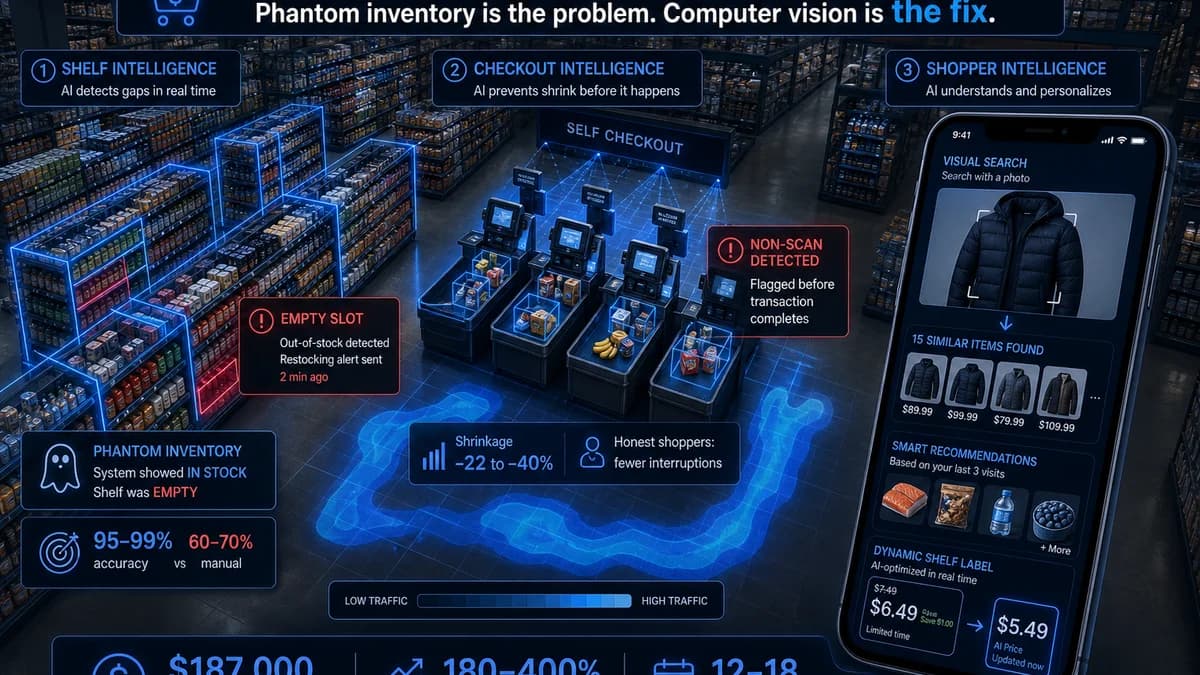
Out-of-stocks cost the global retail industry over $1 trillion annually in lost sales. But the number that matters more is not the out-of-stock rate — it is the phantom inventory rate. Phantom inventory occurs when your inventory management system shows a product as in stock while the physical shelf is empty. The item has been stolen, misplaced, damaged, or miscounted — but the system was never updated. Because the system shows stock, no replenishment order fires. The shelf stays empty. The customer finds nothing, buys a competitor's product instead, or leaves the store without completing the purchase.
Manual stock checking catches phantom inventory — eventually. A floor associate with a handheld scanner does a cycle count, discovers the discrepancy, and triggers a replenishment. In a large supermarket with 30,000 SKUs, the cycle between checks might be hours or days. In those hours, every customer who passes the empty shelf and cannot find what they came for is a lost sale that the inventory report will never capture. Computer vision shelf monitoring solves phantom inventory by scanning shelves continuously — detecting empty slots within minutes of occurrence and sending restocking alerts to the nearest available associate's device before the next customer reaches that aisle.
Market Size, Adoption, and the ROI Case
The computer vision in retail market reached $1.66 billion in 2024 and is projected to hit $5.24 billion in 2026, growing at 23.8% CAGR toward $12.56 billion by 2033. This is not speculative future growth — it is the product of adoption decisions already made. A 2024 Deloitte Retail Tech Survey found that 68% of US retailers are either piloting or actively implementing computer vision. Walmart uses shelf-scanning robots and Focal Systems smart shelves to monitor stock continuously. Kroger analysed customer dwell times through computer vision and redesigned key store sections, achieving a 12% increase in conversion rate. Old Navy and Gap partnered with Radar in March 2025 to deploy AI-powered RFID and computer vision across their store network. Everseen partnered with Google in January 2025 to advance Vision AI applications in physical retail. The 63% of retailers who now consider AI essential for competitive advantage — according to Everseen's 2025 survey — are not referring to future technology. They are referring to systems already deployed in competing stores.
The payback timeline varies by application. Self-checkout monitoring has the fastest payback — typically 6–9 months — because it simultaneously reduces shrinkage and improves customer experience. Full inventory automation systems take 12–18 months to reach payback. Across the full implementation, computer vision in retail delivers 180–400% ROI over five years — making it one of the highest-returning technology investments available to retail operators in 2026.
The 6 Computer Vision Applications in Retail
Smart Shelf Monitoring and Out-of-Stock Detection
Smart shelf monitoring deploys cameras at shelf level or uses overhead cameras with sufficient resolution to continuously scan product facings. AI image recognition identifies each product's presence, position, and facing count — detecting empty slots, misplaced products, wrong facings, and planogram deviations in real time. When an out-of-stock or deviation is detected, an alert is sent directly to the nearest available associate's mobile device, specifying exactly which shelf, which product, and the nature of the issue.
Planogram compliance monitoring uses the same camera infrastructure to compare actual shelf layouts against the approved planogram design. Research shows compliance improvement from 64% to 91% drives a 0.9% category sales increase — and promotional display compliance improvement of 60–90% enhances promotion effectiveness by 10–30%. At scale across hundreds of stores, these improvements represent substantial revenue that manual compliance auditing cannot capture consistently.
- Empty slots — product out of stock, alert triggered for restocking
- Low stock — facing count below threshold, proactive replenishment triggered
- Misplaced products — wrong item in a facing position
- Planogram deviations — layout differs from approved design
- Promotional display compliance — end-cap and feature display execution verified
- Pricing label accuracy — price tag present and matching planogram specification
Loss Prevention and Shrinkage Reduction
Computer vision loss prevention converts passive CCTV infrastructure into a proactive detection system. AI behaviour analytics identifies specific patterns associated with theft — unusual dwell time near high-value merchandise, concealment behaviour, coordinated activity between multiple individuals — and alerts loss prevention staff in real time rather than after the fact. Unlike blanket surveillance approaches that treat every customer as a suspect, AI identifies specific behavioural signals, directing staff attention to genuine risks rather than generating noise that erodes staff responsiveness.
Self-checkout monitoring is the fastest-payback application: AI cameras watch self-checkout lanes for non-scanned items in real time, flagging deliberate and accidental misses before the transaction completes. IDC predicts that by 2028, 50% of large retailers will expand computer vision specifically for store monitoring, reducing shrinkage by 40%. Retailers currently report 22–40% shrinkage reduction across documented implementations.
- Self-checkout non-scans — items placed in bag without scanning, flagged before transaction completes
- Concealment behaviour — items placed into bags, clothing, or containers within the store
- Unusual dwell patterns — extended time near high-value merchandise categories
- Coordinated activity — multiple individuals working in concert (distraction + concealment)
- After-hours anomalies — movement, access, or perimeter breaches outside trading hours
- Receipt check bypass — individuals exiting past the checkout zone without purchase
Customer Behaviour Analytics and Store Optimisation
Customer behaviour analytics uses anonymised camera data to generate operational intelligence that manual observation cannot produce at scale: which store sections attract the most traffic, where customers pause and engage with products, where traffic flows create bottlenecks, which checkout lanes generate the longest queues at which times of day. This data drives layout decisions, staffing allocation, and checkout capacity planning that improve throughput, reduce queue wait times, and optimise the path through the store to maximise basket size.
Kroger's application of dwell time analysis to redesign key store sections — resulting in a 12% conversion rate increase — is the most documented retail outcome from customer behaviour AI. The methodology is applicable to any retail format: identify the sections with the highest traffic but lowest conversion (browsed but not purchased), analyse why shoppers pause without buying, and use layout or merchandising changes to close the gap.
- Footfall — total traffic counts by hour, day, zone, and entry point
- Dwell time — time spent in each store zone and at specific fixtures
- Traffic heatmaps — visual representation of customer flow patterns across the store
- Queue depth — real-time queue length triggering additional checkout openings
- Conversion zone analysis — traffic vs purchase rate by section
- Staff-to-customer ratio — coverage gaps identified in real time
Cashierless and Frictionless Checkout
Cashierless checkout allows shoppers to pick items from shelves and leave the store without stopping at any checkout lane — the system tracks what they have taken and automatically charges their payment method on exit. Computer vision tracks shopper position and item interactions through overhead cameras, object recognition identifies each product picked up or replaced, and sensor fusion (combining visual data with weight sensors and RFID) provides the cross-validation that eliminates misidentification.
Amazon Go pioneered the format at enterprise scale, and the technology has become more accessible and affordable since — with cloud-based processing reducing the hardware investment required for implementation. Beyond full cashierless stores, computer vision enables a spectrum of checkout improvements: AI-assisted self-checkout that speeds scanning, computer vision payment (customers pay by showing their palm or face), and frictionless product verification that eliminates the need for loss-prevention-motivated receipt checks.
- Overhead camera array with object detection tracking customer movement and selections
- Computer vision product recognition identifying items by visual appearance
- Weight sensor shelves validating items removed match visual identification
- RFID cross-validation for high-value or difficult-to-distinguish items
- Exit gate payment triggering on departure with digital receipt
- Edge computing for low-latency processing without cloud dependency
Product Quality Control and Freshness Detection
Computer vision quality control applies to retail operations across two contexts: receiving (inspecting incoming deliveries for damage, incorrect products, and packaging integrity) and on-shelf freshness monitoring (detecting produce, bakery, and deli items approaching end of shelf life). AI defect detection identifies cracks, colour deviations, label misalignment, and packaging damage with higher consistency than human inspection — catching defects that visual fatigue causes human inspectors to miss on high-volume production lines. For perishable categories, AI freshness grading enables dynamic markdown decisions before products become unsaleable waste rather than after, reducing both waste and the cost of goods written off.
- Packaging damage — dents, cracks, open seals, and punctures on received goods
- Label integrity — missing, misaligned, or incorrect labelling
- Freshness grading — visual quality assessment of produce, bakery, and prepared foods
- Wrong product — delivery item does not match purchase order specification
- Returns assessment — condition grading on returned items for restocking vs disposal
- Expiry date verification — AI OCR reads date codes at receiving
Warehouse and Supply Chain Vision AI
Computer vision extends beyond the store floor into receiving docks and warehouse operations. AI cameras verify incoming shipments against purchase orders — scanning pallet contents, reading barcodes, and checking quantities without manual counting. DHL uses AI cameras to detect packaging errors and automate quality assurance in warehouses at scale. Picking accuracy AI monitors fulfilment operations to verify that the correct item was selected for each order, reducing mis-picks that generate returns and customer complaints. For omnichannel retailers, warehouse vision AI integrates with the same computer vision infrastructure as store operations — using consistent models and data pipelines across the full inventory lifecycle.
- Receiving verification — inbound pallet contents matched to purchase order
- Barcode scanning at scale — AI reads multiple barcodes simultaneously without handheld scanning
- Picking accuracy — visual confirmation each picked item matches the order specification
- Damage detection — packaging integrity check before goods enter warehouse inventory
- Shipment verification — outbound orders verified before dispatch
- Slot occupancy tracking — real-time warehouse location accuracy
Which computer vision application solves your most expensive retail problem first?
Automely's retail AI consultation identifies your highest-ROI first implementation — phantom inventory, shrinkage, or checkout friction. Book a free 45-minute call.
The Dual ROI of Self-Checkout AI — Less Shrinkage AND Better Customer Experience
Self-checkout monitoring is the highest-ROI entry point for computer vision in retail — and the reason is a dual-outcome dynamic that most retail operators undervalue when they evaluate the financial case. Standard loss prevention analysis counts only the shrinkage reduction side. But self-checkout AI delivers its ROI through two simultaneous mechanisms, both of which are commercially significant.
📉 Shrinkage Reduction
AI catches non-scanned items — both deliberate theft and accidental misses — before the transaction completes. The system flags the specific item and the specific lane, enabling targeted intervention rather than blanket suspicion. Retailers deploying self-checkout monitoring reduce shrinkage by double-digit percentages in the first year, with a 6–9 month payback period on implementation cost.
😊 Honest Shopper Experience
AI-targeted intervention means honest shoppers — the overwhelming majority — experience fewer unnecessary interruptions. Traditional loss prevention at self-checkout (manual audits, receipt checks, blanket camera warnings) creates friction for every customer to catch a small minority. AI targets only genuine anomalies, reducing friction for the majority while catching the same or more loss events.
The Forrester principal analyst Indranil Bandyopadhyay characterises this as the defining commercial case for self-checkout vision AI: reduced loss for the retailer, and better experience for the customer, simultaneously from the same system. This dual outcome is what makes self-checkout monitoring the recommended starting point for retailers evaluating computer vision for the first time — the financial case is clear on both dimensions, the payback is fast, and the customer experience improvement is measurable through satisfaction scores rather than only through loss prevention metrics.
Personalised Shopping — Computer Vision's Role in the Customer Experience
Beyond operations and loss prevention, computer vision is reshaping how retailers deliver personalised shopping experiences at scale. Three applications are commercially mature in 2026:
Visual Search — Finding Products by Photo
Visual search allows shoppers to photograph a product they want — a piece of clothing they saw on social media, a piece of furniture in a magazine, a product on a shelf — and receive instant results showing the same or similar items available for purchase. Computer vision matches the query image against the retailer's product catalogue using visual similarity models, returning results by shape, colour, pattern, and style rather than relying on text search terms that consumers often cannot formulate accurately for visual products. Visual search converts browsing intent into purchase intent by eliminating the friction between "I want something like this" and "here it is in your size."
In-Store AI Recommendations and Smart Displays
Anonymised customer analytics — footfall patterns, dwell zones, interaction signals from smart shelves — feed recommendation engines that adjust which products are featured on digital shelf labels and smart displays in real time. A display at the end of an aisle that was showing a promoted item that attracted little dwell time switches to a different featured product based on real-time engagement data. Dynamic pricing through digital shelf labels adjusts markdown timing based on actual demand signals — reducing waste on perishables and maximising margin on high-demand items simultaneously.
Virtual Try-On and AR Shopping
Computer vision-powered virtual try-on allows shoppers to see how clothing, eyewear, cosmetics, and home furnishings look on them without physically trying items on. AR overlays powered by computer vision measure the shopper and render the product accurately at scale — reducing the uncertainty that causes returns, particularly in apparel and home categories. Retailers deploying virtual try-on report significant reduction in online return rates for the product categories covered, directly improving the margin on categories that are otherwise loss-making due to return logistics costs.
Privacy Architecture — How to Deploy Computer Vision Without Violating Customer Trust
Every discussion of computer vision in retail eventually raises the privacy question — and for good reason. The difference between a retail AI system that builds customer trust and one that destroys it is not the technology. It is how the data is handled. Privacy architecture must be designed into computer vision retail systems from the start, not added as a compliance afterthought.
Anonymisation at the Edge — Before Data Leaves the Store
Faces and identifiable features must be blurred or anonymised before any data leaves the store environment or reaches cloud processing. Analytics systems should operate on metadata — positions, trajectories, dwell times, interaction signals — not on identifiable individuals. This is not just good ethics; it is the legal requirement under GDPR, CCPA, and the emerging state-level privacy laws in the US.
Strict Retention Windows — Delete What You Do Not Need
Operational retail analytics does not require storing raw video footage beyond the operational window — typically 30–90 days for loss prevention purposes, shorter for analytics. Define retention windows at the architecture level and enforce them automatically. Data that does not exist cannot be breached, subpoenaed, or misused.
Aggregate Analytics — Count People, Do Not Track Them
Customer analytics should generate aggregate insights — footfall counts, dwell time averages, traffic pattern heatmaps — without creating individual profiles of identifiable customers. The commercial value of retail analytics comes from the aggregate, not from individual tracking. Systems designed to produce aggregate insights are both more privacy-compliant and more useful for operational decision-making.
Transparent Signage — Tell Customers What Is in Use
Clear, visible signage informing customers that AI-powered cameras are in use for loss prevention and store analytics is both a legal requirement in many jurisdictions and a trust-building commercial decision. Customers who know what the technology does — and understand that it is not identifying them personally — are significantly less negative about its use than customers who discover it unexpectedly.
Retailers that build privacy architecture into their computer vision systems from day one — and communicate it clearly to customers — consistently report higher net promoter scores than those that treat privacy as a compliance burden. Customer trust in AI-powered retail analytics doubled in a single year (2025 to 2026) specifically because retailers began communicating what the systems do and do not do. Privacy-first design is not a constraint on commercial ambition — it is the commercial decision that makes long-term AI deployment sustainable.
Implementation Priority Matrix — Where to Start With Retail Computer Vision
The most common retail computer vision implementation mistake is trying to solve every problem simultaneously. Every application in this guide generates positive ROI — but attempting all six at once creates integration complexity, change management overload, and confounded performance data that makes it impossible to identify what is working. The implementation priority should be driven by your store format, your existing camera infrastructure, and the size of the problem you are trying to solve.
Self-Checkout Monitoring (6–9 month payback)
Start here if you operate self-checkout lanes and your shrinkage rate is above 1.5% of revenue. Works with existing CCTV infrastructure in most cases. Clear, fast, measurable ROI on both shrinkage and customer experience dimensions. Build your internal business case and technology confidence on this application before expanding.
Smart Shelf Monitoring — High-Velocity Categories First
Start with your highest-velocity SKUs — the items that go out of stock most frequently and where out-of-stock incidents cost the most in lost sales. Deploy shelf monitoring cameras in those aisles first. Measure phantom inventory reduction and restocking response time. Expand to full store coverage using documented per-aisle ROI as the expansion justification.
Customer Behaviour Analytics (after baseline metrics established)
Deploy footfall and dwell time analytics once shelf monitoring infrastructure is in place — the cameras required for shelf monitoring often provide the coverage needed for behaviour analytics at minimal additional cost. Use traffic data to inform your next physical store refresh or layout change.
Planogram Compliance Monitoring (for multi-store operators)
Deploy planogram compliance monitoring at scale once you have a documented clause library of approved planogram designs by store format and category. The ROI is greatest for retailers running frequent promotional cycles where execution compliance drives significant revenue — missed promotional displays compound across hundreds of stores.
Cashierless Checkout (significant infrastructure investment)
Full cashierless checkout requires the highest initial infrastructure investment and is most appropriate for high-traffic convenience formats where checkout speed is a primary competitive differentiator. Evaluate after demonstrating ROI from shelf monitoring and loss prevention deployments, and with existing loyalty infrastructure that can support frictionless payment.
Pick one problem — phantom inventory OR loss prevention OR queue management. Calculate your current loss from that problem specifically — that is your ROI benchmark. Evaluate your existing CCTV infrastructure (cameras need to be at least 1080p HD with adequate lighting and correct viewing angles). Most retail AI platforms work with existing infrastructure, significantly reducing upfront cost. Pilot for 6–8 weeks in your highest-impact location. Document the before/after on the specific metric you targeted. Use that documented ROI to justify full-estate expansion.
Building Retail Computer Vision with Automely
Automely's AI agent development, generative AI development, and AI integration services cover the full stack of retail computer vision implementations — shelf monitoring with out-of-stock and planogram compliance detection, loss prevention behaviour analytics, self-checkout fraud monitoring, customer footfall and dwell time analytics, and personalised shopping recommendation AI.
All Automely retail AI implementations include privacy architecture by design: anonymisation at the edge before data processing, GDPR and CCPA-compliant data handling with configurable retention windows, aggregate analytics output without individual tracking, and customer signage consultation. We do not separate the technical build from the privacy architecture — they are designed simultaneously because retrofitting privacy controls post-build is significantly more expensive and less effective than designing them in from day one.
Browse our case studies, read client testimonials, and explore our full AI services portfolio including AI chatbot development for retail customer service, AI consulting services, and our AI in eCommerce guide for the online retail personalisation parallel. For the manufacturing quality control context, our AI in manufacturing guide covers the same computer vision defect detection technology applied to production environments.
Ready to fix the phantom inventory problem and recover the $187K annual benefit per store?
Book a free 45-minute retail AI consultation. We will audit your camera infrastructure, identify your highest-ROI first application, and scope the privacy architecture — before any development commitment.