


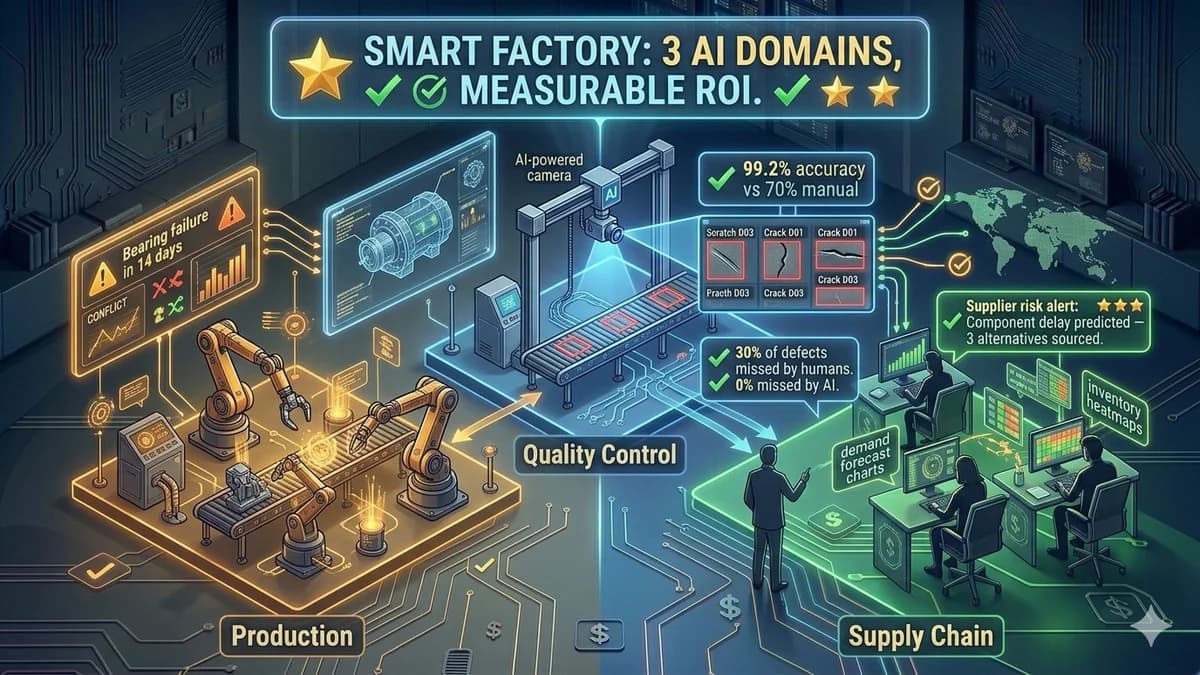
3 Manufacturing AI Domains — And the One Question That Determines Where You Start
Manufacturing AI operates across three distinct domains: production (making the product), quality control (ensuring the product is correct), and supply chain (moving materials in and products out). Each domain has its own AI use cases, data requirements, implementation timeline, and ROI profile. They are connected — a predictive maintenance failure affects quality, which affects supply commitments — but they can be implemented independently and sequenced based on where your current performance gap is most expensive.
The question that determines your starting domain: where is your most expensive operational problem right now? If it is unplanned downtime and equipment failure, start with production AI. If it is defect rates, rework costs, or recall risk, start with quality control AI. If it is demand forecasting accuracy, inventory carrying costs, or supplier disruption, start with supply chain AI. The ROI from the first implementation funds the second. The second builds the data infrastructure that accelerates the third.
AI in manufacturing is the intelligence layer of Industry 4.0 — the integration of connected devices, real-time data, and automation that characterises the smart factory. IoT sensors generate the data; AI analyses it. Without AI, Industry 4.0 infrastructure generates data but not decisions. Without IoT sensor infrastructure, AI has nothing to analyse. The two must be planned and deployed together. The data infrastructure section of this guide covers the specific sensor and data pipeline requirements for each AI use case.
Domain 1 — Production AI: From Predictive Maintenance to Process Optimisation
Production AI focuses on keeping equipment running and making it run better. Unplanned downtime is one of the most expensive operational failures in manufacturing — a single hour of unplanned downtime on a high-throughput production line can cost $10,000–$250,000 depending on the industry. AI addresses this at three levels: predicting failure before it occurs, optimising process parameters in real time to maintain quality and throughput, and simulating process changes in digital twins before implementing them on the physical line.
Production AI — Keeping Equipment Running and Running Better
Production AI focuses on keeping equipment running and making it run better. Unplanned downtime is one of the most expensive operational failures in manufacturing — a single hour of unplanned downtime on a high-throughput production line can cost $10,000–$250,000 depending on the industry. AI addresses this at three levels: predicting failure before it occurs, optimising process parameters in real time to maintain quality and throughput, and simulating process changes in digital twins before implementing them on the physical line.
- Equipment Failure Prediction — sensor data (vibration, temperature, pressure, acoustic emission, current draw) detects early failure signatures and alerts maintenance 2–4 weeks ahead. ↓ 25–40% unplanned downtime · ↓ 10–25% maintenance costs
- Real-Time Process Parameter Optimisation — AI continuously adjusts temperature, speed, pressure, and feed rate based on incoming material properties and current output. ↑ 5–15% throughput · ↓ 10–20% material waste
- Virtual Factory Simulation (Digital Twin) — a real-time virtual replica of the line, used to test parameter changes, scheduling decisions, and maintenance windows before physical deployment
- AI-Coordinated Collaborative Robots (Cobots) — AI manages handoffs between cobots and human operators in real time, adjusting cobot behaviour based on human position and task progress
Domain 2 — AI Quality Control: From Sampling to 100% Inspection at Line Speed
Traditional quality control in manufacturing is a sampling problem. Human inspectors can only check a fraction of production output, and even within that fraction, studies show they miss approximately 30% of defects — due to fatigue, the speed of modern production lines, and the limitations of human visual acuity at detecting subtle surface variations. A single defect that reaches a customer can trigger a recall. In some industries — automotive, aerospace, medical devices — a single defect that reaches end use can create safety liability.
AI quality control eliminates the sampling limitation by inspecting every unit at full line speed. McKinsey research confirms that smart quality methods using AI can reduce the total cost of quality by up to 50% — not by improving what human inspectors can do, but by replacing sampling with complete inspection.
AI Quality Control — 100% Inspection at Line Speed, Not Sampling
Traditional quality control in manufacturing is a sampling problem. Human inspectors can only check a fraction of production output, and even within that fraction, studies show they miss approximately 30% of defects — due to fatigue, the speed of modern production lines, and the limitations of human visual acuity at detecting subtle surface variations. A single defect that reaches a customer can trigger a recall. In some industries — automotive, aerospace, medical devices — a single defect that reaches end use can create safety liability.
AI quality control eliminates the sampling limitation by inspecting every unit at full line speed. McKinsey research confirms that smart quality methods using AI can reduce the total cost of quality by up to 50% — not by improving what human inspectors can do, but by replacing sampling with complete inspection.
- 100% Visual Inspection at Line Speed — computer vision detects surface defects, dimensional variations, colour deviations, missing components, and assembly errors. BMW uses AI vision to inspect every car body for paint defects invisible to human inspectors at production speed. 99%+ detection rate vs ~70% human inspection
- AI Statistical Process Control — monitors all production variables simultaneously and alerts 15–30 minutes before the first defective unit would be produced, catching drift before it becomes defect
- AI-Directed Functional and Dimensional Testing — coordinates CMMs, functional test rigs, and electrical test stations, applying risk-based measurement to units with higher anomaly indicators
Which manufacturing AI use case has the highest ROI gap in your operation?
Automely's manufacturing AI assessment identifies your highest-value target and scopes the data infrastructure and build. Book a free 45-minute consultation.
Domain 3 — Supply Chain AI: From Demand Forecasting to Supplier Risk
Supply chain AI addresses the two fundamental failure modes of manufacturing supply chains: too much (inventory carrying costs, working capital tied up in stock that moves slowly) and too little (stockouts that stop production, emergency procurement at premium cost, lost customer orders). AI doesn't eliminate uncertainty — it reduces the margin of error in planning enough to hold less safety stock while maintaining the same fill rate.
Supply Chain AI — Demand Forecasting to Supplier Risk Monitoring
Supply chain AI addresses the two fundamental failure modes of manufacturing supply chains: too much (inventory carrying costs, working capital tied up in stock that moves slowly) and too little (stockouts that stop production, emergency procurement at premium cost, lost customer orders). AI doesn't eliminate uncertainty — it reduces the margin of error in planning enough to hold less safety stock while maintaining the same fill rate.
- AI Demand Forecasting — analyses sales history, order pipeline, seasonal patterns, economic indicators, competitor pricing, weather, and social signals. A 15% improvement in forecast accuracy for a $50M-inventory manufacturer reduces safety stock by $3–5M
- Multi-Echelon Inventory Optimisation — optimises inventory across the full distribution network simultaneously, transferring stock between locations rather than holding buffer at every node. ↓ 15–25% inventory carrying costs
- AI Supplier Risk Monitoring — monitors financial health, news events, delivery performance, and geopolitical signals to alert procurement 4–8 weeks before disruption manifests
- Route and Network Optimisation — optimises carrier selection, routes, consolidation, and delivery timing across the freight network in real time. ↓ 8–15% freight costs
The Data Infrastructure Layer — What Must Exist Before AI Can Work
The most common manufacturing AI implementation failure is not model quality or algorithm selection — it is data readiness. AI in manufacturing requires specific data infrastructure at each domain, and the infrastructure investment often exceeds the AI model development cost. Understanding this before committing to any AI use case prevents the most expensive manufacturing AI mistake: discovering mid-project that the required sensor infrastructure does not exist.
The Data Infrastructure Layer — What Must Exist Before AI Can Work
The most common manufacturing AI implementation failure is not model quality or algorithm selection — it is data readiness. AI in manufacturing requires specific data infrastructure at each domain, and the infrastructure investment often exceeds the AI model development cost. Understanding this before committing to any AI use case prevents the most expensive manufacturing AI mistake: discovering mid-project that the required sensor infrastructure does not exist.
- Sensor Infrastructure (Production AI prerequisite) — vibration, temperature, pressure, and acoustic emission sensors on every monitored machine. Retrofit installation adds 4–12 weeks to project timelines
- Camera and Lighting Infrastructure (Quality Control AI prerequisite) — high-resolution cameras at consistent distances with controlled, uniform lighting. Positioning, lens selection, and lighting design are as important as the AI model itself
- Data Integration (Supply Chain AI prerequisite) — ERP, WMS, TMS, and CRM connectors. Integration work typically takes 6–12 weeks for a moderately complex operation and is the most commonly underestimated cost
- Data Pipeline and Storage (all domains) — real-time collection, 12–24 months minimum history for training, sub-second update frequencies for production AI, hourly/daily for supply chain AI
ROI by Use Case — The Numbers Before You Commit
Manufacturing AI ROI varies sharply by use case, by data readiness, and by the baseline cost of the operational problem the use case targets. The table below summarises the typical ROI range, implementation timeline, and data prerequisite for each of the seven highest-value manufacturing AI use cases. Use it to triage your candidate use cases before scoping any single implementation in detail.
| Use Case | Domain | Data Prerequisite | Timeline | ROI Range |
|---|---|---|---|---|
| Predictive Maintenance | Production | Vibration/temp sensors on machines | 8–16 weeks | ↓ 25–40% downtime |
| Process Optimisation | Production | Real-time machine parameter logging | 10–18 weeks | ↑ 5–15% throughput |
| AI Visual Inspection | Quality Control | Camera + controlled lighting at inspection station | 8–16 weeks | ↓ 50% quality costs |
| AI Statistical Process Control | Quality Control | Real-time sensor data from production process | 6–12 weeks | ↓ Scrap rate 20–35% |
| Demand Forecasting | Supply Chain | 24+ months sales history + ERP integration | 8–16 weeks | ↑ 15–30% forecast accuracy |
| Inventory Optimisation | Supply Chain | WMS integration + demand history | 10–16 weeks | ↓ 15–25% inventory cost |
| Supplier Risk Monitoring | Supply Chain | Supplier database + external data feeds | 6–12 weeks | 4–8 week risk lead time |
Before deploying any manufacturing AI use case, document the current baseline: exact downtime hours per machine per month, exact defect rate and cost per defect, exact forecast accuracy and inventory carrying cost. Without a documented baseline, you cannot prove the AI made a difference — and without proof, internal investment in the next use case is harder to justify. Measure before you build. Measure again at 30, 60, and 90 days post-deployment. The numbers you produce at 90 days are the business case that funds the next implementation.
The Manufacturing AI Implementation Sequence
Manufacturing AI is not a single project — it is a programme of waves, each one funded by the documented ROI of the previous wave. The most successful manufacturing AI programmes follow a deliberate sequence: identify the highest-cost operational problem, assess data readiness, deploy on a single machine or line, measure rigorously at 30/60/90 days, and expand using Wave 1 ROI as the funding source. Skipping the measurement step is the most common reason internal investment stalls after Wave 1.
The Manufacturing AI Implementation Sequence
Manufacturing AI is not a single project — it is a programme of waves, each one funded by the documented ROI of the previous wave. The most successful manufacturing AI programmes follow a deliberate sequence: identify, assess, deploy small, measure, expand. Skipping the measurement step is the most common reason internal investment stalls after Wave 1.
- Step 1 — Identify your highest-cost operational problem. Quantify the annual cost of downtime, defects, and inventory inefficiency. The highest-cost problem is your Wave 1 target, not the most technically interesting AI use case
- Step 2 — Assess data readiness for the selected use case. Sensors in place? Camera infrastructure point identified? Data sources mapped? Gaps add to timeline and budget — identify them before committing
- Step 3 — Deploy on a single machine, line, or location first. Predictive maintenance on one machine before the fleet. Visual inspection at one station before the full line
- Step 4 — Measure, document, and report at 30/60/90 days. Produce a written ROI report — a number, not a slide deck. Example: 'Predictive maintenance on Line 3 reduced downtime from 14.2 to 4.8 hours/month. At $18,000/hour, that is $168,000/month recovered, against a $45,000 system cost'
- Step 5 — Expand using Wave 1 ROI as the funding source. Wave 2 reuses the infrastructure, integration patterns, and internal expertise from Wave 1, reducing implementation time and cost
4 Manufacturing AI Implementation Risks to Manage from Day One
Every manufacturing AI implementation faces the same four categories of risk. The successful programmes do not avoid them — they identify and mitigate them explicitly from the scoping phase. The failed programmes encounter them in production, after the budget is committed and the timeline is fixed.
Data quality and availability underestimated at scoping
The most consistent cause of manufacturing AI project overruns. Sensors that technically exist but produce data of insufficient quality or resolution for AI analysis. ERP systems that have the right data fields but inconsistent population or poor historical coverage. Legacy historian systems that logged data in proprietary formats requiring significant transformation before use. Assess data quality with a sample extraction and analysis before finalising project scope and timeline.
Operator and maintenance team adoption failure
An AI predictive maintenance system that generates alerts that maintenance teams ignore is worthless. An AI quality control system that operators learn to route around destroys the defect reduction case. Adoption failure in manufacturing AI is most commonly caused by implementing AI without involving the people whose workflows it changes — operators, quality inspectors, and maintenance engineers. Involve them in defining the alert logic, the workflow triggers, and the escalation paths. Their domain knowledge also improves the AI's performance.
Model accuracy measured in testing, not in production conditions
A computer vision model trained on clean images in controlled lighting can perform at 99% accuracy in validation testing and 72% in production when lighting conditions vary, camera positions shift due to vibration, and product variants outside the training set appear on the line. Test under actual production conditions — including the variability, contamination, and edge cases that occur in real manufacturing environments — before declaring the system production-ready.
Connectivity and network infrastructure inadequate for real-time AI
Predictive maintenance and quality control AI require reliable, low-latency connectivity between sensors/cameras and the AI processing layer. Factory floors — with interference from large metal equipment, welding operations, and variable network coverage — frequently have connectivity gaps that are not apparent until real-time data streaming reveals them. Assess network coverage and latency at the specific sensor and camera locations before sensor installation. Edge computing deployments (AI processing at the machine rather than the cloud) mitigate network dependency for time-critical applications.
Building Manufacturing AI Systems with Automely
Automely's AI agent development and AI integration services cover the software and AI layer of manufacturing AI implementations — sensor data pipeline integration, predictive maintenance AI models, quality control AI with production monitoring dashboards, supply chain AI with ERP and WMS integration, and the alert and escalation workflows that connect AI outputs to the teams that act on them.
Our approach to manufacturing AI implementations follows the sequence described in this guide: scoping begins with the operational problem and the data readiness assessment before architecture selection. We do not propose AI architecture before we understand what data exists, what data is missing, and what the measurable ROI baseline is. The implementations we build are designed to produce a documented, quantified ROI at 90 days post-deployment — the number that funds the next wave.
Browse our case studies, read client testimonials, and explore our full AI services portfolio including generative AI development, AI chatbot development, and AI consulting services. For the computer vision parallel applied to retail operations, see our computer vision in retail guide.
Know your highest-cost manufacturing AI target. Need to scope the implementation?
Book a free 45-minute manufacturing AI assessment. We will review your data readiness, scope the AI architecture, and produce a timeline and ROI estimate.