


The 9 AM Problem — Why Response Speed Is Real Estate's Most Expensive Metric
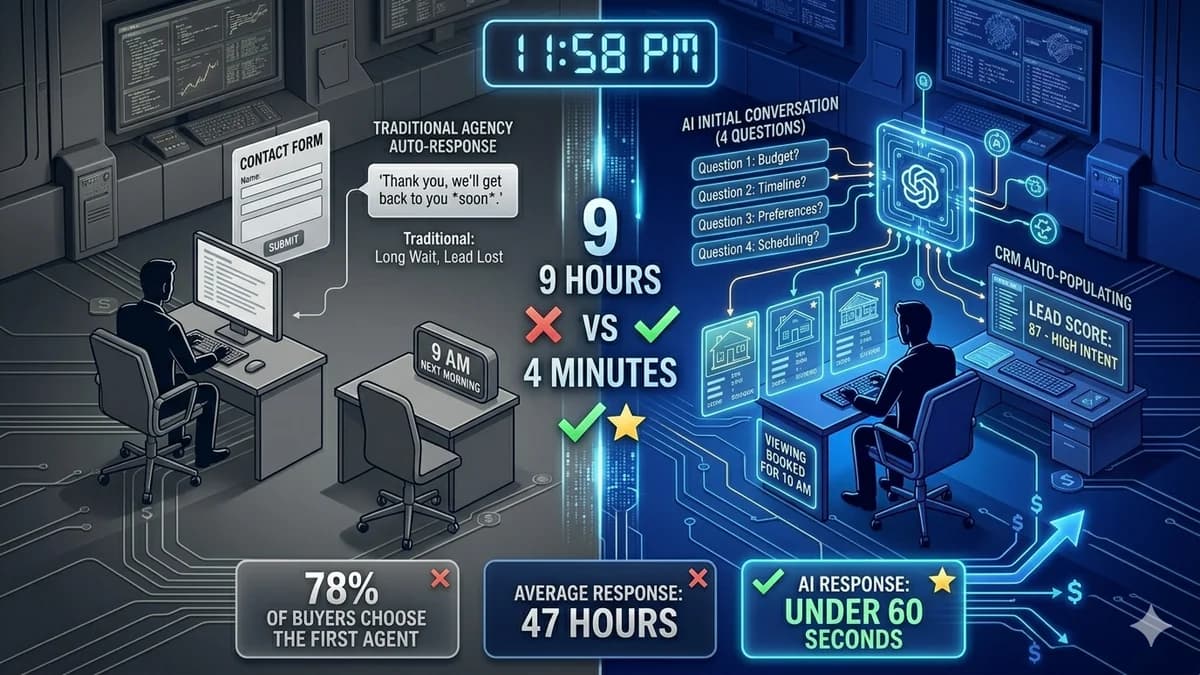
A buyer browses your listings at 11:58 PM on a Thursday. They have three questions about a property they are seriously interested in. They fill in the contact form, or send a WhatsApp message, or start a chat session. Your team is not there. The auto-response says someone will be in touch soon. At 9 AM the next morning, an agent sees the inquiry in their inbox and begins crafting a response.
By 9 AM, that buyer has already booked a viewing with a competitor. Not because the competitor's properties were better. Because their AI agent responded in 30 seconds, qualified the buyer through a brief conversation, matched three relevant listings to their criteria, and booked the viewing for 10 AM that morning — while your team slept.
This is the 9 AM problem. And the data behind it is unambiguous: 78% of buyers work with the first agent who responds to their inquiry. The average response time across the real estate industry is 47 hours. The gap between those two statistics — the buyer's decision timing and the industry's response timing — is the most expensive performance gap in real estate, and it is entirely solvable with AI.
❌ Traditional Agency — No AI
11:58 PM — Buyer submits inquiry. Auto-response: “We'll be in touch.” 9:03 AM — Agent finds inquiry in inbox, starts drafting a personalised reply. 9:15 AM — Response sent. Buyer has already booked elsewhere. Cost: one qualified buyer lost. At 2% commission on a $750K property, that is $15,000.
✓ AI-Enabled Agency
11:58 PM — Buyer submits inquiry. AI agent responds in 28 seconds, collects budget and timeline in 4 questions. 12:04 AM — AI matches 3 properties, sends listing cards, offers viewing slots. 12:07 AM — Buyer selects a slot. Viewing booked for 10 AM. CRM updated. Agent notified.
The 9 AM problem has a second layer that is equally expensive: not just the failure to respond fast enough, but the failure to follow up consistently with leads that did not convert on first contact. Industry data shows that 60% of real estate leads receive no follow-up beyond the first contact. These are leads that an agency has already paid to generate — through portal advertising, social media campaigns, referral programmes — and then abandoned when they did not immediately convert into viewings. AI does not just respond faster; it also nurtures every lead across the full 3–6 month decision cycle without a single one slipping through the cracks.
Lead qualification AI, property matching engines, AI voice agents, automated follow-up sequences, and predictive listing signals. Each addresses a specific gap in how real estate agencies currently convert, match, and retain clients. They can be deployed independently and sequenced based on where your agency's revenue gap is largest.
The 5 Real Estate AI Systems — What Each One Does
Real estate AI in 2026 spans five distinct system categories, each addressing a specific failure point in the lead-to-close pipeline. The systems are independently deployable, and most agencies sequence them based on where their current revenue leak is largest — starting with qualification on the highest-volume inbound channel, then layering matching, voice agents, follow-up automation, and predictive seller signals as the data and integration foundation matures.
AI Lead Qualification Agent — Every Inquiry Engaged in Under 60 Seconds
An AI lead qualification agent engages every incoming lead the moment they make contact — via website chat, WhatsApp, Facebook Messenger, or property portal integration — regardless of the time or day. Through a structured conversational flow, it collects the qualification data your agents need: budget range, purchase timeline, property type preferences, location, pre-approval or mortgage-in-principle status, and current living situation. Each answer contributes to a lead score, and when the score crosses a defined threshold, the AI triggers an agent notification with a complete handover summary.
Leads that score below the threshold enter automated nurture sequences. Leads with specific timeline commitments ("we need to move in 6 weeks") are flagged as urgent and trigger an agent notification regardless of time. The AI handles the volume that no human team can match — hundreds of simultaneous conversations, consistent questioning regardless of how busy the team is, and complete CRM logging of every interaction.
- Budget ceiling and flexibility (is the stated budget firm or starting point?)
- Purchase timeline (browsing, ready in 3 months, need to move in 6 weeks)
- Property requirements (bedrooms, parking, garden, specific features)
- Location flexibility (single area, or open to adjacent neighbourhoods?)
- Financial position (pre-approved, cash buyer, first-time buyer)
- Current situation (renting, need to sell first, sold subject to contract)
AI Property Matching Engine — Matching What Buyers Actually Buy, Not What They Say
What a buyer says they want and what they actually buy are frequently different. A buyer who says they want a 4-bed detached in a specific postcode might buy a 3-bed semi-detached in a neighbouring area because the price-to-size ratio was better. An AI property matching engine learns from this gap — building a preference model from stated criteria, browsing behaviour (which listings the buyer viewed multiple times, which they clicked past), feedback from viewings, and the properties that similar buyer profiles ultimately purchased.
This model is applied against the current listing inventory to produce a personalised match ranking for each buyer. When new listings are added, the AI immediately assesses whether they match high-priority buyers and generates proactive alerts — "Hi James, we just listed a property in W4 that matches 6 of your 7 key criteria. Would you like to see it before it goes public?" For agencies with large listing databases, this proactive matching capability is a significant competitive advantage — buyers learn that this agency surfaces relevant properties faster than competitors.
- Stated preferences from qualification conversation
- Browsing behaviour — time spent on listing, return visits, features examined
- Viewing history — properties viewed, offers made, reasons offers declined
- Similar buyer profile outcomes — what did buyers with identical criteria ultimately purchase?
- Price sensitivity signals — response to listings above and below stated budget
AI Voice Agent — A Real Phone Call in 30–60 Seconds, Not a Text
The AI voice agent calls incoming leads within 30–60 seconds of their inquiry — not sending a text, not opening a chat window, but calling their actual phone number with an AI that speaks and listens in a natural conversational voice. It introduces itself as the agency's contact system, collects qualification data through natural conversation, answers basic property questions, and books viewings — all without agent involvement. Every call is recorded and transcribed, and the qualification summary is written to the CRM for agent handover.
AI voice agents represent a significant capability step beyond chatbots. Many buyers — particularly those who are higher intent and accustomed to phone-first interaction — prefer a phone call to a chat conversation. The AI voice agent delivers the fastest possible response for phone-preference leads, at any hour. For agencies where inbound leads come predominantly from portal listings (where the primary call-to-action is a phone number), the AI voice agent is the highest-impact first AI investment.
- Introduction: "Hi, this is the XYZ Properties contact system. I saw you were enquiring about a property — can I ask a few quick questions so our team can help you better?"
- Qualification: 4–6 natural questions collecting the core criteria (budget, timeline, bedrooms, location)
- Matching: "Based on what you've told me, we have 2 properties that sound like strong matches — would you like to hear a brief description of each?"
- Booking: "Would 10 AM or 2 PM tomorrow work for a viewing? I can confirm that now."
- Handover: Transcription and lead summary sent to CRM and agent notification
Automated Follow-Up Sequences — Multi-Month Nurture Across SMS, Email, WhatsApp
The average property transaction takes 3–6 months from first inquiry to offer. Most real estate agencies have a follow-up process for the first few days after initial contact. They have no systematic follow-up for the lead that said "we're 4 months away from being ready to buy" at the qualification stage. AI automated follow-up sequences manage multi-month nurture programmes — delivering relevant content, market updates, new listing alerts, and check-in messages across SMS, email, and WhatsApp on a schedule customised to each lead's stated timeline.
The content is personalised based on the lead's qualification data: a buyer who said they wanted a 3-bed in W6 with a garden receives new listing alerts specifically for properties matching that profile. A buyer approaching their stated purchase date receives an automated prompt to reconnect. A buyer who viewed two properties but made no offer receives a follow-up asking what they were looking for that neither property provided — and feeding the answer back into the property matching engine.
- Day 1: Qualification summary + 2 matched listings sent via SMS
- Day 3: Market report for their target area (AI-generated)
- Day 7: New listing alert if anything new matches their criteria
- Day 14: Check-in: "Are you still actively looking? Has your timeline changed?"
- Day 30: Personalised update + 3 new matches
- Day 60: Timeline proximity trigger: "You mentioned you're looking to move in about 30 days — would now be a good time to arrange viewings?"
Predictive Listing Signals — Identifying Sellers 3–6 Months Before They List
The most valuable seller lead in real estate is the homeowner who is about to list — before they have contacted any agent. By the time a property appears on a portal, multiple agencies have already pitched for the instruction. AI predictive listing signal systems identify homeowners likely to sell in the next 3–6 months by monitoring the combination of signals that precede listing decisions: life events (marriage, divorce, new child, death in family), financial signals (mortgage term approaching, refinancing activity, equity threshold reached), property data (length of current ownership), and behavioural signals (sell-side portal browsing, estate agent website visits).
For agencies operating in specific geographic markets, AI predictive signals allow proactive outreach campaigns — "We noticed you've been in your property for 8 years. Given current market conditions in [area], your home would likely achieve [value range]. Would you like a complimentary valuation?" — to the highest-probability sellers in their territory, 3–6 months before competitors identify the same prospects through reactive portal monitoring.
- Life event signals: marriage, divorce, probate records, new birth registrations
- Financial signals: mortgage term expiry approaching, refinancing, equity threshold crossed
- Behavioural signals: property portal sell-side browsing, estate agent site visits
- Property data: length of ownership (typical listing window: 7–12 years in most markets)
- Local market signals: area price appreciation above owner's stated purchase price by meaningful margin
Which of these 5 real estate AI systems closes the biggest revenue gap for your agency?
Automely's real estate AI consultation maps your lead pipeline and identifies the highest-ROI first implementation. Book a free 45-minute call.
What Your AI Qualification System Needs to Assess — And How to Define It
Before implementing any AI lead qualification system — off-the-shelf or custom — you must define your qualification criteria. Most real estate agencies have these criteria in agents' heads, not written down anywhere. The AI cannot implement a qualification process that does not have an explicit definition. This is the most important pre-implementation step, and the one most commonly skipped.
💰 Financial Qualification
- Budget ceiling (stated maximum purchase price)
- Financial position: cash, pre-approved, needs mortgage
- First-time buyer status (affects stamp duty and timeline)
- Budget flexibility — is the stated amount a ceiling or a starting point?
- Dependence on selling current property (chain risk)
⏱️ Timeline Qualification
- Purchase timeline: browsing, 1–3 months, 3–6 months, urgent
- Has motivation driving the timeline (relocation, school year, lease ending)?
- Is the motivation external (employer relocation) or discretionary?
- Has the lead already viewed other properties this month?
🏘️ Property Qualification
- Minimum bedrooms and property type (house, flat, terrace, detached)
- Specific area requirements or flexibility
- Must-have features (garden, parking, school catchment)
- Condition tolerance (ready to move in, or open to renovation?)
🎯 Intent Signals
- Source of inquiry (portal, referral, direct, social) — correlates with intent
- Specific property enquiry vs general area browsing
- Multiple inquiries in the past 30 days — active search signal
- Requested a viewing before being prompted — highest intent signal
Once these criteria are defined, they become the scoring logic for the AI qualification system. A lead that is pre-approved (or cash), has a sub-3-month timeline with external motivation, has a specific property type requirement that matches your inventory, and has requested a viewing is a score-90+ lead that warrants immediate agent escalation and a phone call in under 5 minutes. A lead that is “just browsing” with no timeline and no financial position is a score-20 lead that enters a long-term nurture sequence. The AI makes this routing decision consistently, at scale, for every single inquiry.
Tools — Off-the-Shelf vs Custom-Built Real Estate AI
The real estate AI tooling market in 2026 is split between mature off-the-shelf platforms — Follow Up Boss AI, kvCORE, BoomTown, Structurely, Rex CRM, Reapit, SmartZip — and custom builds for agencies whose qualification logic, CRM stack, or data sources fall outside what configurable tools can cover. The decision framework is rarely about capability ceiling; it is about integration depth and whether you end up with one source of truth or five fragmented systems your agents have to reconcile.
| System | Off-the-Shelf Options | Type | When to Build Custom |
|---|---|---|---|
| Lead Qualification Agent | Follow Up Boss AI, BoomTown, kvCORE, Structurely | Off-the-shelf | When qualification logic is complex (commercial vs residential, multi-currency markets) or needs deep integration with proprietary CRM |
| Property Matching | Rex CRM, Reapit, Salesforce for RE (Salesforce AI) | Off-the-shelf | When matching against private portfolio not on public portals, or incorporating proprietary buyer behaviour data from multiple channels |
| AI Voice Agent | Structurely Voice, Lofty AI, Ylopo | Off-the-shelf | Custom branded voice personality, unique qualification flow, or integration with non-standard telephony infrastructure |
| Follow-Up Sequences | Klaviyo (email/SMS), ActiveCampaign, Follow Up Boss workflows | Off-the-shelf | Custom AI-generated content per lead (not just personalised variables), predictive send-time per lead profile |
| Predictive Listing Signals | SmartZip, Likely.AI, Offrs | Off-the-shelf | Build custom when combining proprietary data sources (local council data, land registry, agency-specific market knowledge) for market-specific signal models |
Most real estate agencies that implement multiple off-the-shelf AI tools end up with a fragmented system: the qualification chatbot does not write to the same CRM format as the follow-up tool, the voice agent logs do not integrate with the matching engine, and agents receive duplicate notifications from different systems. Before selecting tools, map your data flow — where each lead enters, where qualification data should live, and which system is the single source of truth. A fragmented AI stack often performs worse than a single, less-capable, well-integrated platform.
The Data Your Real Estate AI Needs — And the Gaps That Break It
Real estate AI systems depend on three data foundations. Without each of these in clean, complete, accessible form, the AI's performance will fall significantly short of its potential:
Lead history with outcome data
Every prior lead in your CRM — with their qualification data, the properties they were shown, whether they viewed, whether they offered, whether they bought, and what they ultimately purchased. Lead qualification AI and property matching engines train on this historical data. An agency with 3 years of clean, complete lead history builds a significantly more accurate qualification model than one with partial records across multiple legacy systems. Before implementing AI, export and clean your historical lead data — the effort pays substantial dividends in model accuracy.
Listing inventory data with rich attributes
Every property on your books — not just portal description text, but structured attribute data: square footage, tenure (freehold/leasehold), EPC rating, council tax band, nearest schools with ratings, transport links, garden direction, parking, renovation status. Property matching AI needs structured attributes to match against buyer criteria. Portal-scraped text descriptions are insufficient — the AI needs comparable fields across every listing to score relevance accurately.
CRM contact data with channel attribution
Where each lead came from (portal, referral, social, organic, direct), when they first contacted the agency, every subsequent touch point, and which channels produced the highest-quality leads (highest lead score, fastest timeline to viewing, highest offer-to-viewing ratio). This data is what allows AI to weight lead routing and follow-up intensity — portal leads that historically convert at 3% get different treatment than referral leads that convert at 18%.
Before deploying any real estate AI system, document the current baseline: exact average first-response time, exact follow-up rate beyond day 7, exact qualification-to-viewing conversion, exact viewing-to-offer conversion. Without a documented baseline, you cannot prove the AI made a difference — and without proof, internal investment in the next system is harder to justify. Measure before you build. Measure again at 30, 60, and 90 days post-deployment. The numbers you produce at 90 days are the business case that funds the next implementation.
5-Step Implementation for Real Estate Agencies
Real estate AI is not a single rollout — it is a sequence of waves, each one validated by measurable improvement in response time, qualification rate, and viewing booking rate. The most successful agencies follow a deliberate sequence: write down qualification criteria, audit current performance, deploy on the highest-volume channel, define agent handover, then measure and expand. Skipping the criteria-writing step is the most common reason internal investment stalls — the AI cannot implement a qualification process that does not have an explicit definition.
5-Step Real Estate AI Implementation Sequence
Real estate AI is not a single rollout — it is a sequence of waves, each one validated by measurable improvement in response time, qualification rate, and viewing booking rate. The most successful agencies follow a deliberate sequence: write down qualification criteria, audit current performance, deploy on the highest-volume channel, define agent handover, then measure and expand. Skipping the criteria-writing step is the most common reason internal investment stalls — the AI cannot implement a qualification process that does not have an explicit definition.
- Step 1 — Write down your qualification criteria before evaluating any tool. Fill in the four qualification boxes (financial, timeline, property, intent) for your specific market. Define hot, warm, and nurture tiers and the agent action for each
- Step 2 — Audit your current lead response time and follow-up consistency. Measure average first-response time over 30 days and follow-up rate beyond 7 days. These baselines are what the AI will be measured against
- Step 3 — Deploy AI qualification on your highest-volume lead source first. Pick one channel (website chat, portal, WhatsApp, phone). A focused first deployment produces clean ROI data, not confounded results
- Step 4 — Define agent handover protocols for AI-qualified leads. Notification path, response SLA, and the handover summary structure. Agents who respond within 5 minutes of a fully-summarised AI lead convert dramatically higher
- Step 5 — Measure, report, and add the next system. Compare response time, qualification rate, and viewing booking rate against pre-AI baselines at 30/60/90 days. Use the documented improvement to fund the next AI system
From 2 FTE Manual Qualification to a 24/7 AI Qualification System
Automely built a B2B lead qualification agent that processed inbound inquiries 24/7, scored leads against a multi-criteria qualification framework, routed high-intent leads to sales agents with full context, and placed lower-intent leads into automated nurture sequences — fully integrated with Close CRM and Apollo.io. The same architecture applies directly to real estate: inbound inquiry → AI qualification → lead score → agent routing or nurture sequence → CRM integration. The real estate implementation adds property matching and viewing booking as additional AI actions triggered by qualification outcome.
Building Real Estate AI with Automely
Automely's AI agent development and AI integration services cover the full real estate AI stack — AI lead qualification agents, property matching engines, AI voice agent integration, automated follow-up sequences across SMS, email, and WhatsApp, and CRM integration with all major real estate platforms (Salesforce, HubSpot, Follow Up Boss, Rex, Reapit).
Our lead qualification agent architecture — used in the B2B case study above — is directly applicable to real estate. The qualification logic, CRM integration, lead routing rules, and follow-up sequence structure are adapted to the specific criteria and channels of each agency. For real estate clients, we add property matching (connecting buyer qualification data to listing inventory), viewing booking (AI agent books directly into agent diaries), and lead score-driven nurture sequence personalisation across the full 3–6 month decision window.
Automely builds real estate AI systems — lead qualification chatbots, property matching engines, AI voice agents, multi-channel follow-up automation, CRM integration, and predictive listing signal models. Real estate AI projects start from $15,000. Book a free 45-minute consultation at cal.com/Automely.ai/45min.
Browse our case studies, read client testimonials, and explore our full AI services portfolio including AI chatbot development, generative AI development, and AI consulting services. For the manufacturing parallel applied to industrial operations, see our AI in manufacturing guide.
Ready to close the response gap and qualify every lead 24/7?
Book a free 45-minute consultation. We will scope the AI qualification system, property matching engine, and CRM integration for your agency — before you commit to any development.