

The Honest Picture — $73 Billion Spent, 4 Banks With Verified ROI
The banking sector spent over $73 billion on AI technologies in 2025 — a 17% year-on-year increase. JPMorgan Chase allocates approximately $2 billion specifically to AI from an $18 billion technology budget. Bank of America has committed $4 billion to AI initiatives. Goldman Sachs GS AI Assistant now reaches all 46,500 employees. McKinsey reports 50 of the world's largest banks announced over 160 AI use cases in 2025. Every conference deck in financial services features generative AI prominently.
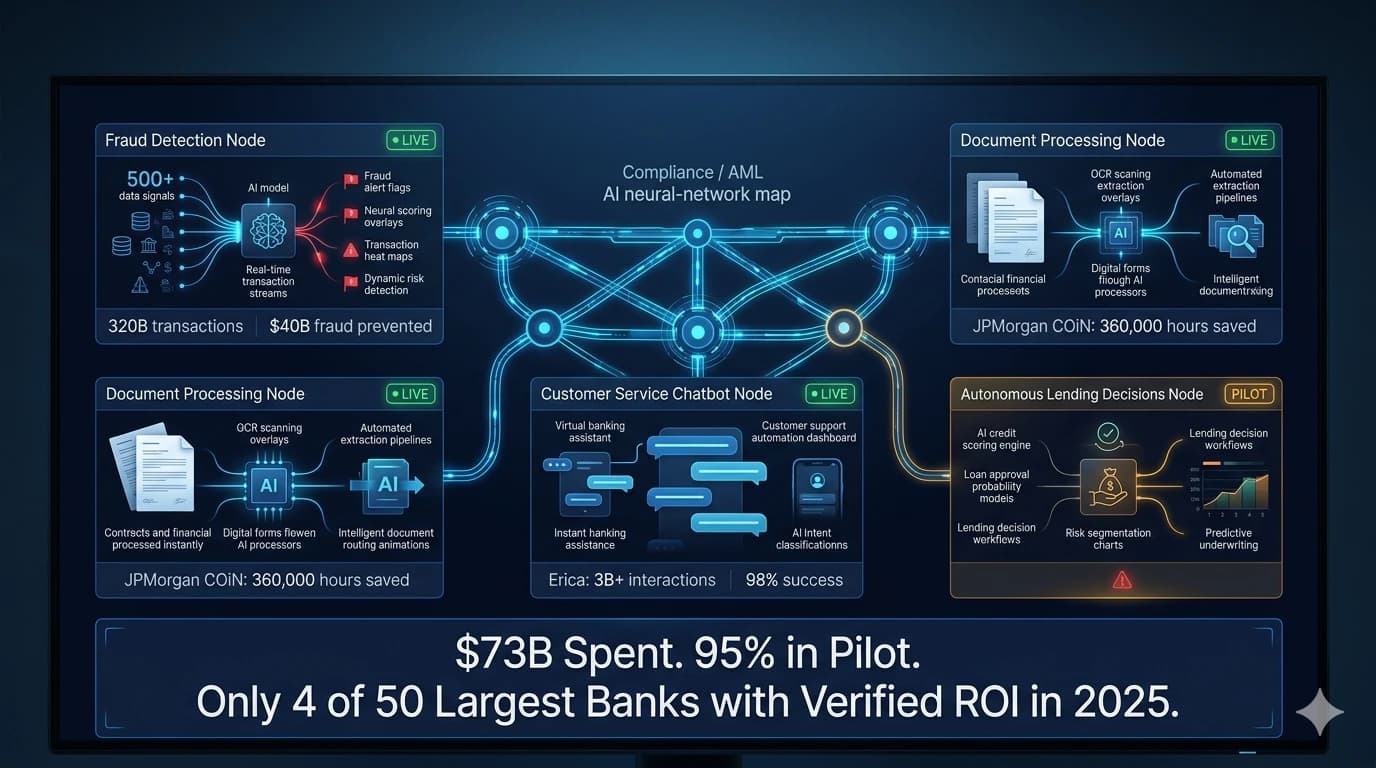
Here is the number those same conference decks do not feature: 95% of generative AI implementations in financial services remain in pilot phases rather than scaled production. Only 4 of the 50 largest banks reported realised return on investment from AI use cases in 2025. The gap between announced investment and verified production deployment is the widest it has ever been in banking technology. This is not a failure of AI technology — it is a failure of deployment methodology in an industry where the regulatory approval requirements, model explainability standards, and legacy system integration complexity make the path from pilot to production significantly longer than in other sectors.
But the 5% that is live is genuinely impressive. The institutions that have navigated from pilot to production share a consistent pattern: they deployed AI first in back-office and internal productivity functions before regulated client-facing functions, built data infrastructure and regulatory approval processes before scaling, and defined success metrics before contracts were signed. This guide maps what that 5% looks like in practice, where the remaining 95% is stuck, and what the deployment sequence looks like for institutions that want to move from one category to the other.
What Is Actually Live — Verified Production Outcomes From Major Banks
The following outcomes are documented production deployments with verified results — not vendor case studies, not projected ROI, not pilot outcomes presented as enterprise-wide results.
JPMorgan Chase — COiN Contract Intelligence Platform
COiN (Contract Intelligence) processes 12,000 commercial credit agreements in seconds — a task previously requiring 360,000 hours of annual lawyer and loan officer time. JPMorgan's firm-wide LLM Suite reaches 200,000+ employees, generating approximately $1.5 billion in annual business value. The bank targets $2.5 billion in total annual AI-driven value. COiN specifically supports over 300 use cases in production across the enterprise — the most extensive Wall Street AI rollout documented.
Bank of America — Erica Virtual Financial Assistant
Erica, Bank of America's AI-powered virtual financial assistant, has handled over 3 billion customer interactions at a 98% success rate. The chatbot handles Tier 1 customer service inquiries — balance queries, transaction history, account management, spending insights, bill payment assistance — deflecting 70% of routine banking customer queries at top North American institutions. AI chatbots in banking reduce call centre volume by 32% across documented implementations.
Goldman Sachs — GS AI Assistant Firm-Wide Rollout
Goldman Sachs completed a firm-wide rollout of its GS AI Assistant, reaching all 46,500 employees. The technology supports document drafting, code generation, research summarisation, market analysis, and internal knowledge retrieval. Goldman's approach — internal productivity AI deployed at scale before client-facing AI — represents the sequencing model that is producing measurable outcomes, vs the reverse sequence that is producing 95% pilot rates industry-wide.
Visa & Mastercard — AI Fraud Prevention at Scale
Visa's AI fraud system prevented over $40 billion in fraud across 320 billion analysed transactions — representing one of the most impactful production AI deployments in financial services history. Mastercard's Decision Intelligence Pro grew Value-Added Services revenue 22% year-on-year through AI fraud detection enhancements. PayPal's AI security engine blocks $500 million in fraud per quarter using 500+ transaction data points. These are not pilots: they are AI fraud systems processing billions of transactions in real time, daily.
The Full Use Case Map — Live vs Pilot vs Still Hype
| Use Case | Status | Documented Outcome |
|---|---|---|
| AI fraud detection / AML transaction monitoring | ✓ Live | $40B prevented (Visa), 80% false positive reduction, 35–55% alert precision vs 5–15% rule-based |
| AI-powered banking chatbots / virtual assistants | ✓ Live | 3B+ interactions at 98% success (Erica), 70% Tier 1 query deflection, 32% call centre volume reduction |
| Document processing / contract analysis | ✓ Live | JPMorgan COiN: 12,000 agreements in seconds, 360,000 hours saved. 90% reduction in paper-based verification |
| RPA back-office automation (reconciliation, reporting) | ✓ Live | 30–40% ROI, 60–70% faster processing, 45% error reduction in automated workflows |
| KYC / digital customer onboarding | ✓ Live | 4 minutes vs 20+ minutes manual; 90% paper-based process reduction in mid-tier banks |
| AI credit risk scoring (ML models) | ✓ Live | 25% faster loan processing, improved approval accuracy, JPMorgan credit scoring projections |
| Generative AI for customer personalisation | ⚡ Emerging | Limited production, strong pilot results. Regulatory approval for personalised financial advice creating deployment lag |
| Autonomous lending decisions (AI-generated) | ⚡ Pilot | Pilot stage at most institutions. EU AI Act high-risk classification creates compliance requirements before scaling |
| GenAI investment research / market analysis | ⚡ Emerging | Internal productivity deployments live (Goldman GS AI). Client-facing financial advice AI faces regulatory friction |
| Autonomous AI trading systems | ⚡ Limited | Quantitative and algorithmic trading AI live at specialist firms; fully autonomous AI trading decisions limited at regulated institutions |
RPA in Banking — The Decade-Long Foundation and Its 2026 Ceiling
Robotic Process Automation has been the primary banking automation technology for a decade. RPA bots automate structured, rule-based back-office tasks — processing invoices, reconciling accounts, generating regulatory reports, routing loan applications, verifying KYC documents, and populating data across core banking systems — typically delivering 30–40% ROI on these workflows. The European RPA in financial services market reached €6.41 billion in 2025, growing at 16.2% CAGR.
In 2026, banking institutions are confronting RPA's specific limitations: bots follow scripted steps and break when data formats or workflows change. They cannot handle unstructured documents (handwritten notes, variable-format contracts, regulatory guidance documents). They cannot reason through exceptions that fall outside their defined rules. In highly regulated, data-intensive banking environments where process exceptions are frequent and regulatory interpretations evolve continuously, these limitations are costly: every process change requires expensive bot reconfiguration, and every exception requires manual human intervention that partially offsets the automation gains.
❌ Traditional Banking RPA
- Follows scripted steps only — breaks on format changes
- Cannot process unstructured documents
- Cannot reason through regulatory exceptions
- Requires costly reconfiguration after process changes
- Cannot learn or improve from new data
- Every exception = manual human intervention
- 30–40% ROI on structured back-office workflows
✓ AI Agents in Banking
- Adapts to varied document formats and structures
- Processes unstructured text with NLP/OCR
- Reasons through regulatory edge cases with explainability
- Learns from feedback — continuously improves accuracy
- Handles exceptions autonomously within defined guardrails
- Boosts investigator productivity by hundreds of percent (AML)
- 3.5× ROI within 18 months across institutions
By 2026, banking institutions are treating RPA as a legacy layer. New automation projects are centred on AI agents and intelligent workflows rather than script-driven bots. The transition is not immediate — existing RPA estate represents significant operational investment that cannot be replaced overnight — but for any new banking automation initiative in 2026, the question is not "which RPA platform?" but "which AI agent architecture, and what is the regulatory approval pathway for this use case?"
The 6 Banking AI Systems With Verified Production ROI
AI Fraud Detection and AML Transaction Monitoring
AI fraud detection is the most mature and most commercially impactful banking AI use case in production. ML models analyse hundreds of transaction signals simultaneously — amount, merchant category, geographic location, device fingerprint, behavioural patterns, velocity, network relationships — to score each transaction for fraud probability in milliseconds. The performance improvement over traditional rule-based systems is substantial: rule-based AML generates 5–15% alert precision (85–95% of alerts are false positives requiring analyst review time with zero fraud outcome). Well-calibrated AI fraud models reach 35–55% alert precision within 90 days, with continued improvement as analyst feedback trains the model.
ACAMS estimates financial institutions spend 60–70% of compliance budgets on transaction monitoring and investigation. AI fraud detection directly compresses this cost: 40–60% reduction in false positives, 50%+ reduction in manual review costs, and compliance examination cycles measured in weeks rather than months. But there is an adversarial dynamic that banks must account for: GenAI-enabled fraud losses in the US are projected to reach $40 billion by 2027 — up from $12.3 billion in 2023 — as fraudsters use AI to generate synthetic identities, deepfake voice authentication bypasses, and highly personalised social engineering at scale.
- Real-time payment fraud scoring — each transaction scored before settlement
- AML transaction monitoring — network analysis across account relationships
- Synthetic identity detection — pattern recognition across application data points
- Account takeover detection — behavioural biometrics, device anomalies
- First-party fraud — detecting misrepresentation in loan applications
- SAR (Suspicious Activity Report) drafting assistance — AI generates draft text for analyst review
AI Banking Chatbots and Virtual Assistants
Banking virtual assistants are the most consumer-visible AI deployment in financial services. Bank of America's Erica set the production benchmark: 3 billion+ interactions at 98% success, handling account balance queries, transaction explanations, spending pattern analysis, bill payment assistance, credit score monitoring alerts, and proactive financial insights. AI chatbots now handle 70% of Tier 1 customer queries at top North American financial institutions. AI chatbots have contributed to a 32% drop in call centre volume across documented banking implementations, with average cost savings of $0.72 per chatbot interaction delivering high-volume ROI across large customer bases.
The performance ceiling for banking chatbots is defined by regulatory boundaries: virtual assistants can answer questions about existing products, transactions, and account status. They cannot provide personalised financial advice (regulated by SEC, FINRA, FCA depending on jurisdiction), make lending decisions, or process complaints with regulatory implications without human oversight. The institutions with the highest-performing banking chatbots have the clearest scope definitions — the AI knows exactly what it can answer and escalates everything else cleanly.
- Account balance and transaction history queries
- Fund transfers and bill payments within defined limits
- Product information — rates, fees, eligibility criteria
- Dispute initiation and case status tracking
- Card management — block, unblock, limit adjustments
- Spending insights and budget alerts from transaction data
Compliance Automation and Regulatory Reporting
Compliance automation is the banking AI use case with the widest regulatory approval pathway — because it automates the process of demonstrating compliance rather than making regulated decisions. 89% of banks report using AI to monitor regulatory compliance in real time in 2025. NLP tools automate regulatory reporting with 98% accuracy. AI has decreased compliance-related costs by an average of 19% across global financial institutions. Audit preparation time has been cut by 35% through AI-assisted documentation generation and control testing.
Banks spend 10–15% of full-time staff specifically on KYC/AML — yet traditional approaches detect only about 2% of global crime flows. AI compliance automation compresses the human review burden on low-risk alerts, enabling compliance teams to concentrate their expertise on genuinely suspicious cases. Agentic AI systems now execute tasks like screening sanctions, making preliminary risk decisions, and generating SAR draft reports with limited human oversight — with human investigators reviewing and approving before filing.
- Regulatory report generation — CCAR, DFAST, Basel III, MiFID II reporting
- Real-time regulatory text monitoring — flag relevant rule changes automatically
- Control testing documentation — automated evidence gathering for audit cycles
- Sanctions screening — automated cross-reference against OFAC, UN, EU lists
- SAR draft generation — NLP-based narrative from case data for analyst review
- Policy compliance monitoring — alert on transactions that approach regulatory thresholds
KYC and Digital Customer Onboarding
Digital KYC onboarding has been compressed from 20+ minutes of manual document review to under 4 minutes through AI-powered document verification, identity matching, and risk scoring. AI document processing has reduced paper-based verification processes by 90% in mid-tier banks. A customer uploads their identity document; AI extracts and validates the document data, matches against government databases, applies risk scoring based on customer profile and account type, and completes the onboarding workflow automatically for standard cases — escalating to human review for elevated-risk profiles or incomplete documentation.
- Document extraction — OCR extraction from passports, driving licences, utility bills
- Identity verification — liveness detection, biometric matching, database cross-reference
- Risk scoring — customer risk profiling for AML risk categorisation
- PEP/sanctions screening — automated Politically Exposed Person and sanctions database check
- Ongoing monitoring — continuous re-screening against updated sanctions lists
- Enhanced due diligence routing — flagging high-risk customers for human review
Document Processing and Contract Analysis
Document processing AI is the use case where JPMorgan's COiN created the banking industry's most-cited production AI outcome. The system processes 12,000 commercial credit agreements in seconds — extracting key terms, payment conditions, covenant triggers, and legal clauses from contracts that previously required lawyers and loan officers to read manually. The 360,000 hours saved annually represents one of the clearest ROI calculations in banking AI: a defined document volume, a measured processing time before and after, and a cost per lawyer-hour that makes the annual value straightforward to quantify.
Loan processing AI applies the same approach to consumer and commercial loan applications: extracting financial statement data, verifying income documentation, cross-referencing credit bureau reports, and populating loan origination systems. Banks report 25% faster loan processing time with AI-driven document extraction and verification. The AI handles the structured data extraction and system population; credit decisions involving judgment about creditworthiness remain with human underwriters, supported by AI-generated risk summaries.
- Credit agreement analysis — term extraction, covenant identification, anomaly flagging
- Mortgage document verification — income verification, asset documentation, title review support
- Loan application data extraction — financial statement parsing, income normalisation
- Regulatory document monitoring — new guidance extraction and impact assessment
- Contract due diligence — M&A, lending, and securitisation document review
- Invoice and payment processing — data extraction, matching, reconciliation
RPA in Banking — Back-Office Automation (The Foundation)
RPA in banking remains the foundation of back-office automation for structured, rule-based, high-volume workflows where the process is well-defined, the data is structured, and the format is consistent. Account reconciliation, payment processing, transaction posting, regulatory report population, and account maintenance workflows all have active RPA deployments across major banks, delivering the 30–40% ROI that made RPA the dominant banking automation technology of the 2015–2024 period. The BFSI sector is expected to capture 35% of global intelligent automation revenues as institutions invest in combining RPA foundations with AI agent capabilities.
The 2026 distinction: for net-new automation projects in banking, the question is whether the workflow is better served by RPA (structured, consistent format, no judgment required) or AI agents (unstructured, variable format, judgment required for exceptions). Existing RPA deployments continue delivering their value; new automation investment is increasingly directed toward AI agents for the workflows that break RPA bots.
- Payment reconciliation — automated matching of payment records across systems
- SWIFT message processing — automated parsing and routing of structured messages
- Regulatory report population — data extraction from defined sources into report templates
- Account statement generation — automated compilation from transaction data
- Trade confirmation and settlement — matching confirmations, flagging discrepancies
- Fraud alert triage routing — directing alerts to appropriate investigation queues
Is your banking AI investment in the 5% with verified production ROI — or the 95% still in pilot?
Automely's banking AI consultation maps your highest-ROI first deployment and the regulatory approval pathway. Free 45-minute call.
The Regulatory Landscape — What Banks Must Comply With Before Deploying AI in 2026
| Regulation | Jurisdiction | Requirement for AI in Banking | Deadline |
|---|---|---|---|
| EU AI Act — High Risk Classification | EU / EEA | AI systems for credit scoring, lending decisions, and AML classified as high-risk. Requires conformity assessment, explainability, human oversight, registration. Penalties: up to 7% of global annual turnover for non-compliance. | 2 August 2026 |
| SR 11-7 Model Risk Management | US Federal (Fed / OCC) | All models used in banking decisions require documented development, validation by independent teams, and ongoing monitoring. AI/ML models are subject to the same governance requirements as traditional statistical models. | Ongoing |
| ECOA / Fair Lending (US) | US Federal | AI credit scoring models must comply with fair lending requirements — no disparate impact on protected classes. Adverse action notices must explain AI-generated credit decisions in terms customers understand. | Ongoing |
| GDPR — Automated Decision-Making | EU / EEA | Article 22 restricts solely automated decisions with significant effects on individuals. AI credit decisions and AML determinations must either include meaningful human involvement or provide opt-out rights. | Ongoing |
| BSA / FinCEN AML Requirements | US Federal | AI AML systems must maintain complete audit trails of all alerts generated and actions taken. SAR filings must be based on human review and decision, not autonomous AI determination. Explainability of flagging logic required for regulatory examination. | Ongoing |
High-risk AI systems used in credit scoring, lending decisions, and AML must comply with the EU AI Act by 2 August 2026. Penalties for non-compliance reach up to 7% of global annual turnover — the highest penalty tier in EU regulatory history. Banks with AI in credit scoring or AML that have not completed conformity assessments, established human oversight mechanisms, and registered in the EU AI database must remediate before this deadline. The conformity assessment process for high-risk AI requires documentation of training data, model validation methodology, bias testing results, and ongoing monitoring procedures — a 3–6 month process that must begin immediately for institutions that have not started.
The Implementation Sequence That Separates the 5% From the 95%
The institutions that have produced verified production ROI from banking AI share a consistent deployment sequence. The institutions still in pilot follow the reverse — deploying complex, regulated, client-facing AI before building the data and governance infrastructure that makes those deployments sustainable.
- Deploy internal productivity AI first. Goldman Sachs, JPMorgan, and Bank of America all deployed internal AI tools (document analysis, code generation, knowledge retrieval) to large numbers of employees before deploying client-facing AI. This builds AI literacy, creates institutional knowledge about what works and what fails, and produces measurable productivity gains without the regulatory approval burden of regulated client-facing deployments. JPMorgan's LLM Suite serving 200,000 employees preceded their expansion into regulated use cases.
- Build the data infrastructure that regulated AI requires before building the models. Banking AI in regulated use cases (credit, AML, lending) requires clean, consistent, auditable data with documented lineage. Legacy core banking systems were not designed for AI-ready data access. Data modernisation — cleaning historical data, building API access layers, establishing data governance — is the prerequisite investment that most 95%-in-pilot banks skipped. Model performance is a function of data quality; if the data foundation is not ready, no model architecture produces regulatory-grade outputs.
- Engage regulators before production deployment, not after. The fastest path from pilot to production for regulated banking AI is the one that includes regulatory engagement from the project definition stage. SR 11-7 model validation, EU AI Act conformity assessment, fair lending disparate impact testing — these are not post-deployment activities. Institutions that include regulatory and compliance teams in AI project design from the start consistently reach production deployment faster than those that treat regulatory approval as a final gate.
- Define success metrics before signing vendor contracts. The most common banking AI failure pattern (after data problems) is ambiguous success criteria. A fraud AI pilot that reduces false positives by 40% but adds 2 weeks to the regulatory examination process has not delivered ROI. Define the metrics before deployment — alert precision rate, false positive reduction, examiner-facing explainability quality, regulatory approval processing time — and contract for outcomes against those specific metrics, not against feature sets.
- Scale via parallel validation, not big-bang deployment. Every documented banking AI production success used a parallel validation period: running the AI model alongside the existing process (RPA or manual), comparing outputs, measuring performance against defined thresholds, and only transitioning volume from the old process to the AI after validated production performance. Big-bang deployments in regulated banking contexts produce regulatory findings and operational incidents. Parallel validation produces audit-ready evidence of model performance that regulators accept.
Building Banking AI and RPA Systems with Automely
Automely's AI agent development, AI integration services, and AI consulting services cover the full stack of banking AI implementation — AI fraud detection and AML automation, RPA for back-office workflows, KYC and onboarding AI, compliance reporting automation, AI customer service chatbots for banking, document processing with OCR/NLP, and the transition from legacy RPA estate to AI agent architecture.
All Automely banking AI implementations include regulatory compliance design from the start: SR 11-7 model documentation architecture, EU AI Act conformity assessment preparation for high-risk use cases, ECOA fair lending testing for credit AI, and GDPR Article 22 human-in-the-loop design for automated decisions. We do not deploy banking AI without the regulatory approval architecture in place — because the compliance finding that follows a live deployment without proper governance is significantly more expensive than building governance correctly from day one.
For the closest parallel in regulated-sector AI implementation, see our RPA in healthcare guide — the HIPAA compliance architecture mirrors the SR 11-7 and EU AI Act requirements for banking AI. For the AI chatbot implementation principles applicable to banking customer service, see our AI chatbot solutions guide. For the broader enterprise AI deployment sequence across regulated industries, see our enterprise AI solutions guide.
Ready to move your banking AI from pilot to production — with the regulatory compliance architecture built in from the start?
Book a free 45-minute banking AI consultation. We map your use case, scope the regulatory approval pathway, and identify the data infrastructure requirements before any development begins.