

The $496 Billion Administrative Tax on US Healthcare
US patients and healthcare providers pay approximately $496 billion annually in billing and insurance-related costs. This is not the cost of care. It is the cost of the paperwork surrounding care — the insurance claim submissions, the eligibility verifications, the prior authorisation requests, the denial appeals, the payment reconciliations, and the compliance reports that consume clinician and administrative staff time at every stage of the care delivery process.
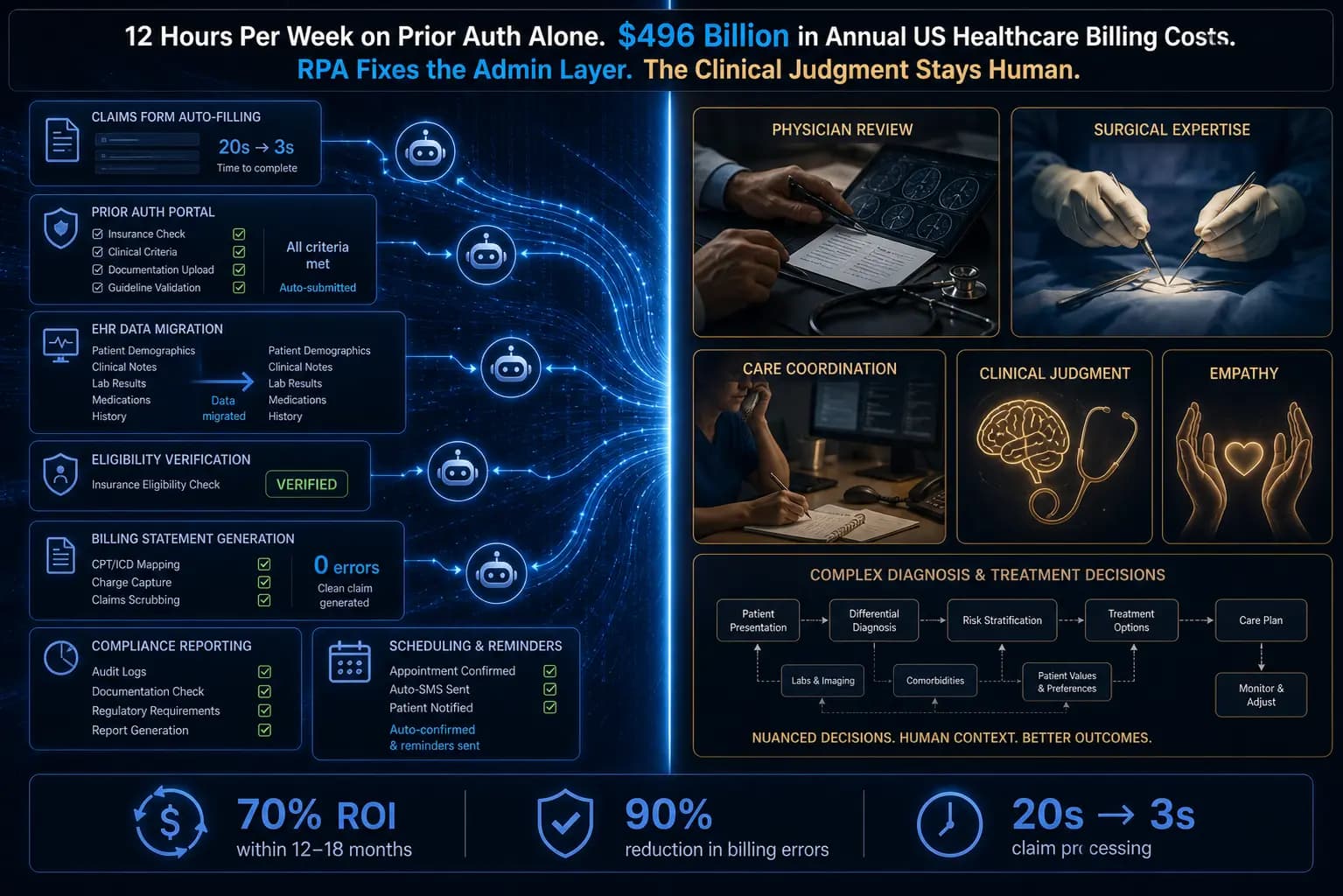
The American Medical Association's 2024 prior authorisation survey found that physicians and their staff spend an average of 12 hours per week on prior authorisation alone. Twelve hours per week, per physician, on a process that adds no clinical value whatsoever — it exists solely to satisfy insurance payer requirements. Multiply that across the 756,000 actively practicing physicians in the United States and you have a staggering volume of clinical workforce time consumed by administrative tasks that software bots can execute faster, with higher accuracy, and without burning out.
This is the problem robotic process automation in healthcare is designed to solve. Not the clinical work. Not the diagnosis. Not the patient relationship. The administrative layer that sits between the care and the payment for that care — rule-based, repetitive, structured, high-volume — is precisely the environment where RPA delivers its most significant and most measurable returns.
What RPA Is — and What Separates It From AI
Robotic process automation in healthcare is frequently misunderstood in two directions: confused with physical robots (it is purely software) and conflated with AI (it operates on predefined rules, not learned models). Getting this distinction right matters for implementation because it determines which workflows are candidates for RPA, which require AI, and which require both.
An RPA bot is a software agent that operates within existing applications — the same applications that human staff use — navigating screens, clicking buttons, filling forms, extracting data, and transferring information between systems. It does exactly what a human would do, on the same interfaces a human would use, at machine speed, 24 hours a day, without fatigue or transcription errors. The bot does not “think” — it follows a defined sequence of steps. When the steps are clear, consistent, and rule-based, the bot executes them with perfect fidelity. When exceptions occur that fall outside the defined rules, the bot routes the case to a human for resolution.
Use RPA when: the task follows explicit rules, involves structured data, repeats at high volume, and does not require judgment. Eligibility verification, claims submission, appointment reminders, payment posting — these are RPA candidates. Use AI when: the task involves unstructured data (clinical notes, referral letters, physician queries), requires pattern recognition or prediction, or needs to adapt to situations that were not explicitly programmed. Clinical documentation support, diagnostic assistance, predictive analytics — these require AI. Use intelligent automation (RPA + AI) when: the workflow involves both structured and unstructured data — prior authorisation with supporting clinical documentation is the most common example, where RPA handles the form submission and AI processes the clinical justification text.
The 8 Highest-ROI Healthcare RPA Use Cases
Claims Processing and Denial Management
Claims processing is the single highest-volume administrative workflow in healthcare organisations and the highest-ROI RPA target. A single RPA bot can extract procedure codes and patient data from the EHR, verify them against payer requirements, generate the claim, submit it through the payer's EDI system (HIPAA X12 837 transaction), check status, receive remittance (HIPAA X12 835), and reconcile the payment against the expected amount — all without human involvement for clean claims. When denials occur, the bot sorts them by denial reason code, routes straightforward denials to automated correction and resubmission workflows, and escalates complex denials to human coders.
The Medicare Fee-for-Service improper payment rate stood at 7.66% in fiscal year 2024, representing $31.70 billion in improper payments — a problem that consistent, rule-compliant RPA claims processing is uniquely positioned to reduce. Claims with mismatched CPT and ICD-10 codes are flagged before submission rather than after denial.
- Extract procedure (CPT code) from appointment records and EHR
- Verify against diagnosis (ICD-10) — flag mismatches before submission
- Generate and submit claim to payer via EDI/API
- Check status on payer portal; retrieve approval or denial
- Post approved payment to billing system; reconcile against expected amount
- Route denials by reason code — automate simple corrections, escalate complex cases
Prior Authorisation Automation
Prior authorisation is one of the most time-intensive administrative burdens in healthcare — physicians and staff spend an average of 12 hours per week on prior auth, and healthcare providers collectively spend $35 billion annually on related administrative costs. The process is almost entirely rule-based: identify which service requires authorisation, log into the payer portal, populate the auth request form with patient demographics and clinical data, submit, record the confirmation number, and periodically check for status updates. Every one of these steps is executable by an RPA bot.
RPA prior auth bots log into each payer's portal (or use the payer's API where available), navigate to the authorisation request section, auto-populate the form with data pulled directly from the EHR, submit the request, record the submission confirmation, set a status check schedule, and trigger notifications to clinical staff and patients when authorisation is approved or denied. The clinical justification documentation — where physician input is genuinely required — remains with the clinician. The administrative execution of that submission process does not.
- Identify procedure requiring authorisation from EHR appointment record
- Log into payer portal or access payer API
- Auto-populate auth request with patient demographics and clinical data from EHR
- Submit request; record confirmation number in EHR and billing system
- Set periodic status check — retrieve approval or denial when available
- Trigger notifications to clinical staff and patient; update EHR with decision
Patient Registration and Data Entry
Patient registration involves collecting demographic, insurance, and contact information from patient intake forms and entering it consistently into the EHR, billing system, insurance verification system, and any other clinical platforms the practice uses. Manual data entry across multiple disconnected systems is the primary source of patient demographic errors — wrong insurance ID numbers, incorrect date of birth, transposed phone numbers — that cascade downstream into billing failures and claims denials. An RPA bot extracts data once from the source intake form and populates all downstream systems consistently, eliminating the re-entry errors that manual double-entry produces.
- Extract patient demographics from digital intake forms or scanned documents (with OCR)
- Validate completeness — flag missing required fields before EHR entry
- Populate EHR, billing system, scheduling system, and insurance portal simultaneously
- Check for duplicate records; merge or flag for human review
- Trigger insurance eligibility verification on completion of registration
Insurance Eligibility Verification
Insurance eligibility verification before each patient appointment ensures that the service is covered, that the patient's deductible and copay are accurately established, and that the encounter is coded and billed against the correct insurance plan. Manual eligibility checks require staff to log into each payer's portal, enter patient data, retrieve benefit information, and manually update the patient's record — a process that takes multiple minutes per patient and is frequently skipped or batched so infrequently that policy lapses go undetected. RPA bots run eligibility checks automatically for every scheduled appointment, 24–48 hours before the encounter, and update the patient's insurance record with the verified benefit details before the patient arrives.
- Pull appointment schedule — identify upcoming appointments requiring eligibility check
- Submit eligibility request to each patient's insurer via API or portal navigation
- Receive coverage status, deductible, copay, and benefit details
- Update patient record in EHR and billing system automatically
- Flag lapsed or inactive coverage for immediate staff attention
- Generate patient financial responsibility estimate for point-of-service collection
Medical Billing and Payment Posting
Medical billing workflows span from charge capture through patient statement generation, payment processing, and accounts receivable management. RPA handles the structured, rule-based components of this workflow: generating patient billing statements from encounter data, posting insurance payments from remittance advices to the correct patient accounts, reconciling payments against expected reimbursements, flagging underpayments and overpayments for review, and sending automated payment reminders to patients with outstanding balances at defined intervals. CareCloud reports 70–80% reduction in claim processing time and 90% reduction in billing errors for practices using RPA-powered billing workflows.
- Generate patient billing statements from encounter and insurance payment data
- Post remittance payments to correct patient accounts — match against expected reimbursement
- Flag discrepancies (underpayments, denials, zero-pays) for staff review
- Send automated payment reminders at 30, 60, 90-day intervals
- Generate accounts receivable reports and ageing summaries automatically
Appointment Scheduling and Reminders
Appointment scheduling, confirmation, and reminders are high-frequency, low-complexity interactions ideally suited for RPA and conversational automation. Bots integrated with scheduling systems handle online appointment booking, send automated confirmation messages via the patient's preferred channel (SMS, email, patient portal), dispatch reminders at 48-hour and 24-hour pre-appointment intervals, process cancellations and trigger waitlist notifications, and send no-show follow-up messages offering rescheduling options. CareCloud reports 15% reduction in late cancellations through automated reminder workflows — directly recovering revenue that would have been lost to empty appointment slots.
- Online appointment booking integrated with provider scheduling system
- Immediate confirmation message via SMS, email, or patient portal
- Automated reminders at 48-hour and 24-hour pre-appointment intervals
- Cancellation processing with automatic waitlist notification
- No-show follow-up with rescheduling link and next available slot
- Post-appointment satisfaction survey dispatch
Compliance and Regulatory Reporting
Healthcare compliance reporting requires extracting data from multiple clinical and administrative systems and compiling it into standardised reports for CMS quality programmes, state health departments, payer quality initiatives, and internal compliance monitoring. The data extraction and compilation steps are entirely rule-based — defined data elements from defined system fields, formatted to defined specifications, submitted on defined schedules. RPA handles the extraction, compilation, validation (checking completeness against submission requirements), and submission of regulatory reports, maintaining complete audit trail logs of every data point extracted, every report generated, and every submission made.
- Extract required data elements from EHR and administrative systems on schedule
- Validate completeness against CMS or payer submission requirements
- Generate report in required format (XML, CSV, portal-specific)
- Submit to CMS, state portal, or payer quality system
- Log submission confirmation; retain audit trail of all data extracted
- Alert compliance team of submission failures or validation errors
Discharge Documentation and EHR Data Management
Discharge documentation requires extracting structured data from multiple EHR modules — admissions records, nursing notes, lab results, medication records, procedure records — and compiling them into a standardised discharge summary. The extraction and compilation of structured data elements across these modules is a task bots can execute in minutes, compared to the 30–60 minutes of manual data assembly that discharge documentation typically consumes. Clinicians then review and finalise the narrative sections — diagnosis, treatment rationale, care plan — that require clinical judgment. RPA also handles data migration between EHR systems, a particularly complex task that involves mapping data fields between source and destination systems, validating migrated data integrity, and flagging records that require manual review.
- Extract structured data elements from admissions, nursing, lab, medication, and procedure modules
- Compile standardised discharge summary template with extracted data pre-populated
- Route completed draft to clinician for review and narrative completion
- Post-review: distribute to referring physician, PCP, and patient portal
- Archive to patient record with audit timestamp
Which of these 8 RPA use cases recovers the most administrative cost in your healthcare organisation?
Automely's healthcare RPA consultation maps your highest-volume workflows and identifies the fastest ROI first implementation. Book a free 45-minute call.
Documented ROI Cases — What Healthcare RPA Has Delivered in Production
Care1st Health Plan Arizona — Claims Processing
Implemented RPA bots for claims processing workflow. Result: individual claim processing time reduced from 20 seconds to 3 seconds — a 6.7× speed improvement on a task executed millions of times annually.
Avera Health — Account Management
Deployed RPA bots to check user account status and notify managers about pending and incomplete claims. Eliminated the manual monitoring workflow that consumed significant staff time across their 5-state health system.
Waystar + Baylor Scott & White Health — Patient Financial Estimation
AI-powered RPA automated 70% of patient cost estimates using real-time insurance data. Increased point-of-service collections by 60–100% by providing accurate cost estimates before the encounter rather than billing surprises after it.
UiPath + Omega Healthcare — Revenue Cycle Management
Expanded partnership automating over 100 million annual transactions in revenue cycle management — spanning denial management, claims submission, eligibility verification, and payment posting. 75% of the top 100 US health systems use UiPath for healthcare automation.
Across documented implementations, the headline metrics are consistent: nearly 70% of healthcare organisations achieve full ROI within 12–18 months. McKinsey estimates 30% reduction in claims processing costs for organisations that automate 60–70% of claims administration actions. Hospitals using RPA for insurance verification report 30–50% faster processing times with direct cash flow improvement from faster, more accurate claims cycles.
What Stays Human — The Clinical Boundary RPA Cannot Cross
The most important section of any honest guide to RPA in healthcare is not what the technology can do. It is the clear delineation of what it absolutely should not do — the clinical and human functions that automation cannot replicate and that, if automated, would create patient safety risks, ethical failures, and legal liability that no efficiency gain could justify.
Clinical Diagnosis and Treatment Decisions
RPA can retrieve and display patient data; it cannot interpret symptoms, apply differential diagnosis reasoning, or formulate a treatment plan. Clinical judgment requires integrating formal medical knowledge, patient-specific context, risk tolerance, ethical considerations, and real-time physical assessment — a reasoning process that rule-based bots cannot execute and that AI, in 2026, cannot safely replicate without human oversight on every output. Every diagnostic and treatment decision remains with a licensed clinician. Always.
Patient Communication on Complex and Sensitive Topics
Informing a patient of a serious diagnosis, discussing prognosis and end-of-life options, navigating a patient's anxiety about a procedure, and addressing a family's concerns about a care plan — these conversations require empathy, real-time emotional attunement, the ability to adapt to what the patient needs in the moment, and the human presence that is itself therapeutic. RPA can send appointment reminders and balance notifications. It cannot hold a patient's hand through a difficult conversation.
Clinical Documentation Requiring Interpretation
RPA can extract structured data fields and pre-populate document templates. The narrative sections of clinical documentation — the diagnostic reasoning, the clinical impression, the care plan rationale, the assessment of complex social factors — require clinician authorship. These are not form fields with defined values; they are professional judgments expressed in text. AI can assist with the drafting layer (summarisation, template population), but the clinical content and its accuracy is the clinician's professional responsibility.
Ethical and Clinical Judgment Calls
Healthcare constantly generates situations that fall outside defined rules — a patient who declines a recommended treatment, a family disagreement about care, a clinical situation where evidence-based guidelines conflict with the patient's specific circumstances, resource allocation decisions under constraints. These require human judgment that weighs competing values, respects patient autonomy, and exercises professional discretion. Automating these decisions — or creating systems that appear to automate them — creates both safety risks and legal liability.
Care Coordination Requiring Contextual Reasoning
Understanding how a patient's social circumstances (housing instability, caregiver availability, health literacy, mental health co-morbidities, cultural context) interact with their clinical situation to shape the right care pathway requires human care coordinators who can hold complexity, build relationships, and make judgments that data alone cannot produce. RPA supports this work by reducing the administrative tasks that coordinators perform — it does not replace the coordination itself.
Healthcare RPA should be designed as a system that frees clinical and administrative staff from the rule-based, high-volume administrative tasks that consume their time — so they spend proportionally more time on the work that requires their professional training, judgment, and human presence. The metric is not “how much can we automate?” It is “how much higher-value work can our staff do when the administrative burden is lifted?” The best healthcare RPA implementations are evaluated on both measures: administrative efficiency improved, and clinician time for patient care recovered.
HIPAA Compliance for Healthcare RPA — The Non-Negotiable Architecture
Every healthcare RPA implementation processes Protected Health Information (PHI) — patient names, dates of birth, insurance identifiers, diagnoses, procedure codes, and financial information. HIPAA's Security Rule and Privacy Rule apply fully to RPA systems that access, process, or transmit PHI. Designing HIPAA compliance into the RPA architecture from the start is not optional — and is significantly cheaper than retrofitting it after a compliance audit or a breach incident.
Encrypted Data Transmission
All data transmission between the RPA bot and the systems it interacts with — EHR, payer portals, billing platforms, email systems — must use encrypted protocols (TLS 1.2 or higher). PHI at rest within the RPA platform's bot storage must be encrypted. Any temporary files created during bot execution must be encrypted and deleted after use.
Role-Based Bot Access Control
RPA bots must access only the data and systems their specific tasks require — principle of least privilege. A claims processing bot should have access to billing and claims systems, not to clinical notes or mental health records. Bot credentials must be managed through the organisation's identity management system, not stored in plain text within bot scripts. Access permissions must be reviewed and recertified on a regular schedule.
Complete Audit Trail Logging
Every bot action that accesses, processes, or transmits PHI must be logged: which bot, which workflow, which patient record, what data was accessed, what action was taken, at what timestamp. This audit trail is both a HIPAA requirement (for breach investigation and audit response) and an operational requirement (for diagnosing bot errors and demonstrating compliance to payers and regulators).
PHI Minimisation in Bot Workflows
Bots should process the minimum PHI necessary for each task. Data extracted from one system for submission to another should not be retained in bot memory or logs beyond the duration of the task. Temporary files containing PHI should be automatically deleted after successful task completion. PHI should never appear in bot activity logs in plain text — reference IDs should be used instead where possible.
Business Associate Agreements with RPA Vendors
Any RPA platform vendor whose software processes PHI on behalf of a covered entity is a Business Associate under HIPAA and must execute a Business Associate Agreement (BAA) before deployment. UiPath, Automation Anywhere, Blue Prism, and Microsoft Power Automate all provide HIPAA-compliant deployment configurations and BAA provisions. The BAA must be in place before the first bot accesses PHI in any environment, including testing.
Implementation Sequence — Where to Start With Healthcare RPA
Process discovery — map your highest-volume, most repetitive administrative workflows
Before selecting a first RPA use case, conduct a structured process discovery with clinical, financial, and operations leaders. Identify the workflows that: (a) consume the most staff time, (b) involve the least clinical judgment, (c) have the most consistent and well-documented rules, and (d) generate measurable financial impact when errors occur or processing is delayed. Prior authorisation and claims processing consistently meet all four criteria in most healthcare organisations. Document the exact steps in each identified process — a bot can only be programmed to what can be written down.
Establish HIPAA compliance architecture before writing the first bot
Engage your compliance officer, IT security team, and legal counsel before scoping the technical architecture. Confirm which RPA platforms have BAA provisions. Design the encryption, access control, audit logging, and PHI minimisation controls as architecture requirements — not as post-build additions. This pre-work adds 2–4 weeks to the project timeline and prevents the 3–6 month retrofitting that occurs when compliance requirements are discovered after bots are in production.
Build and test in a sandbox before any production PHI touches the bot
RPA development and testing must occur in a test environment with synthetic or de-identified data — never with production PHI. Test environments must mirror production systems sufficiently to catch the interface changes and exception cases that cause bots to fail. A bot that fails in production on a live claims submission can create denials, delayed payments, and compliance incidents that are more expensive than the efficiency gains the bot was designed to produce.
Run parallel operations for the first 30 days — bots and humans simultaneously
For the first 30 days after production deployment, run the RPA workflow in parallel with the manual workflow — the bot executes the process, and staff verify a sample of outputs against the manual result. Compare bot outputs against human outputs; investigate every divergence. This parallel operation period identifies the edge cases and exception scenarios that were not captured in process documentation, builds staff confidence in bot outputs, and provides the documented evidence that the bot is functioning correctly before manual processes are wound down.
Measure, document, and use ROI to fund the next wave
At 60 and 90 days post-deployment, measure the specific metrics you established at the start: claims processing time before vs after, denial rate before vs after, staff hours on prior authorisation before vs after, error rate before vs after. Document these in a format your CFO can use for budget conversations. At 70% of healthcare organisations, RPA investments achieve full ROI within 12–18 months. The documented return from your first bot is the business case that funds the second, third, and fourth without requiring a new capital request.
Building Healthcare RPA with Automely
Automely's AI agent development, AI integration services, and AI consulting services cover the full stack of healthcare RPA and intelligent automation implementations — claims processing bots, prior authorisation automation, patient registration workflows, EHR data management, medical billing automation, scheduling systems, compliance reporting, and discharge documentation pipelines.
All Automely healthcare RPA implementations include HIPAA compliance architecture from the start: encrypted data transmission protocols, role-based bot access controls, complete PHI audit trail logging, PHI minimisation design, and Business Associate Agreement provisions with all platform vendors. We do not treat compliance as a post-build checkbox — it is a design input at the architecture stage, because retrofitting HIPAA controls after a bot is in production is consistently more expensive and more disruptive than designing them correctly the first time.
Browse our case studies and our full AI services portfolio. For the broader intelligent automation context, see our business workflow automation guide — the process discovery and parallel operations phases described here apply equally to any AI or automation implementation.
Ready to recover the 12 hours per week your physicians spend on prior authorisation and redirect it to patient care?
Book a free 45-minute healthcare RPA consultation. We will scope the HIPAA compliance architecture, process discovery, and first-bot implementation — before any development commitment.