


Clinical AI gets the headlines — diagnostic imaging, drug discovery, genomic analysis. These are genuinely consequential applications, and they will reshape medicine over the next decade. But they also take years to validate, require regulatory approval, and demand specialised infrastructure that most clinics and hospitals do not have.
Operational AI is different. It is available now. It does not require FDA approval. It generates measurable ROI in 60–90 days. And it targets the part of healthcare spending that most administrators already know is indefensible: the 30–40% of healthcare organisation costs that come from administrative overhead — scheduling staff, billing and coding teams, documentation hours, and patient communication functions that repeat the same tasks thousands of times per week.
This guide covers the six healthcare AI operational use cases generating the most consistent ROI in 2026 — with honest implementation timelines, the compliance requirements that govern each, and the implementation sequence that most healthcare organisations should follow.
The Administrative Burden That Makes Operational AI Healthcare's Most Urgent Problem
A physician in the United States in 2026 spends an average of 50% of their total working hours on documentation, billing, scheduling coordination, and administrative communication — not on patient care. In some specialties and practice environments, that percentage is higher. This is not a technology problem that has been ignored. It is a problem where prior generations of software — EHR systems, scheduling platforms, billing software — provided structure but not intelligence. They moved administration from paper to screens without reducing the time it consumed.
AI addresses this differently. Rather than giving a staff member a better interface for the same task, AI handles the task entirely — generating the documentation, validating the billing codes, managing the scheduling, sending the reminders, tracking the referrals — and alerting a human only when a decision requires judgment that the AI is not authorised to make. The shift from tool to agent is what BCG describes as the fundamental healthcare AI transition in 2026: from systems that assist humans with tasks to systems that own and complete entire administrative workflows.
Operational AI handles administrative, scheduling, billing, documentation, and communication workflows. Available now, no FDA approval required, ROI measurable within 90 days. Clinical AI assists with diagnosis, treatment planning, imaging analysis, and clinical decision support. Subject to FDA regulation, validation requirements, and liability considerations. This guide covers operational AI. Clinical AI deserves its own guide — and a very different implementation conversation with your legal and compliance team.
Agentic AI — The 2026 Shift From Tool to Autonomous Healthcare Workflow
The most significant development in healthcare AI in 2026 is the shift from reactive to proactive AI — what the industry is calling agentic AI. Traditional healthcare AI was reactive: a staff member triggered it, it processed the input, and it returned an output for the human to act on. Agentic AI initiates, monitors, and completes workflows without being triggered for each individual task.
🔁 Automatic appointment confirmation
The system monitors scheduled appointments, sends confirmations at defined intervals, interprets patient responses, handles rescheduling requests, and flags no-shows to a human coordinator — without manual trigger.
⚠️ Clinical risk identification
The system monitors patient data streams, identifies patients overdue for follow-up based on their clinical profile, and generates outreach tasks for care coordinators — before the patient calls.
🧾 Billing validation without review
The system extracts billing codes from completed clinical notes, validates against procedure documentation, flags denial-risk codes for human review, and submits clean claims automatically.
📋 Referral tracking and follow-through
The system tracks every outbound referral, monitors whether the patient has been seen by the specialist, and alerts the care coordinator when a referral has not progressed within the expected timeframe.
The practical significance of agentic AI in healthcare operations is that it changes the staffing model for administrative functions. A scheduling team that previously managed 200 appointment confirmations per day manually now manages 20 exceptions flagged by an AI system that handled the other 180 autonomously. The staff's role shifts from execution to oversight — higher-value work, less burnout, and the same output with fewer hours.
The 6 Highest-ROI AI Use Cases in Healthcare Operations
Patient Scheduling and No-Show Reduction
No-show rates at US clinics average 18–22%. Each missed appointment represents lost revenue ranging from $150 (primary care) to $850 (specialist procedures). AI-powered scheduling systems address this through two mechanisms: predictive risk scoring (identifying patients with high no-show probability based on historical patterns and sending additional confirmation touchpoints) and multi-channel reminder sequences (automated SMS, email, and voice reminders timed to maximise response rates for each patient's communication preference).
The ROI is immediate and measurable. A 200-appointment-per-day clinic reducing its no-show rate from 20% to 14% recovers 12 additional appointments per day — at $200 average revenue per appointment, that is $2,400 per day in recovered revenue, or approximately $600,000 annually, from a single AI implementation.
Multi-channel reminder sequences, rescheduling requests, waitlist management for newly opened slots, no-show prediction scoring, patient preference tracking across appointments.
Ambient Clinical Documentation
Ambient AI documentation systems listen to clinical encounters — with patient consent — and generate structured clinical notes in real time that are ready for physician review and EHR submission within seconds of the encounter ending. The physician reviews, edits where needed, and approves. Documentation that previously took 2–3 hours of after-hours charting per physician per day is completed during the clinical encounter itself.
The financial value of this time return is substantial. A physician earning $300,000 annually works approximately 2,500 hours per year. Two hours of documentation returned per day represents 500 hours per year — 20% of total work time — at a physician value of $120/hour, that is $60,000 in recaptured physician capacity per year, per physician. For a 10-physician practice, the capacity recapture exceeds $600,000 annually — before accounting for the additional appointments that can be accommodated in the time returned.
Real-time transcription and note generation, structured data extraction (medications, diagnoses, procedures, follow-up instructions), SOAP note formatting, EHR field population, physician review queue management.
Medical Billing and Coding Automation
Medical billing errors are expensive in both directions: incorrect codes result in claim denials (revenue delay and resubmission cost) and undercoding results in revenue leakage (services rendered but not fully billed). AI billing automation extracts relevant billing codes from clinical notes with 90–97% accuracy, validates each code against the documented procedures and diagnoses, and flags denial-risk combinations for human review before submission.
The economics of billing automation compound across volume. A practice with 100 daily claims and a 15% denial rate processes 15 denied claims per day — each denial requiring approximately 45 minutes of staff time to investigate, correct, and resubmit. AI that reduces the denial rate to 9% eliminates 6 denials per day — saving 270 minutes of billing staff time daily, equivalent to freeing over half of one billing FTE for higher-value work.
ICD-10 and CPT code extraction from clinical notes, code validation against documentation, denial-risk flagging, clean claim submission, denial pattern analysis for systematic correction, resubmission drafting for denied claims.
Patient Communication Automation
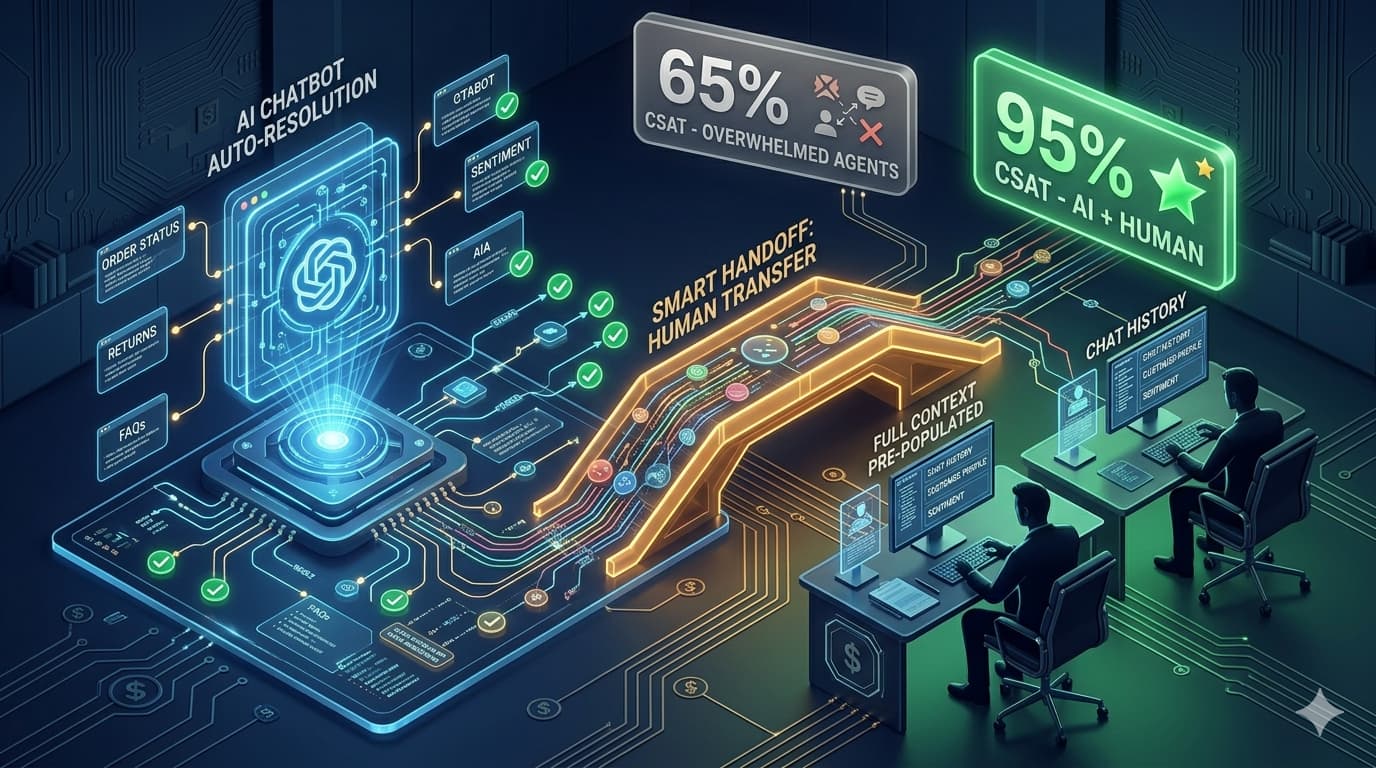
Healthcare front-desk staff spend the majority of their call volume on six repeating query types: appointment booking and rescheduling, appointment reminders and confirmations, prescription refill requests, test result status inquiries, referral status questions, and basic FAQ responses (hours, directions, insurance acceptance). AI communication systems handle all six autonomously across SMS, email, web chat, and voice — with seamless handoff to human staff when the query falls outside the AI's authorised scope.
The patient experience improvement from AI-handled communication is frequently counter-intuitive. Patients prefer immediate AI responses at 9 PM to the next-morning call from a staff member who answers the phone on hold after four minutes. Response time for routine inquiries drops from hours to seconds. Patient satisfaction scores on communication typically improve, not decline, when AI handles routine interactions appropriately.
Appointment booking, rescheduling, and confirmation; pre-visit preparation instructions; post-visit follow-up instructions; prescription refill routing; test result notification (non-clinical — flags for provider review, does not communicate results); FAQ responses; insurance and billing queries routing.
Referral Management and Care Coordination
Studies consistently show that 25–50% of primary care referrals do not result in specialist appointments — patients do not follow through, or the receiving provider cannot confirm the referral was received. This represents both a patient safety gap (conditions that needed specialist evaluation go unaddressed) and a revenue gap for referral networks where completing the care loop is commercially significant. AI referral management systems track every outbound referral, monitor whether the receiving provider has acknowledged it, follow up with the patient to confirm appointment booking, and alert the care coordinator when a referral has stalled beyond a defined time threshold.
Referral creation from clinical notes, receiving provider notification, patient appointment booking follow-up, status monitoring with time-based alerts, referral completion confirmation, care coordinator escalation triggers.
Supply Chain and Inventory Management
Healthcare supply chain management is a high-cost, high-waste function in most hospital and clinic environments. Manual inventory management results in two failure modes: stockouts (critical supplies unavailable when needed, resulting in care delays or emergency procurement at premium cost) and overstock (supplies expiring before use, particularly significant for biologics and medications with short shelf lives). AI inventory management integrates with clinical scheduling data to forecast supply needs by procedure type and volume, triggers reorders before stockout thresholds, and identifies expiry-risk items for redistribution or return.
Usage pattern analysis by procedure and volume, predictive reorder triggering, expiry risk monitoring, supplier integration for automated ordering, waste tracking and trend reporting.
Which of these six use cases would generate the highest ROI for your organisation?
Automely's healthcare AI assessment identifies your highest-value operational automation target and scopes the implementation. Book a free 45-minute consultation.
HIPAA and AI — What Every Healthcare Organisation Must Get Right
Every AI system that processes protected health information (PHI) in a healthcare context must be HIPAA compliant. This is not optional and not a checkbox — it is a legal requirement with significant penalty exposure for violations. The requirements for AI are the same as for any business associate handling PHI, with additional considerations specific to AI processing.
🔒 HIPAA Requirements for Healthcare AI Systems
- ✓Business Associate Agreement (BAA) — every AI vendor whose system processes PHI must sign a BAA before any patient data is shared. This includes AI API providers. Most major healthcare AI platforms offer BAAs. General-purpose AI APIs used without BAA compliance create serious liability.
- ✓Minimum Necessary PHI — AI systems must be designed to process only the minimum PHI required for the specific function. A scheduling AI does not need access to clinical notes. A documentation AI does not need billing history. Data minimisation in AI system design is a HIPAA requirement.
- ✓Encryption — PHI processed by AI must be encrypted in transit (TLS 1.2+) and at rest (AES-256 or equivalent). This applies to PHI within the AI system, in transit between the AI and EHR, and in storage.
- ✓Audit Trail — all AI access to PHI must be logged with timestamps, the specific data accessed, and the action taken. These audit logs must be maintained for a minimum of 6 years and must be available for compliance review.
- ✓AI Output Validation — AI outputs that influence patient care or billing (documentation, coding, communication) must have a defined review and approval process. AI generates; an authorised person reviews and takes responsibility. Autonomous AI output that bypasses human review for clinical or billing decisions creates liability.
- ✓Breach Notification — if AI system data is breached (including during model training or API transmission), the same HIPAA breach notification requirements apply as for any other PHI breach. 60-day notification requirements, HHS reporting, and patient notification obligations.
The practical implication for healthcare organisations evaluating AI vendors: require BAA before any data integration discussion begins. Ask specifically about data handling — where is PHI stored, how is it used in model training, who at the vendor can access it? The most significant compliance risk in healthcare AI is not the AI itself — it is the data handling practices of the vendor implementing it.
The Implementation Sequence — Where to Start
Healthcare organisations that try to implement all six operational AI use cases simultaneously consistently underdeliver. The right sequence builds internal capability, generates validated ROI, and uses each implementation's results to justify and fund the next.
| Implementation Order | Use Case | Timeline | First Measurable ROI | Why This Order |
|---|---|---|---|---|
| First | Patient Scheduling & No-Show Reduction | 4–8 weeks | Day 30–60 post-launch | Clearest baseline (current no-show rate), fastest measurable revenue impact, lowest EHR integration complexity |
| Second | Patient Communication Automation | 6–12 weeks | Day 30 post-launch | Reduces staff workload immediately visible to clinical team, builds internal AI confidence, easy to measure call volume reduction |
| Third | Medical Billing Automation | 8–16 weeks | Day 60–90 post-launch | Denial rate reduction measurable after first full billing cycle, requires more integration effort but ROI is large and definitive |
| Fourth | Ambient Clinical Documentation | 6–14 weeks | Day 14 post-launch | Physician satisfaction impact is immediate, but requires clinical team adoption — build internal credibility with operations staff first |
| Fifth | Referral Management | 8–14 weeks | Day 60–90 post-launch | Requires integration with external provider systems — more complex, builds on communication infrastructure from Implementation 2 |
| Sixth | Supply Chain AI | 10–16 weeks | Day 90–120 post-launch | Longest data training period needed for accurate forecasting — implement last when AI capabilities are proven internally |
Every healthcare organisation's first AI implementation should generate measurable, quantifiable ROI within 90 days of production deployment. If the first implementation's ROI cannot be measured at 90 days — because the baseline was not documented, because the metrics were not defined, or because the system is not yet live — the internal case for the next implementation is undermined. Establish the baseline before any AI is deployed and measure impact at 30, 60, and 90 days. The numbers you produce at 90 days are the business case that funds Implementation 2.
What AI in Healthcare Does Not Replace — And Why This Matters
The credibility of AI healthcare discussions depends on being honest about where AI creates genuine value and where it does not — and should not — operate. Three boundaries that responsible healthcare AI implementation must maintain:
Clinical decisions remain with licensed clinicians. AI that assists documentation does not make clinical decisions. AI that flags billing codes does not determine what treatment is appropriate. The role of AI in the clinical pathway is to present information, surface patterns, and complete administrative tasks — not to determine diagnosis, treatment, or discharge. Every AI-generated clinical document requires physician review and approval before entering the official record. This is not a technical limitation — it is a legal and ethical boundary.
Emotionally sensitive patient interactions require human connection. An AI that handles appointment scheduling for routine follow-ups is appropriate. An AI that handles a patient calling to discuss a cancer diagnosis is not. Defining the specific categories of interaction that always route to human staff — regardless of AI capability — is as important as defining what the AI handles. These routing rules are not failure modes. They are design decisions that preserve the human elements of healthcare that patients most value.
AI does not replace the human judgment that healthcare outcomes depend on. The goal of AI in healthcare operations is not to eliminate human judgment — it is to apply human judgment where it matters most, by removing the administrative overhead that currently consumes human attention before it can be applied to meaningful care decisions. A care coordinator with 4 hours per day freed from manual referral tracking has 4 more hours for complex patient advocacy, care plan navigation, and the conversations that no AI should be having.
Building Healthcare AI Operations Systems with Automely
Automely's AI agent development and AI integration services cover healthcare operations automation — patient scheduling agents, clinical communication systems, billing workflow AI, referral tracking automation, and custom integrations with existing EHR and practice management systems — with HIPAA-compliant data handling as a development standard, not an afterthought.
Our development process for healthcare clients includes: BAA execution with all AI API providers in scope before any data integration begins; PHI data minimisation review at the architecture stage; audit trail implementation for all AI access to patient data; and a human-review workflow for all AI outputs that touch clinical or billing records. We do not ship healthcare AI that sends PHI to unaudited APIs or that removes human review from clinical and billing pathways.
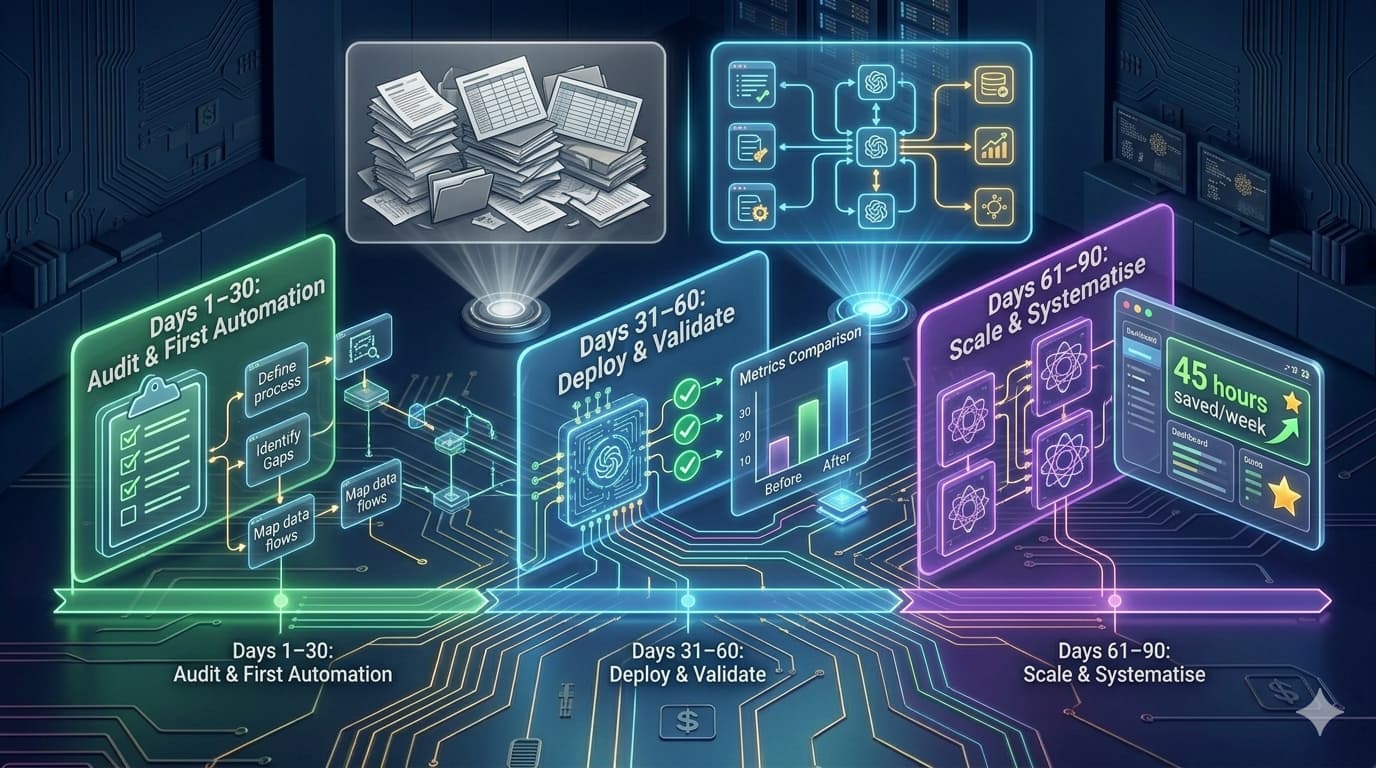
For healthcare organisations evaluating AI investments, we recommend starting with the process audit described in our 90-day business automation guide — applied specifically to the six operational use cases in this guide — to identify which function has the most measurable ROI gap and the cleanest implementation path given your current systems. Browse our case studies, read client testimonials, and explore our full AI services portfolio including AI chatbot development, generative AI development, and AI consulting services.
Ready to automate your clinic or hospital's operational workflows?
Book a free 45-minute healthcare AI assessment. We will identify your highest-ROI operational AI target and scope the HIPAA-compliant implementation.