

The 44-Day Hiring Crisis — Why Recruiters Are Losing the War on Administrative Work
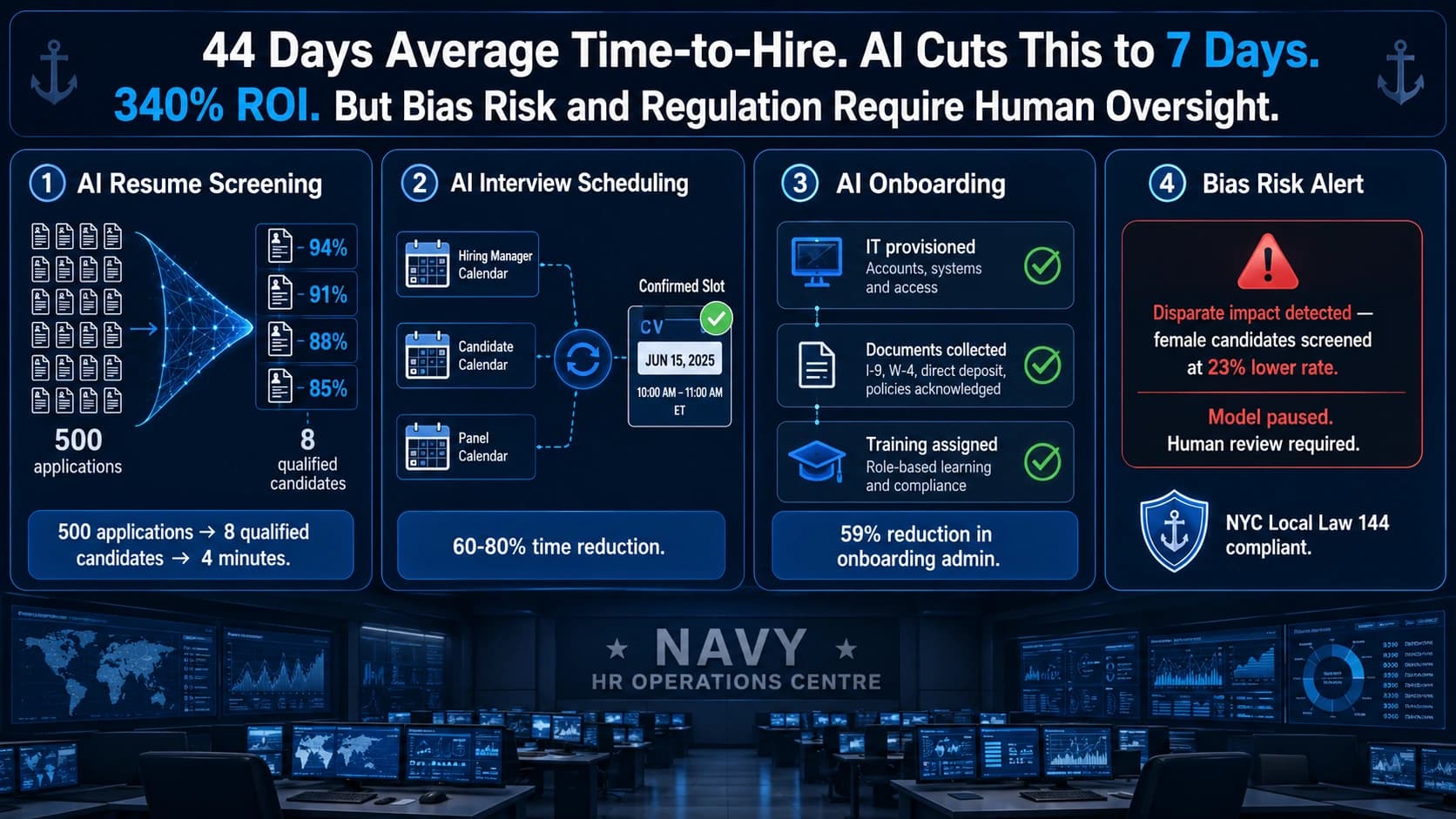
The global average time-to-hire has reached 44 days — an all-time high. This is not primarily a talent shortage problem. It is an administrative capacity problem. Talent acquisition professionals waste between 10 and 20 productive hours per week on repetitive tasks: manually screening hundreds of applications, coordinating interview schedules across multiple stakeholders, chasing candidate documentation, updating ATS records, sending status communications, and processing new hire paperwork. None of this work finds the right person. All of it delays the moment when a qualified candidate meets a human who can actually make a decision.
Enterprise AI solutions for HR are not a future proposition. In 2026, 80% of large companies use AI in some stage of hiring. 99% of Fortune 500 companies rely on AI tools across their recruiting workflows. The global average time-to-hire for organisations using AI-powered workflows has dropped from 44 days to under 25 days — and some companies report reductions from 27 days to 7 days. The 340% average ROI within 18 months (PwC analysis) makes this one of the most commercially justifiable enterprise AI investments available. But there is a second set of data that any honest guide to AI in HR must address upfront: Amazon scrapped an AI recruiting tool in 2018 after it systematically penalised applications from women. The bias risk and regulatory complexity of AI in hiring are as real as the efficiency gains — and this guide covers both.
The 6 Enterprise AI Systems for HR and Recruitment
AI Resume Screening and Candidate Matching
AI resume screening parses CVs at scale — extracting skills, experience, qualifications, and work history — and ranks candidates against defined job requirements using machine learning models. For a position receiving 500 applications, AI produces a ranked shortlist of the most qualified candidates in minutes, with each candidate scored against specific role criteria and ranked by predicted fit. AI screening achieves 89-94% accuracy in resume parsing and skill matching, and reduces time-to-shortlist by up to 75% compared to manual review. For high-volume recruiting — entry-level roles, seasonal hiring, multi-site expansion — this is the most immediately impactful AI investment available.
The critical design requirement: AI screening must be trained on diverse, representative datasets and continuously monitored for disparate impact across demographic groups. The Amazon 2018 cautionary case — where an AI screening tool learned to penalise applications from women — is covered in detail in Section 4. Without bias monitoring, AI screening amplifies historical hiring bias at machine speed rather than eliminating it.
- CV parsing — extracting skills, qualifications, experience, and education from any format
- Job requirement matching — scoring each candidate against structured role criteria
- Skills gap identification — flagging required skills absent from the candidate's profile
- Candidate ranking — ordered shortlist with individual match scores for recruiter review
- Duplicate detection — identifying the same candidate applying through multiple channels
- Passive candidate rediscovery — surfacing previous applicants who match new roles
AI Interview Scheduling Automation
Interview scheduling is universally cited as one of the most time-consuming and frustrating components of the hiring process. Coordinating availability across a candidate, a hiring manager, two interviewers, and a panel for a 4-stage process can require 15–20 email exchanges over several days. AI scheduling eliminates this entirely: candidates select interview slots directly from a conversational interface showing only valid options, the AI books the interview, sends calendar invitations, dispatches reminders 24 hours before, and handles rescheduling requests without recruiter involvement.
Chipotle's implementation of Paradox's conversational AI scheduling assistant cut time-to-hire by 67%. GM and Johnson Controls both reported double-digit percentage improvements in hire rates from AI scheduling implementations that removed the scheduling bottleneck causing candidate drop-off between offer of interview and confirmed slot. AI-led scheduling reduces interview coordination time by 60-80% — recovering multiple hours per hire that recruiters previously spent in email coordination.
- Multi-interviewer availability coordination — shows candidates only valid slots
- Automated calendar invitations to all parties with joining details
- Interview confirmation and reminder sequences (48-hour and 24-hour)
- Rescheduling requests — candidate-initiated changes handled without recruiter involvement
- No-show follow-up — automated rescheduling offer when candidate misses interview
- Panel interview logistics — room booking, video link generation, briefing notes
AI Candidate Engagement and Chatbots
Candidate engagement is the highest-frequency communication task in recruitment — the same questions asked by hundreds of candidates consuming recruiter time that should be spent on the candidates who most need human contact. AI candidate engagement chatbots handle these high-frequency, low-judgment interactions 24/7, answering application FAQs, delivering status updates, conducting structured pre-screening conversations, and escalating to human recruiters only when the query requires professional judgment.
Automated candidate FAQs save recruiters 4-8 hours per week per active requisition. For an enterprise organisation running 50 concurrent requisitions, this recovers 200-400 recruiter hours weekly — equivalent to 5-10 additional full-time recruiters' bandwidth, without the headcount. 72% of candidates report positive experiences with AI-powered application processes; 64% are comfortable with AI conducting initial screening conversations. 81% appreciate AI chatbots for answering basic questions 24/7 — the always-on availability that human recruiters cannot provide.
- Application FAQ responses — salary, benefits, remote work, culture, process questions
- Status update delivery — application received, under review, shortlisted, not progressed
- Pre-screening conversations — availability, notice period, right to work, deal-breakers
- Candidate nurture sequences — keeping warm candidates engaged between process stages
- Post-rejection engagement — feedback delivery and future opportunity opt-in
- Offer acceptance communication — offer details, document collection, joining date confirmation
AI Skills Assessment and Technical Screening
Skills assessment AI administers, evaluates, and scores structured tests — psychometric assessments, technical coding challenges, situational judgment tests, and work sample exercises — without human grading time for the initial evaluation. AI-administered technical coding assessments reduce grading time by 50%+ while improving rubric adherence consistency: every candidate's code is evaluated against the same criteria with the same weighting, eliminating the variation that occurs when multiple human graders evaluate assessments with slightly different interpretations of the rubric.
Video interview AI analyses recorded responses for structured content signals — whether the candidate addressed the specific criteria in the question, the completeness of their response against defined criteria — with the output being a structured evaluation against the assessment framework rather than an autonomous hiring recommendation. The EU AI Act and growing regulatory scrutiny specifically address AI video interview analysis; emotion recognition in hiring was banned in the EU in February 2025. Video interview AI that analyses structured response content against defined criteria remains permissible; AI that analyses facial expressions, tone, or other biometric signals faces regulatory restriction in multiple jurisdictions.
- Technical coding tests — automated administration, test case running, output evaluation
- Psychometric assessments — standardised administration, scoring, and benchmarking
- Situational judgment tests — automated delivery and response scoring
- Video interview content analysis — structured response completeness against criteria
- Work sample exercises — automated task delivery and completion verification
- Assessment fraud detection — copy-paste detection, timing anomaly flags
AI-Powered Onboarding Automation
New hire onboarding is the moment where talent acquisition meets operational efficiency — and where manual administrative overhead most visibly affects the new hire's first experience of the organisation. An AI onboarding system automates the document collection workflow, triggers IT system provisioning based on role and department, assigns mandatory training modules in the LMS, schedules introduction meetings with key colleagues, sends the structured welcome communication sequence, and delivers pre-boarding content before the start date. Automated AI-driven onboarding processes reduce administrative time by 59% for new hires and for HR teams simultaneously.
- Document collection — contract signing, right to work, personal details, bank information
- IT provisioning triggers — laptop request, software licences, system access by role
- LMS training assignment — mandatory modules assigned based on role, department, location
- Pre-boarding communication sequence — welcome, what to expect on day one, logistics
- Buddy and mentor assignment — automated matching and introduction facilitation
- 30-60-90-day check-in scheduling — structured touchpoints with manager and HR
Workforce Planning and Predictive Analytics
The highest-value HR AI application is also the furthest from day-to-day recruitment operations: predictive workforce planning uses people analytics to forecast hiring demand before vacancies occur, identify skills gaps before they constrain business capacity, model attrition risk at the individual and team level before resignations happen, and support succession planning with data-driven talent identification. 68% of companies now use AI for predictive analytics in workforce planning and recruitment forecasting. The ROI of preventing attrition in a specialised role (where replacement costs often exceed 100-150% of annual salary) is vastly higher than optimising the cost of filling the role after the departure.
- Attrition risk scoring — identifying employees at elevated flight risk before they resign
- Demand forecasting — predicting hiring needs 6-12 months ahead from business growth signals
- Skills gap analysis — mapping current workforce capability against future role requirements
- Succession planning data — identifying internal candidates for critical roles
- Hiring funnel optimisation — identifying which sourcing channels produce best-retention hires
- Offer acceptance prediction — scoring probability of offer acceptance at defined package levels
Which enterprise AI HR system recovers the most recruiter capacity and delivers the fastest ROI at your organisation?
Automely's HR AI consultation maps your highest-volume bottlenecks and scopes the bias audit architecture. Free 45-minute call.
ROI Evidence — What Enterprise AI HR Has Delivered in Production
- Chipotle + Paradox AI assistant: time-to-hire cut by 67%. GM and Johnson Controls reported double-digit hire rate improvements from AI scheduling that eliminated candidate drop-off between interview offer and confirmed slot.
- Unilever AI screening: 16% increase in diversity of hires. AI-based blind screening eliminated 54% of gender bias and improved underrepresented minority hiring by 35% across documented implementations.
- Enterprise average cost savings: $23,000 per hire with comprehensive AI recruitment platforms. At 100 hires per year, AI screening automation alone generates approximately $141,000 in annual savings.
- Retention improvement: companies using AI-assisted candidate matching see 25-35% higher first-year retention rates (LinkedIn). AI-matched candidates are 14% more likely to pass interviews and receive offers — indicating better initial match quality that produces better tenure.
- Onboarding ROI: 59% reduction in onboarding administrative time. For organisations hiring 500+ people per year, this recovers the equivalent of multiple full-time HR coordinator positions annually.
- High-volume recruiting: 60-80% cost savings in high-volume recruiting scenarios. For roles receiving 500+ applications per posting, AI screening compresses a week of manual review to a few hours of structured AI output review.
The Bias Risk — Amazon's 2018 Lesson and Why It Still Matters in 2026
In 2018, Amazon scrapped an AI recruiting tool that the company had been developing since 2014. The tool had been trained on 10 years of historical Amazon hiring data — and those 10 years reflected the company's historically male-dominated workforce in technical roles. The AI learned from this data and replicated the pattern: it began systematically downgrading resumes that contained words associated with women's experiences — including phrases like "women's chess club" or "women's college." The tool penalised CVs from two women's colleges. Amazon shut it down before deployment, but the case became the canonical cautionary tale for AI in HR — and its lessons are more relevant than ever as AI screening adoption scales to enterprise deployments affecting millions of candidates.
2018 — Amazon's AI screening tool scrapped
The tool trained on historically male-dominated hire data learned to penalise applications mentioning women. Shut down before deployment, but the case established the core risk: AI amplifies historical bias at machine speed when trained on biased historical data without bias monitoring.
2023 — NYC Local Law 144 takes effect
New York City requires bias audits for automated employment decision tools (AEDTs) used in NYC hiring and requires employers to notify candidates when AEDTs are used. First jurisdiction to regulate AI screening tools specifically. Became a template for other jurisdictions.
2025 — EU bans emotion recognition in hiring AI
The EU AI Act's enforcement provisions include a specific ban on AI emotion recognition systems used in employment contexts in EU member states, effective February 2025. AI video interview tools that analyse facial expressions, vocal tone, or physiological signals for hiring decisions are prohibited.
2026 — Full EU AI Act enforcement; US state regulations proliferating
EU AI Act classifies AI systems used in recruitment as high-risk AI, requiring conformity assessment and human oversight. US state-level requirements now include Illinois Video Interview Act, Maryland Video Interview Act, Colorado AI employment regulations, and growing state-by-state variation that enterprises must navigate. 53% of job applicants worry about AI bias — a trust deficit that HR leaders cannot ignore.
1. Diverse training data: AI screening cannot be trained on historical hire data that reflects historical bias — train on role competencies, not on who was hired in the past. 2. Continuous disparate impact analysis: monitor AI screening outcomes across gender, race, age, and other protected categories after every deployment cycle — not just at build time. 3. Independent bias audit: NYC Law 144 and emerging regulations require independent third-party bias audits; build this into the implementation timeline. 4. Candidate transparency: disclose to candidates when AI is being used in screening and assessment. 5. Human review on all consequential decisions: AI provides a scored shortlist; a human makes the final decision on who to interview and hire. AI screens in, not out — final exclusion decisions require human judgment.
The Regulatory Landscape — What HR Leaders Must Know in 2026
| Regulation | Jurisdiction | Key Requirement | Applies To |
|---|---|---|---|
| NYC Local Law 144 | New York City, US | Annual independent bias audit of all automated employment decision tools. Employers must notify candidates and employees when AEDTs are used. Results of bias audits must be publicly posted. | All AI screening, scoring, and ranking tools used in NYC hiring |
| EU AI Act | EU / EEA | AI systems for recruitment and employment decisions classified as high-risk AI. Requires conformity assessment, technical documentation, human oversight mechanisms, and transparency to candidates. Emotion recognition in hiring banned. | All AI screening, interview, and assessment tools used in EU hiring |
| Illinois Video Interview Act | Illinois, US | Employers must notify candidates before video interviews that AI analyses the interview. Must explain how AI is used. Cannot share video without consent. Must delete videos within 30 days if requested. | AI video interview analysis tools used in Illinois hiring |
| Maryland Video Interview Act | Maryland, US | Requires candidate consent before using AI facial recognition analysis in video interviews. Restricts collection of facial feature data without explicit consent. | AI video interview tools using biometric or facial analysis |
| EEOC Guidance (US) | Federal (US) | AI hiring tools are subject to Title VII, ADA, and ADEA requirements. Employers remain liable for discriminatory outcomes produced by AI tools, even when the tool is provided by a third-party vendor. Disparate impact testing required. | All AI screening and assessment tools used by US employers |
Regulatory compliance for AI in HR must be designed into the system architecture before deployment, not added as a legal review after the fact. The bias audit programme, the candidate transparency notifications, the disparate impact monitoring dashboards, and the human review workflow for consequential decisions are architecture requirements — not compliance overhead. Enterprises that design compliance in from the start avoid the expensive retrofitting that occurs when a regulatory examination or a discrimination claim arrives after a live deployment.
What Stays Human — The Hiring Decisions AI Cannot Make
93% of hiring managers say human involvement remains essential for final hiring decisions. The most successful enterprise AI HR deployments in 2026 are not those that automate the most — they are those that automate the right stages and preserve human judgment at the stages that require it.
Final Hiring Decision
AI provides a ranked shortlist, skills match scores, assessment results, and structured interview summaries. The decision of whether to make an offer — and to whom — remains with the hiring manager. This is not only legally required in many jurisdictions; it is professionally correct. Consequential employment decisions require human accountability.
Culture Fit and Value Alignment Assessment
Whether a candidate's working style, communication approach, and values align with the team and organisation requires the kind of nuanced interpersonal assessment that AI cannot perform reliably — and that attempts to automate have produced both poor predictive validity and discrimination risk.
Leadership and Executive Hiring
Senior and executive recruitment requires relationship building with passive candidates, nuanced reference conversations, assessment of strategic vision and leadership presence, and the trust-building between a senior executive and the organisation that AI cannot replicate. Executive search remains a human relationship business.
Offer Negotiation
Compensation negotiation requires real-time reading of candidate signals, judgment about flexibility, and the persuasion and relationship-building that converts a hesitant candidate into an enthusiastic hire. AI can model offer probability and optimal package composition; it cannot negotiate.
Rejection with Meaningful Feedback
Giving a rejected candidate genuinely useful feedback — specific, actionable, honest — requires human professional judgment and empathy. Automated rejection messages without meaningful feedback create a negative employer brand impression that costs future hiring. Strong candidates who receive specific, respectful feedback from a human remain open to future roles and refer others.
Implementation Sequence for Enterprise AI HR
Audit your highest-volume hiring bottleneck before selecting AI
Different organisations have different bottlenecks: some are drowning in applications they cannot screen fast enough; others have screened candidates but lose them to scheduling delays; others have process throughput but poor onboarding completion rates. Map your hiring funnel with data: where do candidates drop out? Where does the most recruiter time go? Where is time-to-hire lost? The audit answer determines which AI system to deploy first — not which AI vendor has the most impressive demo.
Build the bias audit framework before deploying screening AI
Before any AI screening system processes a single live candidate, design and test the bias monitoring framework: define the demographic groups to monitor, the metrics to track (pass-through rate by gender, race, age bracket), the threshold for flagging disparate impact, and the intervention process when disparity is detected. This framework is also the compliance infrastructure for NYC Law 144 and EU AI Act requirements. Building it first prevents deploying a live system that is producing discriminatory outcomes before the monitoring exists to detect them.
Start with scheduling automation — fastest payback, lowest risk
AI interview scheduling has the fastest ROI (1-3 months), the lowest bias risk (it coordinates calendars, not candidate evaluation), and the clearest measurable outcome (interview scheduling time before vs after). It also generates immediate candidate satisfaction improvement — faster scheduling means fewer candidates lost between interview offer and confirmed slot. Deploy scheduling automation first, measure time saved and drop-off rate reduction, and use the documented ROI to build the business case for screening AI.
Train screening AI on competency frameworks, not historical hire data
The Amazon 2018 failure was specifically caused by training AI on historical hire data that encoded historical bias. The correct training approach for AI screening is competency-based: define the skills, experience, and qualifications required for the role; train the AI to score candidates against these defined criteria; and explicitly exclude demographic proxies from the training features. This requires collaboration between HR, hiring managers, and the AI development team to build the role-specific competency frameworks before model training begins.
Measure quality of hire, not just time and cost metrics
The most important HR AI metric is not time-to-hire or cost-per-hire — it is quality of hire: how do AI-sourced and AI-screened candidates perform in role and retain at 6 months, 12 months, and 24 months compared to the pre-AI baseline? Companies using AI-assisted matching see 25-35% higher first-year retention rates. Measuring and documenting this quality improvement is what converts a cost-reduction argument for AI into a talent strategy argument — and what justifies expanding AI investment to workforce planning and predictive analytics.
Building Enterprise HR AI with Automely
Automely's AI agent development, AI integration services, and AI consulting services cover the full stack of enterprise AI solutions for HR — AI candidate screening pipelines integrated with ATS systems, interview scheduling automation, candidate engagement chatbots trained on employer brand and role information, skills assessment automation, AI-powered onboarding workflows, and workforce planning analytics.
All Automely HR AI implementations include bias audit architecture from the start: competency-based training frameworks (not historical hire data), disparate impact monitoring dashboards, candidate transparency notification workflows, and human review integration at consequential decision points. We do not deploy screening AI without the bias monitoring infrastructure — because the regulatory requirement and the ethical obligation are the same: you need to know whether your AI is producing discriminatory outcomes before it processes a million candidates, not after.
Browse our case studies, explore our full AI services portfolio including AI chatbot development for candidate engagement, and see our healthcare RPA guide for the closest parallel on compliance-first AI implementation. The regulatory approach for HR AI closely mirrors the HIPAA compliance architecture for healthcare AI: design compliance in from the start, build audit trails, define human oversight at consequential decisions.
Ready to cut time-to-hire by 50% and recover 10-20 recruiter hours per week — with bias audit architecture built in from day one?
Book a free 45-minute enterprise HR AI consultation. We will map your hiring funnel bottleneck, scope the bias monitoring framework, and identify your highest-ROI first system.