

The Honest Numbers — Two Data Points Every CX Leader Needs Together
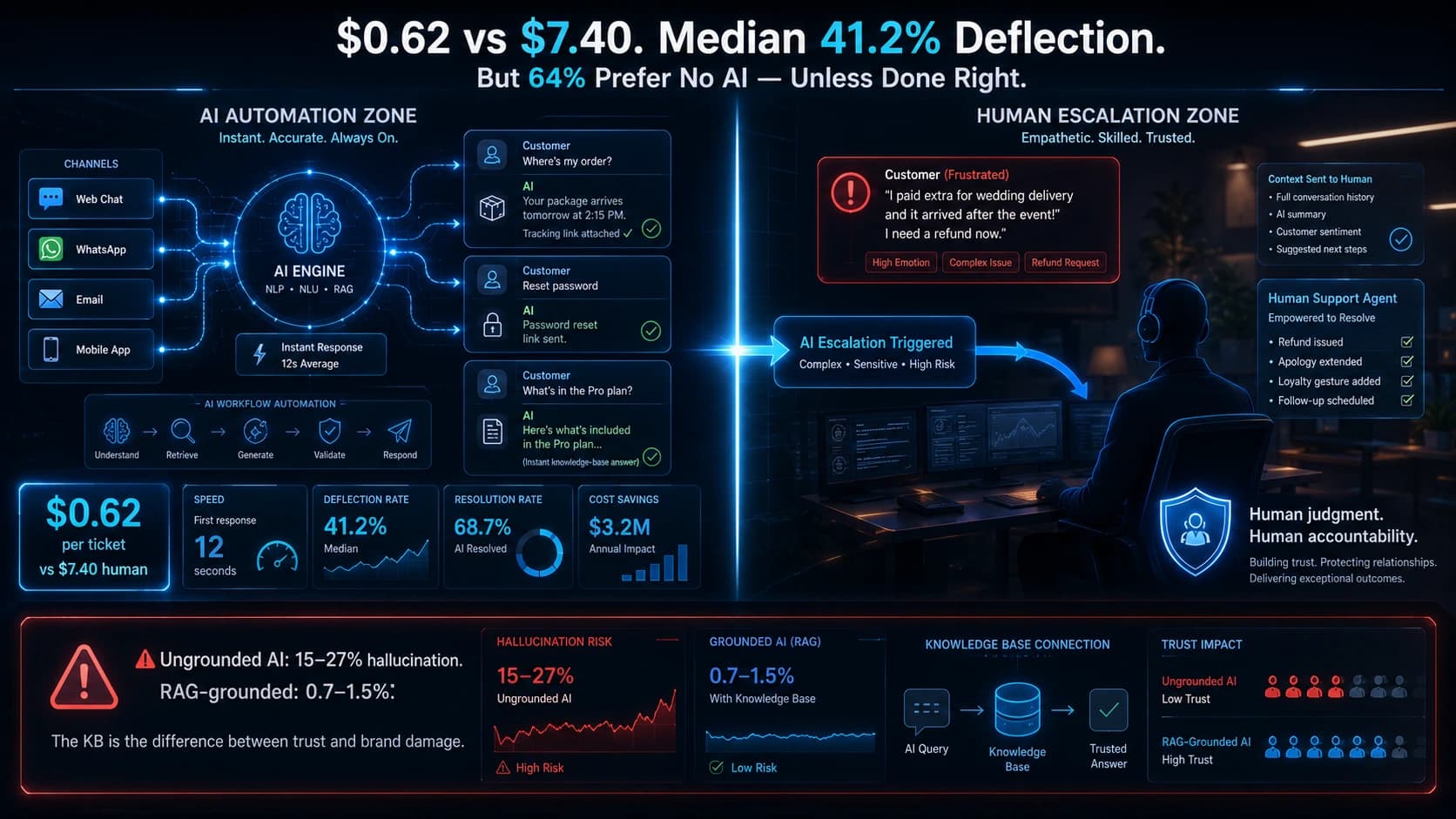
AI chatbot solutions resolve customer service tickets at an average cost of $0.62 — compared to $7.40 for human agent resolution (McKinsey 2026). Median tier-1 ticket deflection across enterprise CX programs in 2026 sits at 41.2%, with top-quartile implementations reaching 58.7%. First response times drop from 12 minutes to 12 seconds. The AI customer service market is projected to reach $15.12 billion in 2026, and Gartner estimates conversational AI will save $80 billion in contact center labour costs by 2026. The ROI case is overwhelming and extensively documented.
Here is the data point that no vendor guide will lead with: 64% of customers say they would prefer companies not use AI for customer service (Gartner 2024 survey). 89% of customers want the option to speak to a human. 84% believe humans are more accurate. Ungrounded AI chatbots — those that generate answers from model training data without retrieving from a verified knowledge base — hallucinate incorrect information 15–27% of the time in live customer service interactions.
Both sets of data are true simultaneously. The economics of AI customer service are genuinely compelling. The risks are also real and specific. This guide covers both: the complete automation map, the six categories that should stay human, the hallucination risk and its solution, the metrics that matter, and the 7-step transition sequence that separates AI chatbot deployments that build customer trust from those that erode it.
What Gets Automated — The Customer Service AI Map
The highest-performing AI customer service deployments in 2026 are not those that automate the most — they are those that automate the right things with precision. The categories where AI reliably delivers both efficiency and customer satisfaction are characterised by two properties: structured queries with predictable answer patterns, and situations where speed is the primary satisfaction driver (not empathy or judgment).
- Order status and delivery tracking
- Password resets and account access
- FAQ and knowledge base responses
- Plan and pricing information
- Return and refund policy queries
- Appointment booking and scheduling
- Ticket routing and classification
- First response acknowledgment
- Multilingual FAQ support
- After-hours query handling
- Complex multi-system complaints
- Emotionally charged situations
- Significant refunds above threshold
- Account closures and cancellations
- Novel situations outside training
- Trust and relationship repair
- Regulated/legally sensitive topics
- Loyalty and retention conversations
- Executive escalations
- Ambiguous or multi-cause issues
Self-service AI bots resolve up to 96% of simple, structured queries and 54% of customer issues across all query types. But deflection rate alone is not the success metric — resolution rate is. AI deflects 45%+ of queries on average, but only 14% of issues are fully self-service resolved per Gartner data. The gap between deflection and resolution is the hidden failure mode: customers who are technically "deflected" but not actually helped are the ones leaving 1-star reviews and calling back to find a human, compounding support costs rather than reducing them.
Agent Assist — The Highest-ROI AI Customer Service Investment Most Teams Underinvest In
Agent assist AI operates alongside human agents in real time — surfacing relevant knowledge base articles, suggesting responses to common queries, summarising previous interactions, and flagging sentiment signals — without removing the human from the conversation. Agents augmented by AI handle 13.8% more customer inquiries per hour (Nielsen Norman Group). Companies resolve tickets 52% faster overall with AI assist deployed across the team. The CSAT impact is positive because the AI makes human agents faster and better-informed without removing the human judgment and empathy that drive satisfaction on complex cases.
Agent assist is the right AI investment for query categories that fall in the middle band — not simple enough for full automation, not complex enough to require extended human deliberation. A human agent with AI-surfaced context and suggested responses handles middle-band queries in a fraction of the time they previously required, with higher consistency across the team. This is the architecture that produces hybrid escalation flows where the CSAT gap between AI and human handling closes to 0.05 points — nearly indistinguishable.
What Stays Human — The Six Non-Automatable Categories
The most important design decision in AI customer service is not which AI to deploy — it is which situations the AI should not handle, and what happens when those situations arise. The six categories below consistently produce worse outcomes when automated than when handled by humans.
- Complex, multi-cause complaints. When a customer has experienced a failure involving multiple systems, the problem requires a human who can understand the full context, own the resolution across multiple teams, and make judgment calls about what resolution is appropriate. AI can retrieve data from multiple systems; it cannot own the resolution of a multi-cause failure with the accountability that turns a frustrated customer into a retained one.
- Emotionally charged interactions. A customer who is distressed, grieving, angry beyond the typical range, or in a vulnerable situation needs empathy, real-time emotional attunement, and the sense that a person cares about their experience. Automated responses to emotionally charged situations routinely produce escalation because the customer's primary need is not information but connection.
- High-stakes decisions above defined thresholds. Refunds above a defined monetary threshold, account closures, significant policy exceptions, and actions with material financial impact require human approval. This is both a customer trust requirement (84% of customers believe humans are more accurate for consequential decisions) and increasingly a regulatory requirement.
- Novel situations outside training data. When a customer describes a situation the AI has not been trained on, the least-harm response is to escalate to a human, not to generate a plausible-sounding but potentially incorrect answer. Defining explicit "I don't know" boundaries and routing novel queries to humans is a design requirement, not a limitation to be hidden.
- Relationship and trust repair after serious failures. When a significant service failure has occurred, the conversation is about the value of the ongoing relationship, not about resolving a specific ticket. These conversations require a senior human who can make decisions, express genuine organisational accountability, and rebuild trust through the kind of personal commitment that no automated system can credibly make.
- Regulated and legally sensitive topics. Insurance claim decisions, financial advice, medical guidance, privacy data requests, and legally sensitive disputes require regulated professionals with professional accountability. Automating these interactions creates both compliance risk and the kind of trust destruction that is disproportionately expensive to recover from.
The Hallucination Risk — Why Most AI Chatbots Fail at Scale
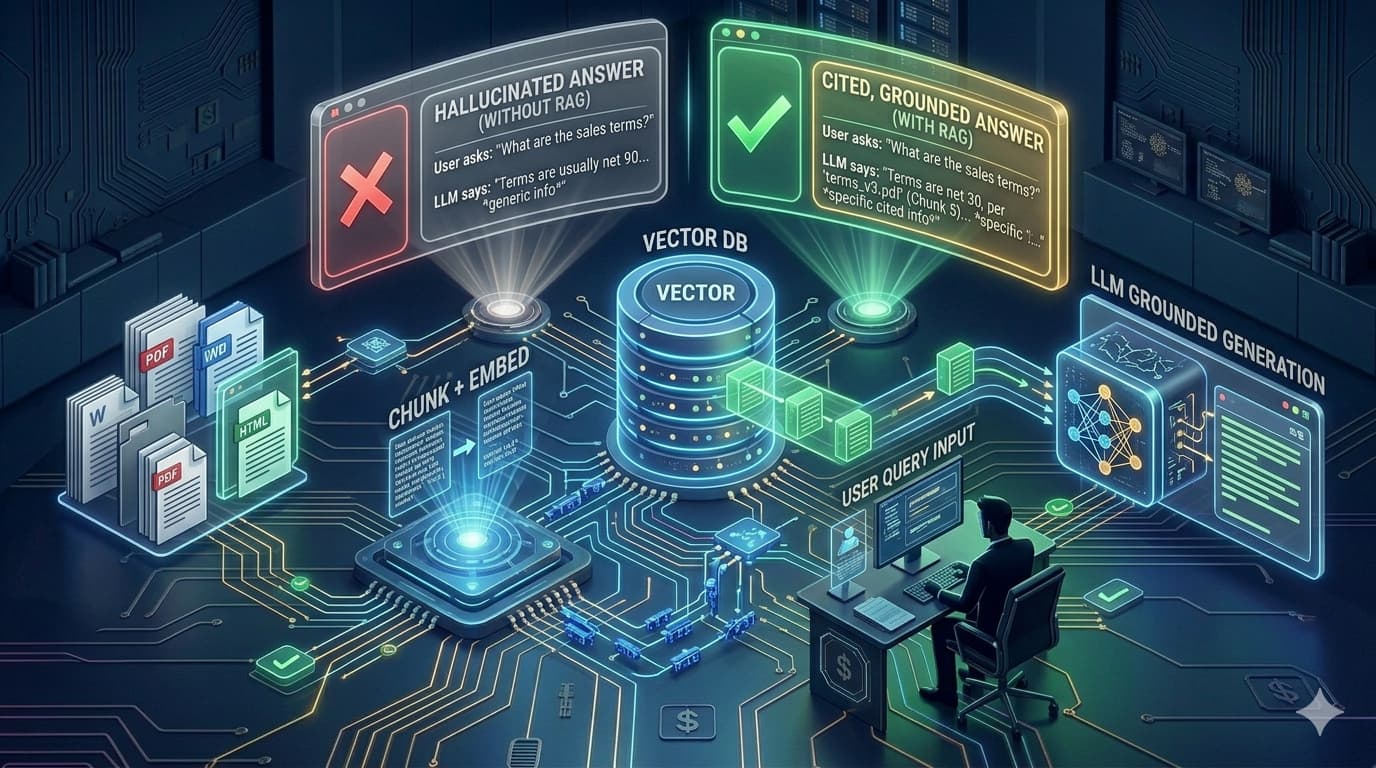
Hallucination is the single biggest accuracy risk in AI customer service. An AI chatbot hallucinates when it generates a response that is plausible-sounding but factually incorrect — quoting a return policy that does not exist, confirming a feature the product does not have, promising a delivery date the logistics system does not support. At a 15–27% hallucination rate for ungrounded chatbots, roughly 1 in 6 to 1 in 4 AI-generated responses in a live customer service interaction contains incorrect information.
❌ Ungrounded LLM Chatbot
Hallucination rate in live customer service. Enterprise average ~18%. Generates answers from model training data without retrieving from a verified source. Every incorrect answer is a brand trust incident.
✓ RAG-Grounded Knowledge Base Chatbot
Hallucination rate with Retrieval-Augmented Generation. The AI retrieves from a curated, up-to-date knowledge base before generating any response. Cannot answer what it cannot retrieve — routes to human instead.
The solution is RAG (Retrieval-Augmented Generation) architecture: rather than generating answers from the model's training data, the AI first retrieves relevant documents from a curated, maintained knowledge base — product documentation, policy pages, FAQ articles, approved response templates — and generates its answer grounded in those retrieved sources. Grounded LLMs drop hallucination rates to 0.7–1.5%. The difference between 18% and 1% hallucination is the difference between a customer service chatbot that creates trust incidents and one that builds trust consistently.
Gartner explicitly identified knowledge management as a barrier to conversational AI success, noting that many organisations face knowledge backlogs and lack formal processes for revising outdated content. A RAG-grounded chatbot is only as accurate as the knowledge base it retrieves from. If the knowledge base contains outdated policies, incorrect product information, or missing FAQ content, the chatbot will retrieve and present that incorrect information with high confidence. Knowledge base maintenance — scheduled reviews, version control, and a defined process for updating content when policies or products change — is not an optional operational overhead. It is the quality control system for the AI. Build a monthly "knowledge ops" cadence into your implementation plan before deploying the chatbot.
Is your AI chatbot grounded on a maintained knowledge base — or generating from model training data?
Automely scopes RAG-grounded customer service AI and the knowledge base architecture that keeps hallucination rates below 1.5%. Free 45-minute call.
The Metrics That Matter — Measuring AI Customer Service Correctly
Deflection rate — the percentage of inbound contacts handled without a human touching the ticket — is the metric most commonly reported by AI vendors and most commonly misused by CX teams as a primary success metric. Deflection counts what the AI handled. It does not count what the AI solved, what the AI got wrong, or how many deflected customers contacted the company again through another channel because their issue was not actually resolved. Track all four metrics simultaneously from deployment day one.
| Metric | What It Measures | Target | Red Flag |
|---|---|---|---|
| Containment / Resolution Rate | % of AI-handled queries where the customer's issue is actually resolved without re-contact | 30–60%+ by category | Deflection ≫ Resolution |
| Deflection Rate | % of inbound contacts handled without human involvement | 40–60% tier-1 | High deflection, low CSAT |
| CSAT by Query Category | Customer satisfaction for AI-handled vs human-handled interactions by ticket type | ≥ 4.0/5 | AI CSAT < 3.5/5 on any category |
| Escalation Rate | % of AI conversations that require human handoff | 25–40% overall | > 60% on claimed automated categories |
| Re-contact Rate | % of customers who contact again within 48hrs after AI resolution | < 10% | > 20% — indicates false deflection |
| Hallucination / Error Rate | % of AI responses containing factually incorrect information | < 2% (grounded RAG) | > 10% — rebuild knowledge base |
| Cost per Resolution | Total AI operating cost divided by fully resolved tickets | < $1.50 | > $3.00 — audit escalation design |
The 7-Step Transition Sequence — From All-Human to Hybrid AI
Categorise your ticket volume by intent and complexity — before selecting an AI tool
Run 3 months of historical ticket data through intent analysis: group tickets by query type (order tracking, password reset, billing question, complaint, etc.) and complexity (single-answer vs multi-step vs judgment-required). Identify the 40–60% that are truly automatable — structured queries with clean, consistent answers — and the 40–60% that require human handling. This analysis determines your realistic deflection ceiling and which categories should not be in scope for the initial deployment. Do this before evaluating any AI chatbot vendor, because the right tool depends on your specific ticket mix.
Build the knowledge base before building the chatbot
The knowledge base is the grounding layer that prevents hallucination. Before deploying any conversational AI, audit and curate your existing knowledge: help centre articles, FAQ content, policy documentation, approved response templates. Remove outdated content, fill gaps identified in your ticket analysis, and structure content consistently. This investment — typically 2–4 weeks of content work — is what separates a RAG-grounded chatbot with 1% hallucination from an ungrounded one with 18%.
Design escalation as a first-class flow — not an afterthought
The most consequential design decision in AI customer service is how the chatbot escalates to a human. One-click human handoff with full conversation context preserved is a CSAT multiplier — the customer does not repeat themselves, the human agent arrives informed, and the handoff feels like a continuation rather than a restart. 54% of customers prefer hybrid service — chatbot plus human handover. Build the escalation experience to be as seamless as the automation, because customers will judge your AI chatbot primarily by what happens when they need a human, not when they do not.
Label AI interactions transparently — do not hide the automation
83% of customers trust companies more when AI interactions are clearly identified as AI. The reflex to hide AI behind human-sounding names and avatars is counterproductive: when a customer suspects they are talking to a bot but cannot confirm it, trust erodes. When a customer knows they are talking to an AI, has a seamless escalation path to a human, and receives accurate, fast responses, trust builds. Transparent AI labeling ("You're chatting with our AI assistant. Connect with a human anytime →") is a trust investment, not a trust risk.
Deploy on one category, one channel — with tight scope and clear boundaries
The highest-ROI first deployment is typically the category with the highest volume AND the most structured query pattern: order tracking, password resets, or billing FAQ. Deploy the chatbot on one channel (web chat or WhatsApp, not all channels simultaneously), in one query category, with an explicit "out of scope" boundary: anything the chatbot cannot answer from its knowledge base goes directly to a human without attempting to generate an answer. This narrow initial scope produces measurable ROI quickly, builds organisational confidence, and surfaces the edge cases that need knowledge base additions before scope is expanded.
Monitor the four metrics from day one — not just deflection rate
From the first day of production deployment, track resolution rate, CSAT by query category, re-contact rate, and escalation rate alongside deflection rate. Run weekly reviews of the metrics for the first 60 days. When re-contact rate rises on a specific query category, investigate — the chatbot is deflecting but not resolving, which means the knowledge base for that category is insufficient or the query pattern is more complex than the initial classification suggested. Reduce scope before the issue affects CSAT. Expand scope when data supports it, never when the vendor claims the AI is "ready."
Reskill your team around AI — do not just reduce headcount
Junior tier-1 agent postings dropped 21% in 2025 and a further 24% is planned for 2026. Senior CX engineer roles — knowledge base curation, AI tuning, quality review, integration work — grew 28% year-over-year. The teams that transition most effectively treat AI as a capacity multiplier that enables their existing team to handle more complex interactions and higher-value conversations, while reskilling tier-1 agents toward the knowledge management and quality assurance roles that the AI system requires. Agents who maintain the knowledge base, review AI outputs for quality, and manage the escalation workflow are doing work that directly improves AI performance — and that no AI can do for itself.
Building AI Chatbot Solutions with Automely
Automely's AI chatbot development, AI agent development, and AI integration services cover the full stack of AI customer service implementation — RAG-grounded chatbots connected to company knowledge bases, agentic AI for ticket creation and resolution actions, agent assist systems for human-in-the-loop workflows, omnichannel deployment across web chat, WhatsApp, email, and voice, and integration with existing CRM and helpdesk platforms (Zendesk, Intercom, Salesforce Service Cloud, HubSpot).
Every Automely customer service AI implementation starts with the knowledge base architecture — the grounding layer that keeps hallucination rates below 1.5% — before any chatbot interface is built. We do not deploy customer-facing conversational AI without a curated knowledge base and a defined escalation design, because the hallucination risk from ungrounded AI and the trust damage from poor escalation flows consistently produce negative outcomes that cost more to remediate than the original AI investment.
Explore our full AI services portfolio and browse case studies including our Cerebra Caribbean AI chat and voice agent platform — a production implementation delivering 10,000+ autonomous conversations with 95% CSAT. For the enterprise AI parallel — deploying AI across a team operation with clear human-AI boundaries — see our enterprise AI solutions guide. For the supply chain AI parallel on data governance prerequisites, see our supply chain automation guide.
Ready to reduce your cost per resolution from $7.40 to $0.62 — with a grounded knowledge base and a handoff design that closes the CSAT gap to 0.05 points?
Book a free 45-minute AI chatbot consultation. We map your ticket categories, scope the knowledge base architecture, and design the escalation flow — before any development commitment.