


The 6.1× Shareholder Return Gap — Why the Insurance Industry Cannot Afford to Wait
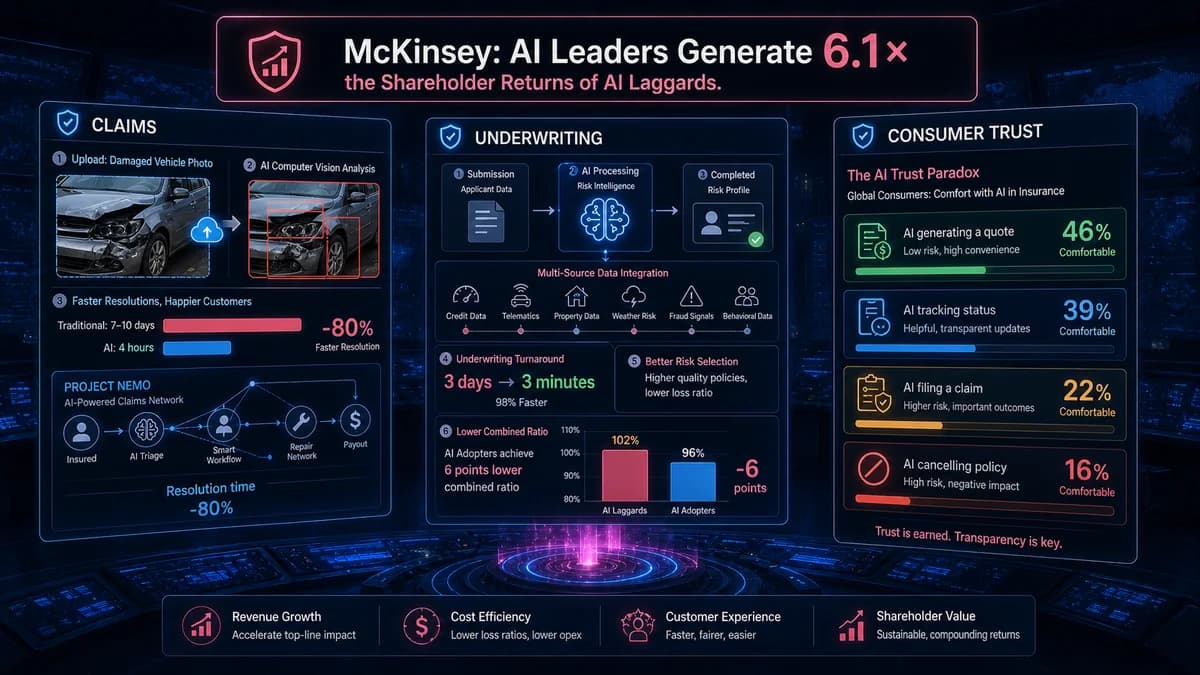
McKinsey's analysis of AI adoption in insurance found that AI leaders have generated 6.1 times the total shareholder returns of AI laggards over a five-year period. Not 6.1% better. 6.1 times. That figure is not a future projection — it is a five-year historical measurement of what has already happened to insurance companies that moved early on AI versus those that did not. The gap is not narrowing. It is widening, because the competitive advantages that AI delivers — faster underwriting, lower claims costs, better fraud detection, higher customer retention — compound over time.
The market data reinforces the urgency. The AI in insurance market surpassed $10 billion in 2025 with a 32.8% annual growth rate. Insurtech funding surged 90% quarter-on-quarter in Q1 2025, driven almost entirely by AI innovation. Straight-through claims processing rates are jumping from 10–15% at traditional carriers to 70–90% at AI-enabled ones. Underwriting timelines are collapsing from three days to three minutes. The transformation that the industry talked about for a decade is happening — and the carriers that deploy AI now are building compounding advantages over those that wait.
The most successful insurance AI deployments in 2026 share a common architecture: AI handles the volume, humans approve every consequence. AI processes submissions, extracts data, assesses damage, screens fraud, and calculates settlements — but a human professional approves every payout, every underwriting decision, every policy cancellation. This is not a regulatory requirement, though regulators support it. It is what consumers demand: only 22% of policyholders are comfortable with AI filing a claim autonomously, and only 16% with AI cancelling a policy. The human-in-the-loop model is the only sustainable architecture for consequential insurance decisions in 2026.
The 3 Pillars of Insurance Automation
Insurance automation in 2026 organises into three pillars, each attacking a distinct cost-and-capability gap in the carrier operating model — claims handling speed and cost, underwriting accuracy and cycle time, and customer service scale and quality. The pillars are independently deployable and most carriers sequence them based on which problem is currently the most expensive — typically claims for established P&C carriers, underwriting for commercial and specialty lines, and customer service for digital-first insurtechs.
📋 Pillar 1 — Claims Automation
Claims processing is where insurance AI delivers the most immediate and measurable ROI. Traditional claims operations involve sequential manual steps — FNOL intake by a call centre agent, assignment to an adjuster, physical inspection scheduling, document review, coverage verification, fraud screening, settlement calculation, and payment processing — that take days or weeks for straightforward claims and months for complex ones. Each manual handoff adds cost and time without adding value for standard cases.
AI claims automation collapses this process for standard cases into hours. Straight-through processing (STP) — the percentage of claims resolved end-to-end without human adjuster involvement — is the defining KPI. Traditional carriers achieve 10–15% STP. AI-enabled carriers achieve 70–90% STP by automating the data extraction, coverage verification, damage assessment, and fraud screening steps that previously required adjuster time. Complex cases — disputed liability, high-value losses, catastrophe events, suspected fraud — are routed to human adjusters with full AI-generated summaries, so adjuster time is spent on the work that requires professional judgement rather than administrative processing.
STP: percentage of claims resolved end-to-end by AI without human adjuster involvement. Complex claims, disputed liability, and suspected fraud always route to human review.
FNOL Automation — 24/7 First Notice of Loss
AI voice and chat agents handle First Notice of Loss intake around the clock, collecting all required claim information through guided conversation, validating coverage in real time, generating claim reference numbers, and initiating the next steps in the claims workflow — without a call centre agent. FNOL intake handled at midnight on a Saturday performs identically to intake at 10 AM on a Tuesday.
AI Damage Assessment — Computer Vision from Photos
AI computer vision models trained on millions of damage images analyse policyholders' uploaded photos and videos to assess damage extent, identify repair requirements, estimate replacement costs, and in some cases trigger automatic payments — without requiring a physical inspection for standard damage types. Carriers using AI damage assessment consistently achieve 40–60% reduction in physical inspection costs for auto and property claims.
AI Fraud Screening — Every Claim, Every Time
AI fraud detection screens every claim simultaneously against hundreds of risk signals — claim frequency patterns, network connections to previously identified fraud, inconsistencies between damage photos and claim description, timing patterns (claims filed shortly after policy inception or premium changes), and geolocation anomalies. Unlike manual fraud screening that applies additional scrutiny to flagged cases based on human intuition, AI screens every claim consistently and flags genuine suspicion scores for human investigator review.
📊 Pillar 2 — AI Underwriting
Underwriting is where AI creates the most durable competitive advantage in insurance. Speed matters in underwriting not just for efficiency, but for competitive positioning: in a market where brokers can place business with multiple carriers simultaneously, the carrier that responds first with an accurate quote wins disproportionate business. Underwriting timelines are collapsing from days to minutes for insurers that have deployed AI submission processing. WTW's March 2026 survey found that insurers using sophisticated AI analytics achieved combined ratios six percentage points lower and premium growth three percentage points higher than slower adopters — for a $1 billion premium portfolio, that translates to approximately $40 million in annual underwriting profit improvement.
The most significant architectural development in 2026 is the shift to multi-agent underwriting systems — where specialist AI agents collaborate on submission processing. One agent ingests and clarifies submission data. A risk profiling agent builds comprehensive risk assessments from structured and unstructured data (loss runs, inspection reports, financial statements, third-party databases). A compliance agent checks against risk appetite guidelines. A pricing agent structures the policy and rates the risk. A decision orchestrator aggregates input and either approves automatically, declines automatically, or routes to a human underwriter with a complete analysis. The underwriter sees only submissions that genuinely require their judgement — with all routine data extraction and cross-referencing already completed.
Submission Triage and Data Extraction
AI automatically extracts structured data from unstructured submission documents — application forms, loss runs, inspection reports, financial statements — and cross-references against internal databases, credit data, third-party risk scores, and the carrier's existing book. Loss run processing that previously took hours of underwriter time completes in seconds, including loss ratio calculation, frequency pattern identification, and anomaly flagging.
Continuous Underwriting — IoT, Telematics, and Real-Time Risk
The most transformative 2026 development is continuous underwriting: risk assessed not once at policy inception but continuously from real-time data streams. Auto insurance telematics data updates driver risk profiles daily based on actual driving behaviour. Commercial property IoT sensors detect changes in risk conditions (equipment maintenance lapses, facility usage changes, environmental exposures). This enables dynamic, risk-adjusted pricing that accurately reflects current risk rather than risk at last renewal — reducing adverse selection and improving portfolio profitability. Telematics-based policies grew 29% in 2025 alone.
💬 Pillar 3 — AI Customer Service
Insurance customer service is heavily repetitive in its query content: policy coverage questions, claims status updates, payment and renewal inquiries, and basic account management requests represent the vast majority of contact centre volume. AI chatbots and voice agents handle these interactions with the same accuracy and patience at 2 AM on a Sunday as at peak business hours — without the staffing costs and quality inconsistency of a 24/7 human contact centre. Consumer support for AI in insurance nearly doubled from 20% to 39% in a single year (2025 to 2026), and comfort with specific AI tasks ranges from 46% for quote generation to 39% for claims status — making these the most appropriate starting points for insurance customer service AI.
Policy Query and Coverage Assistance AI
AI trained on the carrier's policy wordings, coverage definitions, exclusions, and endorsements answers policyholders' coverage questions accurately — "Is water damage from a burst pipe covered under my policy?" — without requiring an agent to pull up the policy, review the coverage, and formulate an explanation. For standard coverage questions, AI provides instant, accurate answers referenced to the specific policy section. Complex coverage interpretation or disputed coverage questions route to human advisors.
Renewal Automation and Personalised Communications
AI generates personalised renewal communications for each policyholder — highlighting relevant coverage changes, market pricing context, and loyalty incentives calibrated to the policyholder's history and risk profile. AI outbound voice agents proactively contact policyholders approaching renewal, answer questions, and complete renewal without requiring a human agent for standard renewals. Personalised renewal communications consistently outperform generic renewal notices on retention rates by 15–25%.
Which of the 3 insurance automation pillars has the highest ROI gap in your operation?
Automely's insurance AI assessment maps your current processes and identifies the highest-value first implementation. Book a free 45-minute call.
Case Study — Allianz Project Nemo: 7 AI Agents, 80% Faster Resolution
The most instructive insurance AI case study of 2025 is Allianz's Project Nemo, deployed in Australia in July 2025 to handle food spoilage claims arising from storm-related power outages. Seven specialized AI agents collaborated to handle the full claims process: coverage verification, weather event validation, fraud screening, loss calculation, payout determination, audit logging, and compliance checking. The result: resolution time dropped by 80%, from several days to hours or minutes. A human professional approves every payout. The entire system was built and deployed in under 100 days.
7 AI Agents Resolving Storm Power Outage Food Spoilage Claims End-to-End
Agent 1: Coverage verification — validates the claimant's policy covers food spoilage from power outages. Agent 2: Weather validation — confirms the reported power outage matches recorded storm events in the claimant's location. Agent 3: Fraud screening — cross-references claim against fraud indicators and prior claim history. Agent 4: Payout calculation — calculates the settlement based on policy limits, deductibles, and reported loss value. Agent 5: Audit trail — logs every decision and data source accessed for regulatory compliance. A human professional reviews and approves the payout recommendation before payment initiates. Allianz is extending this architecture to travel delays, straightforward auto claims, and other high-frequency lines. This is what straight-through processing looks like in production — not a POC, but a live system processing real claims.
The Nemo architecture illustrates the core design principle: each AI agent is a specialist with a narrow, well-defined function — not a general-purpose AI attempting to reason across all claim types simultaneously. This specialist-agent architecture is more reliable, more auditable, and more easily compliant with regulatory requirements than monolithic AI models, because each agent's decision can be independently validated and its data sources traced. The "human approves every payout" principle is not a concession to regulatory caution — it is the architecture that earns policyholder trust.
The Consumer Trust Paradox — What Policyholders Will and Will Not Accept
Consumer support for AI in insurance nearly doubled in a single year: from 20% in 2025 to 39% in 2026. That headline figure suggests rapidly growing acceptance. The detailed data tells a more nuanced story that is essential for insurers designing their AI customer experience.
The pattern is consistent and important: policyholders accept AI in information-provision and process-tracking roles (quote generation, status updates, data changes) but resist AI in consequential-decision roles (filing claims, making policy changes). The comfort threshold drops sharply when AI moves from assisting to deciding. This directly informs the architecture of every insurance customer-facing AI implementation: AI that accelerates and augments the customer experience earns adoption; AI that replaces human judgement on policy and claim decisions — without clear explanation and transparent human oversight — erodes the trust that is the foundation of the insurance relationship.
Insurers building trust with AI should: (1) be transparent that AI is involved ("our AI has reviewed your claim and recommends..."); (2) make human review visible on consequential decisions ("a claims specialist will review and confirm within 2 hours"); (3) lead with the tasks where comfort is highest (quote generation, status tracking) and build toward greater AI involvement as trust accumulates; (4) provide clear explanation of AI decisions rather than just the outcome. The insurer that treats AI as a transparency opportunity rather than a cost-reduction mechanism earns both policyholder trust and regulatory goodwill simultaneously.
The Regulatory Layer — Insurance AI Compliance in 2026
Insurance AI regulation is more complex than in most industries because it is primarily state-level in the US, with rapidly evolving requirements and significant state-to-state variation. As of early 2026:
23 States + DC — AI Governance Requirements
The NAIC's AI Model Bulletin has been adopted in 23 states and Washington DC as of late 2025. It requires insurers to establish documented AI governance frameworks, maintain inventories of AI models in use, document testing procedures, and ensure ongoing human oversight. It does not prescribe specific technical standards, but regulators will assess compliance using the NAIC AI Systems Evaluation Tool currently being piloted in 12 states.
New York Circular Letter No. 7 (July 2024)
New York's DFS requires insurers to establish governance frameworks and explain clearly how AI factors into underwriting and pricing decisions. New York's requirements are among the most prescriptive in the US — carriers operating in New York must have documented processes for AI model validation, bias testing, and adverse action explanation for underwriting decisions that negatively affect applicants.
High-Risk AI Classification for Insurance Applications
The EU AI Act classifies AI systems used in insurance underwriting, pricing, and claims assessment as high-risk AI — requiring conformity assessment before deployment, ongoing monitoring, and transparency obligations. EU-operating carriers must maintain technical documentation, implement human oversight mechanisms, and ensure AI systems are sufficiently transparent and explainable to enable regulatory scrutiny.
Unfair Discrimination and Proxy Discrimination
All US states have unfair discrimination statutes that prohibit insurance pricing and underwriting decisions based on protected characteristics. AI underwriting models must be tested for proxy discrimination — where a seemingly neutral variable (ZIP code, credit score, home ownership status) functions as a proxy for a protected characteristic and produces discriminatory outcomes. NAIC guidance specifically requires bias testing and, where disparate impact is detected, remediation or justification.
The Algorithmic Bias Risk — The Insurance AI Problem That Regulators Watch Most Closely
Algorithmic bias in insurance AI occurs when models trained on historical data perpetuate patterns of discriminatory pricing and coverage denial that were embedded in that data — potentially violating fair insurance laws and regulatory requirements in ways that are genuinely difficult to detect through standard model validation. Historical insurance data reflects decades of human underwriting decisions that contained bias: geographic pricing patterns that functioned as proxy race discrimination, claims handling practices that differed by policyholder demographics, and underwriting rules that disproportionately excluded certain communities.
An AI model trained on this historical data without bias testing and remediation learns to replicate these patterns — at scale, consistently, and invisibly. Unlike a human underwriter whose discriminatory decisions can be identified through individual case review, an AI model's discriminatory pattern is embedded in model weights that produce systematically different outcomes for different groups without any individual case appearing discriminatory.
Testing: disparate impact analysis must be run on model outputs during development and at regular intervals post-deployment — comparing approval rates, premium outcomes, and claims treatment across demographic groups. Remediation: when disparate impact is detected, the responsible model components must be identified and adjusted — removing proxy variables, reweighting training data, or constraining model outputs. Documentation: the entire bias testing and remediation process must be documented for regulatory examination — not just the final model, but the testing methodology, findings, and corrective actions. PwC's 2025 Responsible AI Survey found that 58% of executives believe responsible AI practices improve ROI: governance is not just a compliance cost, it is a competitive asset.
Implementation Sequence — Where to Start With Insurance AI
Insurance AI implementation differs from AI in other industries on two dimensions: compliance and legal must be engaged at the scoping stage rather than after the model is built, and the human-in-the-loop approval step is the core design element — not a bolt-on. The five-step sequence below reflects this regulatory- and trust-first scoping discipline.
Identify your highest-volume, lowest-complexity claim or underwriting type
The first AI implementation in insurance should target the highest-volume claim or underwriting type that has the most standardised processing requirements — the closest equivalent to Allianz's food spoilage claims. For auto carriers, this might be minor windscreen repairs. For property carriers, storm debris removal. For commercial carriers, routine BOP renewals. The standardisation of the process determines how quickly AI can achieve high straight-through processing rates and generate documented ROI.
Document the baseline metrics before AI deployment
Cycle time from FNOL to payment for the target claim type. Adjuster hours per claim. Straight-through processing rate at baseline (typically 10–15%). Customer satisfaction scores for claims handling. These numbers are your before state. Without them, you cannot measure the AI's impact or make the internal case for expanding AI to additional claim types. Measure before you build — always.
Engage compliance and legal before scoping AI architecture
Unlike most AI projects, insurance AI requires regulatory input at the scoping stage. Which states does this AI operate in? What are the state-specific requirements for AI governance and adverse action explanation? Does this AI make underwriting or pricing decisions that require bias testing? What documentation will regulators expect? These questions determine the model architecture, the explainability requirements, the bias testing programme, and the human oversight design — all of which are more expensive to add post-build than to design correctly from the start.
Design the human-in-the-loop approval step first, not last
The human approval mechanism is not an afterthought added to satisfy regulators — it is the core design element that determines whether policyholders trust the system and whether regulators accept it. Design the specific human touchpoint: which types of AI decisions require human approval? What information does the human reviewer see? How long does the human approval step take, and how does that affect overall cycle time? The Allianz Nemo architecture — AI prepares complete payout recommendation, human professional approves — is the right model for all consequential insurance decisions in 2026.
Measure at 30, 60, 90 days and use documented ROI to expand
At 90 days post-deployment, compare straight-through processing rate, cycle time, adjuster hours per claim, and customer satisfaction scores against the pre-AI baseline. The documented improvement is the internal business case for extending AI to the next claim type or the next underwriting segment. For a $1 billion premium portfolio, a 6-point combined ratio improvement represents $40 million in annual underwriting profit — the ROI number that funds the next AI wave without a separate capital request.
Building Insurance AI with Automely
Automely's AI agent development and AI integration services cover the software and AI architecture layer of insurance automation implementations — FNOL chatbots and voice agents, AI claims processing pipelines, computer vision damage assessment integration, AI underwriting decision support systems, straight-through processing workflows with human approval routing, insurance fraud detection AI, and customer service automation for carriers and managing general agents (MGAs).
Our insurance AI engagements start with the three pre-conditions that determine project success: compliance and legal input at the scoping stage (so regulatory requirements are designed in, not retrofitted); baseline metric documentation (so ROI is measurable from day one); and human-in-the-loop design (so the architecture earns both policyholder trust and regulatory acceptance from the first deployment). We build explainability infrastructure and bias testing into every insurance AI system from day one — because the NAIC AI Systems Evaluation Tool is coming, and the insurance carriers that have already audited their AI governance will navigate it significantly better than those who have not.
Automely builds insurance AI systems — claims triage automation, AI underwriting engines, fraud detection, customer service chatbots, document automation for policy admin, and computer vision damage assessment. Insurance AI projects start from $15,000. Book a free 45-minute consultation at cal.com/Automely.ai/45min.
Browse our case studies, read client testimonials, and explore our full AI services portfolio including AI chatbot development, generative AI development, and AI consulting services. For the fintech AI parallel, see our fintech AI guide. For the broader operational AI context, see our AI in logistics guide and our AI agent production deployment guide.
Ready to close the gap between your 10% and the industry-leading 80% straight-through processing rate?
Book a free 45-minute insurance AI assessment. We will scope the claims automation architecture, compliance requirements, and the human-in-the-loop design — before any development commitment.