


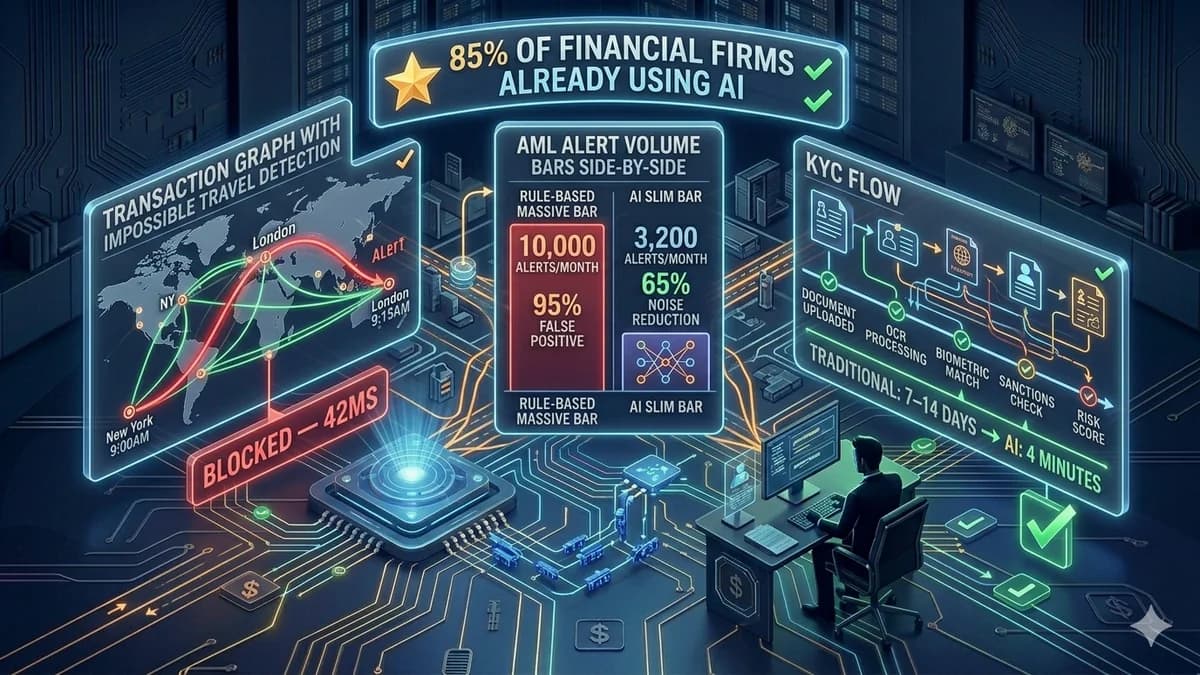
US banks spend approximately $25 billion annually on anti-money laundering compliance. The return on that investment is alarmingly poor: traditional rule-based AML systems produce false positive rates of up to 95%, meaning 95 out of every 100 compliance alerts require manual investigation before being cleared as legitimate transactions. Compliance analysts spend most of their time not catching money launderers — they spend it clearing phantom alerts generated by rules written in a different decade for a different threat landscape.
AI reduces AML false positives by up to 65% while improving genuine suspicious activity detection. This is one of the most documented ROI cases in enterprise AI — and it is only one of six fintech AI systems that are reshaping how financial services companies manage fraud, compliance, customer identity, and onboarding. With 85% of financial firms already deploying some form of AI, the competitive question in 2026 is not whether to use AI in finance. It is whether the AI you have deployed is actually working, and what the systems you have not yet deployed are costing you.
The $25B Compliance Tax — Why the Status Quo in Financial Crime Prevention Is Failing
The compliance problem in financial services is not a budget problem. Banks are spending enough. It is an efficiency problem: the wrong tools generating the wrong signals, consuming the right people's time on the wrong work. A compliance analyst who spends 80% of their day clearing false positive AML alerts is not doing compliance — they are doing administration. And the real financial crime that falls through the gaps is the genuine suspicious activity that the rule-based system failed to flag because it did not match a rule written in 2015.
Same transaction volume. AI system processes 65% fewer false positives while catching more genuine suspicious activity through pattern recognition that rules cannot replicate.
The same structural problem exists in fraud detection. Traditional fraud rules are thresholds — if transaction amount exceeds $X, flag it; if the merchant category code is Y, flag it. These thresholds catch obvious fraud and generate enormous false positive noise on legitimate transactions. They do not catch sophisticated fraud that stays below every threshold. They cannot detect the "impossible travel" scenario (a corporate card used in New York at 9 AM and London at 9:15 AM) without a specific rule written for exactly that scenario. AI fraud detection, trained on the full pattern of thousands of signals simultaneously, catches both the obvious and the sophisticated — and learns continuously as fraud patterns evolve.
Financial services AI faces two challenges that no other industry does at the same severity: (1) Regulatory explainability — AI systems making consequential financial decisions must be auditable and explainable to regulators, which constrains model architecture choices; (2) Adversarial adaptation — fraud and money laundering AI is playing against a thinking adversary who studies and adapts to detection patterns. These two constraints shape every fintech AI implementation and are covered in dedicated sections of this guide.
The 6 Fintech AI Systems — What Each One Does and What It Costs You to Wait
Fintech AI in 2026 spans six distinct system categories, each attacking a specific cost or capability gap in financial services — fraud loss and false declines, AML false positives and compliance analyst overhead, KYC bottleneck time, onboarding drop-off, credit underwriting accuracy on thin-file segments, and contact centre cost. The systems are independently deployable, and most financial services companies sequence them based on which problem is currently the most expensive — typically AML false positives or fraud detection gaps for established institutions, and onboarding speed for digital-first challengers.
🚨 Real-Time AI Fraud Detection
AI fraud detection analyses each transaction against hundreds of simultaneous signals — transaction amount, merchant category, geolocation, device fingerprint, IP address, behavioural patterns established over the customer's full transaction history, and network patterns connecting the customer to other entities — and produces a fraud probability score in milliseconds. Unlike rule-based systems, AI learns from each confirmed fraud outcome and continuously updates its model. American Express uses long short-term memory (LSTM) neural networks to monitor every transaction on its $1.2 trillion annual network, generating fraud decisions in milliseconds. PayPal improved real-time fraud detection by 10% with continuous AI monitoring that evaluates hundreds of factors simultaneously.
The commercial case extends beyond fraud loss reduction. AI fraud systems with lower false positive rates also reduce the false declines that cost financial companies significant legitimate transaction volume — a declined transaction that is actually legitimate loses the transaction, damages the customer relationship, and in competitive markets drives account closures.
- Transaction amount, frequency, and velocity against customer historical baseline
- Geolocation — "impossible travel" detection across multiple simultaneous cards or accounts
- Device fingerprint — new device, spoofed device characteristics, emulator detection
- IP and network signals — VPN usage, data centre IP, distance from customer's established locations
- Counterparty risk — first-time payee, counterparty network connections to known fraud
- Time signals — unusual transaction hours relative to customer's established patterns
🏛️ AI AML Compliance Monitoring
AI AML monitoring replaces static rule-based transaction monitoring with machine learning models trained on historical SAR (Suspicious Activity Report) filings, confirmed money laundering patterns, and network relationship analysis. Instead of triggering on transactions that match predefined rules — which produces the 95% false positive rate that makes current AML processes so expensive — AI analyses transaction sequences, counterparty relationship networks, and behavioural patterns across time to identify genuine suspicious activity that rules consistently miss.
Specific AI techniques in AML: graph neural networks that map transaction networks and identify circular payment structures indicative of layering; sequence models that detect structuring (multiple transactions just below reporting thresholds); and entity resolution that connects accounts controlled by the same beneficial owner across different identities. The 2024 US Treasury report confirming $1 billion recovered in check fraud using machine learning is the most recent government-level validation of AI's superiority over rule-based systems for financial crime detection.
- Transaction network analysis — circular payment flows, layering patterns, smurfing
- Structuring detection — sequences of transactions designed to stay below reporting thresholds
- Entity resolution — connecting accounts controlled by the same beneficial owner
- Correspondent banking risk — flagging high-risk jurisdictions and correspondent chains
- Adverse media monitoring — real-time news and enforcement action monitoring for existing customers
- SAR generation support — AI drafts SAR narrative based on detected pattern for analyst review
🪪 AI KYC — Know Your Customer Automation
AI KYC automates the four bottleneck steps of identity verification: document processing (extracting and validating data from passports, driving licences, and national ID documents using OCR and document authenticity assessment), biometric verification (matching the applicant's selfie to their identity document photograph and detecting liveness to prevent photo substitution attacks), risk screening (simultaneously checking extracted identity data against sanctions lists — OFAC, UN, EU — politically exposed persons databases, and adverse media), and risk classification (producing a customer risk profile that determines whether standard KYC is sufficient or enhanced due diligence is required).
For standard-risk customers, AI handles the entire KYC process automatically in minutes. Edge cases — document quality issues, sanctions list partial matches, high-risk jurisdictions, and complex ownership structures — are flagged for human review. This model reserves compliance officer time for the cases that genuinely require expert judgement, rather than consuming it on the straightforward verifications that represent the majority of onboarding volume.
- Document OCR with tamper detection and forgery scoring
- Facial recognition with liveness detection (anti-spoofing)
- Real-time sanctions list checking (OFAC, UN, EU, FATF)
- PEP (Politically Exposed Person) database matching with fuzzy name resolution
- Adverse media screening across global news sources
- Customer risk score generation and EDD trigger decision
⚡ Customer Onboarding Automation
Traditional financial services onboarding — particularly for business accounts — takes 7–14 days of back-and-forth document collection, manual verification, compliance checks, and account setup. Each additional day of onboarding represents a day of delayed revenue activation and a window where the prospective customer may choose a faster competitor. AI onboarding automation compresses this to hours for retail customers and days for complex business accounts, by running all verification steps simultaneously (rather than sequentially) and automating the document collection workflow so customers can complete onboarding on their own timeline via mobile.
The commercial impact extends beyond speed. AI-powered onboarding systems with intelligent document capture (guiding customers to take usable photos, pre-validating documents before submission) dramatically reduce the abandonment rate at the document upload step — one of the highest drop-off points in digital financial product sign-up flows. Every percentage point improvement in onboarding completion is direct revenue that would otherwise have been lost to friction.
- Guided document capture with real-time quality feedback before submission
- AI form pre-fill from document extraction (no re-entering data that is on the document)
- Parallel KYC, credit bureau, and compliance checks (simultaneous rather than sequential)
- Automated decisioning for standard-risk applications — approval without human review
- Intelligent exception routing — only complex cases require manual intervention
📊 AI Credit Underwriting
Traditional credit underwriting relies primarily on credit bureau data — a backward-looking, thin signal for thin-file applicants (new-to-credit customers, immigrants, gig economy workers) who represent a significant and underserved market segment. AI credit underwriting incorporates alternative data sources to produce more accurate credit assessments for these segments: cash flow analysis (banking transaction patterns indicating income stability and expense management), payment behaviour (utility, rent, and subscription payment reliability), employment and income signals (payroll data, open banking cash flow), and behavioural signals from the application process itself.
For established credit customers, AI underwriting improves default prediction accuracy by modelling the interaction effects between variables that logistic regression models treat as independent — identifying, for example, that a specific combination of balance utilisation pattern, payment timing, and income seasonality is a stronger default predictor than any individual variable. ECOA and FCRA compliance requirements mean credit AI must produce explainable adverse action reasons — constraining architecture choices but not eliminating the accuracy advantages of AI over traditional scorecards.
- Open banking cash flow: income pattern, expense stability, overdraft frequency
- Rent and utility payment history for thin-file applicants
- Payroll data and employment tenure signals
- Subscription and recurring payment reliability
- Application behaviour signals (time spent on sections, correction frequency)
💬 Conversational Banking AI
Conversational banking AI handles the high-volume, low-complexity customer interactions that consume significant contact centre cost in financial services: balance and transaction queries, payment status questions, card activation, dispute initiation, product information, and account management requests. These interactions are highly amenable to AI because they are data-driven (the answer is in the core banking system), rule-governed (clear policies for most scenarios), and repetitive (the same queries occur thousands of times per day across different customers).
Financial services AI chatbots differ from generic customer support AI in two important dimensions: they require deep core banking and card system integration to produce accurate, account-specific responses; and they must navigate regulatory requirements around advice — distinguishing information (which the AI can provide) from financial advice (which requires regulatory authorisation). Well-implemented conversational banking AI reduces contact centre cost 40–60% for the query types it handles, while directing customers to human advisors for the queries that require regulatory oversight or complex judgement.
- Balance, transaction history, and payment status queries
- Card management: block/unblock, PIN reset, travel notifications
- Dispute initiation with guided transaction selection and reason capture
- Direct debit and standing order management
- Product eligibility queries and application initiation
- Fraud alert handling and card security queries
Which of these 6 fintech AI systems has the highest ROI gap in your operation?
Automely's fintech AI consultation maps your current systems and identifies the highest-ROI first implementation. Book a free 45-minute call.
The Regulatory Layer — What Explainability Requirements Mean for Fintech AI Architecture
Fintech AI operates under regulatory constraints that most other industries do not face. An AI model that produces consequential financial decisions — credit approvals, account restrictions, transaction blocks, SAR filings — must be auditable, explainable, and documented in a way that satisfies regulatory examination. This is not a theoretical future requirement. It is current regulatory expectation.
| Regulation | Jurisdiction | AI Requirement | Affects |
|---|---|---|---|
| SR 11-7 | US (Federal Reserve / OCC) | AI models must be validated, documented, and subject to model risk management. Unexplainable black-box models require enhanced validation and ongoing monitoring. | Credit · AML · Fraud |
| ECOA / Reg B | US | Credit denials must include specific adverse action reasons that the applicant can understand and address. Pure black-box AI that cannot generate reasons is non-compliant. | Credit |
| GDPR Article 22 | EU / UK | Individuals have the right not to be subject to solely automated decisions with significant effects, and the right to an explanation. Financial decisions made purely by AI require either human oversight or robust explanation capability. | Credit · Onboarding |
| BSA / FinCEN | US | AML programmes must include written policies, training, and independent testing. AI used in AML must be explainable to examiners. SAR filing decisions driven by AI require documented rationale. | AML |
| EU AI Act | EU | AI in credit scoring, AML, and insurance risk assessment classified as high-risk AI — requiring conformity assessment, human oversight, and transparency obligations before deployment. | Credit · AML · KYC |
The practical impact of these regulatory requirements on fintech AI architecture: pure neural networks (which function as black boxes) are unsuitable for credit decisioning without an explainability layer. The most common approach is using gradient boosting models (XGBoost, LightGBM) — which are inherently more interpretable — with SHAP (SHapley Additive exPlanations) values that attribute each prediction to specific input features. For deep learning fraud detection models, post-hoc explainability using LIME or similar techniques provides the audit trail required by SR 11-7. The explainability requirement is not a reason to avoid AI in fintech — it is a design constraint that informs model selection and documentation requirements from the start of the project.
Adversarial Adaptation — The Problem No Other Industry's AI Has to Solve
Logistics AI faces traffic and weather. Manufacturing AI faces process variation and equipment wear. Fintech AI faces a thinking, motivated, financially incentivised adversary who studies its detection patterns and deliberately adapts to evade them. This is the adversarial adaptation problem, and it fundamentally changes what good fintech AI infrastructure looks like.
AI deploys new fraud detection model
The model is trained on historical fraud data and detects current fraud patterns with high accuracy. False positive rate drops, genuine detection improves. The model goes live.
Fraudsters probe the detection boundary
Sophisticated fraud actors run low-value transactions to identify which patterns the model flags and which it does not. They map the detection boundary through systematic probing — a process that mirrors legitimate security red-teaming.
Fraud patterns adapt below the detection threshold
Transaction amounts, timing, counterparty patterns, and account structures adjust to fall just inside the model's learned boundary. Detection rate declines on the new adapted patterns — the model is seeing fraud it was not trained on.
The response: continuous retraining and champion/challenger
Fintech AI fraud systems require continuous retraining on recent labelled fraud data (not just historical), champion/challenger model management (running a new candidate model alongside the live model to evaluate performance before replacement), and anomaly detection layers that specifically look for novel patterns that fall just inside previous thresholds — the signature of deliberate evasion.
The implication for fintech AI architecture is that a model trained once and deployed is not a fraud detection system — it is a fraud detection system for today's fraud. Six months from now, without retraining, its performance will have degraded against evolved patterns. Fintech AI infrastructure must include the model retraining pipeline, the labelling workflow for new fraud confirmations, and the monitoring infrastructure that detects performance decay before it becomes a fraud loss problem.
Data Requirements — The Unique Challenges of Financial Services AI Data
Financial services AI faces a data challenge that few other industries encounter at the same severity: label imbalance. Fraud events represent 0.1–2% of total transactions. Money laundering patterns represent an even smaller fraction of total transaction volume. AI models trained on this data without correction will learn to classify everything as non-fraud (achieving 98–99.9% accuracy on the majority class while missing all fraud events). Addressing label imbalance requires specific techniques:
🎯 Fraud Detection Data
- 12–24 months of labelled transaction history with confirmed fraud outcomes
- Fraud labels are rare — requires oversampling (SMOTE) or cost-sensitive learning
- Device fingerprint and network metadata alongside transaction records
- Continuous feedback loop from fraud ops team for new confirmed cases
- Negative labels (confirmed non-fraud) equally important as positive labels
🏛️ AML Compliance Data
- Historical SAR filings with transaction chains that triggered them
- Transaction counterparty network data (not just individual transactions)
- Correspondent banking and cross-border payment records
- Entity data: beneficial ownership, corporate structure, jurisdiction
- Regulatory feedback on model outputs for continuous validation
🪪 KYC / Onboarding Data
- Identity document image library with known authentic and fraudulent examples
- Historical KYC outcomes (approved, rejected, EDD triggered) by risk category
- Sanctions and PEP database API access with daily updates
- Adverse media feed integration
- Onboarding funnel drop-off data by step for friction analysis
📊 Credit Underwriting Data
- Credit bureau integration with historical query and response data
- Open banking transaction data with income and expense categorisation
- Loan origination and repayment history (minimum 3 years)
- Alternative data sources (rent, utility, payroll) with consent frameworks
- ECOA-compliant adverse action reason mapping for all model outputs
Implementation Sequence for Fintech and Financial Services
Fintech AI implementation differs from AI in other industries on two dimensions: compliance and legal must be engaged at the scoping stage rather than after the model is built, and shadow-mode deployment is the default validation approach before any AI decision governs a live financial outcome. The five-step sequence below reflects this regulatory-first scoping discipline.
Identify your highest-cost compliance or fraud problem first
Quantify: how much do you spend on compliance analyst time clearing false positive AML alerts per month? What is your monthly fraud loss rate? What is your onboarding conversion rate and how much revenue is lost to abandonment? The largest number is your Wave 1 target. For most financial services companies, the AML false positive problem or fraud detection gap has the most immediate and quantifiable cost.
Engage compliance and legal before scoping technical architecture
Unlike most AI projects, fintech AI requires compliance and legal input at the scoping stage — not after the model is built. The regulatory explainability requirements (SR 11-7, GDPR Article 22, ECOA) constrain model architecture choices. Engaging compliance early prevents building an AI system that is technically accurate but regulatorily non-compliant, which is more expensive to fix post-build than to design correctly from the start.
Audit your training data quality before model development begins
Label quality is the most underestimated risk in fintech AI projects. Fraud labels in many financial systems are incomplete — not all fraud events are flagged in the source system, and fraud confirmed months after the transaction may not be back-labelled correctly. Audit your historical fraud labels for completeness and accuracy before using them as training data. Garbage labels produce garbage models regardless of model sophistication.
Run AI in shadow mode before full deployment — never cold-switch
In financial services, deploying a new AI model directly to production without a validation period is a regulatory and operational risk. Run the new AI model in "shadow mode" alongside the existing system — the AI makes decisions but the existing system's decisions govern actions. Compare AI decisions against existing system decisions over 4–8 weeks. Analyse divergences. Investigate cases where the AI would have made a different decision. This shadow mode period generates the validation evidence that SR 11-7 requires and builds operational confidence before full deployment.
Build the retraining pipeline before deployment, not after fraud rates decline
The adversarial adaptation problem means fraud detection models require continuous retraining. Build the retraining infrastructure — automated data pipeline from fraud ops confirmations to model training, champion/challenger framework, performance monitoring dashboard — at the same time as the initial model. The most common fintech AI mistake is deploying the model brilliantly and the retraining infrastructure never. By the time fraud rates begin declining due to adversarial adaptation, building the retraining infrastructure is an urgent rebuild rather than a planned capability.
Building Fintech AI with Automely
Automely's AI agent development, generative AI development, and AI integration services cover the software, model, and infrastructure layer of fintech AI implementations — fraud detection model development with explainability layers, AML compliance monitoring AI integrated with your core banking system, KYC document verification pipelines, customer onboarding automation, and conversational banking agents.
Our fintech AI engagements start with the two pre-conditions that determine project success: compliance and legal input at the scoping stage (so regulatory requirements are designed in, not retrofitted), and training data quality audit (so the model trains on accurate labels). We build explainability infrastructure into every fintech AI model from day one — SHAP values, audit trail logging, and adverse action reason generation — because regulatory examination of AI systems is a when, not an if, for regulated financial services companies.
Automely builds fintech AI systems — fraud detection engines, AI-powered KYC/AML automation, transaction monitoring, credit risk models, customer onboarding chatbots, and document verification AI. Fintech AI projects start from $15,000. Book a free 45-minute consultation at cal.com/Automely.ai/45min.
Browse our case studies, read client testimonials, and explore our full AI services portfolio including AI chatbot development, AI consulting services, and SaaS development for fintech product builders. For broader operational AI context, see our AI in logistics guide, our AI in manufacturing guide, and our AI agent production deployment guide.
Ready to cut your AML false positive rate and build fraud detection AI that stays effective as patterns evolve?
Book a free 45-minute fintech AI consultation. We will scope the compliance requirements, data readiness, and architecture — before any development commitment.