

Search "AI framework 2026" and you will find a dozen guides comparing TensorFlow and PyTorch. These guides are useful — if your project involves training custom neural networks from millions of labelled examples. For the overwhelming majority of business AI projects in 2026, that framework layer is entirely irrelevant. You are not training models. You are building applications on top of them.
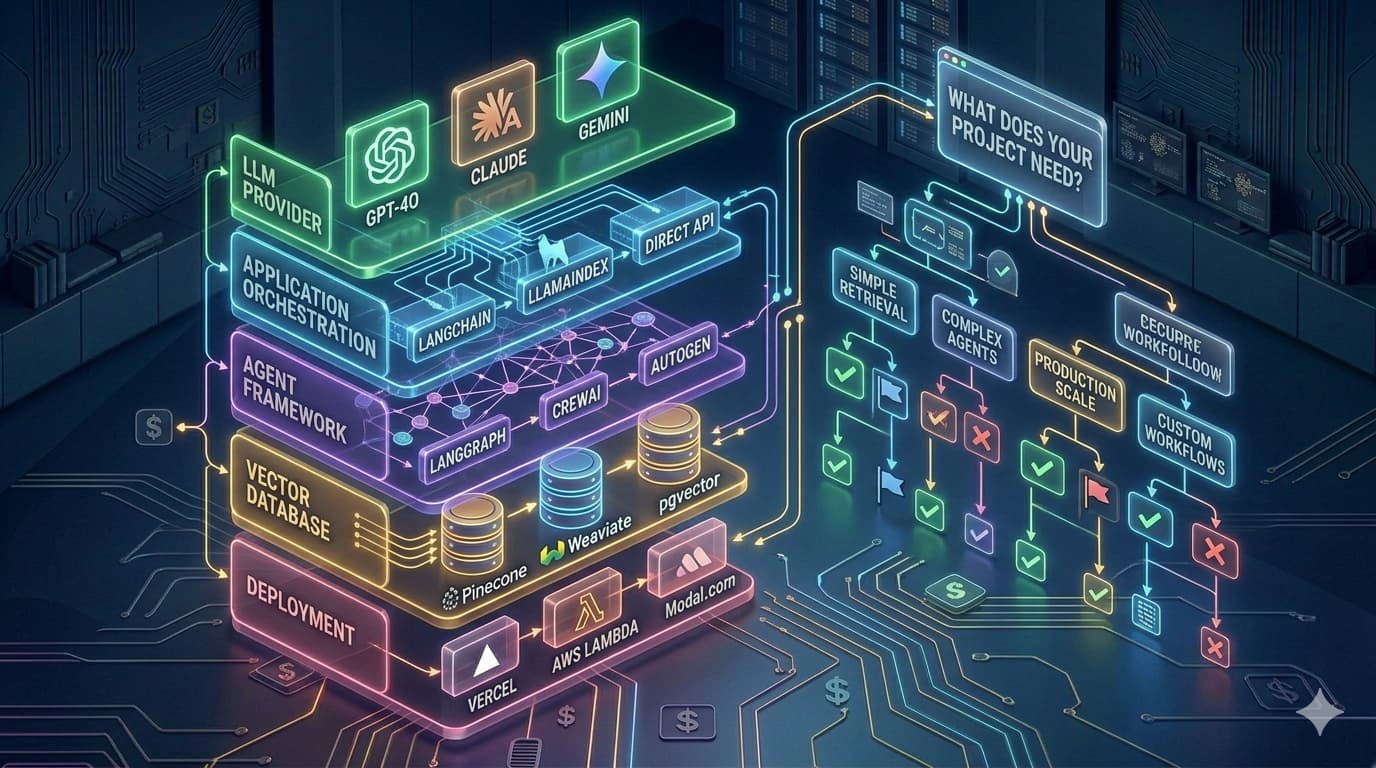
The framework decisions that actually determine whether your AI project succeeds are five layers higher in the stack: which LLM provider, which application orchestration framework, which agent framework, which vector database for retrieval, and which deployment infrastructure. This guide covers all five — with the decision logic that experienced AI development services teams use in practice, not the benchmark comparisons that look impressive but do not translate to production decisions.
Technical product owners, engineering leads, and founders evaluating AI frameworks for a business AI project — chatbot, AI agent, RAG knowledge system, AI-integrated SaaS, or enterprise automation. If you are training a custom ML model from scratch, this guide does not cover that layer. For the generative AI implementation context behind these framework choices, see our generative AI for business roadmap.
Most AI Framework Guides Answer the Wrong Question
The TensorFlow vs PyTorch question is the right question if you are building a custom image classification model or a custom NLP model trained on your proprietary dataset. That represents a small fraction of AI software development services work in 2026. Most AI projects — chatbots, knowledge assistants, AI agents, AI-integrated products — are built on top of existing foundation models accessed via API.
For these projects, the ML training framework layer is irrelevant because you are not training a model. You are calling one. The decisions that actually determine your project's quality, reliability, and maintainability are in the five layers between your application and the model's API. Getting these decisions right — and understanding which layers your project actually needs — is the difference between an AI project that ships in 10 weeks and one that takes 9 months because the framework decision was wrong.
Most AI projects in 2026 touch two or three of the five layers — not all five. A simple AI chatbot with a knowledge base needs Layer 1 (LLM provider), Layer 4 (vector database), and Layer 5 (deployment). It does not need Layer 2 or Layer 3. Adding unnecessary layers is a common source of over-engineering that creates maintenance burden without adding value. Apply the simplicity principle: use the minimum number of framework layers that your project requirements justify.
The 5 AI Framework Layers Every Project Navigates
Think of your AI project's technology stack as five independent decisions made at five different layers. Each layer is independent — your choice at Layer 2 does not lock you into a specific choice at Layer 4. Understanding what each layer does and which of the five your specific project actually requires is the first framework decision.
- LLM Provider — the foundation model that your application calls to generate, reason, or retrieve. Every AI application needs this layer. The decision is which model family and which provider.
- Application Orchestration — the framework that manages the sequence of calls, data flow, and integration connections in your application. Required for complex multi-step applications. Optional for simple single-call applications.
- Agent Framework — the framework that manages autonomous agent behaviour: tool selection, loop control, state management, and multi-agent coordination. Required only for AI agents. Not required for chatbots, RAG systems, or single-function AI features.
- Vector Database — the database that stores embeddings and enables semantic similarity search. Required for all RAG systems. Not required for AI applications that do not use retrieval.
- Deployment Stack — the infrastructure that hosts your AI application, manages its API endpoints, and handles scaling. Required for all production AI applications.
Layer 1 — LLM Provider: Which Brain Does Your AI Use?
The LLM provider decision is the most consequential framework choice because it determines the quality ceiling of everything your application can do. It also determines your cost-per-interaction, your latency profile, and your vendor dependency risk. In 2026, there are three serious foundation model providers for business AI applications — and a meaningful self-hosted option for compliance-sensitive deployments.
LLM Provider Decision
GPT-4oBest GeneralBest general-purpose performance across coding, analysis, generation, and reasoning. Largest ecosystem, most integrations, most documentation, most examples.
Claude Sonnet 4Document LeaderIndustry-leading long-context reasoning and document analysis. Measured, careful outputs — lower hallucination rates on policy and compliance content. Strong structured output.
Gemini 2.0 FlashSpeed + CostFastest time-to-first-token and lowest cost-per-token in the serious provider tier. Native multimodal (text, image, audio). Google infrastructure reliability.
Llama 3.3Self-HostedOpen-weight model deployable on your own infrastructure. No external API calls — all data stays within your environment. Competitive quality for most tasks.
| Provider | Coding Tasks | Document Analysis | High Volume | Compliance | Cost |
|---|---|---|---|---|---|
| GPT-4o | ✓ Best | ✓ Good | ✗ Pricier | ✗ External | $$$ |
| Claude Sonnet 4 | ✓ Strong | ✓ Best | ✗ Moderate | ✗ External | $$$ |
| Gemini 2.0 Flash | ✓ Good | ✓ Good | ✓ Best | ✗ External | $ |
| Llama 3.3 | ✓ Good | ✓ Good | ✓ Scalable | ✓ Best | $$ infra |
The practical recommendation for most business AI projects: start with GPT-4o for simplicity and ecosystem breadth. Evaluate Claude Sonnet 4 for document-heavy or compliance-adjacent use cases. Add Gemini Flash as a fallback or cost-optimised path for high-volume routine tasks. Pin all model calls to specific dated versions — never use floating aliases.
Layer 2 — Application Orchestration: Do You Actually Need a Framework?
This is the layer where most projects make their most expensive framework mistake — choosing a complex orchestration framework when direct API calls would be simpler, more maintainable, and faster to ship. The decision criterion is honest: is your application's complexity — the number of LLM calls, the diversity of integrations, the conditional routing logic — enough to justify adding a framework dependency?
Application Orchestration Decision
Direct API CallsStart HereCall OpenAI, Anthropic, or Gemini APIs directly. No framework dependency, no version conflicts, easiest to debug, easiest to maintain. The correct choice for 60%+ of business AI applications.
LangChainFull Ecosystem200+ integrations, extensive chain primitives, large community, many examples. Adds abstraction overhead — justified when you use many of its integrations. Frequent API changes are a maintenance consideration for long-lived projects.
LlamaIndexRAG LeaderSpecialised for data ingestion, document parsing, and retrieval pipelines. Superior to LangChain for complex RAG systems with structured/unstructured data sources. LlamaParse handles complex PDFs, spreadsheets, presentations better than generic loaders.
Vercel AI SDKFrontend AIProvider-agnostic SDK optimised for web applications. Handles streaming, multi-provider switching, structured output validation with Zod. Best choice for Next.js and React AI applications.
LangChain and LlamaIndex abstract underlying API calls into higher-level primitives — which aids rapid development but creates a debugging layer when things go wrong in production. A simple application using LangChain abstractions can take 3x longer to debug than the same application built with direct API calls, because the abstraction layer obscures which specific API call failed and why. Use frameworks when their integrations and chains provide genuine development speed advantages. Do not use them just because they are popular.
Not sure which framework layers your AI project needs?
Automely's AI development services include framework recommendation as part of the scoping process. Book a free 45-minute call.
Layer 3 — Agent Framework: Only When You Actually Need Agents
An agent framework is required when your AI application must autonomously make decisions about which tools to call, loop through multi-step reasoning, maintain state across interactions, or coordinate multiple AI instances. Many applications described as "AI agents" in product documentation are actually simple prompt-response chatbots — they do not need an agent framework. Apply this test: does the AI need to decide what to do next based on intermediate results, rather than following a fixed sequence? If yes, you need an agent framework. If no, a simpler orchestration approach is sufficient and more reliable.
Agent Framework Decision
LangGraphProduction LeaderGraph-based state machine for AI agents. Explicit state management, conditional edges, checkpoint persistence, and streaming — all production-critical features. Built on LangChain but works independently. Most production-mature agent framework in 2026.
AutoGenMulti-AgentMicrosoft's framework for multi-agent conversations — where multiple AI agents collaborate, critique, debate, or verify each other's outputs. Strong for research and analysis tasks where adversarial agent review improves quality.
CrewAIRole-BasedSimple configuration for role-based agent teams (Researcher, Writer, Editor). Lower barrier to entry than LangGraph. Less production-mature but significantly easier to configure for teams without deep framework expertise.
Pydantic AIType-SafeType-safe AI agent development with Pydantic validation on all inputs and outputs. Strong for teams that want Python typing guarantees on agent state and outputs. Growing rapidly in enterprise teams. Newer but already production-used.
Layer 4 — Vector Database: Required for All RAG Systems
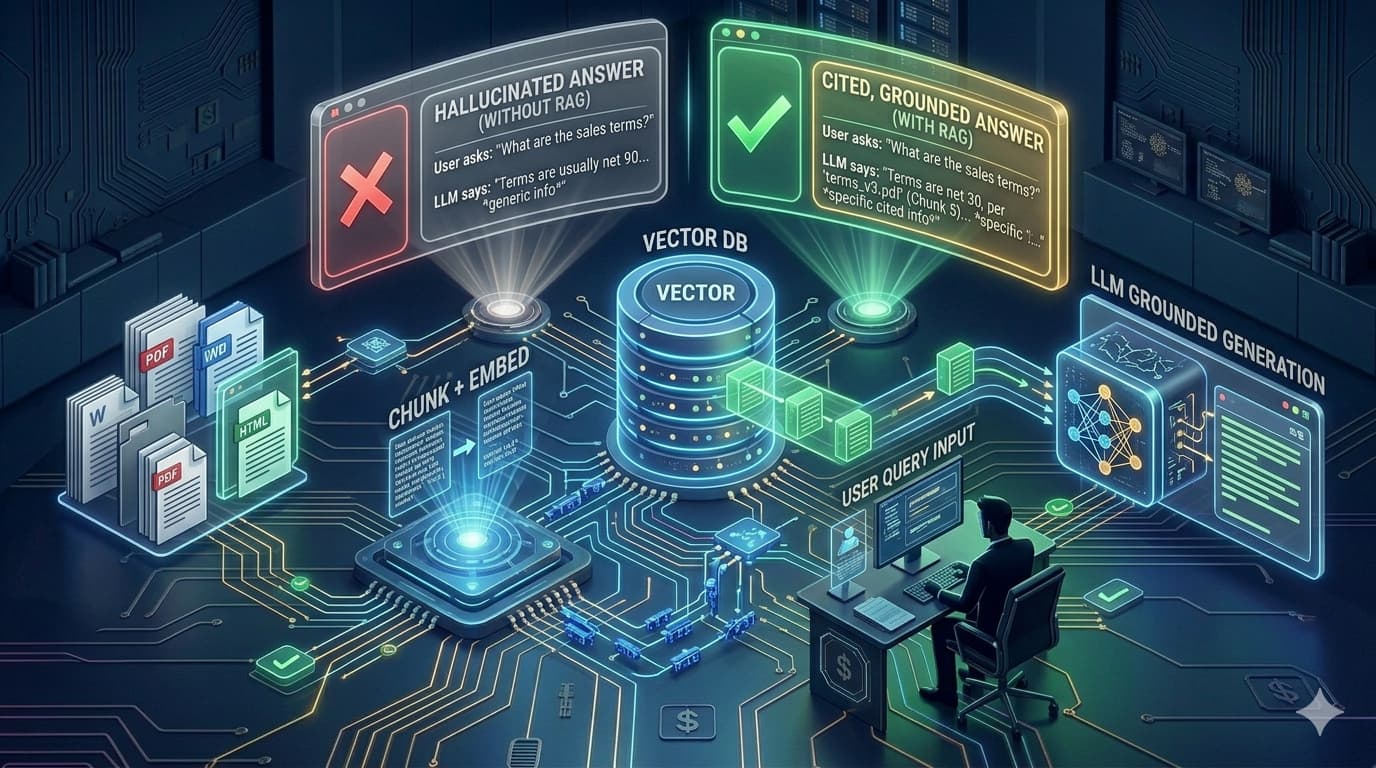
If your AI application needs to answer questions about your specific business knowledge — products, policies, documentation, customer data — it needs retrieval-augmented generation (RAG) and therefore a vector database. If your application does not use retrieval, this layer is not required. For a full guide to RAG system architecture, see our RAG system development guide.
Vector Database Decision
PineconeFastest to ShipManaged cloud vector database. No infrastructure to operate. Excellent performance up to hundreds of millions of vectors. Best choice for most first RAG systems — deploy in an afternoon.
WeaviateHybrid SearchBuilt-in BM25 keyword + vector hybrid search without needing a separate keyword engine. Cloud and self-hosted options. Best when hybrid retrieval (semantic + keyword) is required without adding separate infrastructure.
QdrantSelf-HostedHigh-performance open-source vector database. Best for compliance-sensitive projects requiring data sovereignty. Excellent filtering on payload metadata. Rust-based for performance.
pgvectorPostgres-FirstVector extension for PostgreSQL. Zero additional infrastructure if already on Postgres. Best for teams where the knowledge base lives alongside relational data. Efficient up to ~5M vectors.
Layer 5 — Deployment Stack: Where Your AI Application Lives
The deployment decision determines your application's latency profile, scaling behaviour, cost model, and operational complexity. AI applications have one deployment characteristic that traditional software does not: each request involves external API calls (to the LLM provider) with variable latency. This means timeout handling, retry logic, and streaming responses are essential deployment considerations rather than optional optimisations.
Deployment Stack Decision
VercelWeb AI AppsServerless deployment with native streaming support, excellent Next.js integration, global edge network, and automatic scaling. Best for consumer and B2B web AI applications. Cold starts are a consideration for latency-sensitive endpoints.
AWS Lambda + API GWAPI-FirstServerless functions behind API Gateway. Maximum AWS ecosystem integration (Bedrock, S3, RDS, SageMaker). Best for AI APIs that serve other applications rather than direct user interfaces.
Railway / RenderFull-Stack EasyContainer-based deployment with simpler configuration than raw AWS. PostgreSQL, Redis, and background workers all available on the same platform. Good middle ground between Vercel simplicity and AWS power.
Modal.comGPU WorkloadsServerless GPU infrastructure for running self-hosted AI models (Llama, Mistral, Whisper). Pay per GPU-second. Best for compliance-driven self-hosted model deployment without managing GPU clusters.
4 Proven Production AI Stacks — What We Actually Ship
Theory is useful. What Automely's AI development services teams actually deploy across production systems is more useful. These four stacks cover the most common business AI project types, selected based on reliability record, maintenance simplicity, and team capability fit:
4 AI Framework Mistakes That Cost Projects Months
Choosing a framework before defining the project requirements
"We're building with LangChain" is not a project requirement. It is a conclusion without premises. The right framework emerges from the requirements — what layers does the project need, what is the team's expertise, what are the production reliability requirements. Teams that choose a framework first and then bend their requirements to fit it consistently produce over-engineered systems that are harder to maintain than the requirements justified.
Using LangChain for everything, including simple applications
LangChain is appropriate for complex applications with many integrations. It is not appropriate for a single-function AI feature that makes one API call. A simple classification endpoint built with LangChain abstractions introduces version dependency risk, debugging difficulty, and maintenance overhead with zero benefit over a 20-line direct API call. Start without a framework. Add LangChain or LlamaIndex specifically when the complexity of your pipeline justifies the overhead.
Not pinning model versions — inviting silent drift
Every production AI application in this guide's recommended stacks uses pinned model versions — gpt-4o-2024-08-06, not gpt-4o. A floating model version means your LLM provider can update the underlying model checkpoint without your knowledge, changing your application's behaviour without a code change. This is a framework-level decision that must be made at project setup, not added later when a production incident triggers the post-mortem that reveals it.
Starting with no-code platforms and hitting the ceiling mid-project
No-code AI tools (Flowise, Dify, n8n AI nodes) have a legitimate role for straightforward workflows. They become expensive mistakes when chosen for projects that will eventually require custom logic, complex integrations, or production-grade error handling — because retrofitting from no-code to custom development mid-project costs more time and money than starting with custom development. Evaluate no-code tools honestly against your full project requirements, including future requirements, before committing to one for a production system.
Automely's AI Framework Choices — What We Use and Why
Automely's AI development services cover the full framework stack — framework evaluation, architecture design, development, and production deployment. Our framework selection follows the five-layer decision tree in this guide, applied to each project's specific requirements rather than a fixed house framework.
For Lamblight — consumer AI SaaS, 20,000+ users, $312K ARR — we used direct API calls to OpenAI with a custom RAG layer on Pinecone and Vercel deployment. No LangChain, because the application logic was complex enough to justify custom state management but did not benefit from LangChain's integration ecosystem. For Cerebra Caribbean — multi-channel B2B communication AI, 10,000+ conversations, 95% CSAT — we used LangChain for orchestration (multiple integration points with CRM and communication APIs), LlamaIndex for the document ingestion pipeline, and Pinecone for vector storage. For the B2B German lead qualification agent — LangGraph for agent state management, with direct CRM integration to Close.io and Apollo.io, deployed on Railway.
Each stack was chosen based on the project's actual complexity at the relevant layer — not based on what the team was most familiar with or what was trending. Browse our case studies, read client testimonials, and explore our full service portfolio including AI agent development, generative AI development, AI chatbot development, and AI integration services. For full context on the development process that follows framework selection, see our AI software development process guide.
Need the right AI framework stack selected and built for your project?
Automely's AI development services include framework recommendation as part of the scoping process — with the build that follows. Book a free 45-minute call.