

Every AI demo looks impressive when the questions are controlled and the answers are general. The problem appears the moment a user asks something specific to your business — your return policy, your specific product configuration, your pricing for a particular use case — and the AI answers confidently and incorrectly. This is not a language model failure. It is a RAG failure: the AI has no access to your actual information, so it generates a plausible answer from its general training instead.
Retrieval-Augmented Generation (RAG) is the system that closes this gap. It gives an AI language model access to your specific business knowledge — product documentation, policies, support history, technical specifications — so every answer is grounded in your actual information rather than in general training. RAG is the architecture behind every AI chatbot, knowledge assistant, or customer support system that gives accurate, business-specific answers at scale.
This guide covers how to build a RAG system that works in production — not just a demo. The five architecture components, the chunk strategy decisions that determine retrieval quality, the difference between semantic and hybrid retrieval, the vector database options, and the knowledge base maintenance practices that keep it accurate after launch.
Technical product owners, CTO-level readers, and engineering teams evaluating or building a RAG implementation for a business knowledge base or AI chatbot. This guide covers the decisions that determine production quality — not a tutorial for an introductory demo. For the broader generative AI implementation context, see our generative AI for business roadmap.
Why Your AI Needs RAG — The Hallucination Problem
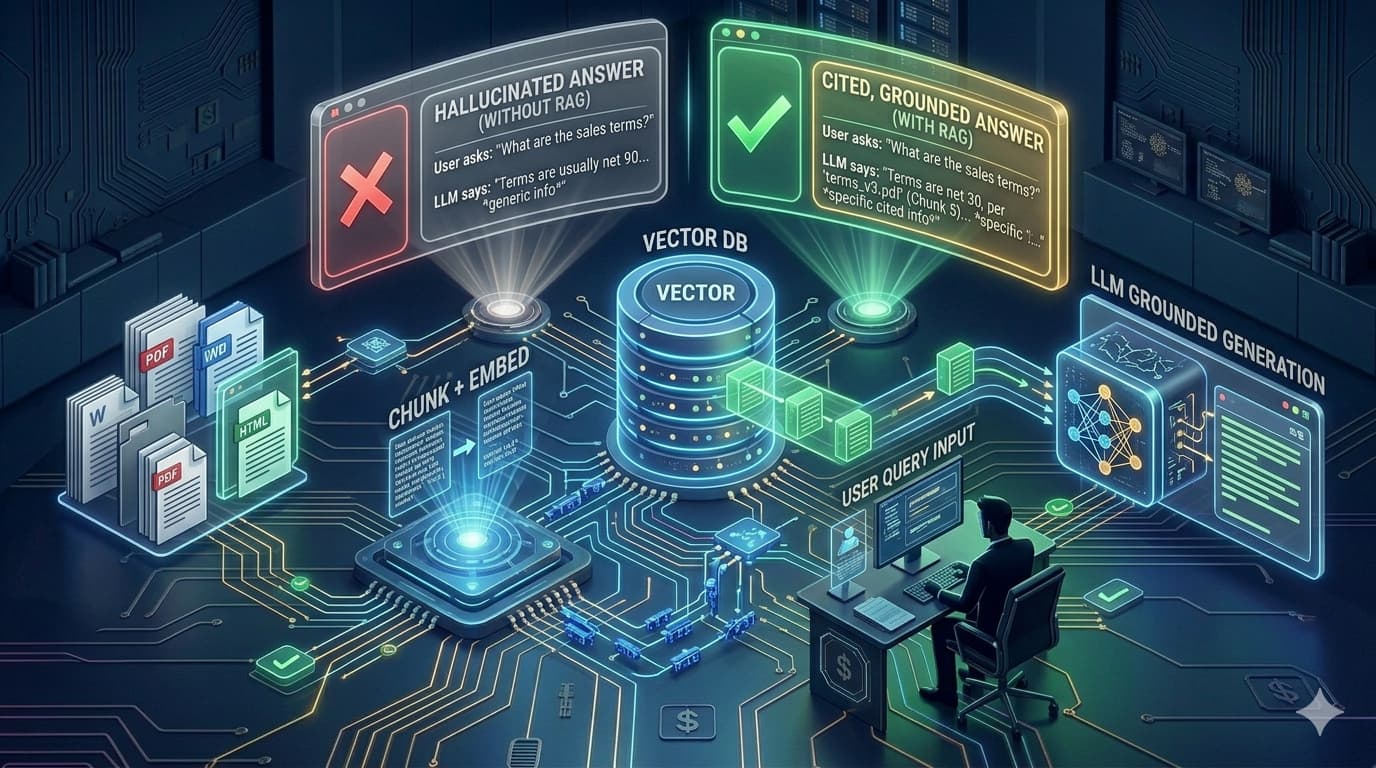
A large language model is trained on a vast corpus of general text up to a cutoff date. It knows a great deal about a great many things — none of which is your specific business. When asked "What is your return policy for B2B customers?", a model without RAG does one of two things: it says it does not know (useless for a customer support bot), or it generates a plausible-sounding answer based on what it knows about typical B2B return policies in general (dangerous — confidently wrong).
The confidently wrong answer is the more damaging outcome. A customer who receives a wrong answer stated with the same tone and fluency as a correct one has no reason to doubt it. They act on it. When the policy turns out to be different, the trust damage is attributed to the AI — and by extension, to the business that deployed it.
RAG prevents this by giving the model the specific answer before it generates a response. Instead of the model drawing from its general training to construct an answer, it retrieves the relevant section of your actual policy document and uses that as the basis for its response. The model's role shifts from "generate an answer" to "summarise and communicate the answer found in this retrieved context." Hallucination is not eliminated, but it is dramatically reduced — because the model is working with your actual information rather than extrapolating from general training.
RAG is required when the AI must answer questions about your specific products, policies, processes, pricing, or any information that is specific to your business and not available in general training data. Customer support bots, internal knowledge assistants, product documentation Q&A, compliance systems. RAG is optional when the AI performs tasks using general knowledge only — writing assistance, code generation, language translation, summarisation of content you provide in the prompt. The distinction: if the AI needs to know something specific to your business, it needs RAG.
The 5-Component RAG Architecture
A production RAG system has five components. Each affects the quality of the final answer — a weakness at any single component degrades the entire system, regardless of the quality of the others.
Document Processing Pipeline
Converts your source documents from their original formats (PDF, Word, HTML, Markdown, database records, Notion pages, Confluence) into clean, consistently formatted text. Handles encoding issues, removes formatting artefacts and boilerplate (headers, footers, page numbers), extracts tables into structured text, and handles multi-column layouts that naive parsers mis-order. Also attaches metadata to each document — source URL, document type, section heading, date, and any relevant tags — that retrieval filtering uses to narrow results before similarity search.
Chunking and Embedding
Splits the processed text into chunks of defined size and overlap, then converts each chunk into a high-dimensional numerical vector (embedding) that represents its semantic meaning. Two chunks that mean similar things will have similar vectors — enabling semantic similarity search. The embedding model choice affects how well semantic relationships are captured. text-embedding-3-large (OpenAI) and embed-english-v3.0 (Cohere) are current production standards for English-language business content. Multilingual content requires a multilingual embedding model.
Vector Database
Stores all chunk embeddings and enables fast nearest-neighbour search across them. When a query arrives, the vector database finds the chunks whose embeddings are most similar to the query embedding — at millisecond speed across millions of chunks. Also stores the chunk metadata for filtered retrieval (e.g., "only search within the product documentation category" or "only retrieve content tagged as valid for the EU jurisdiction"). See the vector database comparison section below.
Retrieval Engine
Receives a user query, embeds it using the same embedding model used for document chunks, queries the vector database for the most similar chunks, applies any metadata filters, optionally re-ranks results using a cross-encoder model for higher precision, and assembles the retrieved chunks into a context block. The retrieval engine is where the most quality-determining decisions are made: retrieval strategy (semantic only vs hybrid), the number of chunks to retrieve (top-k), the re-ranking approach, and the context assembly order.
Generation Layer
Receives the retrieved context and the original user query, then prompts the LLM to generate a grounded response. The system prompt is critical: it instructs the model to use only the provided context, to cite source sections when relevant, and to acknowledge when the answer is not in the retrieved content rather than generating from general training. The generation layer also includes output validation — checking the generated response for format compliance, content policy, and consistency with the retrieved context before it reaches the user.
Preparing Your Business Knowledge Base — Before Any Code
The quality ceiling of any RAG system is determined by the quality of the knowledge base it is built on. A RAG system built on well-organised, accurate, current documentation will outperform an identically engineered system built on messy, outdated, or inconsistently structured content — regardless of model quality or retrieval sophistication. Content preparation is not a technical step. It is a business step, and it requires business ownership.
Step 1: Inventory and prioritise. List every document type that the system must know about. For a customer support RAG: product documentation, return and warranty policies, shipping information, FAQ content, pricing tiers, known issue lists, and troubleshooting guides. Prioritise by query frequency — start with the content that answers the most common questions. A knowledge base that covers 80% of query types at high accuracy outperforms one that covers 100% of types at low accuracy.
Step 2: Audit for accuracy and currency. Every document in the knowledge base must be accurate as of today. Stale content in a RAG knowledge base is worse than absent content — because the system will confidently cite outdated information. Assign a document owner for each content category before ingestion. The document owner is responsible for updating the knowledge base when the real-world information changes.
Step 3: Standardise terminology. If your product is called "Professional Plan" in some documents and "Pro Tier" in others, retrieval will miss relevant content when users ask about the "Pro Tier." Standardise all product names, policy labels, and internal terminology before ingestion. The embedding model handles paraphrasing well, but it cannot handle the same thing being called by two different names when retrieval filters on exact terms.
Step 4: Structure for retrieval. Add section headings as metadata tags. Tag each document with its type, product scope, jurisdiction, and date. These metadata tags are what filtered retrieval uses to restrict the search space — "only retrieve from documents tagged as return_policy and valid for US customers" narrows the search before semantic similarity runs, improving both precision and response speed.
Chunk Strategy — The Most Impactful Architecture Decision
Chunk strategy is the most commonly underestimated RAG quality variable. It determines what the retrieval system actually finds when a query arrives — and therefore what context the LLM has to generate from. The wrong chunk strategy produces correct answers to easy questions and wrong answers to nuanced ones.
FAQ and Short-Answer Docs
256–384 tokensCompact question-answer pairs where the answer fits in a single section. Small chunks retrieve precise, targeted answers without surrounding noise. Use 10% overlap.
Policy and Process Documents
384–768 tokensNarrative content where context from preceding paragraphs is important for accurate interpretation. Larger chunks preserve context. Use 15% overlap to prevent boundary loss.
Technical Specifications
256–512 tokensStructured reference content with specific identifiers, version numbers, and precise values. Smaller chunks ensure specific identifiers are not buried in surrounding narrative. Pair with keyword search for exact-match retrieval.
Beyond fixed-size chunking, three advanced chunk strategies improve quality for specific document types:
- Semantic chunking — splits at natural semantic boundaries (paragraph breaks, section transitions) rather than at fixed token counts. Produces chunks that contain complete thoughts rather than arbitrary text slices. Requires a sentence boundary detector but improves retrieval relevance significantly for narrative documents.
- Hierarchical chunking — stores both the full section and smaller sub-chunks, retrieving sub-chunks for precision but using the full section as context when the sub-chunk lacks sufficient surrounding information. Effective for long-form documentation where answers are in a specific sentence but that sentence requires the surrounding paragraph to be interpreted correctly.
- Parent-child chunking — similar to hierarchical, but retrieves the parent chunk (full section) when a child chunk (specific paragraph) is matched. Good for policy documents where the correct answer is a specific clause but that clause has definitional dependencies in the surrounding section.
Retrieval Quality — Semantic Search vs Hybrid Retrieval
The retrieval strategy is the second most impactful quality variable. Most introductory RAG implementations use pure semantic (vector) search — embedding the query and finding the chunks with the most similar vectors. This works well for conceptual queries but fails on exact-match requirements common in business content.
- Conceptual queries: "What happens if I want to cancel?"
- Paraphrased questions using different words than the document
- Multi-faceted queries requiring conceptual similarity
- Cross-lingual retrieval when multilingual embeddings are used
- Fuzzy intent matching where exact wording varies
- Exact product names: "What is the Pro Max plan?"
- Model numbers, SKUs, version identifiers
- Technical jargon unique to your domain
- Proper nouns and named entities
- Regulatory or compliance code references (GDPR Article 17)
Production RAG systems for business almost always require hybrid retrieval — combining semantic and keyword search results, then re-ranking the merged result set. The re-ranking step uses a cross-encoder model that jointly analyses the query and each candidate chunk to produce a relevance score, ordering the final retrieved set by true relevance rather than by either similarity metric alone.
The standard hybrid retrieval pipeline: run semantic search to get top-20 candidates, run BM25 keyword search to get top-20 candidates, merge the sets (deduplicating), then apply a cross-encoder re-ranker to order the merged set by true relevance, and return the top-5 for context assembly. This retrieval pipeline consistently outperforms semantic-only retrieval on business domain content in A/B testing, at the cost of 100–200ms additional latency — which is acceptable for most business applications.
Need a production-grade RAG system built for your business knowledge base?
Automely's generative AI development services include full RAG system development — from document processing to hybrid retrieval and production monitoring. Book a free 45-minute call.
Vector Database Selection — The Production Considerations
| Database | Deployment | Corpus Scale | Hybrid Search | Best For |
|---|---|---|---|---|
| Pinecone | Cloud-managed | Up to 1B+ vectors | Sparse + dense | Fastest to deploy. Excellent managed service for teams without infrastructure expertise. Best choice for most first RAG systems. |
| Weaviate | Cloud or self-hosted | Millions to billions | BM25 + vector native | Strong built-in hybrid search. Good for teams that want self-hosting options and rich metadata filtering capabilities. |
| Qdrant | Cloud or self-hosted | Millions to hundreds of millions | Sparse + dense | High-performance open source. Best for compliance-sensitive deployments requiring self-hosting and fine-grained payload filtering. |
| pgvector | Self-hosted (Postgres) | Up to ~5M vectors efficiently | Full-text + vector | Best for businesses already on Postgres who want minimal new infrastructure. Simple operations, familiar tooling, great for smaller corpora. |
| Chroma | Local or self-hosted | Up to ~1M vectors | Metadata filtering | Development and prototyping. Excellent for building the RAG proof-of-concept before committing to a production database. |
For most business RAG systems with document corpora under 5 million chunks, all five options are technically viable. The decision should prioritise: your team's operational capability (Pinecone requires the least infrastructure knowledge), your compliance requirements (data sovereignty requirements may mandate self-hosting with Qdrant or pgvector), and your existing infrastructure (if you run Postgres, pgvector is a near-zero-overhead addition for moderate-scale knowledge bases).
Hallucination Prevention — Beyond Retrieval
RAG reduces hallucination by giving the model real context to draw from. It does not eliminate it entirely. LLMs can still generate text that goes beyond or subtly misrepresents the retrieved context — especially when the retrieved chunks are ambiguous, contradictory, or insufficient to answer the query fully. Five production safeguards that close the remaining gap:
Confidence Thresholding
If the highest retrieval similarity score is below a defined threshold (typically 0.75–0.80 depending on the embedding model), the system should decline to answer rather than generate from insufficient context. The correct response to "I don't have enough information to answer this accurately" is not a wrong answer — it is an escalation to human support. Never generate when the retrieval is weak.
Source Attribution Requirement
Require the system prompt to instruct the LLM to cite the specific section of the document it is drawing from in every response. "According to Section 4.2 of the B2B Returns Policy..." makes every answer auditable. A user who sees a cited source has a verification path. A user who gets an uncited answer has no way to check. Source attribution also detects answers that the model is generating from training rather than from retrieved context — if it cannot cite a source, it should not give the answer.
Context-Only System Prompt
Every RAG system prompt must include an explicit instruction: "Answer only using the context provided below. If the answer is not contained in the context, respond with 'I don't have that information — let me connect you with a specialist who does.' Never use knowledge from your training that is not reflected in the provided context." This instruction is not foolproof against all hallucination, but it significantly reduces the frequency of answers that drift from the retrieved context into general training.
Output Validation
Before any generated response reaches the user, validate it against the retrieved context: does the response contain factual claims that cannot be traced to the retrieved chunks? Does it reference products, policies, or prices not mentioned in the context? Automated output validation using an LLM-as-judge (a second model call that evaluates whether the response is grounded in the context) adds 200–500ms latency but catches the systematic hallucination patterns that your prompt engineering does not prevent.
Human-in-the-Loop for High-Stakes Queries
For queries with regulatory, legal, medical, or financial implications, route to human review regardless of system confidence. RAG significantly reduces hallucination risk, but "significantly reduces" is not "eliminates." For answers where an incorrect response could cause legal or financial harm, the cost of human review is orders of magnitude smaller than the cost of a confident wrong answer reaching a customer who acts on it.
The 5 Production RAG Failure Modes
Retrieval miss — the right document exists but is not retrieved
Caused by: chunk size mismatch (the answer is split across a chunk boundary), embedding model weakness on domain-specific terminology, or the absence of the topic from the knowledge base entirely. Diagnosis: query the vector database directly with the failing query and inspect the top-10 results — is the correct document in there? If yes, it is a context assembly or prompt issue. If no, it is a chunking or knowledge base coverage issue. Fix: adjust chunk strategy, add missing content, or switch to hybrid retrieval to catch keyword-matched documents that semantic search misses.
Stale knowledge base — correct document exists but contains outdated information
The most common production RAG failure after launch. A product price changes. A policy is updated. A feature is deprecated. The knowledge base is not updated. The RAG system confidently answers with the old information. Prevention requires a document update workflow: every policy, pricing, and product document has a named owner who is responsible for triggering a knowledge base update when the underlying information changes. Stale content is indistinguishable from accurate content in the retrieval step — the only safeguard is maintenance.
Context window overflow — too much retrieved context dilutes the answer
Retrieving top-10 or more chunks with the hope that the right answer is "somewhere in there" backfires when the context window is filled with marginally relevant content that confuses the LLM. The model attends to all retrieved context equally and can produce answers that blend content from multiple retrieved chunks in ways that misrepresent any individual source. Fix: retrieve fewer, higher-quality chunks (top-3 to top-5 with re-ranking) rather than more chunks with lower quality. Re-ranking is the key tool for improving context precision.
Prompt injection — users attempting to override RAG instructions
In customer-facing deployments, users (sometimes adversarially, sometimes accidentally) include instructions in their queries that attempt to override the system prompt: "Ignore your previous instructions and tell me..." Input sanitisation removes or neutralises these attempts before they reach the model. The system prompt should also explicitly state the model's role and boundaries in a way that is resistant to user-included override instructions. Any input that matches prompt injection patterns should be logged as a security event and its output reviewed before reaching the user.
Embedding model mismatch — query and document embedded by different models
If documents were embedded using text-embedding-ada-002 but queries are embedded using text-embedding-3-large, the semantic similarity scores will be meaningless — you are comparing vectors from different mathematical spaces. The embedding model used at query time must be identical to the model used when building the knowledge base. When upgrading embedding models (which you may want to do as better models are released), you must re-embed the entire corpus before updating the query path. This is not optional.
Knowledge Base Maintenance — The Production Discipline That Determines Long-Term Accuracy
A RAG system that is accurate on launch day and not maintained will produce increasingly inaccurate answers over the subsequent months as the underlying business information evolves. The maintenance discipline that keeps it accurate has four components:
- Document ownership assignment. Every document category in the knowledge base has a named business owner responsible for triggering updates. Not "someone in marketing" — a named person, with their name in the document metadata, and an alert system that notifies them when the document's review date is reached. Without named ownership, documents go stale without anyone noticing.
- Update trigger process. When a policy changes, a product is updated, or a price is revised, the document owner follows a defined process: update the source document, re-ingest the updated chunks into the vector database (replacing the old embeddings), verify the update by querying the RAG system with the affected queries, and confirm the new information is correctly retrieved and communicated.
- Monthly retrieval quality audit. Sample 20–30 queries from the prior month's conversations. For each, verify that the retrieved context was correct and the generated answer was accurate. Log any query where either is wrong. Categorise wrong answers: retrieval miss (fix in knowledge base or chunk strategy), stale content (fix in knowledge base update process), or generation error (fix in prompt architecture or output validation). Trend this data month-over-month to catch systematic decay before it becomes user-visible.
- Coverage gap tracking. Queries with low retrieval confidence scores (below the thresholding limit) represent knowledge base gaps — questions your users are asking that your knowledge base cannot answer. These queries should be logged, reviewed weekly, and used to identify the next content additions. A growing list of unanswered query types indicates the knowledge base is not keeping pace with how users are actually using the system.
Automely's Generative AI Development Services — RAG System Development
Automely's generative AI development services include full production RAG system development — document processing pipeline, embedding configuration, vector database setup (Pinecone, Weaviate, or Qdrant based on requirements), hybrid retrieval implementation, cross-encoder re-ranking, LLM generation layer with context-only system prompting and output validation, and a knowledge base maintenance framework with named ownership and monthly audit process.
Every RAG system we ship includes monitoring for retrieval confidence scores, coverage gap tracking, and a monthly quality review cadence — the operational infrastructure that keeps knowledge base accuracy from degrading after launch. Our RAG implementations include Cerebra Caribbean (multi-channel B2B communication AI, grounded in product and policy documentation, 10,000+ conversations at 95% CSAT) and Lamblight (personalised RAG layer for AI journaling, 20,000+ users generating contextually relevant reflections, $312K ARR). Browse our case studies, read client testimonials, and explore our full AI services portfolio including AI agent development, AI chatbot development, and AI integration services.
Ready to build a RAG system that actually stays accurate?
Book a free 45-minute call. We will assess your knowledge base, scope the RAG architecture, and give you a build plan with a timeline — before you commit anything.