

Developing AI software is not the same as developing traditional software with AI features added at the end. The difference is not cosmetic — it changes the scoping process, the architecture decisions, the testing methodology, and what "done" actually means at delivery. A team that approaches an AI software project using traditional software development patterns will consistently produce systems that work in demos and fail in production.
This guide covers the complete AI software development process from the perspective of a team that has shipped multiple production AI systems — from the scoping questions that prevent failure before a line of code is written, through the seven development phases, the AI-specific testing framework, and the delivery checklist that defines what production-ready actually means for AI software.
This covers AI software development using foundation models — generative AI, AI agents, RAG systems, and AI-integrated applications. It does not cover training custom ML models from scratch, which is a substantially different process appropriate for organisations with large labelled datasets and dedicated ML research teams. For the great majority of business AI software in 2026, foundation model-based development is the right approach.
How AI Software Development Differs From Traditional Software Development
Traditional software is deterministic: given input A, the code always produces output B. Testing is complete when all paths through the code produce the correct output. The software is "done" when it passes all tests and deploys without errors.
AI software has a fundamentally different property: its core component — the language model — is probabilistic. Given the same input twice, the output may vary. A test that passes 100% of the time on a controlled test set may fail 8% of the time on real user inputs that the test set did not anticipate. This changes three things about the development process:
Testing is probabilistic, not deterministic. AI software cannot be declared "tested" by passing a fixed test suite. It must be evaluated against an acceptance rate threshold across a representative sample of real-world inputs. A 95% acceptance rate is not the same as passing 20 out of 20 test cases — it means that across a representative sample, 95% of outputs meet the quality criteria.
Monitoring is a permanent development responsibility, not a post-launch activity. Traditional software is monitored for uptime and error rate. AI software must also be monitored for output quality — a metric that standard APM tools do not capture. An AI system with 0% error rate and 99.9% uptime can be producing wrong answers 20% of the time, and standard monitoring will show it as healthy.
The system has non-code dependencies that degrade over time. AI software depends on a knowledge base (which becomes stale as business information changes), a model version (which can be updated by the provider without a code change), and external tool APIs (which can change their response formats without warning). These dependencies must be managed with the same rigor as code — versioned, tested, and reviewed on a schedule.
The 6 Scoping Questions That Determine Whether Your AI Project Succeeds
The scoping phase of an AI software project is more consequential than in traditional software because the failure modes of AI are less obvious and more expensive to fix late. A traditional software project that has an ambiguous requirement produces a feature that does not quite fit. An AI software project that has an ambiguous requirement produces a system that confidently does the wrong thing at scale.
Faculty.ai's delivery framework emphasises that AI scoping must translate business problems into well-designed AI solutions — not start with the AI and search for a problem to apply it to. These six questions operationalise that principle:
What is the specific, measurable problem the AI solves?
"Improve customer support" is not a problem. "Reduce manual handling of tier-1 support tickets from 25 hours/week to under 5 hours/week, with a customer satisfaction score no lower than the current 78%" is a problem. The specificity of this answer determines whether you can scope, build, test, and evaluate the system. Any AI project that cannot answer this question in one specific sentence is not ready to begin development.
What does a correct output look like — specifically?
You must be able to show an example of a correct AI output before you build the system. "A helpful response" is not a definition. "A response that accurately cites the relevant section of the return policy, gives the customer their specific next step, and does not suggest options that are not available to their account tier" is a definition. This definition becomes your acceptance criteria — what you test against in quality evaluation.
What data or knowledge does the AI need, and do we have it in usable form?
The data readiness assessment determines your timeline more than any other variable. Identify every piece of information the AI must have access to — product documentation, policies, customer records, process guides — and assess its current state: Is it digitised? Is it accurate and current? Is it structured consistently? Are there any regulatory restrictions on its use in an AI system? Poor data readiness adds 2–8 weeks to any AI project timeline.
What happens when the AI produces a wrong answer?
Define the failure handling before you design the success path. Who detects the wrong answer? What triggers the detection — output validation, user feedback, downstream system error? What happens after detection — correction, escalation, audit? How does the correction prevent the same failure recurring? AI systems without defined failure handling produce wrong answers that propagate through downstream systems until someone notices — which may be much later than intended.
What existing systems must the AI integrate with?
Integration complexity is the second-most common timeline variable after data readiness. For each system the AI must read from or write to — CRM, ERP, ticketing system, billing platform, custom internal database — document the API or integration method, authentication approach, data format, rate limits, and test environment availability. An integration that requires a vendor to expose a new API endpoint can add 4–8 weeks to a project timeline.
Who owns this system after launch?
Name the post-launch owner before development begins — not technically, but operationally. Who updates the knowledge base when business information changes? Who reviews the monthly quality sample? Who escalates when the output quality metric drops? An AI system without a named operational owner degrades within 3–6 months of launch. This is not a technical decision; it is an organisational one, and it must be made before development starts.
The 7-Phase AI Software Development Process
Problem Scoping and Feasibility
Answer the six scoping questions above. Produce a written scope document that includes: the specific problem statement with measurable success criteria, the acceptance criteria for AI output quality, the data and knowledge inventory with readiness assessment, the integration map, the failure handling design, and the post-launch operational ownership plan. No development begins without a signed-off scope document. Changes to the scope after development begins are the primary cause of AI project cost overruns.
- Scope document signed off by business and technical owners
- Success criteria and acceptance rate threshold defined
- Data readiness assessed — no hidden data preparation surprises
Architecture Selection
Select the AI architecture — prompt engineering only, RAG knowledge system, fine-tuned model, AI agent with tools, or multi-agent system — based on the requirements established in Phase 1. Apply the simplicity principle: use the least complex architecture that can meet the acceptance criteria. Choose the surrounding software stack — backend language, database, hosting, authentication approach, integration method. Document all decisions and their rationale. Revisiting architecture decisions after significant development is extremely costly.
- AI architecture selected with written rationale
- Full technical stack documented
- Integration approach confirmed for each system
Data and Knowledge Preparation
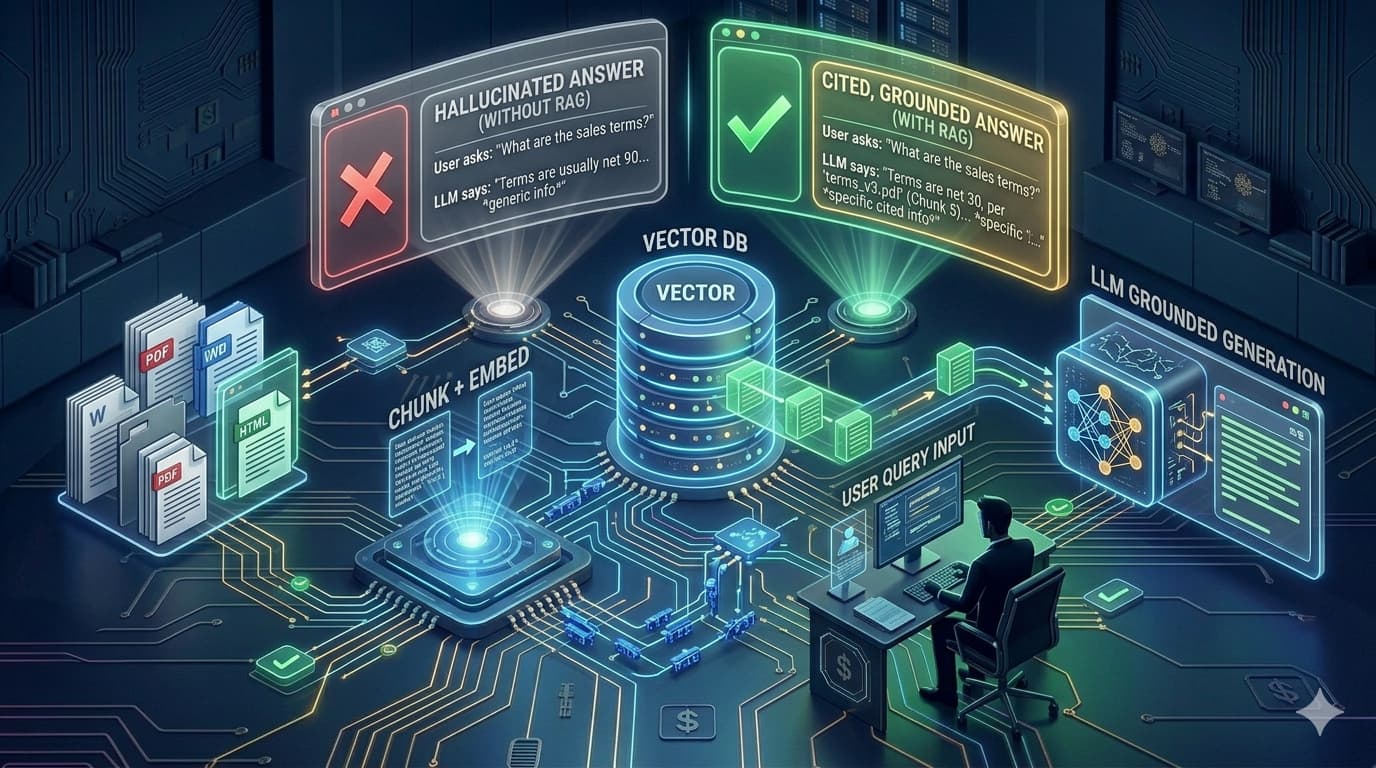
For RAG systems: clean and structure the knowledge base content, add metadata tags, ingest into the vector database, and verify retrieval quality on a sample of representative queries before any application code is written. For AI agents: establish access to all required tool APIs and data sources, validate authentication and response formats. For ML model projects: acquire, clean, and prepare the training data, establish the train/validation/test splits, and validate data quality before model training begins. Data preparation issues discovered during development delay the project; issues discovered during testing delay it further.
- Knowledge base or training data prepared and validated
- Retrieval quality tested on sample queries (for RAG systems)
- All tool API authentications confirmed working
Core AI Development
Build the AI core — the prompt architecture, RAG pipeline, agent orchestration, or model integration. Simultaneously build the surrounding software that the AI operates within: the API layer, user interface, authentication and authorisation, subscription or billing layer (for SaaS), integration connectors to external systems, and the output validation layer. The output validation layer — the mechanism that reviews AI outputs before they reach users or downstream systems — is not optional and not a post-launch addition. It is built in this phase, before any testing begins.
- AI component producing outputs on representative inputs
- Output validation layer built and functioning
- All integrations connected and returning expected responses
AI-Specific Testing
Apply all four layers of the AI testing framework (see Section 4 below). This phase runs in parallel with the latter part of Phase 4 — deterministic unit tests can run as soon as code is written. Probabilistic quality evaluation and adversarial testing run once the full system is integrated. Human sampling evaluation — the phase gate — runs last and must meet the defined acceptance rate threshold before the project proceeds to deployment.
- All deterministic unit and integration tests passing
- AI quality acceptance rate above defined threshold
- Human sampling review completed and signed off
Production Hardening and Deployment
Production hardening is the step that separates a demo from a system that runs reliably at scale. Before deploying to real users: add failure handling and circuit breakers for all external dependencies; implement cost monitoring with daily spend alerts; set up trace logging for all AI executions; configure quality monitoring with alerts for output quality drop; add input sanitisation for prompt injection prevention; and run the delivery checklist (Section 5). Deploy with parallel validation — the AI system runs alongside the manual process or previous system for 1–2 weeks while real-world performance is verified before full cutover.
- Delivery checklist complete — all items verified
- Monitoring stack active with baseline metrics established
- Parallel validation completed and results reviewed
Post-Launch Monitoring and Iteration
Week-over-week quality sample reviews for the first month (10–15 outputs reviewed per week against acceptance criteria), transitioning to monthly reviews. Knowledge base updates when underlying business information changes. Monthly quality score trend review. Quarterly regression testing when model versions or major integration dependencies change. Coverage gap tracking — what query types have low retrieval confidence, indicating knowledge base gaps that need filling. The named post-launch owner from Phase 1 now executes this maintenance cadence.
- Weekly quality sample review for first 4 weeks post-launch
- Monthly quality metric trend review
- Knowledge base updated within 48 hours of any content change
Have an AI software project you need to develop?
Automely runs the complete 7-phase process — from scoping through production deployment. Book a free 45-minute scoping call to get a timeline and cost estimate.
The AI-Specific Testing Framework — 4 Layers
AI software testing requires four distinct layers. All four must be completed before deployment. Skipping any layer is equivalent to deploying traditional software without running integration tests — the failures will appear in production, where they are more expensive to fix and more damaging to user trust.
Unit and Integration Testing
All non-AI code — API endpoints, data processing, authentication, billing logic, integration connectors — is tested with standard deterministic unit and integration tests. These tests must pass at 100% before any AI-specific testing begins. Deterministic tests are not modified based on AI output quality — they test the surrounding software's correct function, independently of what the AI produces.
Quality Evaluation on Representative Inputs
The AI component is evaluated against a test set of 50–100 inputs representative of real production queries. Each output is scored against the acceptance criteria defined in Phase 1. The result is an acceptance rate (e.g., "87 of 100 test inputs produced outputs that meet quality criteria"). The pre-defined minimum acceptance rate threshold (e.g., 90%) is the gate for proceeding to deployment. If the threshold is not met, the prompt architecture, knowledge base, or retrieval configuration is revised and the evaluation is re-run.
Edge Case and Adversarial Input Testing
Test inputs that are outside the normal distribution: empty inputs, unusually long inputs, inputs in unexpected languages, inputs with special characters, ambiguous or contradictory queries, and adversarial inputs that attempt to override system instructions ("Ignore your previous instructions and..."). For each adversarial input, the expected correct outcome is defined (usually: graceful handling, decline to answer, or escalation — never a confidently wrong answer). Failures in adversarial testing indicate missing input validation or a system prompt that is vulnerable to injection.
Domain Expert Quality Review
A sample of AI outputs — typically 30–50 from the Layer 2 evaluation set — is reviewed by a domain expert who is not the developer: someone who knows the business context, can identify subtle inaccuracies, and can evaluate whether the outputs would satisfy real users. The domain expert produces a signed-off quality report that serves as the final gate before production deployment. This is not a technical review — it is a business quality review by someone who represents the user's perspective.
The AI Software Delivery Checklist — What "Done" Means
Traditional software has a clear definition of done: all features built, all tests passing, staging deployment successful. AI software requires an expanded definition that covers the AI-specific infrastructure and operational requirements. Use this checklist at the end of Phase 6 to confirm the system is production-ready — not just demo-ready.
Model version pinned to a specific dated version — no floating labels that can be silently updated
System prompt versioned in the codebase — not hardcoded in a database field that has no change history
Output validation layer deployed and actively filtering outputs before user delivery
Confidence thresholding configured — system declines to answer when retrieval or model confidence falls below threshold
All external API dependencies have failure handling — timeout, retry with exponential backoff, circuit breaker, graceful degradation
AI API spend monitoring active with daily alerts at 80% of monthly budget
Fallback path defined and tested — what the system does when the primary AI API is unavailable
Rate limiting configured to prevent runaway usage from unusual traffic patterns
Trace logging active — every AI execution logged with input, retrieved context, and output
Quality monitoring dashboard live — output quality score visible and baselined
Latency monitoring with alert threshold configured
Coverage gap tracking — queries with low retrieval confidence logged for knowledge base review
Knowledge base content audited for accuracy as of today — no stale documents
Document update process documented — named owner, trigger event, update procedure, re-ingestion steps
Monthly quality review cadence scheduled with a named reviewer
Post-launch operational runbook delivered to the business owner
Input sanitisation configured — adversarial inputs and prompt injection attempts handled
PII and regulated data confirmed not sent to third-party AI APIs without DPA
Audit trail implemented where regulatory requirements demand it
Human escalation path operational for high-stakes query categories
AI Technical Debt — What Gets Skipped and What It Costs
AI technical debt accumulates faster than traditional software technical debt because its failure modes are often invisible — quality degradation, not crashes; stale answers, not error codes; model drift, not build failures. The five most common forms of AI technical debt and the cost each accumulates if not addressed before launch:
Floating model version
Using "gpt-4o" instead of "gpt-4o-2024-08-06". The provider updates the model. Your prompt was optimised for the previous checkpoint. Behaviour changes without any code change and with no alert. Retrofitting model version pinning requires re-testing the entire system against the new pinned version — days of engineering time. Do it at build time: cost zero. Retrofit it after a model drift incident: cost 3–5 days plus the trust damage from the incorrect outputs that triggered the incident.
No output validation layer
AI outputs sent directly to users or written directly to databases without quality checking. The first production incident — an incorrect CRM entry, a wrong policy statement sent to a customer, a hallucinated price quoted in a sales conversation — requires emergency development of the output validation that should have been built in Phase 4. Cost at build time: 1–2 weeks. Cost as an emergency retrofit: 2–4 weeks plus incident management, stakeholder communication, and reputational damage.
No prompt versioning
Prompt logic stored in a database field or environment variable with no change history. When output quality drops and the investigation begins, there is no way to know whether a prompt change caused the regression — because prompt changes are not tracked. Retrofitting prompt versioning requires migrating all prompt logic into the version-controlled codebase and establishing a deployment process. Build time: 1 day. Retrofit: 1–2 weeks of migration plus the debugging time on all incidents that occurred without prompt history.
Knowledge base without a maintenance plan
Launching a RAG system without a named owner, a document update trigger process, or a monthly quality review. Within 2–4 months, product changes, policy updates, and new pricing that have not been reflected in the knowledge base accumulate. The system confidently answers with outdated information. Retrofit requires a retrospective audit of all outdated content, re-ingestion, and the implementation of a maintenance process that should have been in place on day one. Do not launch without a maintenance owner and process.
No observability
Deploying AI software with only standard APM monitoring (error rate, uptime, latency). Output quality, retrieval confidence, model version changes, and per-execution AI costs are invisible. The first signal of a problem is user complaints or a shocking API invoice. Retrofitting observability — trace logging, quality monitoring, cost tracking — requires code changes in production, which means risk during deployment. Build the observability stack in Phase 6 before any user traffic arrives.
Realistic AI Software Development Timelines and Costs
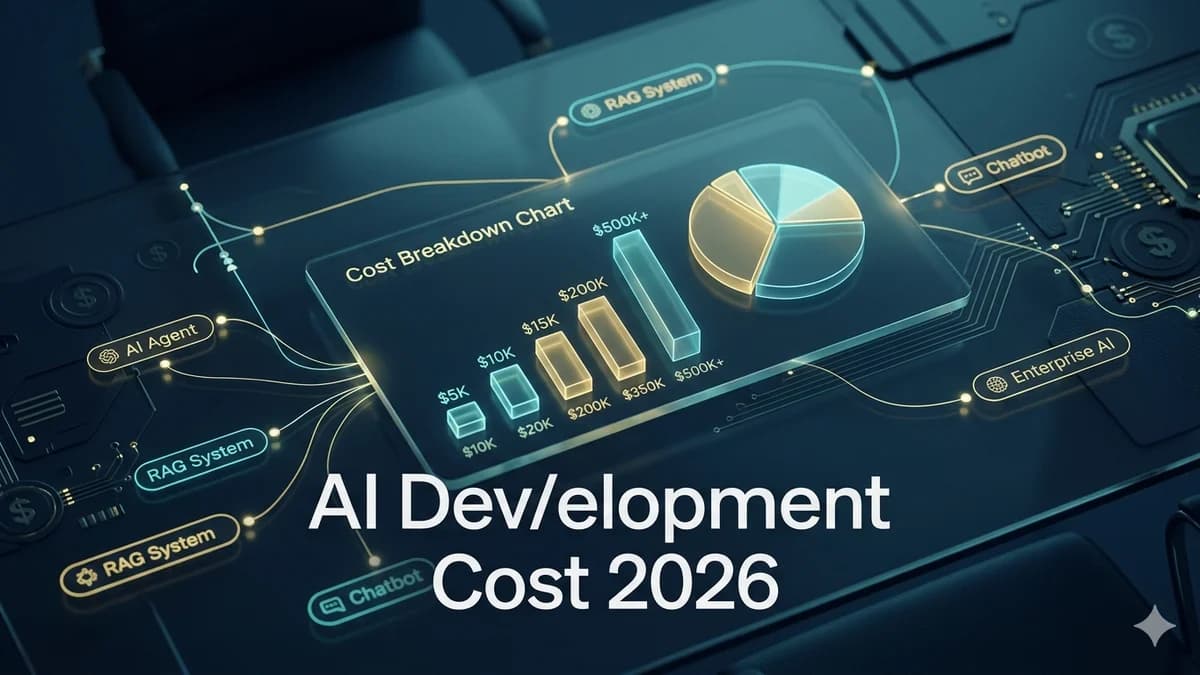
| Project Type | Timeline | Build Cost | Ongoing Monthly |
|---|---|---|---|
| AI API integration (add AI to existing product) | 2–6 weeks | $5,000–$20,000 | $200–$1,500 |
| RAG knowledge assistant or chatbot | 6–12 weeks | $10,000–$40,000 | $300–$2,000 |
| AI agent with multi-system integration | 8–16 weeks | $20,000–$65,000 | $500–$3,000 |
| Full AI SaaS product (MVP) | 10–18 weeks | $40,000–$120,000 | $800–$5,000 |
| Enterprise AI platform | 6–18 months | $150,000–$1M+ | $2,000–$20,000+ |
The most common budget error in AI software development is underestimating the ongoing operational cost. Unlike traditional SaaS where ongoing costs are primarily hosting and support, AI software has a LLM API cost that scales with usage. A system that handles 10,000 AI interactions per month at an average of $0.08 per interaction has $800/month in AI API costs alone — before hosting, monitoring tools, or maintenance. Model these costs per usage scenario before setting subscription prices or budget allocations. See our detailed breakdown in the AI development cost guide.
Developing AI Software with Automely
Automely's AI software development service runs the complete 7-phase process described in this guide — starting with a structured scoping session that answers the six questions before any architecture decision is made, through production deployment with the full delivery checklist, and into post-launch monitoring support with operational runbook delivery.
Our delivered AI software includes Lamblight ($95K build, 20,000+ users, $312K ARR), built as a full AI SaaS product with a RAG-based personalisation layer and output validation across every AI interaction; Cerebra Caribbean ($65K build, 10,000+ conversations, 95% CSAT), a multi-channel AI communication system with tier-classification routing and full trace logging; and a B2B lead qualification agent ($24K build, 11 weeks, replaced 2 FTE) with full integration into Close CRM and Apollo.io. All three systems are running in Phase 7 — actively monitored, knowledge base maintained, and quality-reviewed monthly.
Browse our case studies, read client testimonials, and explore our full AI services portfolio including AI agent development, generative AI development, AI chatbot development, and SaaS development. For context on how we scope and price projects, see our AI development ROI guide.
Ready to develop your AI software with a team that has shipped it before?
Book a free 45-minute scoping call. We will run through the 6 scoping questions, give you an architecture recommendation, and produce a scoped timeline and cost estimate — before you commit anything.