

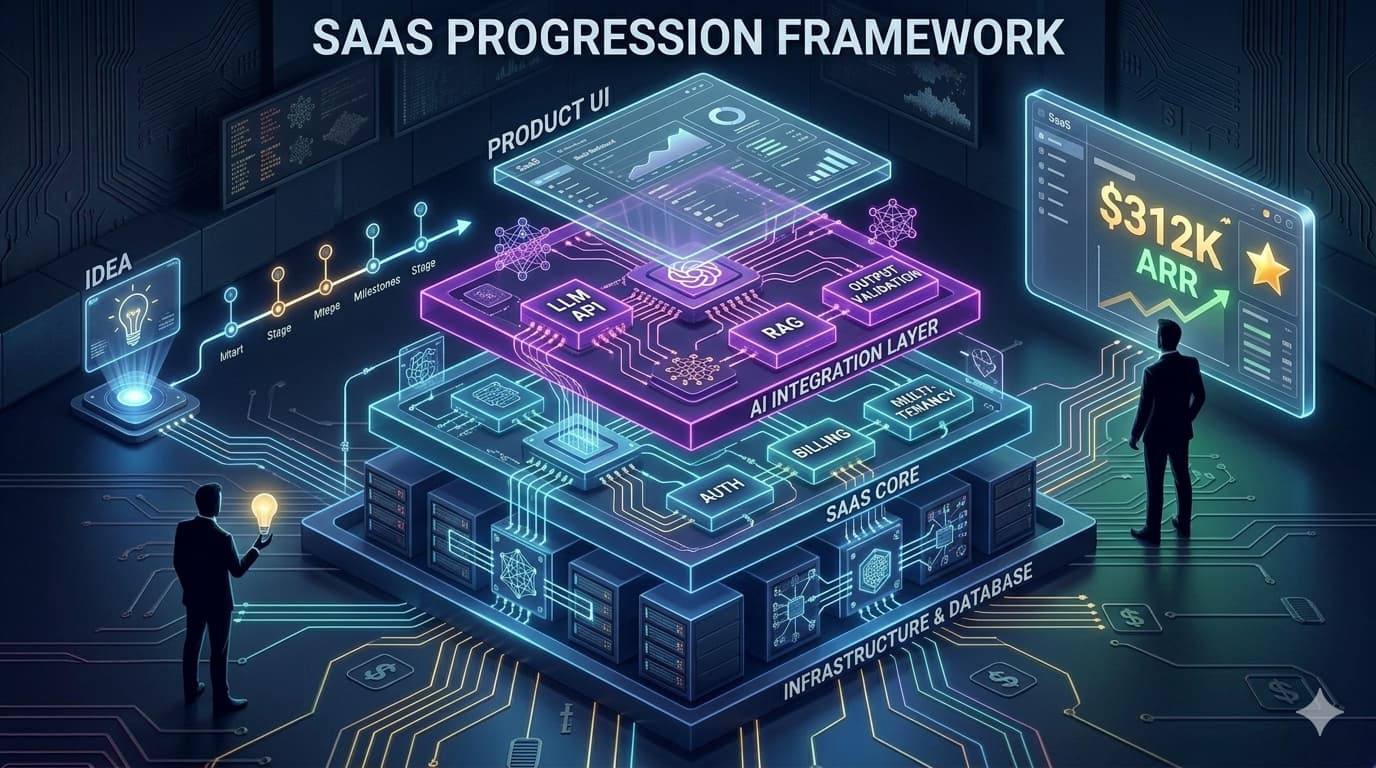
We built Lamblight — an AI journaling and reflection SaaS — from zero to 20,000 active users and $312,000 in ARR. We have also seen AI SaaS projects that consumed $200,000 in development budget and never launched. The difference between those outcomes is not the idea. It is the build sequence, the architecture decisions, and whether the team treated the MVP as a hypothesis test or a vision delivery.
This guide is built from direct AI SaaS development experience — not from extrapolating general SaaS principles. It covers the decisions that are genuinely different in an AI SaaS build: how AI changes the cost structure, why multi-tenancy design in AI SaaS has unique requirements, how AI SaaS pricing works differently from traditional subscription pricing, and what go-to-market looks like when your core value proposition is an AI capability your customer has never seen in a product before.
Founders and product leaders who have an AI SaaS idea and are deciding whether to build it with an internal team, commission a development agency, or hire a CTO. This guide covers the decisions you need to make before anyone writes code — and the ones that your development team will make that you need to understand well enough to evaluate.
AI SaaS vs Traditional SaaS — The 3 Genuine Differences That Change Everything
Most AI SaaS guides treat an AI SaaS product as "SaaS with an AI feature." That framing undersells how different the economics and architecture are. There are three differences that are significant enough to change your build sequence, pricing structure, and financial model:
1. AI SaaS has variable COGS that scale with usage intensity, not user count. Traditional SaaS gross margins are 70–90% because COGS (hosting, infrastructure) are largely fixed and scale gradually with users. AI SaaS gross margins depend on how often each user invokes AI features — and each AI API call has a real cost. A user who makes 500 AI requests per month on a $49/month plan may cost you more in LLM API fees than their subscription generates. This unit economics reality must be designed into the pricing model before launch, not discovered after six months of operation.
2. AI SaaS has different retention dynamics — the product gets better as users use it more. Traditional SaaS churns when the product fails to deliver value. AI SaaS that learns user patterns (personalisation, preference modelling, context accumulation) creates increasing switching costs over time. A user who has 6 months of journal entries, preferences, and interaction history in Lamblight has a much higher switching cost than one who signed up last week. This means AI SaaS can have lower early retention but dramatically higher retention curves at 6–12 months — which affects how you model LTV and justify acquisition cost.
3. AI SaaS requires a different go-to-market motion — demo-first, not feature-first. Traditional SaaS sells on features, integrations, and pricing. AI SaaS sells on the experience of seeing the AI work on the buyer's specific context. You cannot describe what a personalised AI journaling experience feels like — you have to show it on the prospect's actual inputs. This makes the demo the sales asset, not the website. And it means the quality of your core AI output at the demo stage is more commercially important than most founders anticipate.
Problem Validation and the AI Competitive Audit
Before any technical decisions, you need two things: confidence that the problem is real, and an honest assessment of whether AI adds genuine competitive value versus what already exists.
Problem validation for AI SaaS: The problem must exist independently of AI. "People struggle to reflect consistently on their work and growth" is a problem that exists independently of AI — people have tried bullet journals, therapy, coaching, and daily review rituals with varying success. "I think AI could help people journal" is a technology hypothesis, not a validated problem. Start with the problem. Confirm it is real by finding 10 people who have tried and abandoned existing solutions to solve it — not 10 people who agree it sounds nice in theory.
The AI competitive audit: Before building, audit whether AI genuinely creates competitive advantage in your specific use case. Ask three questions: Does AI solve a part of the problem that humans or rules-based software cannot solve adequately? (If yes — proceed.) Does AI add enough quality improvement over the non-AI alternative to justify the price premium required to cover your AI COGS? (If yes — proceed.) Do existing competitors have AI features that already do what you plan to build? (If yes — what is your differentiation, not just your feature, that creates switching motivation?)
Build a manual version of your AI feature using human effort before writing any code. If you are building an AI that personalises workout recommendations, send personalised recommendations manually to 20 users for two weeks. Track whether they follow them, whether they re-engage, and whether they would pay for the service. If manual personalisation does not generate the engagement signal you need, AI will not either — because the problem may be in the recommendation quality, not the delivery mechanism.
The AI Architecture Decision — Made Before Any Development Starts
The most consequential technical decision in your AI SaaS build is the AI architecture — and it needs to be made before development begins, because it determines your development timeline, your ongoing cost structure, and your competitive moat. There are four options, from simplest to most complex:
Foundation Model API + Prompt Engineering
Call an existing model API (GPT-4o, Claude Sonnet, Gemini Pro) with carefully engineered prompts. The model handles all reasoning; you handle the interface and product experience. Zero model training. Fastest to MVP.
Right for: content generation SaaS, writing assistants, analysis tools, summarisation products, code assistance products.
Foundation Model API + RAG Knowledge Layer
Add a vector database containing your specific knowledge, content, or user data. The model retrieves relevant context before generating. Enables AI answers grounded in your specific data — not just general training. This is the architecture behind most successful AI SaaS products in 2026.
Right for: document analysis SaaS, knowledge management tools, customer-specific AI assistants, research tools.
Fine-Tuned Foundation Model
Continue training a pre-trained model on your domain-specific data to improve performance on specific tasks or voice adaptation. Higher quality on targeted tasks; harder to update; requires labelled training data. Only warranted when Option 1/2 demonstrably underperform after optimisation.
Right for: highly specialised domain SaaS where generic model quality is insufficient after prompting optimisation.
Custom AI Model Training
Train a model from scratch on your data. Requires millions of training examples, significant compute budget, and ML research expertise. Produces a proprietary AI model you own entirely. Rarely the right choice for a new SaaS product — the competitive advantage of model ownership must outweigh the 10–100x cost premium over Options 1–3.
Right for: only when existing models cannot approach the required capability and you have the data and budget.
For the vast majority of first-time AI SaaS products: Option 1 for the initial MVP if speed is critical, Option 2 as the production architecture. Start with the simplest architecture that can validate your hypothesis. Add architectural complexity only when the simpler approach demonstrably fails to deliver the quality your target users require.
MVP Scope — The Cut That Determines Whether You Launch
The most reliable predictor of AI SaaS launch failure is not technical — it is scope. Teams that try to build their full product vision as the MVP consistently run out of time, runway, and motivation before launching. They spend 12 months building a product that has not yet validated whether the core AI feature is valuable enough to pay for.
The right MVP scope for an AI SaaS product contains exactly five things:
✓ In the MVP
- User authentication (sign up, login, account management)
- The single core AI feature — one, built to production quality
- Subscription billing with plan gating
- Usage limits per plan tier (prevents cost overruns)
- User feedback mechanism on AI output quality
✗ Not in the MVP
- Team/collaboration features
- Third-party integrations (Zapier, Slack, etc.)
- Mobile app (start with responsive web)
- Advanced analytics or admin dashboard
- Multiple AI features beyond the core one
- White-labelling or API access
- SSO or enterprise authentication
The question that determines what goes in and what stays out: "Does this element help us validate whether users will pay for our core AI feature?" If removing it would not affect your ability to answer that question — it belongs in v1.1, not in the MVP.
Have an AI SaaS idea and need it scoped and built?
Automely has shipped AI SaaS products from MVP to $312K ARR. Book a free 45-minute scoping call to get a build timeline and cost estimate.
The 7 Build Stages — Sequenced for an AI SaaS Product
Technical Architecture and Data Modelling
Weeks 1–2Define the technical architecture before writing a line of product code. This includes: the full stack (frontend framework, backend language and framework, database schema, AI integration layer, hosting), the multi-tenancy model (how tenants are isolated, how AI costs are attributed per tenant), and the data model for all core entities. The most expensive refactoring in SaaS development is restructuring data models that were not designed for multi-tenancy from the start.
Authentication and Account Infrastructure
Weeks 2–3Build the authentication layer: email/password login, optional social auth (Google, GitHub), email verification, password reset, and session management. For most AI SaaS products, using an auth library (Clerk, Auth0, Supabase Auth) is faster and more secure than building from scratch. At this stage, also implement the tenant data model so every subsequent feature is built within the correct multi-tenant structure.
Core AI Feature — The One That Validates Everything
Weeks 3–7Build the single AI feature that is the core hypothesis of your product. This takes the most time and the most iteration. The sequence within this stage: build the bare-bones AI call and see the output; design and refine the prompt architecture; build the output validation layer; add caching for repeated or similar inputs; implement error handling and fallbacks; build the user interface around the AI interaction. Do not move to subscription billing until you have seen the core AI feature work on real inputs and produce outputs that make you confident it will impress a paying customer.
Subscription Billing and Plan Gating
Weeks 6–8Implement subscription billing using Stripe. For most AI SaaS products: a free tier with severe usage limits (demonstrates value, captures emails, creates upgrade pressure), a core paid tier at the price point where your AI unit economics work, and an optional higher tier with expanded usage limits. At the same time, implement usage tracking: every AI call must be logged to the correct user and plan, usage limits must be enforced before the API call is made (not after), and usage dashboards must be visible to both the user and you as the operator.
Production AI Hardening
Weeks 7–10The step that separates AI SaaS that reliably retains users from AI SaaS that frustrates them. Add output validation (every AI output reviewed before display — format checking, quality thresholding, content policy filtering); failure handling (what happens when the AI API is down — graceful error states, not raw error messages); spend monitoring with automatic alerts at 80% of monthly AI budget; latency monitoring (alert when AI calls exceed acceptable thresholds); and hallucination detection patterns for your specific use case.
Onboarding Flow and First-Value Experience
Weeks 9–11The most important UX work in an AI SaaS product is getting the user to the first moment of genuine AI value within their first session. Define that moment for your product and build the onboarding flow backward from it. For Lamblight, the first-value moment was receiving a personalised AI reflection on their first journal entry — which required collecting enough context (life area, current focus) to make the AI output feel relevant and specific. If users do not reach the first-value moment in session one, churn within the first two weeks is near-certain.
Launch Preparation and Monitoring Infrastructure
Weeks 11–14Before opening to real users: set up error monitoring (Sentry or equivalent), performance monitoring, LLM API spend monitoring with daily alerts, user event tracking (which AI features are being used, at what frequency, with what retention signal), and a structured process for collecting and reviewing user feedback on AI output quality. Launch without monitoring infrastructure and you will be flying blind on the performance issues that inevitably appear in the first two weeks of real usage.
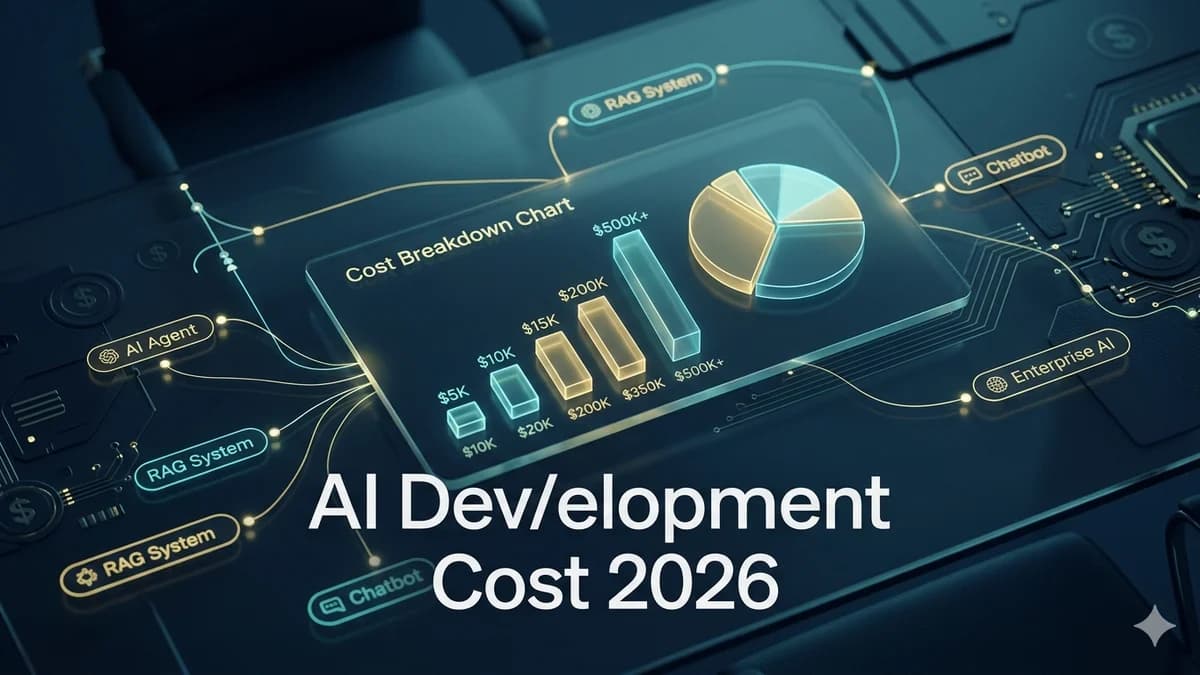
The AI SaaS Cost Model — What No Standard SaaS Guide Covers
Traditional SaaS has predictable, largely fixed COGS. AI SaaS has variable COGS that depend on usage intensity. Understanding and modelling this before launch is the difference between a viable business and a product that grows into losses.
| Cost Category | One-Time Build Cost | Monthly Ongoing | Notes |
|---|---|---|---|
| Focused MVP (1 AI feature, web app) | $25,000–$65,000 | — | Auth, billing, core AI feature, usage limits |
| Full v1 (3–5 AI features, integrations) | $65,000–$150,000 | — | Multi-tenant, advanced AI layer, integrations |
| LLM API costs (GPT-4o) | — | $200–$8,000+ | Highly variable — depends on usage intensity per user |
| Vector database (Pinecone/Weaviate) | — | $70–$500 | Required if RAG architecture is used |
| Cloud hosting (Vercel + AWS/GCP) | — | $100–$1,000 | Scales with user count, not AI usage |
| Monitoring and observability | — | $50–$300 | Sentry, Helicone, LangSmith, analytics |
| Payment processing (Stripe) | — | 2.9% + $0.30 per transaction | Standard Stripe fees |
Before setting any subscription price, calculate your AI cost per user per month: (average AI calls per active user per month) × (average cost per AI call). If your average user makes 200 AI calls per month and each call costs $0.02 in API fees, your AI COGS per user per month is $4. For a $29/month plan targeting 70% gross margin, your maximum allowable COGS is $8.70. If your AI COGS alone is $4, you have $4.70 left for all other hosting, payment processing, and support costs — which is workable. If average usage is higher and costs $12 in AI COGS, your plan price is too low for your target margin.
Pricing Your AI SaaS Product
AI SaaS pricing has an additional constraint that traditional SaaS does not: your pricing must account for variable AI usage costs while remaining simple enough for customers to understand and commit to. Three viable pricing models:
Customers pay per AI interaction. Simple, transparent, aligns with your cost structure.
Advantage: no heavy users subsidised by light users. Revenue scales with actual usage.
Disadvantage: unpredictable revenue for you and unpredictable costs for the customer — which creates friction for commitment and annual deals.
Best for: developer tools, API-first AI products, B2B where usage is measurable and variable.
Fixed monthly tiers with included AI usage quotas. The most common AI SaaS pricing model.
Advantage: predictable revenue, familiar to SaaS buyers, naturally creates upsell pressure as users hit limits.
Disadvantage: must model usage distribution carefully — if 20% of users are heavy users, they may consume disproportionate AI costs within the flat tier.
Best for: most consumer and prosumer AI SaaS products.
Users purchase credit packages redeemable for AI features. Credits reset or expire monthly.
Advantage: usage is explicit and visible, reducing the surprise of heavy usage; good for variable-usage products where some users need a lot and some need a little.
Disadvantage: more complex to explain than a monthly subscription; requires credit accounting infrastructure.
Best for: creative AI tools, AI image generation, AI writing with large output volume variation.
Go-to-Market for AI SaaS — What Is Different
AI SaaS go-to-market differs from traditional SaaS in one critical way: the demo is the sales process. You cannot describe what personalised AI feels like — you have to show it on the prospect's actual content, data, or problem. This changes the sales motion, the website design, and the free trial structure.
The interactive demo is your primary sales asset. Build a publicly accessible demo that lets prospects experience the core AI feature on their own inputs before signing up. Not a video of someone using the product — an actual AI interaction they can initiate immediately. The conversion rate from interactive demo to trial signup is typically 3–4x higher than from a feature-first product page. The friction of requiring email before the demo experience costs more in lost conversions than it gains in lead capture.
Position around the outcome, not the AI. "AI-powered" is not a differentiator in 2026 — it is an expectation. Position around the specific outcome your AI delivers. Not "an AI journaling app" — "the first daily reflection practice that actually gets better the more you use it." Not "AI writing assistant" — "sales emails that sound like your best sales rep wrote each one individually, at volume." The AI is the mechanism. The outcome is the product.
Free tier design for AI SaaS. Your free tier should deliver enough AI value to create genuine product love — but with a limitation that makes the paid tier feel like a natural next step rather than a wall. Do not throttle response quality. Throttle volume (number of AI interactions per month, number of documents processed, number of outputs generated). A user who has experienced genuinely excellent AI output on 5 free interactions is far more likely to convert to paid than one who has experienced mediocre output on unlimited free interactions.
Content-led growth for AI SaaS. The highest-performing organic growth channel for AI SaaS products in 2026 is problem-specific content — guides, templates, and tools that address the specific problem your product solves, distributed where your target users already gather. Our generative AI for business guide is an example: it addresses the problem (implementing generative AI) that Automely's SaaS development clients are trying to solve, positioning us as the expert before they evaluate vendors. Build the equivalent for your target user.
5 Fatal AI SaaS Mistakes That Sink Projects Before Launch
Building for every customer instead of one specific user type
The earliest AI SaaS products that succeed solve a specific problem for a specific user type with remarkable quality. The ones that fail try to solve a broader problem for a broader audience with acceptable quality. "AI assistant for businesses" competes with every AI assistant. "AI that writes German-language outreach emails for B2B sales reps at SaaS companies" competes with nobody — and wins all of them. Specificity is the competitive advantage of early-stage AI SaaS.
Treating AI as the product rather than the mechanism
Users do not buy AI. They buy outcomes — better writing, faster analysis, more relevant recommendations, less manual work. The product that says "we use GPT-4" is explaining the engine. The product that shows you the outcome in the first 30 seconds of the demo is making a purchase decision easy. Every "AI-powered" claim on your website should be immediately followed by a specific, measurable outcome claim.
Demo-quality AI in production
An AI that produces impressive outputs in 30 controlled demo scenarios does not reliably produce impressive outputs across 30,000 real user inputs. The gap is filled by output validation (filtering poor outputs before users see them), error handling (graceful states when the AI underperforms), and systematic feedback collection (knowing when outputs are poor before users churn over it). Shipping a demo as production is the fastest way to accumulate churn that cannot be explained because you have no visibility into output quality.
Pricing without knowing your AI COGS
We have reviewed AI SaaS pricing structures where the LLM API cost for an average heavy user was 80–120% of the subscription price. These businesses grew into losses — each new paying customer made the financial situation worse. Calculate AI COGS per user per month before setting any subscription price. Build in a margin buffer for heavy users. Set usage limits that protect your margin on the top 10% of your usage distribution, which almost always accounts for 40–50% of total AI API spend.
Shipping the full vision before validating the core hypothesis
Every feature beyond the core AI feature delays launch and increases the financial cost of a failed hypothesis. The most expensive product to build is the second version of one that never found product-market fit because it took too long and cost too much to build the first version. The minimum viable AI SaaS is the smallest product that can definitively answer: "Will users pay for this AI feature?" Everything else is optimism.
Building Your AI SaaS Product with Automely
Automely's SaaS development and generative AI development services cover the full build — architecture decisions, MVP scoping, AI integration layer, multi-tenant SaaS infrastructure, subscription billing, production hardening, and post-launch iteration. Our MVP development service is specifically designed to deliver a production-ready AI SaaS MVP in 8–14 weeks.
Lamblight is our most documented AI SaaS build: a consumer AI journaling and reflection application built on Option 2 architecture (foundation model API plus personalised RAG layer), with a credit-based usage model, a free tier limited to 5 AI interactions per week, and an onboarding flow designed around the "first genuine AI reflection" as the first-value moment. It reached 20,000+ active users and $312,000 in ARR — not because we built a lot, but because we validated the core hypothesis fast and iterated aggressively after the first cohort data arrived.
Our engagement process starts with a scoping session that covers: the core hypothesis, the right MVP scope for your hypothesis, the appropriate AI architecture, the AI cost model and pricing implications, the team structure required, and an honest 8–14 week timeline with milestones. Browse our case studies, read client testimonials, and explore our full AI services portfolio including AI agent development, AI integration services, and AI consulting services.
Have an AI SaaS idea? Ready to scope the MVP and get a timeline?
Book a free 45-minute scoping call. We will define the right MVP scope, the AI architecture, the pricing model, and the build timeline — before you commit anything.