

The term generative AI developer has become one of the most searched-for but least precisely understood roles in the current hiring market. Everyone wants one. Far fewer people can accurately evaluate one.
The challenge is that generative AI as a production discipline is genuinely new. The most experienced generative AI developers in the world have two to three years of real production experience — and that compressed timeline has produced a job market flooded with people who have completed a few LangChain tutorials, built a GPT wrapper, and now claim to be specialists. The difference between them and someone who has actually shipped RAG systems, managed hallucination at scale, and maintained production LLM pipelines is enormous. And the hiring patterns that work for other engineering roles — check GitHub contributions, look for relevant degrees — largely fail to surface it.
This guide tells you exactly what to look for, what to ask, and what will tell you the truth regardless of how polished the candidate's pitch is.
Ask any candidate to describe a specific RAG system they built for production — not a tutorial, not a demo. Ask what evaluation metrics they used before deploying. Ask what the retrieval failure rate was in the first week. Anyone with real production experience answers this with specific, sometimes uncomfortable details. Tutorial-level candidates cannot answer it at all.
What a Generative AI Developer Actually Builds
Before evaluating a candidate, you need to know what the role actually involves. Generative AI development in 2026 is not simply “using ChatGPT for coding” or “writing prompts.” It is a specific engineering discipline covering LLM integration, retrieval system architecture, output quality management, and production reliability for AI systems that generate content or make decisions.
A production generative AI developer builds systems that:
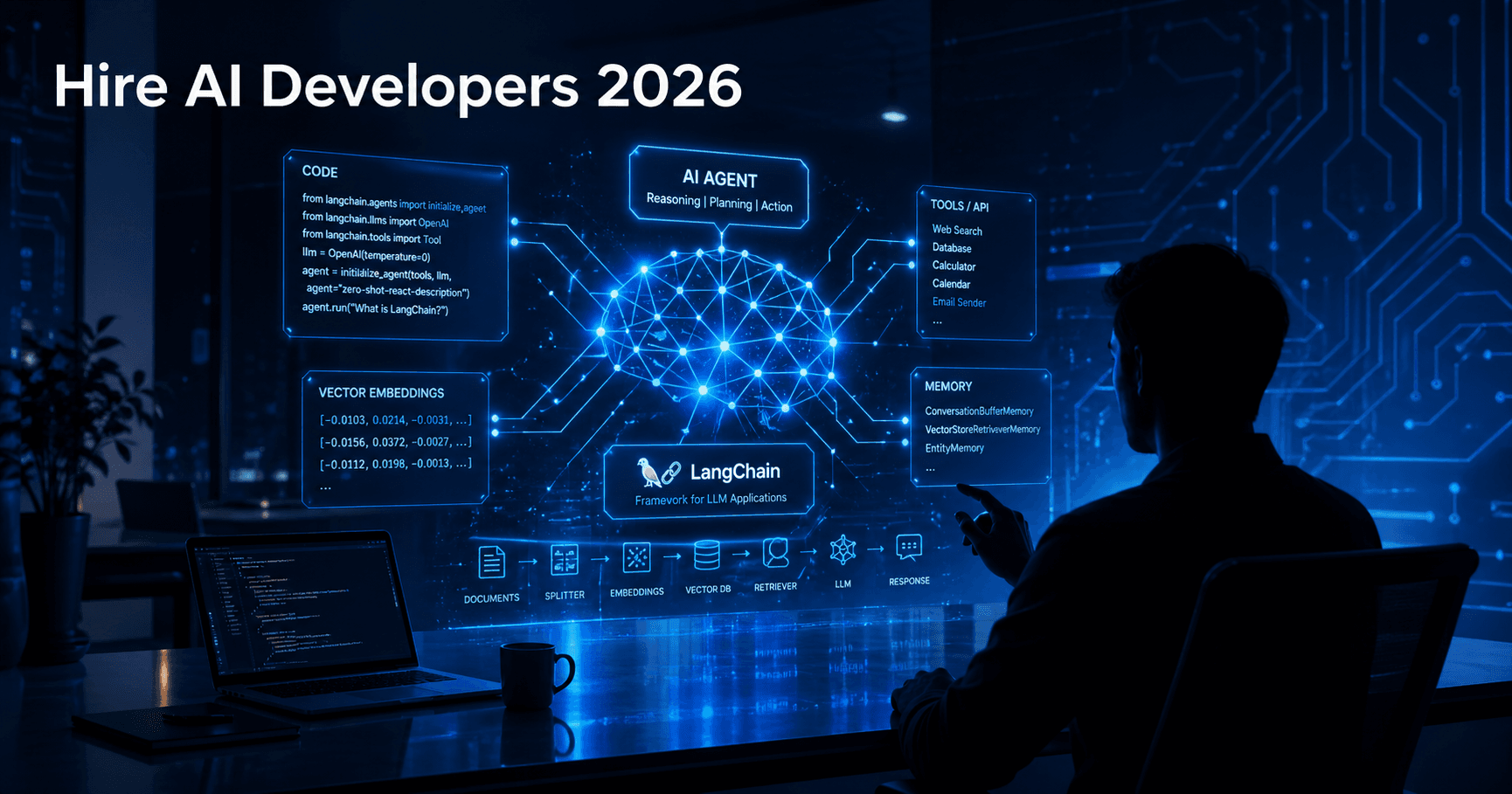
- Ingest, chunk, embed and index proprietary knowledge into vector databases so that an LLM can retrieve relevant context per query rather than hallucinating from general training
- Design and iterate prompt architectures — the system and user prompt structures that reliably produce consistent, high-quality, correctly formatted outputs across thousands of different user inputs
- Build multi-turn conversational systems that maintain context across a session, understand when to ask clarifying questions, and escalate to humans when the AI reaches the limits of its capability
- Implement output validation layers that check generated content against schemas, business rules, and quality thresholds before it reaches users
- Monitor and optimise production systems — tracking hallucination rates, retrieval quality, latency, and token costs over time, and making architectural changes when metrics degrade
- Integrate generative AI components with existing business systems — CRMs, knowledge bases, communication platforms, and data warehouses
This is meaningfully different from general AI development. A machine learning engineer trains predictive models. A generative AI developer builds systems on top of pre-trained foundation models. A general software engineer could theoretically call an LLM API but would lack the architectural judgment to build a system that is accurate, reliable, and economically sustainable in production. Our generative AI development service covers all of these layers.
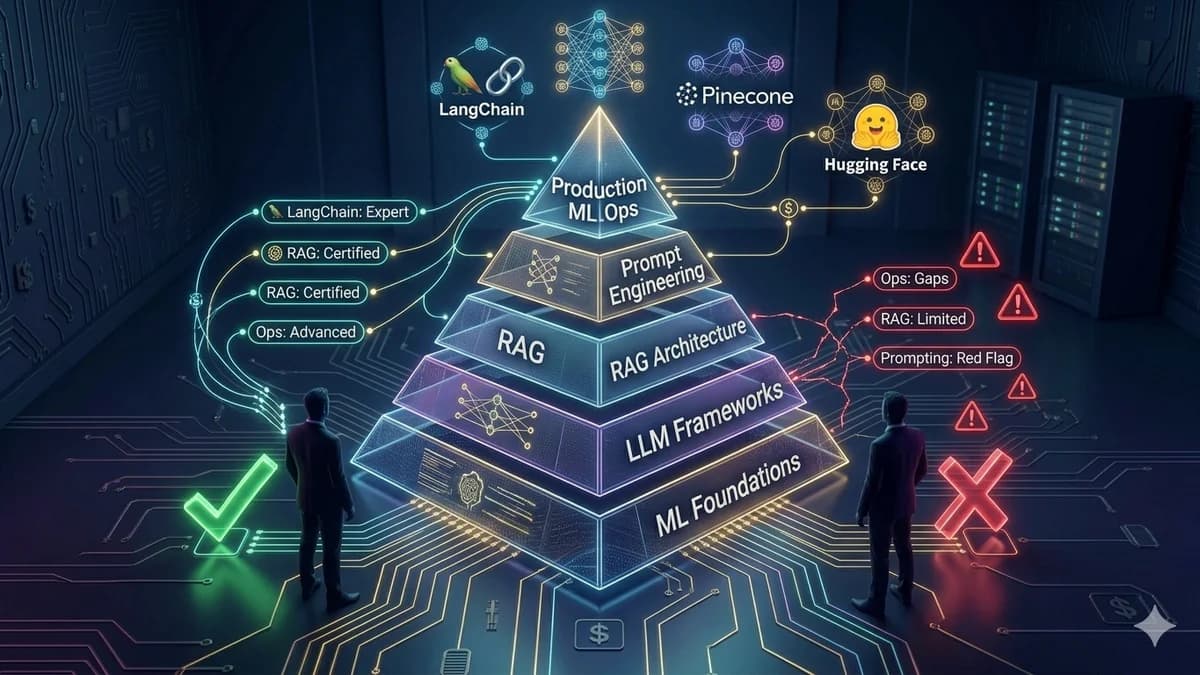
The 6 Skills That Actually Matter — Tiered by Importance
RAG System Architecture
Retrieval-Augmented Generation is the dominant architecture for business generative AI systems in 2026. It is what allows an LLM to answer questions accurately about your specific business data, policies, products, or customer history rather than hallucinating from general knowledge. A generative AI developer who cannot design, build, and evaluate a RAG system cannot build the type of generative AI application most businesses need.
RAG depth includes: chunking strategy (how documents are split before embedding — fixed size, semantic, hierarchical, parent-child), embedding model selection and its tradeoffs, vector database architecture (Pinecone, Weaviate, ChromaDB, Qdrant, pgvector), retrieval evaluation frameworks (measuring precision and recall before deployment), hybrid search combining dense and sparse retrieval, and re-ranking strategies for improving result quality.
LLM Framework Depth — LangChain, LangGraph, LlamaIndex
Knowing that LangChain exists is not the same as having built production AI systems with it. A generative AI developer needs deep hands-on experience with the major LLM orchestration frameworks — understanding their limitations, their failure modes, and when to use which tool for which problem. In 2026, LangGraph has become increasingly important for stateful, multi-step generative AI workflows.
The evaluation question is not “have you used LangChain?” — everyone has. The question is “what are LangChain's limitations for stateful multi-agent workflows and how does LangGraph address them?” A developer who cannot answer this specifically has not used either framework beyond tutorials.
Prompt Engineering and Output Control
Production prompt engineering is not writing clever one-liners in ChatGPT. It is designing system prompt architectures that produce consistent, correctly formatted, on-brand outputs across thousands of different user inputs with different intents, contexts, and edge cases. It includes chain-of-thought prompting for complex reasoning tasks, output schema enforcement (using libraries like Instructor or Outlines), few-shot learning examples for consistent output style, and structured parsing of LLM outputs into downstream system-usable formats.
A key indicator of prompt engineering depth: can the developer describe how they test a prompt architecture across a diverse set of inputs before deploying? Random testing is a red flag. A structured evaluation set with defined quality metrics is the real signal.
Foundation Model API Integration
Most generative AI systems in 2026 are built on foundation model APIs — OpenAI (GPT-4o, GPT-4o-mini), Anthropic (Claude Sonnet, Claude Haiku), Google (Gemini 1.5 Pro, Gemini Flash), and increasingly open-weight models served via Ollama, Together AI, or Groq. A generative AI developer needs deep familiarity with multiple providers — their pricing models, context window limits, output consistency characteristics, latency profiles, and rate limiting behaviours.
Critically, they need to know when to use which model and why. Using GPT-4o for a task that GPT-4o-mini handles equally well adds 5x the cost per query. At scale, this is not a minor inefficiency — it is a system design failure. Model selection and cost optimisation are part of the job.
MLOps and Production Infrastructure
A generative AI system that cannot be monitored is a system that will silently degrade. Hallucination rates change as user behaviour evolves. Retrieval quality drifts as knowledge bases grow. Token costs increase as conversations become longer. A production generative AI developer builds observability into the system from the start — not as an afterthought after the first production incident.
This includes LLM observability tools (LangSmith, Helicone, Weights & Biases), custom output quality monitoring (tracking hallucination proxies, user correction rates, session abandonment), cost per query tracking, latency monitoring, and automated alerts when key metrics leave acceptable ranges. The developer who builds a generative AI system without this infrastructure has not shipped a real production system.
Python and ML Fundamentals
Python proficiency, understanding of transformer architecture fundamentals, familiarity with ML concepts (embeddings, attention mechanisms, tokenisation), and comfort with data processing libraries (NumPy, Pandas) are baseline requirements — not differentiators. Every generative AI developer candidate should have these. The skills listed above are what separate the production developers from the tutorial completers.
Fine-tuning and model adaptation (LoRA, QLoRA, PEFT) are valuable but not essential for most business generative AI projects. Most applications should use foundation model APIs with well-engineered retrieval and prompting before considering fine-tuning. A developer who recommends fine-tuning before attempting a RAG approach likely does not have sufficient experience to judge which is appropriate.
Skills That Sound Impressive But Are Not Differentiators in 2026
The generative AI skills landscape changes fast and some things that sounded cutting-edge in 2024 are now table stakes — or are less important than commonly assumed for business applications.
- Training large models from scratch. This was never the primary job of a generative AI developer for business applications. Pre-trained foundation models via API have made custom training unnecessary for 95% of use cases. A candidate who leads with this as their primary expertise is focused on research-level work, not business AI.
- Computer vision specifically. Valuable in specific contexts but not core to most text-based generative AI systems. Do not conflate general AI expertise with generative AI development depth.
- Knowing many LLM tools. The Metana research cited earlier shows that learning one tool deeply beats dabbling in ten. A developer who lists fifteen frameworks without being able to speak deeply to any of them has breadth but not depth. Depth matters for production systems.
- Being a “prompt engineer” exclusively. In 2026, standalone prompt engineering without system architecture depth is an insufficient skill for building serious generative AI systems. Prompt engineering is one part of the job, not a job title.
Want a vetted generative AI developer matched to your project in 48 hours?
Automely's generative AI developers have shipped RAG systems, LLM pipelines, and production conversational AI for clients across the US, UK, and EU.
Interview Questions That Actually Reveal Production Experience
Skip algorithm challenges. Skip whiteboard coding. These tests were designed for general software engineers. For a generative AI developer, the tests that matter are production-focused questions about system architecture, failure modes, and measurement.
Red Flags That Predict a Tutorial-Level Developer
They have built “AI projects” but cannot name a single live system with real users. The gap between a GitHub repository and a system handling real traffic is enormous. If every example they give is a side project, a Colab notebook, or a hackathon entry — they have not navigated production challenges.
They recommend fine-tuning before you have explored RAG. Fine-tuning is expensive, time-consuming, and requires significant data. For most business use cases, a well-engineered RAG system on a foundation model delivers better results with a fraction of the cost and time. A developer who jumps to fine-tuning recommendations does not have the judgment that comes from shipping real systems.
They describe RAG as a simple pipeline but cannot discuss evaluation. Building a RAG pipeline is relatively straightforward. Building one that retrieves the right context reliably, at acceptable latency, with measurable quality, in production — that is the hard part. A developer who skips over evaluation entirely has not done the hard part.
They equate “using AI” with “building AI systems.” Generating images with Midjourney or writing emails with Claude is not generative AI development. If a candidate's experience is primarily as an AI user rather than an AI builder — with specific engineering artefacts to show — they are not a generative AI developer.
They have no view on monitoring. Ask how they measure system quality in production. A developer with no specific answer for this has not had to maintain a generative AI system that real users depend on. Quality drift in generative AI systems is real — and invisible without monitoring.
They are unfamiliar with output validation. Any production generative AI system that passes raw LLM output directly to users without validation is a liability. Ask about their approach to output quality control. If the answer is “the model is good enough,” they have not built a system where the consequences of a bad output are significant.
What Generative AI Developers Cost in 2026
The generative AI talent market is tight. Demand significantly outpaces supply of genuine production-experienced developers. Here are real market rates across hiring models.
| Hiring Model | Region / Type | Cost | Notes |
|---|---|---|---|
| Freelancer (Upwork/Toptal) | South Asia (mid-level) | $50–$100/hr | High management overhead. Better for small, bounded tasks only. |
| Freelancer | Eastern Europe (senior) | $80–$140/hr | Better depth. Still divided attention across multiple clients. |
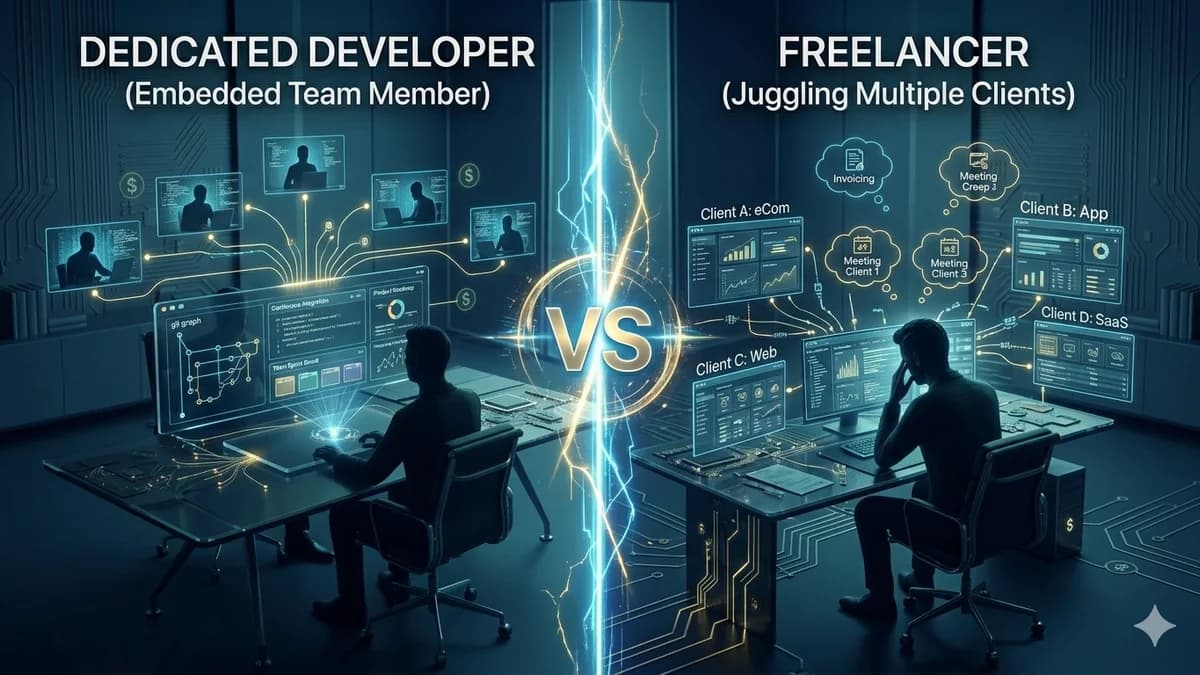
| Freelancer | US / UK / Canada | $150–$300/hr | Highest rate. No structural guarantee of full-time focus. |
| In-House (Full-Time) | US salary | $130,000–$220,000/yr | 3–6 month hire timeline. Benefits + equity add ~30% to base. |
| Dedicated via Agency | South Asia specialist | $4,000–$6,000/mo | Full focus on your project. Agency provides QA. Automely starts here. |
| Dedicated via Agency | Senior / Architect | $6,000–$9,000/mo | Deep RAG + LLM production experience. Complex systems only. |
A junior generative AI developer at $2,000/month who recommends fine-tuning when RAG would suffice will spend three months and $40,000 in compute costs on the wrong approach. A senior developer at $6,000/month who makes the right architectural call on day one costs less in total. Production generative AI development rewards experience in ways that standard software engineering does not — because the failure modes are harder to diagnose and more expensive to fix after the fact.
Automely's Generative AI Development Team
Automely's generative AI development team has shipped production generative AI systems across consumer apps, enterprise platforms, and business automation. This includes Lamblight — an AI journaling app that uses a custom generative AI engine to produce personalised daily devotionals, journal reflections, and spiritual insights for 20,000+ active users — and Cerebra Caribbean, a multi-channel AI communication platform for Caribbean businesses.
Our generative AI developers have specific production depth in RAG architecture (chunking strategy, retrieval evaluation, vector database management), LLM framework integration (LangChain, LangGraph, LlamaIndex), prompt engineering for consistent production output, multi-turn conversational AI, output validation design, and LLM observability infrastructure. We have shipped systems that handle tens of thousands of queries monthly and have navigated the real production challenges — model deprecations, retrieval quality drift, hallucination incidents — that separate shipped systems from demos.
Dedicated generative AI developer engagements are available from $4,000/month. Every engagement starts with a scoped discovery phase covering your specific use case, data assessment, RAG vs non-RAG architecture decision, and implementation roadmap. Browse our case studies, read client testimonials, and explore our full AI development services including AI agent development, AI chatbot development, and dedicated developer hiring.
Need a generative AI developer with real production experience?
Automely matches businesses with dedicated generative AI developers within 48 hours. Book a free call — we will discuss your project and match you with the right developer profile.