

The 95% Pilot Failure Problem — Why Supply Chain AI Value Dies Before It Scales
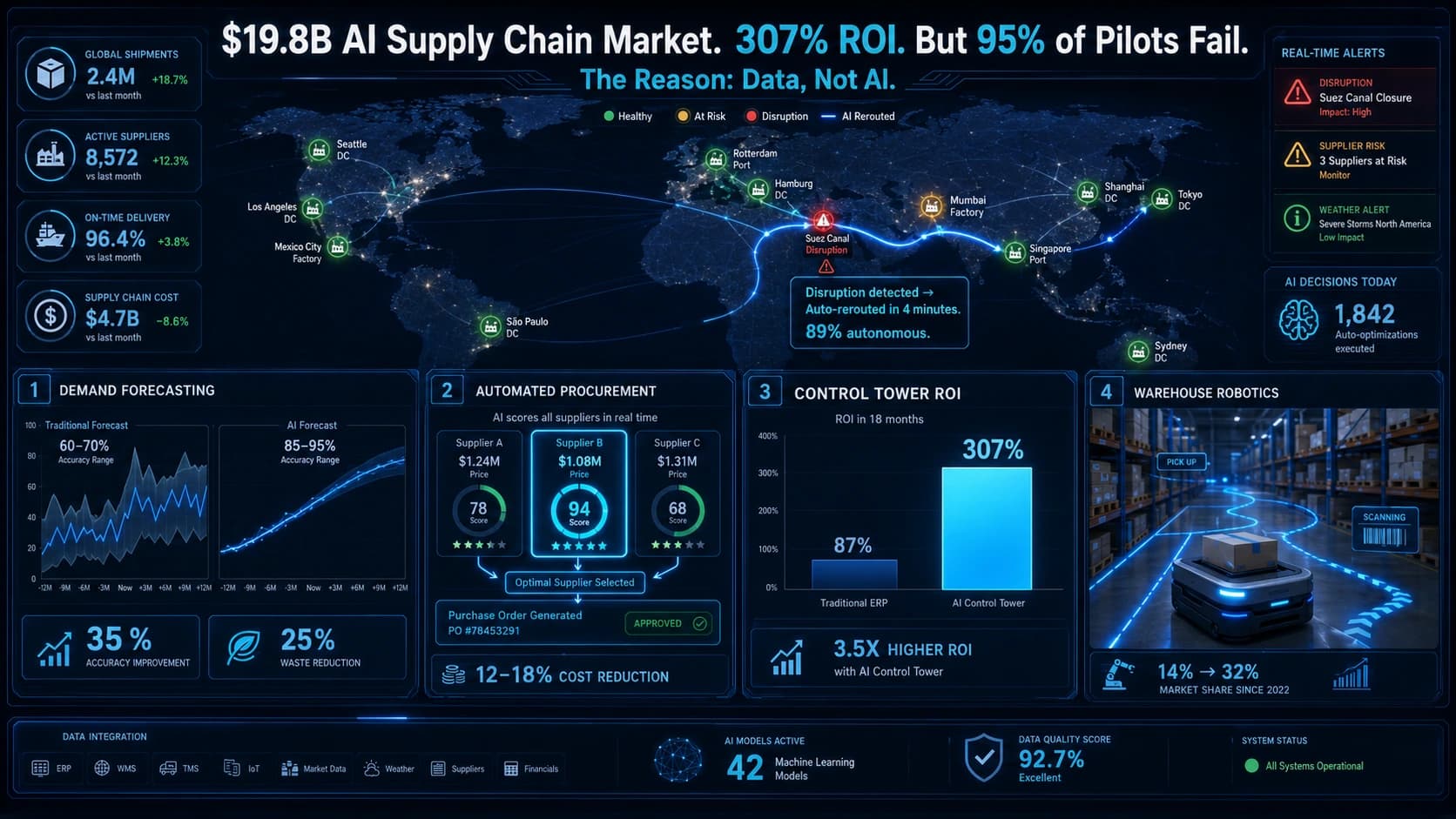
The global AI in supply chain market reached $19.8 billion in 2026, growing at 45.3% CAGR with projections exceeding $70 billion by 2030. AI-powered control towers deliver 307% ROI within 18 months. Demand forecasting AI achieves 85–95% accuracy compared to 60–70% for traditional statistical methods. The ROI case is established, the technology is mature, and enterprise investment is accelerating. Yet up to 95% of generative AI supply chain initiatives struggle to deliver sustained ROI — failing to scale beyond the pilot before budgets are redirected.
The limiting factor is consistently the same across documented failure cases: not the AI technology, but fragmented data, siloed systems, and undocumented workflows. An organisation launches an AI demand forecasting pilot on 200 of its most stable SKUs with clean historical data. The pilot demonstrates 90% accuracy and a compelling business case. The attempt to scale to the full 8,000-SKU catalogue reveals that 65% of the required data is scattered across ERP, WMS, TMS, and supplier portals with incompatible formats, missing fields, and inconsistent definitions across business units. The AI cannot produce reliable outputs from unreliable inputs — not because the model is inadequate, but because the data foundation that a scaled system requires was never built.
Capgemini found that companies with a formal AI change management plan — including dedicated data governance architecture before deployment — are 2.7 times more likely to achieve ROI within the first 12 months. This guide covers not just what the six supply chain AI systems do, but the data prerequisite that determines whether any of them deliver when it matters.
The 6 Supply Chain AI Systems — What They Do and What They Require
AI Demand Forecasting and Inventory Optimisation
Demand forecasting is the most widely adopted AI supply chain function — 87% enterprise adoption in 2026 — and the one with the clearest and most immediate downstream impact on inventory efficiency, production planning, and waste reduction. AI demand forecasting models combine historical sales data, seasonality patterns, promotional calendars, economic indicators, social media signals, and real-time market data to generate demand predictions at 85–95% accuracy across SKU, location, and time horizon dimensions simultaneously. The improvement over traditional statistical methods (ARIMA, moving averages) is a 35% accuracy gain that compounds into measurable operational savings.
The downstream effects are direct: 20–30% reduction in inventory carrying costs through better-calibrated safety stock; 28% reduction in stockouts through improved replenishment timing; 25% reduction in product waste through demand-accurate production planning — particularly impactful in perishable goods supply chains. Companies using Dynamics 365 Supply Chain Management with Azure AI report achieving 95% forecast accuracy and 30% reduction in inventory waste in documented production implementations.
- Historical sales data — point-of-sale, order history, channel-level transaction records
- External signals — weather forecasts, economic indicators, social trend data, competitor activity
- Promotional calendars — planned promotions, price changes, new product launches
- Supplier lead times — current and predicted variability by supplier and category
- Real-time inventory positions — current stock across all locations and in-transit
- Replenishment cost parameters — carrying cost rates, ordering costs, service level targets
AI-Powered Procurement Automation
Procurement automation AI covers the full source-to-pay cycle: identifying sourcing opportunities through spend analytics, scoring and selecting suppliers based on price, reliability, lead time, quality history, and risk exposure, generating purchase orders when inventory triggers defined replenishment thresholds, monitoring contract compliance, and surfacing negotiation intelligence from market price trends and supplier performance data. Procurement costs decline 12–18% through automated supplier selection and dynamic pricing optimisation — identifying consolidation opportunities, negotiating leverage moments, and price anomalies that manual category management misses across high-volume transaction data.
Top-performing supply chain organisations invest in AI-powered spend analytics and supplier risk scoring at more than twice the rate of low-performing peers (Gartner). The compounding advantage is particularly pronounced in supplier risk management: AI monitors supplier financial health, geopolitical exposure, and operational capacity signals continuously, flagging single-source dependencies and capacity risks weeks before they materialise as delivery failures.
- Spend analysis — categorisation, consolidation opportunity identification, tail spend management
- Supplier scoring — price, quality, lead time, reliability, and risk factor weighting
- Automatic PO generation — triggered when inventory hits replenishment thresholds
- Supplier communications — automated RFQ distribution, acknowledgement processing
- Contract compliance monitoring — alerting on deviations from agreed terms
- Risk monitoring — financial health signals, single-source dependency flags, geopolitical exposure
AI Logistics and Route Optimisation
Logistics optimisation AI calculates the most cost-effective routes by analysing traffic patterns, fuel costs, weather conditions, delivery windows, carrier capacity, and load constraints simultaneously — producing routes and carrier selections that manual logistics planners cannot optimise at comparable speed or comprehensiveness. Transportation costs improve 15–25% through intelligent route optimisation and load consolidation. McKinsey estimates AI cuts logistics costs 5–20% across the full logistics cost base including carrier rates, fuel efficiency, and delivery time window compliance.
The sustainability impact is equally significant: 30% carbon emissions reduction through route optimisation is documented across enterprise implementations. AI logistics systems also handle real-time rerouting: when a disruption (traffic, weather, port congestion, carrier capacity change) is detected mid-delivery, the system automatically calculates alternative routes and carrier options, communicating status changes to all parties without requiring manual intervention from the logistics team.
- Route planning — multi-stop optimisation across delivery windows, road conditions, and constraints
- Carrier selection — rate benchmarking, performance history, capacity availability
- Load consolidation — identifying backhaul and consolidation opportunities to reduce empty miles
- Real-time rerouting — automatic path recalculation when disruptions occur mid-delivery
- Delivery window compliance — predictive ETA generation and proactive exception alerting
- Emissions tracking — CO2 per shipment calculation and reporting for ESG compliance
AI Control Towers — Disruption Management and Visibility
An AI supply chain control tower replaces static dashboards with a predictive, self-correcting monitoring system that tracks the entire supply network in real time — inventory positions, supplier performance, logistics status, demand signals, and external risk indicators simultaneously — and autonomously responds to disruptions before they cascade into delivery failures. AI control towers identify potential disruptions 2–3 weeks earlier than traditional monitoring approaches, automatically reroute shipments in 89% of disruption cases, and reduce disruption impact by 41% on average.
The architecture distinction matters: traditional supply chain visibility dashboards show what has happened; AI control towers predict what will happen and act on those predictions. BCG reports that agentic AI systems accounted for 17% of total AI supply chain value in 2025, projected to reach 29% by 2028 — autonomous decision-making is the highest-value trajectory for control tower AI.
- Inventory positions — real-time stock levels across all warehouses, in-transit, and at suppliers
- Supplier risk signals — financial health, capacity, geopolitical exposure, on-time delivery trends
- Logistics status — carrier tracking, port congestion, customs clearance, last-mile delivery
- Demand signal changes — early detection of demand shifts that require supply plan adjustment
- External disruption monitoring — weather, geopolitical events, regulatory changes
- Autonomous response — rerouting, reallocation, alternative sourcing initiation
Warehouse Automation and AI Robotics
Warehouse automation AI coordinates autonomous robotic systems for picking, packing, and sorting tasks, supported by computer vision for quality inspection and AI algorithms for inventory slotting optimisation. AI-powered picking robots have grown from 14% to 32% warehouse market share since 2022 — a 128.6% increase. Amazon, Walmart, DHL, and Maersk are among the organisations operating at scale with autonomous warehouse AI, but mid-market deployments are increasingly accessible through robotics-as-a-service models that reduce the upfront capital requirement.
Computer vision quality control AI inspects products for defects with real-time anomaly detection. Slotting optimisation AI analyses order patterns and SKU velocity to determine optimal storage locations within the warehouse, reducing travel time per pick and improving throughput without physical infrastructure changes. Combined, these systems reduce warehouse labour costs, error rates, and processing time simultaneously.
- Autonomous picking robots — goods-to-person systems for high-velocity SKU operations
- Computer vision quality control — real-time defect detection at line speed
- AI slotting optimisation — dynamic storage assignment based on pick frequency and order patterns
- Inventory accuracy — RFID and computer vision for real-time stock position verification
- Packing optimisation — AI-determined carton sizes for shipping cost and sustainability
- Dock scheduling — AI coordination of inbound and outbound vehicle timing
Sustainability AI and Waste Reduction
Sustainability AI covers the environmental performance dimensions of supply chain operations that are increasingly material to regulatory compliance, customer requirements, and investor expectations. AI-driven route optimisation reduces carbon emissions by 30% through smarter routing, load consolidation, and fuel consumption modelling. Demand accuracy reduces product waste by 25% — in perishable and short-shelf-life categories, this is a direct reduction in landfill contribution. Sustainable supplier selection algorithms score suppliers on environmental, labour, and governance criteria alongside commercial factors.
Scope 3 emissions tracking — the supply chain emissions that now appear in SEC climate disclosure requirements and EU Corporate Sustainability Reporting Directive obligations — is increasingly managed through AI systems that aggregate emissions data across supplier tiers, logistics networks, and product categories into the audit-ready reporting format that regulators require. Organisations that build AI sustainability reporting infrastructure now avoid the manual audit burden that will scale with regulatory disclosure requirements through 2026 and beyond.
- Scope 3 emissions — supplier-tier carbon data aggregation for regulatory disclosure
- Logistics carbon — CO2 per shipment, lane, carrier, and mode tracking
- Waste analytics — overproduction waste, packaging waste, returns waste quantification
- Sustainable supplier scoring — ESG criteria embedded in supplier selection algorithms
- Circular economy tracking — return, reuse, and recycling flow monitoring
- ESG report generation — automated compilation of supply chain sustainability metrics
Which of these 6 systems has the highest ROI for your supply chain operation — and do you have the data foundation to scale it?
Automely's supply chain AI consultation starts with the data integration audit, because the AI capability is never the bottleneck. Free 45-minute call.
ROI Evidence — What Supply Chain AI Delivers in Production
❌ Traditional ERP Dashboard
✓ AI-Powered Control Tower
Across the documented supply chain AI implementations, the specific cost reduction benchmarks are consistent:
- Inventory carrying costs: −20–30% through improved demand forecasting and dynamic safety stock calibration. For a business holding $50M in average inventory, this recovers $10–15M in working capital annually.
- Transportation costs: −15–25% via intelligent route optimisation, load consolidation, and carrier selection. McKinsey's estimate of 5–20% logistics cost reduction applies across the full logistics cost base including carrier rates, fuel, and delivery compliance.
- Procurement costs: −12–18% through automated supplier selection, spend consolidation, and dynamic pricing optimisation.
- Disruption impact: −41% on average. AI control towers detecting disruptions 2–3 weeks earlier creates the response window that manual monitoring cannot provide.
- AlfaPeople/Dynamics 365 production case: 95% forecast accuracy achieved with 30% reduction in inventory waste — a documented production outcome combining Microsoft Dynamics 365 Supply Chain Management with Azure AI services.
- Carbon emissions: −30% through route optimisation — simultaneously a cost reduction (fuel), a sustainability improvement, and a Scope 3 emissions reporting contribution.
The Data Governance Prerequisite — Why AI Fails in Supply Chain
The 95% GenAI pilot failure rate in supply chain is not an indictment of the technology. It is a diagnosis of the data environment that most enterprises have accumulated across decades of organic system growth. Understanding the specific failure modes is essential for any organisation planning a supply chain AI programme — because the failure mode determines the fix, and the fix must be planned before the AI investment begins.
Fragmented Data Across Disconnected Systems
ERP systems that do not communicate with WMS systems. Supplier portals that output data in incompatible formats. Logistics data locked in carrier systems with no API access. Demand data in the commercial team's spreadsheets, not in the system the supply planning team uses. AI models that require integrated signals from all these sources produce garbage outputs when inputs arrive fragmented. The data integration prerequisite — ingestion pipelines, format standardisation, and master data alignment — is as important as the model itself, and must be built first.
Siloed Organisations Producing Siloed Data
Supply chain AI requires cross-functional data that mirrors cross-functional operations: the demand data sits with commercial, the inventory data with operations, the supplier data with procurement, the logistics data with the transport team. When these functions do not share data in a unified architecture, the AI sees an incomplete picture and produces recommendations that optimise one function at the expense of another. Organisational data governance — who owns what data, who is responsible for quality, what the shared definitions are — must be resolved before the model architecture is designed.
Undocumented Workflows and Institutional Knowledge
Supply chain operations in most organisations are partially governed by institutional knowledge that has never been documented: the buyer who knows that supplier X always runs 3 weeks late in Q4; the planner who applies a 15% uplift to the system forecast for product category Y because of known seasonal understating. AI models trained on the raw data output of these processes learn only the pattern, not the underlying knowledge that shapes it. Capturing and structuring this institutional knowledge as explicit model inputs or override rules is an essential pre-deployment step that most AI vendor implementations skip.
Pilot Success That Does Not Generalise
The most common failure pattern: a pilot on a controlled subset of clean data shows excellent performance. Scaling to the full data environment reveals that the clean subset was unrepresentative. Historical data completeness, outlier prevalence, SKU proliferation, and system fragmentation all increase at scale. Pilots that do not deliberately stress-test on the messy, representative data that scaled production will encounter are not measuring what matters. Before declaring a pilot successful, test it on the 20% of your data that is most incomplete, most fragmented, and most dependent on manual correction.
1. Data integration: all required data sources connected via automated ingestion pipelines — no manual exports, no spreadsheet bridges. 2. Master data alignment: consistent product codes, supplier codes, and location codes across all systems. 3. Data quality baseline: completeness, accuracy, and timeliness metrics established per data domain before model training begins. 4. Historical depth: minimum 24 months of clean history for demand models; 36 months preferred for seasonal pattern detection. 5. Institutional knowledge capture: documented manual adjustments, exception rules, and planning heuristics that planners currently apply outside the system. 6. Change management plan: the Capgemini 2.7× factor — organisations with formal AI change management plan are 2.7× more likely to achieve ROI within 12 months.
Implementation Sequence — Starting Where Value and Data Quality Are Highest
Identify your highest-ROI pilot candidates by data quality, not by use case appeal
The most appealing use case (AI control tower) is not necessarily the right starting point for every organisation. The right starting point is the use case with the highest ROI potential AND the best existing data foundation. Demand forecasting on stable, high-velocity SKUs with complete 3-year history is a better first pilot than demand forecasting on a new product category with 6 months of data. Pick the pilot where the data is clean and the ROI is significant — not the pilot with the most impressive headline use case.
Build the data integration layer before building the AI models
Budget 30–40% of your Year 1 AI implementation investment for data engineering: ingestion pipelines from all source systems, data quality monitoring, master data management, and the API connections that allow the AI to receive real-time signals rather than batch updates. This investment is not glamorous and it does not produce visible AI outputs. It is the infrastructure that makes everything else work at scale. Organisations that skip this step and build models first spend the next 12 months retrofitting data quality into a live production system — which is significantly more expensive and disruptive than building it correctly in sequence.
Run the pilot on messy, representative data — not the clean subset
After the model is built and tested on clean historical data, deliberately test it on the 20% of your data that is most problematic: incomplete records, high outlier frequency, SKUs with erratic demand patterns, supplier data with gaps. This stress test reveals how the model behaves at the edge of its training distribution — and edge cases are exactly what production will deliver when the pilot scales. Models that perform well on stressed data are deployment-ready. Models that only perform on clean data are not.
Define phase gates with binary go/no-go criteria before scaling
Each scale-up phase should have defined binary criteria that must be met before the next phase begins: minimum forecast accuracy threshold on hold-out data, minimum OTIF uplift in production, maximum exception rate requiring manual intervention. These phase gates prevent the "perpetual pilot" failure mode — organisations that keep running pilots on additional subsets without ever committing to full production because the governance for scaling was never defined.
Measure outcomes that the CFO can use — not just model accuracy
Forecast MAPE (mean absolute percentage error) is the right technical metric for model quality. It is not the metric that secures continued AI investment from the CFO. The metrics that matter for business case maintenance are: inventory carrying cost reduction (documented before and after), stockout rate change, logistics cost per unit shipped before and after, procurement cost per dollar spend, and disruption recovery time. Build the measurement framework — baseline the current metrics before deployment, measure monthly during rollout, report to the executive sponsor quarterly.
Building Supply Chain AI with Automely
Automely's AI agent development, AI integration services, and AI consulting services cover the full stack of supply chain AI implementation — demand forecasting models connected to ERP and POS systems, procurement automation pipelines, logistics optimisation AI, control tower monitoring systems, warehouse AI integration, and the data governance and ingestion architecture that makes all of them work at scale.
Every Automely supply chain AI project starts with the data integration audit — mapping all required data sources, assessing quality and completeness, identifying the gaps that must be closed before model development begins. This is not an optional pre-step; it is the foundation that determines whether the AI delivers at pilot stage and whether it scales to production. Organisations that rush to model building before data governance is addressed spend significantly more on remediation than they would have spent on getting the foundation right initially.
Browse our case studies and explore our RPA guide for the closest parallel on data-prerequisite AI implementation. For the AI agent architecture underlying control tower autonomous decision-making, see our AI agent development service. For the RAG and knowledge-base architecture that powers supplier contract monitoring in procurement AI, see our guide on building RAG systems for business knowledge bases.
Ready to close the gap between supply chain AI pilot and production — starting with the data integration audit?
Book a free 45-minute supply chain AI consultation. We will map your data sources, identify the highest-ROI first system, and scope the data governance architecture that makes it scale.