


The Single-Word Problem — Why Manual Contract Review Is Your Firm's Biggest Liability
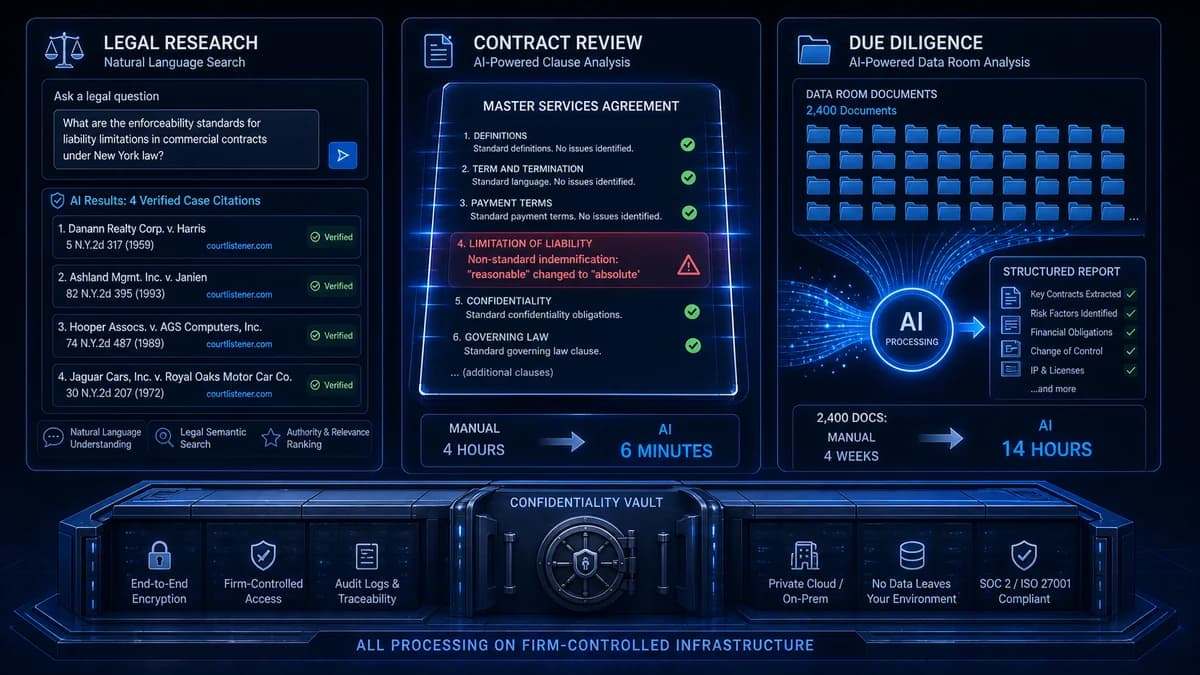
A real estate practice receives a new commercial lease from a tenant's counsel. The document is 60 pages. On page 34, buried in the indemnification clause, the tenant's attorney has made a single word substitution: "reasonable" changed to "absolute." The shift in liability exposure is substantial — what was a mutual obligation of reasonable care becomes an absolute indemnification regardless of fault. An overworked paralegal, reviewing against a deadline, misses it. The lease is executed. Eighteen months later, a dispute arises. The single word that cost the client more in litigation than the lease was worth.
This is not a hypothetical. It is the failure mode that manual contract review produces consistently — not because the reviewers are incompetent, but because human attention is finite, deadlines are real, and a 60-page contract with a single critical deviation is genuinely difficult to catch through linear reading. AI contract review does not get tired on page 34. It does not read faster at the end of a long day. It extracts every clause, compares each one semantically against the firm's approved standards library, and flags the deviation with a side-by-side comparison — in 6 minutes, not 4 hours.
This guide covers the 6 legal AI use cases that generate the highest ROI for law firms — contract review, legal research, due diligence, document drafting, e-discovery, and case management AI — followed by the two unique challenges of legal AI that no other industry faces at the same severity: the confidentiality wall requirement (why generic AI tools are inappropriate for legal work) and the hallucination risk (why AI legal research requires RAG architecture grounded in verified legal databases). This guide is written for law firm partners, managing partners, and legal operations directors evaluating AI for their practice.
Where Lawyer Time Actually Goes — The Economic Case for Legal AI
The economics of AI in legal practice are more compelling than in almost any other professional services context, because the cost of lawyer time is so high and the proportion of that time spent on tasks AI can perform is so substantial. Research consistently shows that attorneys spend approximately 40% of their working time on legal research, document review, and drafting tasks — activities that AI can handle in a fraction of the time with comparable or higher accuracy.
At a billing rate of $400 per hour for a mid-level associate, 40% of an 8-hour working day represents $1,280 in research and document review time — every day, per associate. Across a firm of 20 associates, that is $25,600 daily in attorney time spent on tasks where AI assistance can compress the time by 60–80%. The AI does not replace the attorney's judgment on the output — it eliminates the time spent retrieving, reading, and structuring the raw material for that judgment.
Manual Process
With AI Assistance
The 6 Legal AI Use Cases — What Each One Does and What It Recovers
Legal AI in 2026 organises into six high-ROI use cases, each attacking a distinct part of the law firm operating model — contract review, legal research, due diligence, document drafting, e-discovery, and practice management. Each use case is independently deployable, and most firms sequence them based on which task currently consumes the most billable attorney time in the practice.
AI Contract Review and Redlining
AI contract review works through three sequential processes: clause extraction (identifying and isolating every material clause in the document regardless of formatting), semantic comparison (comparing each extracted clause against the firm's approved clause library using vector embeddings that capture legal meaning rather than exact word matching), and deviation flagging (generating a report that highlights every non-standard clause with a side-by-side comparison of the contract language and the firm's approved version).
The semantic comparison is the technically critical step. A basic keyword-matching approach catches only identical language changes. Semantic comparison — using vector embeddings that represent legal meaning — catches the substitution of "reasonable" for "absolute," the deletion of a mutual limitation, the expansion of a definition that changes scope — cases where the words change but a simple diff would not catch the legal significance. Attorneys review the flagged deviations and make judgment calls. They do not read the entire document.
- Complete clause extraction with clause type classification
- Side-by-side comparison: contract language vs firm's approved standard for each clause type
- Deviation summary ranked by severity and materiality
- AI-generated redline suggestions for non-standard clauses
- Confidence scores on each extraction — low-confidence items flagged for manual attorney verification
AI Legal Research
AI legal research takes a natural-language question — "What is the applicable standard for piercing the corporate veil in Delaware when a parent company disregards corporate formalities?" — and retrieves the relevant case law, statutory provisions, and regulatory guidance from verified legal databases, producing a structured research memorandum with every citation linked to its source. The attorney reviews the research output, verifies the citations, and applies professional judgment — they do not spend 3 hours searching Westlaw and reading cases to find the answer.
The critical design requirement for legal research AI is that it must be grounded in verified legal databases — not relying on the AI model's general training knowledge, which can produce hallucinated citations. The hallucination risk in legal AI and the RAG architecture that mitigates it are covered in detail in Section 5 of this guide.
- Relevant cases with holding summaries and citation to verified source
- Applicable statutory text with amendment history
- Regulatory guidance and agency positions
- Structured research memo draft with cited support for each proposition
- Contrary authority flagged — AI identifies cases that cut against the client's position
AI Due Diligence
Due diligence in M&A, financing, and real estate transactions requires reviewing thousands of documents — contracts, corporate records, intellectual property agreements, regulatory filings, financial statements, employment agreements, litigation records — to identify material provisions, ongoing obligations, and risk items before the transaction closes. Traditionally, this requires 2–4 weeks of paralegal and associate review for a mid-size transaction. AI due diligence processes the same document set in hours: classifying each document by type, extracting material provisions, checking for consent requirements, identifying change of control triggers, flagging expiry dates and renewal options, and generating a structured due diligence report.
The AI does not replace attorney judgment on the materiality and risk significance of flagged items — it eliminates the days of reading that precede that judgment. Partners and associates spend their time on the exceptions and risk analysis, not on reading standard form agreements to confirm they contain standard terms.
- Change of control provisions and consent requirements
- IP ownership, assignment restrictions, and work-for-hire clauses
- Limitation of liability caps and exclusions
- Non-compete, non-solicit, and exclusivity provisions
- Termination rights, notice requirements, and renewal options
- Material adverse change definitions and conditions
AI Document Drafting
AI document drafting generates first-draft contracts, legal memoranda, demand letters, client correspondence, and court filings from the firm's templates and specific matter instructions. The AI draws on the firm's approved clause library, incorporates matter-specific variables (parties, dates, consideration, governing law, dispute resolution mechanism), and produces a document that requires attorney review and finalisation rather than creation from a blank page. Attorney time shifts from drafting to reviewing and refining — a significantly more time-efficient workflow, particularly for high-volume transactional work where similar agreements are produced repeatedly.
- NDAs, confidentiality agreements, term sheets
- Service agreements, consulting agreements, software licences
- Employment agreements, restrictive covenant agreements
- Demand letters, cease and desist notices
- Client update letters and status memoranda
- Board resolutions, officer certificates, closing documents
AI E-Discovery
E-discovery document review is the highest-volume legal AI application — and historically the most expensive. Large litigation matters can involve millions of electronic documents that must be reviewed for responsiveness to discovery requests, privilege, and production. At traditional attorney review rates and speeds, reviewing a million documents can cost millions of dollars. AI e-discovery reduces this cost by 90% or more by performing the initial responsiveness and privilege review automatically, clustering similar documents for efficient attorney review, and identifying key custodians and communication patterns that focus attorney attention on the most relevant evidence.
- Responsiveness classification for discovery requests
- Privilege log generation with attorney-client and work product identification
- Document clustering — groups of similar documents reviewed together
- Key custodian and communication thread identification
- Near-duplicate detection and email threading
- Confidential information redaction (PII, financial data)
Case Management and Client Service AI
Beyond legal work product, AI reduces the administrative overhead that consumes attorney and support staff time in practice management. AI conflict checking searches the firm's client database against new matter parties in seconds rather than the manual review that frequently creates intake bottlenecks. AI time entry capture reconstructs billable activity from emails, document access logs, and calendar events — ensuring accurate capture of billable time that is frequently written off because reconstruction is too time-consuming. AI client intake handles preliminary matter intake, conflict questionnaires, and engagement letter generation for routine matter types.
- Automated conflict checking against full client and matter database
- AI time entry reconstruction from activity logs and email metadata
- Client intake chatbot — preliminary questions before attorney consultation
- Deadline and court date management with automatic docketing
- Client update drafting — status letters generated from matter notes
- Bill narrative drafting from time entries for partner review
Which legal AI use case recovers the most billable time in your practice?
Automely's legal AI consultation identifies your highest-ROI first implementation and scopes the confidentiality wall architecture. Book a free 45-minute call.
The Confidentiality Wall — Why Generic AI Tools Are Insufficient for Legal Work
The most important distinction between legal AI and AI in almost every other professional service context is the confidentiality requirement. Attorney-client privilege is one of the most protected legal doctrines in existence — and it creates a strict constraint on how AI can be used with client documents. When an attorney submits a client document to a generic AI tool — ChatGPT, a public Claude.ai interface, or any AI platform that does not operate under a documented data processing agreement — there is a material risk that the submission constitutes a waiver of privilege, a breach of the duty of confidentiality, or both.
The minimum architecture for legal AI that handles privileged client communications:
Firm-Controlled Infrastructure — No Third-Party Processing
All AI processing of client documents must occur within infrastructure that the firm controls — typically the firm's own AWS, Azure, or Google Cloud environment with private endpoints. Documents submitted to the AI are processed on servers that are logically and physically separate from the AI provider's general infrastructure. Client data does not pass through or reside on any system outside the firm's control boundary.
Data Processing Agreements Confirming No Retention or Training Use
API access to AI models (rather than consumer interfaces) must be accompanied by a data processing agreement from the AI provider that explicitly confirms: the firm's documents are not stored beyond the API call; the documents are not used to train or improve the AI model; and the provider acknowledges its data processor role under applicable privacy laws. Without this agreement, using an AI model via API carries the same confidentiality risk as a consumer interface.
Complete Audit Trail — Every AI Interaction Logged
Every AI interaction with client documents must be logged: which document was processed, when, by which attorney, what AI function was applied, and what output was generated. This audit trail serves dual purposes: it enables the firm to demonstrate to clients and regulators that client data was handled appropriately; and it provides the basis for reviewing AI outputs where malpractice risk is elevated.
Confidence Scoring — Automatic Flagging for Attorney Review
Every AI output in a legal context must include a confidence score, and outputs below a configurable threshold must be automatically flagged for attorney verification before they are acted upon. In contract review, a clause extraction that the AI rates at 72% confidence requires attorney verification before the absence of a deviation is treated as confirmation of compliance. This confidence-based flagging converts the AI from a potential source of malpractice liability into a risk-managed tool with appropriate attorney oversight.
The Hallucination Risk — Why Legal AI Requires RAG Architecture
The hallucination risk in legal AI is more severe than in virtually any other AI application, because the consequences of a fabricated legal citation are catastrophic and publicly visible. In 2023, US courts sanctioned multiple attorneys who submitted legal briefs containing citations to cases that did not exist — cases that AI had generated with sufficient plausibility that the attorneys did not verify them. The reputational and financial consequences were significant. The risk is not historical: as AI legal research tools become more widely adopted, the pressure to use AI research output without verification increases — and the risk of serving the client with a fabricated legal argument increases with it.
❌ General AI Without RAG
The AI generates legal research from its training knowledge. It produces case citations, legal propositions, and statutory analysis — but these outputs come from pattern matching in training data, not retrieval from verified legal databases. Cases may not exist. Holdings may be misrepresented. Statutes may be outdated. The attorney has no way to know without independently verifying every citation.
✓ Legal AI With RAG Architecture
The AI retrieves actual documents from verified legal databases (Westlaw, LexisNexis, official legal repositories) before generating any research output. Every legal proposition is grounded in a retrieved source document. Every citation links to its verified source. The AI cannot fabricate a case it has not retrieved. The attorney verifies retrieved cases — they do not check whether the case exists, only whether the AI's characterisation of it is accurate.
RAG architecture significantly reduces hallucination risk in legal AI by grounding research in verified sources — but it does not eliminate the attorney's professional obligation to verify citations before relying on them. An AI legal research system built on RAG can retrieve real cases and mischaracterise their holdings. It can retrieve outdated statutes that have been amended. It can retrieve cases from the wrong jurisdiction. The obligation to verify that every cited authority actually supports the proposition for which it is cited remains with the attorney. RAG architecture makes that verification faster and more reliable — it does not eliminate its necessity.
Implementation Sequence — Choosing Your First Legal AI Use Case
Legal AI implementation differs from AI in other industries on two dimensions: information security and the firm's professional responsibility obligations must be engaged at the scoping stage rather than after the model is built, and the clause library — the firm's documented standard versions of each material clause — must exist before contract review AI has anything to compare against. The five-step sequence below reflects this security- and data-readiness-first discipline.
Identify the highest-volume, most standardised task in your practice
The best first legal AI implementation is the task your attorneys perform most frequently that has the most consistent structure. For transactional practices, this is typically contract review for a specific document type (NDAs, commercial leases, software licences). For litigation practices, this is typically e-discovery or legal research for a specific matter type. The standardisation of the task — defined clause types, consistent document structure, repeatable research questions — determines how quickly AI achieves reliable performance and generates measurable time recovery.
Build or audit your clause library before deploying contract review AI
AI contract review compares extracted clauses against your approved standards library. If your firm does not have a documented, centralised clause library — approved versions of each material clause type by practice area and matter type — the AI has nothing to compare against. Building this library is frequently the most time-consuming pre-deployment step, but it produces value independently of the AI: a documented clause library is a risk management asset regardless of whether AI is used for comparison.
Engage IT and information security before scoping architecture
The confidentiality wall architecture — firm-controlled infrastructure, documented data processing agreement, audit trail, confidence scoring — must be designed with input from the firm's IT and information security function, not by the AI development team in isolation. The architecture decisions (which cloud environment, what network topology, how documents are encrypted at rest and in transit, what logging is required) are security and compliance decisions that require expertise the AI developers do not have and the law firm's IT function does.
Pilot on historical matters before deploying on live client work
Test the AI contract review system on 20–30 historical contracts where the correct clause analysis is already known — the attorney reviewed the contract, the deviations were identified, the matter concluded. Compare the AI's output against the known analysis. Measure precision (of the deviations the AI flagged, what percentage were genuine) and recall (of the genuine deviations, what percentage did the AI catch). Adjust confidence thresholds and prompting until precision and recall reach acceptable levels. Only then deploy on live client matters — and only initially with mandatory attorney review of all AI outputs.
Measure time recovery at 30 and 60 days, use results to expand
Measure the hours attorneys spent on contract review of the target document type in the 60 days before AI deployment versus the 60 days after. The difference is the time recovery. Convert to dollar value at the attorney billing rate. Subtract the AI system cost. The net figure is the ROI that justifies expanding to the next use case — the next document type, or the legal research AI, or the due diligence pipeline. Each implementation builds on the infrastructure and institutional knowledge of the previous one.
Building Legal AI with Automely
Automely's AI agent development, generative AI development, and AI integration services cover the full stack of legal AI implementations — contract review systems with semantic clause comparison, legal research AI built on RAG architecture grounded in verified legal databases, due diligence document processing pipelines, AI document drafting trained on firm-specific clause libraries, and e-discovery review AI — all deployed on firm-controlled cloud infrastructure with the confidentiality wall architecture, audit trail, and confidence scoring that legal work requires.
Our legal AI implementations begin with two pre-conditions that determine project success: the confidentiality and security architecture review (so the deployment satisfies the firm's professional responsibility obligations from day one) and the clause library audit (so the contract review AI has standards to compare against before processing a single client document). We do not propose AI architecture before we understand the firm's document types, matter volume, existing technology infrastructure, and risk tolerance for AI-assisted legal work.
Automely builds legal AI systems — contract review automation, legal research engines, due diligence AI, document classification, eDiscovery support, and intake chatbots. Legal AI projects start from $15,000. Book a free 45-minute consultation at cal.com/Automely.ai/45min.
Browse our case studies, read client testimonials, and explore our full AI services portfolio including AI chatbot development for client intake and AI consulting services. For the regulated-industry parallel, see our insurance AI guide and our fintech AI guide. For the technical architecture behind legal research AI, see our AI agent production deployment guide.
Ready to recover the 40% of attorney time currently spent on research and document review?
Book a free 45-minute legal AI consultation. We will scope the clause library audit, confidentiality wall architecture, and first use case — before any development commitment.