

The Central Tension — Two Simultaneously True Statistics
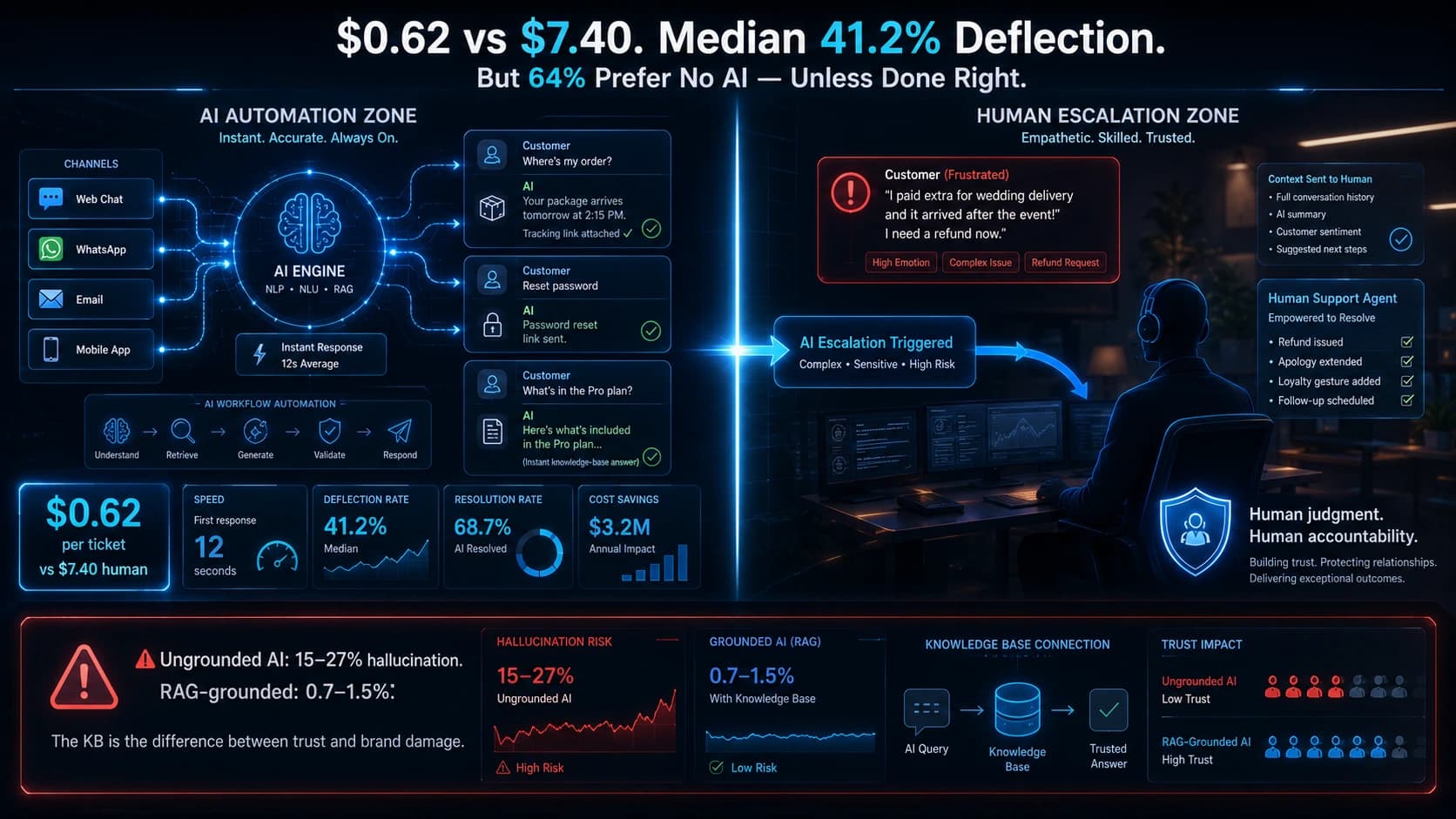
AI customer service in 2026 is defined by a tension between two simultaneously true statistics. The first: 65% of incoming support queries are now resolved without human intervention in mature AI deployments. AI self-service costs $1.84 per contact versus $13.50 for human agents — and the per-interaction advantage is even sharper at $0.50 to $0.70 for AI chatbots versus $6.00 to $8.00 for human agents. Gartner projects $80 billion in global contact center labor savings by 2026. The business case is overwhelming.
The second statistic: 64% of customers would prefer that companies didn’t use AI for customer service at all (Gartner). 53% would consider switching to a competitor if they learned a company uses AI. 79% of Americans prefer humans when it comes to customer service overall.
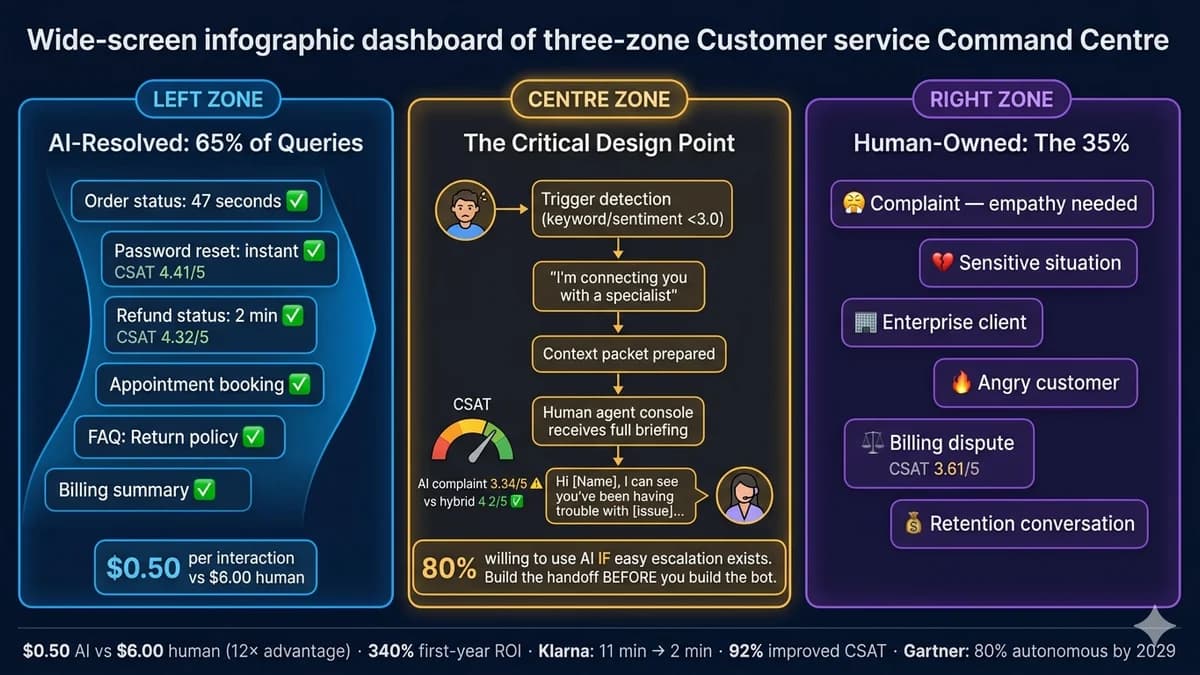
Both statistics are real. Both are sourced from 2026 research. And both are compatible — because the customer preference data contains a crucial qualifier that transforms the business decision. 80% of customers are willing to use AI for customer service if there is easy escalation to a human. 74% prefer chatbots for simple questions. 62% prefer chatbots over waiting for a human. 54% do not care how they interact — as long as their problem gets solved. The customers who object to AI are objecting to AI that fails them and traps them without a way out. They are not objecting to AI that resolves their order status query in 47 seconds while they are on the bus.
The business that navigates this correctly is not the one that maximises automation. It is the one that designs the human-AI boundary correctly — automating the interactions customers actually prefer AI to handle, protecting the interactions where human judgment and empathy are irreplaceable, and building the handoff between the two in a way that preserves context and feels seamless. This guide maps exactly that boundary.
What Gets Automated — The 65% That Customers Actually Prefer AI to Handle
The customer preference data reveals something important: customers do not object to AI across the board. They object to AI handling the wrong things — complexity, emotion, and novel situations — and to AI with no exit when it fails. For structured, transactional, time-sensitive queries, the majority of customers actively prefer AI. They prefer the 47-second resolution over the 8-minute wait for a human. They prefer the 2am availability over the business-hours limitation. They prefer the consistency over the human variability.
- Order status and shipment tracking — highest AI CSAT, instant resolution
- Account access and password reset — 4.41/5 AI CSAT (Zendesk 2026)
- Refund status enquiries — 4.32/5 AI CSAT, well-defined rules
- FAQ and knowledge base queries — product information, policy questions
- Appointment scheduling and rescheduling
- Account updates — address changes, preference settings
- Standard returns processing — within-policy returns with clear criteria
- Bill payment and balance enquiries
- Subscription changes — upgrades, downgrades, pauses
- Product troubleshooting — step-by-step guided diagnosis
- Complaints involving anger or distress — AI CSAT 3.34/5 (Zendesk 2026)
- Complex multi-system or multi-department issues
- Billing disputes — AI CSAT 3.61/5; fraud allegations
- Sensitive situations — bereavement, health, financial hardship
- Enterprise and VIP account relationships
- Retention conversations — customers considering cancellation
- Novel problems outside training data
- De-escalation from frustration or anger
- Complex sales requiring discovery and nuanced consultation
- Situations requiring regulatory or legal judgment
The distinction between what AI handles and what stays human is not primarily about query complexity — it is about the presence of emotion and the requirement for judgment. A technically simple query (“why was I charged twice?”) may require human handling because it involves customer anger. A technically complex query (cancelling and prorating a multi-seat subscription) may be fully automatable because the rules are clear and the customer’s emotional state is neutral. Map your interaction types by emotion-level and rule-clarity, not complexity alone.
What Must Stay Human — The Interactions Where AI Degrades the Experience
The CSAT data from Zendesk’s 2026 Customer Experience Trends analysis makes the human-retention case with precision. AI-handled interactions achieve the highest satisfaction scores — 4.41/5 for password resets, 4.32/5 for refund status — when the interaction is structured, the rules are clear, and the customer’s primary desire is speed and accuracy. The same AI produces 3.34/5 for complaint handling and 3.61/5 for billing disputes. The 4.0 CSAT threshold is an operational standard: interactions that consistently score below 4.0 on AI handling should be automatically escalated to human agents.
IBM’s research on mature AI adopters — organisations operating or optimising AI-powered customer service — confirms the pattern: mature AI adopters report 17% higher customer satisfaction. The additional finding: the satisfaction premium comes not from the automation rate but from the quality of the human-AI collaboration, including how well the escalation process preserves context and how quickly the handoff occurs when AI has reached its limit.
There is also a human-on-human dynamic that AI cannot replicate: the ability to match emotional register. When a customer is frustrated, the most effective human response often acknowledges the frustration before addressing the issue — “I can see this has been a frustrating experience and I want to help you resolve it right now.” AI systems trained on resolution-oriented responses frequently skip the emotional acknowledgement and go directly to the solution, which reads as dismissive to an already-frustrated customer and makes the situation worse. This is not a solvable problem with better prompting — it is a fundamental difference in what a trained human agent brings versus what a language model produces under emotional pressure.
CSAT by Interaction Type — The Data That Draws the Boundary
| Interaction Type | AI CSAT | Recommended Routing | Why |
|---|---|---|---|
| Password reset / Account access | 4.41/5 | AI — automate | Structured, rule-based, instant. Customers value speed above all. |
| Refund status enquiry | 4.32/5 | AI — automate | Clear data lookup. No judgment required. Fast resolution preferred. |
| Order tracking / shipping status | 4.28/5 | AI — automate | Pure data retrieval. 24/7 availability advantage maximised. |
| FAQ / Policy questions | 4.20/5 | AI — automate | Knowledge base queries. AI consistency advantage over human variability. |
| Appointment scheduling | 4.10/5 | AI — automate | Calendar logic well-handled by AI. Customer controls outcome. |
| Standard return processing | 3.92/5 | Hybrid — AI initiates, human if outside policy | Within-policy returns: AI. Outside-policy or exceptional: human. |
| Technical troubleshooting (guided) | 3.88/5 | Hybrid — AI for common, human for novel | Step-by-step diagnosis: AI. Unresolved after standard steps: human. |
| Billing dispute | 3.61/5 | Human — escalate immediately | Involves money and perceived unfairness. Emotion-heavy. Human judgment essential. |
| Complaint handling | 3.34/5 | Human — never automate | Lowest AI CSAT. Emotion and empathy are the entire value of the interaction. |
| Retention conversation | N/A | Human — always | High-value relationship decision. Human nuance, authority, and relationship irreplaceable. |
The NPS dimension adds a further data point to routing decisions. Bain and Company’s research finds that a pure-AI customer service approach produces -3 NPS points relative to the all-human baseline — while a hybrid approach produces +1 NPS points. The hybrid outperforms both pure AI and pure human precisely because the right interactions go to the right channel: AI handles what customers prefer AI for, and humans handle what they do not. Getting the boundary right is worth 4 NPS points versus getting it wrong.
Want to map your specific interaction types against this CSAT data and design the human-AI boundary for your customer service operation? Automely builds the AI chatbot solution and the escalation workflow.
Free 45-minute consultation. We map your interaction volume by type, calculate the automation opportunity, and recommend the routing and escalation architecture that maximises both cost savings and CSAT.
Designing the Handoff — The Most Important Decision in AI Customer Service
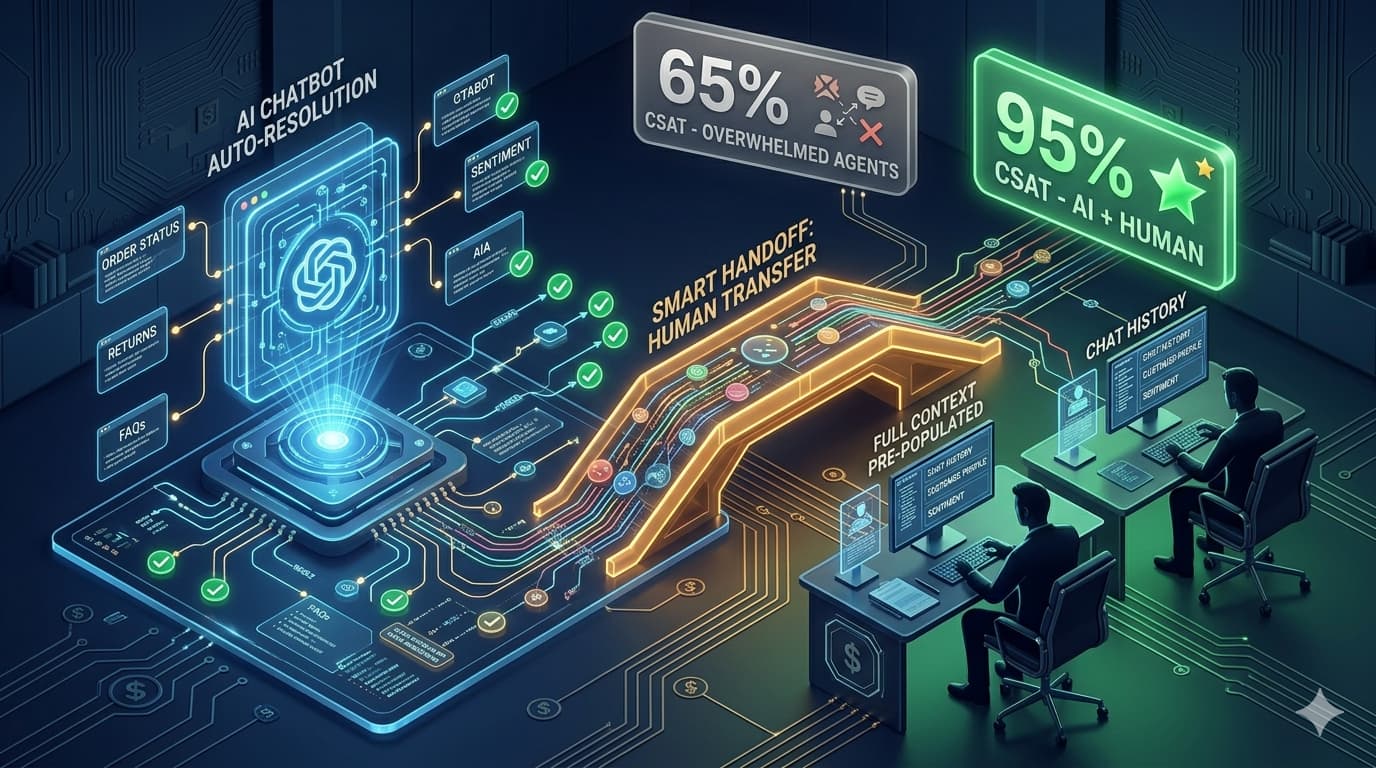
The single most common reason AI customer service implementations reduce CSAT is not the AI itself — it is the handoff design. Specifically: AI that detects it cannot resolve an issue but either traps the customer in a loop (“I’m sorry, I didn’t understand that”) or passes them to a human without any context (“Please hold for an agent”) destroys the experience that the AI’s speed advantage built. The customer arrives at the human agent re-frustrated, having already explained their issue once, and needing to explain it again.
The design principle that resolves this is stated in the data: 80% of customers are willing to use AI if there is easy escalation to a human. “Easy” means two things: the trigger for escalation is clear (customers know how to reach a human), and the transition is warm (the human agent arrives with full context of the AI conversation, no re-explanation required).
Step 1: Trigger detection
AI monitors sentiment, repeated failures to resolve, explicit requests for a human, and keyword patterns (“frustrated”, “unacceptable”, “complaint”, “speak to a person”). Any of these triggers the escalation path — not a dead end.
Step 2: Transparent escalation message
AI acknowledges the situation without making the customer feel they have failed: “This looks like something I’d like to get a specialist involved in — they’ll have all of our conversation in front of them so you won’t need to repeat anything.” Honesty about the transition increases CSAT vs pretending a human was always available.
Step 3: Context package auto-prepared
The system creates a briefing for the human agent containing: full conversation transcript, customer history and account status, the specific unresolved issue, detected sentiment score, any products or orders involved, and suggested opening from the agent. Human agent reads this in 30 seconds and arrives prepared — not cold.
Step 4: Warm human opening
“Hi [Name], I’m [Agent] and I can see you’ve been having trouble with your order from last Tuesday. Let me take a look at this right now.” The customer knows the agent has their context — the experience of re-explaining is eliminated. This single design decision is worth approximately 0.5–1.0 CSAT points on escalated interactions.
Step 5: Resolution with AI assistance behind the scenes
The human agent operates with AI as a co-pilot — surfacing relevant knowledge articles, suggesting responses, and flagging relevant account notes — while maintaining control of the conversation. Service professionals using gen AI save 2+ hours daily and handle 13.8% more enquiries per hour. Human agents with AI tools are measurably more effective than human agents without them.
Step 6: Post-interaction learning loop
Escalated interactions are tagged with the trigger reason and outcome. Patterns are reviewed regularly: if a specific intent is repeatedly failing AI resolution and escalating, the AI training or routing threshold is updated. The human escalation data is the most valuable quality signal for improving the AI system over time.
The ROI Case — Numbers Business Leaders Should Know
What Comes Next — The Gartner Rehiring Boomerang and the 2029 Horizon
The future of customer service is not automation eliminating human roles. Gartner’s February 2026 prediction is striking: 50% of companies that cut customer service staff due to AI will rehire by 2027. The reason is not that AI fails — it is that AI changes what human agents do, not whether they are needed. The AI handles the 65% of queries where human judgment adds no value and speed is the priority. The freed human capacity is redirected toward the 35% where human judgment, empathy, and relationship management produce outcomes AI cannot match — and toward AI oversight, quality management, and continuous improvement of the automation layer.
Gartner’s 2029 projection is that agentic AI will resolve 80% of common customer service issues without human intervention — a significant increase from the current 65% average. The improvement from 65% to 80% will come from agentic AI that can not just answer questions but take actions: process refunds, update accounts, book services, and complete end-to-end resolutions without human involvement for the increasingly complex class of transactions that current chatbots cannot handle. For the technical architecture behind agentic customer service — how agents connect to CRM, order management, and billing systems to take action — see our guide to what AI agents actually are and do in production.
IBM’s framing of where customer service AI is headed is precise: mature AI adopters reported 17% higher customer satisfaction. Today’s customer service goes far beyond simple AI-powered chatbots and static help pages. These systems use natural language processing to understand intent, context, and sentiment — and they are moving from reactive response to proactive support that reaches customers before they need to ask. Proactive AI customer service — identifying a delayed shipment and reaching out before the customer does, flagging an unusual charge before the billing dispute arrives — is the next frontier after resolution automation.
Ready to build an AI customer service solution that captures the $0.50 per interaction cost advantage while maintaining the CSAT that the 4.0/5 threshold and escalation design protect? Automely builds both the AI layer and the handoff.
Free 45-minute consultation. We map your interaction volume, design the human-AI boundary for your specific customer base, and build the chatbot solution with the escalation workflow that makes the ROI case and keeps the CSAT.