


Why Most AI Startups Fail — and It's Not What You Think
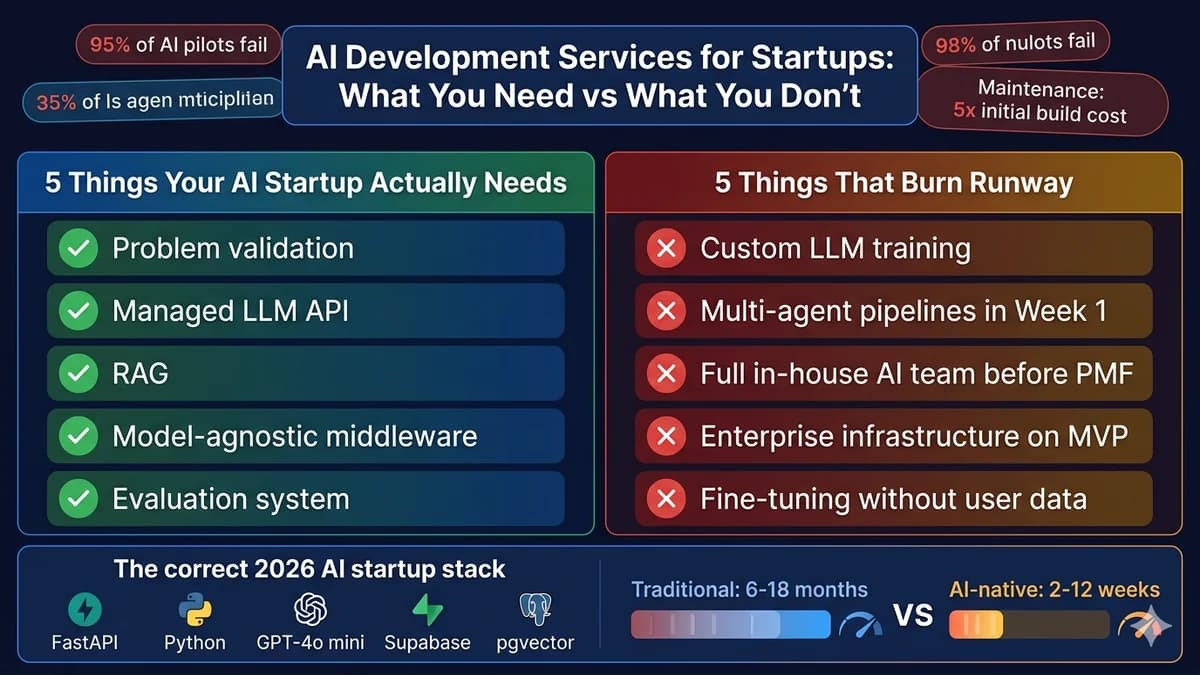
Gartner's data is blunt: 95% of generative AI pilot projects fail to deliver measurable ROI. CB Insights puts the startup failure rate at 80-90% long-term, with 43% failing specifically because they built something nobody actually wanted. These failures are not primarily technical — they are decisions made too early, too expensively, and without sufficient validation of the core hypothesis.
The pattern across failing AI startups is consistent. They begin with a technology decision (we will use RAG, or we will build an agent, or we will fine-tune a model) and then look for a problem to apply it to. They commission expensive AI development services before validating that the problem is real or the market exists. They over-engineer the AI layer — building multi-agent architectures, proprietary models, and enterprise-grade infrastructure — before they have a single paying user. By the time they discover their assumptions were wrong, the runway is gone.
This guide is the counterargument. It covers what AI development services for startups actually need to deliver — the five things worth commissioning — and the five expensive patterns that consume startup runway without producing proportional value. It also covers the correct technical stack for most AI startups in 2026, the build vs buy decision framework, and how to evaluate an AI development partner before you sign anything.
What You Actually Need from AI Development Services
The most valuable thing an AI development service can do for a startup is prevent it from building the wrong thing. This happens before a line of code is written — through a structured validation of the core hypothesis: Is the problem real? Is the audience specific enough to reach? Are they paying for an imperfect solution today? Would AI specifically improve on what they currently do?
The validation exercise takes 30 minutes and costs nothing. Skipping it costs everything. CB Insights documents that 43% of startup failures trace back to building for a non-existent market. An AI development partner that starts with validation — and is willing to tell you the idea needs refinement before taking your money — is worth significantly more than one that starts building immediately.
For 99%+ of startup use cases, integrating a managed LLM via API (OpenAI, Anthropic, Google) produces better results faster than building a proprietary model. GPT-4o mini — the workhorse model for most startup AI workloads — costs $0.15 per million input tokens. LLM API costs for most MVP workloads run $0.01-$0.10 per user interaction, fully modelled into unit economics from day one (DEV Community 2026).
The Mavik Labs case study documents the timeline comparison precisely: choosing managed LLM API integration over building custom AI infrastructure shipped AI features in 3 months versus an estimated 18 months to build. The right AI development service starts with managed APIs, builds your product's intelligence layer on top of them, and creates a model-agnostic middleware that lets you swap providers when a better or cheaper model releases — without rebuilding your product.
Retrieval-Augmented Generation connects the LLM to your specific data at query time — your corpus, your documents, your client data — without fine-tuning the model's weights. It is faster to implement, easier to update (no retraining when your data changes), easier to debug, and better suited to most startup use cases than fine-tuning.
The DEV Community's 2026 AI MVP development guide makes a critical point: not every AI startup needs RAG. If your product is a general-purpose tool (writing assistant, code helper, research summariser), the base LLM's training is sufficient. RAG is necessary when your product's intelligence needs to be grounded in a specific corpus that users expect the AI to know — medical records, legal documents, proprietary company knowledge, domain-specific reference material. The default stack (pgvector with PostgreSQL) handles most startup-scale RAG workloads without the operational complexity or cost of a managed vector database.
The LLM landscape in 2026 changes monthly. Models that were state-of-the-art six months ago are being outperformed by newer releases on cost, capability, and latency. A startup that builds its AI product architecture around a single model provider is placing a technical bet that it cannot win — the moment a better or cheaper model releases, migrating from a single-provider hard-coded architecture takes weeks. A model-agnostic middleware layer makes the same migration take hours.
As the AI Product Strategy 2026 guide documents: "One of the most significant strategic errors a founder can make in 2026 is model lock-in. Build a middleware layer that allows you to swap out your underlying model in hours, not weeks." The middleware routes different task types to different models: simple classification to GPT-4o mini (cheap, fast), complex reasoning to GPT-4o Full (capable, expensive when necessary), customer-facing responses to the lowest-latency option. This tiered routing pattern reduces AI infrastructure costs 60-70% while maintaining output quality at the use-case level.
The principle from every production AI development practitioner in 2026 is consistent: evaluation systems must exist before launch, not as a post-launch improvement. A chatbot that gives wrong answers 30% of the time is not an MVP — it is a broken product that destroys user trust in the first session. Building the evaluation system is not optional overhead; it is the mechanism that separates a demo from a product.
The minimum evaluation system: 50-100 golden examples with expected AI outputs for your specific use case. Automated runs against every prompt change. Quality thresholds below which the product does not ship. When OpenAI or Anthropic releases a model update that changes behaviour, the evaluation suite catches quality regressions before users encounter them. This is the infrastructure an AI development service should build alongside the product, not after the product has launched and users are complaining.
Want to validate your AI startup idea, get the architecture right from the start, and commission only what your idea actually needs — with an AI development partner who builds the evaluation system before a user sees the product?
Free 45-minute consultation. We validate your idea, propose the minimal correct architecture, and give you a realistic build cost and timeline — no over-engineering, no unnecessary services.
What to Skip — 5 Patterns That Burn Startup Runway
Building a proprietary large language model from scratch costs $500,000 minimum and 6-18 months of engineering time. For 99% of startup use cases, managed API integration delivers better results in a fraction of the time at a fraction of the cost. The idea that you need your own model to differentiate is the most expensive misconception in AI startup development.
As Mavik Labs documents: "Build only what creates competitive advantage." Your competitive advantage is not the model — it is your proprietary data, your user experience, your domain expertise, and your workflow integration. The model is a commodity; the application layer is the moat. Commission custom model training only when you have validated product-market fit, have data competitors cannot replicate, and have a specific quality gap that managed APIs cannot close.
Complex agentic architectures — multi-step pipelines, agent orchestration, autonomous tool-using systems — are the most technically impressive and the most frequently premature investment in AI startup development. The DEV Community's 2026 AI MVP guide is direct: "Choosing complex agentic architecture for week one" is the #1 mistake. "A single LLM call with good prompting solves more problems than a five-agent pipeline."
Valtorian's 2026 analysis reinforces the pattern: "AI makes it tempting to automate everything at once. Startups end up with complex pipelines before anyone has validated the core workflow. In practice, most MVPs need only one narrow AI-driven function to test demand." Build the simplest possible version of the core AI feature. If it works — users engage, value is created, retention metrics hold — then add sophistication. Do not build sophistication before you have validated the simple version.
Senior AI engineers command $150,000-$200,000 per year in major markets (articsledge research). A team of three senior AI engineers costs $450,000-$600,000 annually before benefits, equity, recruiting, and management overhead. For a startup that has not yet validated product-market fit, this is a bet that assumes the hypothesis is right before testing it.
Mavik Labs documents the hidden cost that most startups miss: "Maintenance burden = 5× initial development cost." If you commission a custom AI system built by an in-house team, ongoing maintenance, retraining, monitoring, and optimisation will cost 5× what the initial build cost — annually. Before PMF, a dedicated AI development partner on a flat monthly retainer model delivers the same engineering capability at 40-60% lower cost, with the flexibility to adjust scope as the product pivots. Commission dedicated engineers; do not hire full-time before you know what you are building.
AI-Powered MVPs with unnecessary complexity cost $140,000-$300,000+ (Softermii 2026). Most AI startups need the $55,000-$140,000 standard SaaS MVP — and many should start with the $30,000-$55,000 focused AI MVP that validates one specific value proposition before expanding. The Softermii analysis documents: "Don't try to fix every small issue — you'll fix those based on user feedback after launch."
The temptation to build enterprise-ready infrastructure before you have enterprise customers is consistently cited as a top cause of startup over-spend. Kubernetes clusters, microservice architectures, multi-region deployment, SOC 2 compliance infrastructure — all of these are correct investments at $5M ARR. At $0 ARR, they consume engineering resources that should go toward finding the core value proposition. The correct 2026 AI startup stack (detailed below) handles 90%+ of startup AI use cases without enterprise complexity.
Fine-tuning adjusts the model's weights on your specific data to improve performance on your use case. It is the correct investment after you have real user interactions to learn from — hundreds of examples of what "good" looks like in production. Before that, fine-tuning optimises for your assumptions about what users need, not what users actually do.
The sequence that works: start with well-engineered prompts and RAG if relevant. Reach 500-1,000 real user interactions with labelled quality feedback. Identify the specific, consistent failure mode that fine-tuning can solve. Then fine-tune on the real data, with a measurement plan to confirm the improvement. Skipping to fine-tuning before this sequence produces a model optimised for assumptions — and fine-tuning is expensive, time-consuming, and difficult to reverse if the assumptions prove wrong.
The Correct 2026 AI Startup Stack
The DEV Community's 2026 AI MVP development guide documents a point that the broader startup ecosystem has converged on: "The default AI startup stack in 2026 is well-established. There's no reason to stray from it for an MVP unless you have a specific technical requirement." The stack below handles the vast majority of AI startup use cases at MVP scale, costs significantly less than the alternatives, and is well-understood by any competent AI development service.
# Backend & AI Framework
FastAPI + Python
# Python AI ecosystem is unmatched: LangChain, LlamaIndex,
# HuggingFace, vector libraries all work natively.

# Primary LLM — Start Here for Most Workloads
GPT-4o mini: $0.15/million input tokens, $0.60/million output
# 4o-class quality at a fraction of the cost.
# Most MVP workloads: $0.01–$0.10 per user interaction.

# Upgrade Path (tiered routing)
GPT-4o Full → complex reasoning tasks only
Claude Sonnet 4.6 → long-context, nuanced output

# Database + Vector Store + Auth (single managed service)
Supabase: PostgreSQL + pgvector + authentication
# pgvector handles RAG for most MVP-scale workloads.
# No Pinecone needed until you're at serious query volume.

# Model-Agnostic Middleware
Custom router layer → swap providers in hours, not weeks
# Route by task complexity, latency requirement, cost.

# Frontend (web-first for MVP)
Next.js 14 App Router
# Add React Native for mobile after web PMF is validated.

# Payments
Stripe: subscriptions + usage-based billing from Day 1| Component | Standard MVP Stack (Use This) | Over-Engineered Version (Skip) | Cost Difference |
|---|---|---|---|
| LLM | GPT-4o mini via API ($0.15/M tokens) | Custom proprietary model training | $500K+ more |
| Vector DB | pgvector (extension of PostgreSQL) | Dedicated Pinecone/Weaviate/Qdrant | $200-$3K/month more at MVP scale |
| Auth & DB | Supabase (managed, generous free tier) | Custom PostgreSQL + custom auth | 4-6 weeks more engineering |
| Agent architecture | Single LLM call + well-engineered prompt | 5-agent orchestration pipeline | 8-12 weeks more build time |
| Infrastructure | Vercel/Railway/Render (serverless deploy) | Kubernetes cluster on AWS/GCP | $3-10K/month more + DevOps hire |
| AI optimisation | Prompt engineering + RAG if needed | Fine-tuning before user data exists | $20-100K more + 2-4 months |
Build vs Buy — The Decision Framework for AI Startups
The build vs buy decision for AI components is the most consequential technical choice a startup makes in the first month. Mavik Labs' 2026 framework reduces it to a clear principle: "Almost always start with buy. Speed matters more than optimization. Build when you've validated product-market fit and have resources. Build only what creates competitive advantage."
A startup facing this decision chose managed LLM API integration over building custom AI infrastructure. Result: shipped AI features in 3 months versus an estimated 18 months to build. "Engineering stayed focused on product differentiation." The lesson from Mavik Labs: "Your decision isn't permanent. Plan for: different components may have different answers. Almost always start with buy. Build only what creates competitive advantage. Abstract vendor interfaces, use open standards, maintain the ability to migrate."
Your Real Competitive Moat — It's Not the Model
The most common strategic misconception in AI startup development is that the LLM choice is the competitive moat. It is not. Using GPT-4o or Claude is not differentiation — every startup has access to the same APIs at the same price. The ChatGPT wrapper problem (Softermii's term: "ChatGPT wrapper syndrome") describes startups that build a thin UI on top of a popular model without proprietary data, unique UX, or workflow integration — all of which are easily replicated by any competitor who downloads the same API documentation.
VCs in 2026 have identified three real moat categories for AI startups (Atlas Unchained): a data moat — exclusive access to data your competitors do not have; a systems moat — the business system surrounding your AI (integrations, analytics, workflows) that creates switching costs; and a network effect — where more user interactions make the AI smarter in a way that compounds over time. The right AI development services help you build these moats from Day 1, not after the fact.
For a deeper analysis of when to build custom AI versus integrate off-the-shelf, see our build vs buy AI development guide. For the specific technical architecture decisions inside an AI product build, see our Lamblight AI SaaS technical case study.
Choosing an AI Development Partner for Your Startup
The AI Development Partner to Avoid
- Recommends custom LLM training without asking what problem it solves
- Proposes multi-agent architecture in the first meeting without seeing evidence the simple version fails
- Does not ask about validation, business model, or target user before proposing a tech stack
- Quotes based on daily rates with no fixed-price commitment — unlimited scope expansion risk
- Cannot explain the difference between RAG and fine-tuning in plain language
- Does not mention an evaluation system or quality gates before product launch
- Encourages building everything in the first version rather than identifying what to cut
The AI Development Partner That Serves Startups
- Runs a validation exercise before proposing any technology — and is willing to tell you if the idea needs refinement
- Starts with the simplest possible AI architecture and justifies any complexity with a specific, documented requirement
- Provides a "not building" list alongside the build scope — scope discipline is enforced, not left to the founder
- Builds the evaluation system before launch, not after user complaints
- Proposes a model-agnostic architecture — not because it's more complex, but because it protects the startup's flexibility
- Is transparent about where off-the-shelf tools solve the problem better than custom development
- Has shipped AI products for real users, not just AI proof-of-concepts that never reached production
How to Start Right — The 4-Step Sequence
The sequence that consistently produces AI startup success versus the sequence that consistently produces expensive failures differs at Step 1. The failure sequence starts with technology selection. The success sequence starts with validation.
Validate the problem in 30 minutes.
The four questions from this guide's validation framework: Is the problem observable and measurable in one sentence? Is there external evidence it exists at scale? Is the audience specific enough to reach at launch? What do they do today — and is the workaround painful enough to pay to escape? If all four have evidence-backed answers, the idea is worth a product spec. If not, refine first.
Write a machine-readable product spec — not a 20-page PRD.
Four sections: problem and user, core workflow (3-5 steps to value), technical architecture (which model, what retrieval strategy, where data lives, cost model), and business model. This spec drives the AI development, not a wish list of features.
Commission the minimum AI core first.
The AI feature that is the reason the product exists — built, tested, and evaluated against 50 golden examples before the product layer is built around it. If the core AI does not work well enough that users trust it, the product layer is wasted engineering.
Build the product layer around a proven AI core.
Frontend, subscriptions, onboarding, mobile — built to serve users who are already getting value from the validated AI feature. This is the correct order. The reverse — build the product shell and add AI later — produces the expensive rewrites that most AI startup budgets cannot survive. For the complete case study of this sequence applied to a real product, see our Lamblight founder journey: from idea to 20,000 users.
AI makes good startups faster. Menlo Ventures documents that AI-native startups reach product-market fit 2.4× faster than traditional software companies — when they start right. They also fail faster when they do not — burning through runway on custom models, complex architectures, and over-engineered infrastructure before validating the core hypothesis. The right AI development services for startups are not the most technically impressive. They are the ones that validate first, build minimum, ship fast, and scale only what the market has proven it wants.
Have an AI startup concept and want to validate it, get the minimal correct architecture, and commission only what your idea actually needs — with an AI development partner who has shipped AI products at scale, not just demos?
Free 45-minute consultation. Validation, architecture, honest cost estimate, and the "not building" list that protects your runway. No over-engineering. No unnecessary services.