


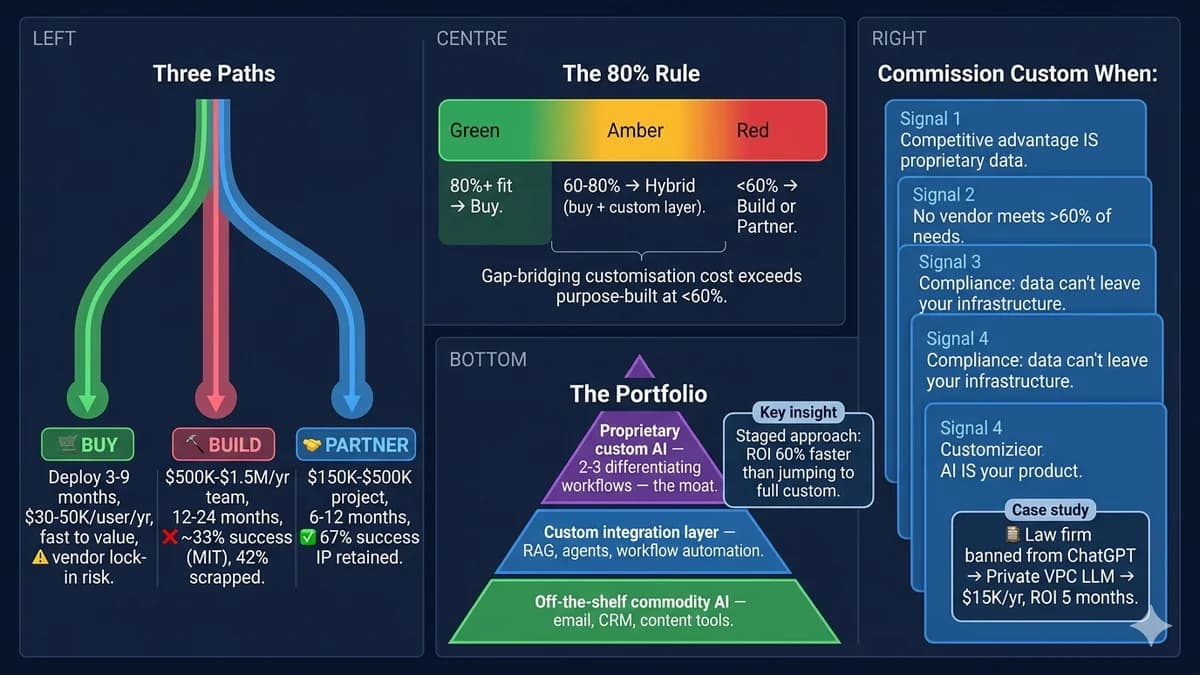
Why the Build vs Buy AI Decision Is Different in 2026
The build vs buy AI decision in 2026 is harder than it was two years ago — not because the core question changed, but because AI has transformed both sides of the equation simultaneously. On the build side: AI-assisted development tools (Claude Code, Cursor, GitHub Copilot) have compressed custom development timelines and costs dramatically. A skilled developer with the right tools can produce a custom AI MVP in three to six weeks for a fraction of historical costs. On the buy side: the off-the-shelf AI market has exploded — but vendor lock-in risk has become more consequential because the AI layer often controls how your data is processed, stored, and used, not just what features you access.
Two statistics capture the tension. Retool's 2026 Builder Report: 35% of teams have already replaced at least one purchased SaaS tool with a custom build, and 78% expect to build more of their own tools by end of year. Simultaneously: 42% of companies scrapped AI initiatives in 2024 because building turned out to be far more demanding than anticipated. Both numbers are simultaneously true. The decision is not simpler in 2026 — it is more consequential. Getting it wrong costs more, in both directions.
The Three Paths — Not Two
Most discussions of build vs buy AI frame this as a binary. It is not. There are three distinct paths, each with a different cost profile, success rate, and strategic implication. Most mature businesses run all three simultaneously for different use cases.
Deploy pre-built AI from a vendor or SaaS platform with limited customisation. Configuration but not deep modification. Data processed by vendor's infrastructure.
Best for commodity use cases — problems that thousands of organisations share and where vendor solutions have been validated at scale.
Assemble an internal team of ML engineers and AI architects to build and maintain AI systems. Full control, full IP ownership, full cost, and full timeline risk.
Appropriate when AI capability is strategic, proprietary, and differentiating — and internal talent exists or can be hired and retained.
Co-build a custom AI solution with a specialised AI development firm. You provide domain knowledge, business context, and data. They provide technical execution. You retain IP.
Best for custom AI needs where internal talent is insufficient but the use case requires proprietary development.
MIT's 2025 enterprise AI research explains the gap: "Specialised partners have solved the deployment problem dozens of times across multiple industries. They know where projects stall, which data quality issues surface at month four, and how to design for adoption rather than just functionality. Internal teams frequently underestimate integration costs and stall in the pilot phase — not because the technology fails, but because the path to production requires workflow redesign, change management, and compliance validation that internal builds rarely budget for adequately." The 67% vs 33% gap is not about AI capability — it is about deployment experience.
The Full Cost Comparison — Including Hidden Costs
| Cost Factor | Buy (Off-the-Shelf) | Build (Internal) | Partner (External Dev) |
|---|---|---|---|
| Initial investment | Low — subscription setup | High — team hiring, infrastructure | Medium — project engagement fee |
| Typical price range | $30K-$50K/user/yr enterprise · $50-500/month SaaS | $500K-$1.5M/yr for small-mid AI team, before infrastructure | $150K-$500K project · $50K-$500K for custom AI |
| Time to production | 3-9 months (HP 2026 data) | 12-24 months | 6-12 months |
| Customisation depth | Configuration only — no model access | Complete — you own every layer | Deep — custom models on your data |
| Data control | Data processed by vendor infrastructure | Complete data sovereignty | Your infrastructure or chosen host |
| IP ownership | Vendor owns model; you license it | You own everything | You retain full IP |
| Vendor lock-in risk | High — switching costs astronomical once embedded | None — full portability | Minimal — you own codebase |
| Ongoing maintenance | Vendor-managed (but pricing changes) | Full MLOps team required — model drift consumes 22% more than initial deployment (Coherent Solutions) | Shared — partner maintains what they built, you staff operations |
| Success rate | Varies — depends heavily on implementation quality, not tool quality | ~33% (MIT) — internal teams underestimate integration and adoption | ~67% (MIT) — specialist deployment experience compounds |
| Competitive moat | None — competitors access same tools | Strong — if the build succeeds | Strong — custom AI on your proprietary data |
The hidden cost that changes every calculation: model drift. AI models are not like traditional software — they work until something breaks. They degrade as real-world patterns shift from their training data. Research from Coherent Solutions indicates that continuous model retraining consumes 22% more resources than the initial deployment cost. This hidden operational cost applies to any path that involves a custom model — build or partner — and must be budgeted explicitly before any project is approved.
Evaluating build vs buy for a specific AI use case and want to run the numbers — realistic cost estimates, timeline, and success probability for your specific situation? Automely provides this assessment free.
Free 45-minute build vs buy AI consultation. We map your use case against all three paths, calculate the realistic cost and timeline for each, and give you a recommendation with the reasoning made explicit.
When to Buy Off-the-Shelf AI — The KPMG 80% Rule
The clearest operational rule for the buy decision comes from KPMG's 2026 enterprise AI framework: buy when the best available vendor solution meets more than 80% of your needs. Below 60%, the customisation effort required to bridge the gap typically exceeds the cost of building a purpose-built system from the outset. Between 60-80% is the hybrid zone — buy the vendor solution and build a custom layer on top.
Beyond the KPMG percentage rule, the buy decision is right when:
The use case is a commodity problem
Customer service automation, invoice processing, marketing content generation, lead scoring — problems that thousands of organisations share and where vendors have built mature, validated solutions. Competitive advantage comes from implementation quality, adoption, and workflow design — not from the underlying AI technology.
Speed to value matters more than differentiation
Vendor solutions deploy in 3-9 months vs 12-24 months for custom development (HP 2026). If your competitive situation requires AI capability within weeks or months rather than a year, buy. Organisations following a staged approach (buy first, build custom later) achieve ROI 60% faster than those jumping straight to custom development.
Internal AI capability is limited
If you do not have ML engineers, data scientists, or MLOps capability in-house — and do not intend to build those capabilities — buying is the only practical path until you establish the foundation. The alternative is partnering for custom development, not internal building.
The AI problem is well-understood and solved
If a vendor has already solved your specific problem across hundreds of similar deployments, there is rarely a justified reason to rebuild from scratch. "We bought the wrong vendor" is easily corrected. "We spent 18 months building what we could have bought" is not.
The 4 Signals That Indicate Custom AI Development
When the buy path does not fit, the question becomes: is this a build (internal) or partner (external dev firm) call? Either way, four signals consistently identify a use case where custom AI development — not vendor configuration — is the right answer. The presence of any one of these is usually sufficient; the presence of more than one makes the decision close to determined.
Your Competitive Advantage Lives in Proprietary Data
If your business advantage comes from data that no vendor has access to — customer interaction history, operational patterns, domain-specific datasets, proprietary signals — generic AI tools cannot leverage this moat. Custom AI trained on your specific data produces outcomes that competitors using the same SaaS tools structurally cannot replicate. Microsoft CEO Satya Nadella: "The future belongs to companies that treat models as components, and treat orchestration, context, and proprietary knowledge as their true differentiators."
No Vendor Meets More Than 60% of Your Needs
If you have genuinely evaluated the best vendor solutions and none meets more than 60% of your actual requirements — not aspirational requirements, but documented workflows — the customisation cost to bridge the gap typically exceeds commissioning a purpose-built system. The test: map your actual workflows step by step and score each vendor on how many steps they handle without modification. Below 60% is the KPMG build threshold.
Compliance or Client Mandates Prevent Data Leaving Your Infrastructure
Healthcare (HIPAA), financial services (FCA, SEC data handling rules), legal (client confidentiality mandates), and government sectors frequently require that sensitive data never leave the organisation's own infrastructure. Most SaaS AI vendors cannot offer complete data residency guarantees at the level these regulations require. A law firm banned from using ChatGPT due to client confidentiality constraints deployed a self-hosted large language model inside their private cloud — achieving full compliance, zero data leakage, and a competitive edge in enterprise client pitches at $15,000 per year ongoing cost with ROI achieved in 5 months.
AI Is Your Core Product, Not Just an Efficiency Tool
If AI capability is what you sell — if your product differentiation, client value proposition, or competitive positioning is built on AI performance that you control — you cannot afford to be dependent on a vendor's roadmap, pricing decisions, or model deprecation schedule. A fintech whose core product is AI-driven risk assessment, a healthtech whose product is clinical decision support, or an edtech whose product is personalised learning — these companies must own their AI entirely. Vendor AI as a core product creates an existential dependency risk.
The Portfolio Approach — Running All Three Simultaneously
The most strategically sophisticated AI posture in 2026 is not choosing one path — it is deliberately assigning each use case to the right path. As the Geeks custom AI analysis states: "Most businesses in 2026 won't be all build or all buy. It's a portfolio." The foundation models from OpenAI, Anthropic, or Google provide the base layer. Vendor SaaS handles common productivity applications. Custom AI solutions handle the 2-3 workflows that truly differentiate the company.
Commodity AI — Off-the-Shelf Tools
Email AI, CRM lead scoring, marketing content generation, productivity SaaS, standard chatbots for FAQ. Fast to deploy, maintained by vendor, competitive advantage comes from implementation quality not technology.
Custom Integration Layer — RAG, Agents, Workflow Automation
APIs connecting your existing systems, RAG (Retrieval-Augmented Generation) grounding vendor AI on your proprietary data, custom agents orchestrating across tools, workflow automation between platforms. The "middleware" approach: intelligence of a large model, specificity of your data.
Proprietary AI — Custom Models on Your Data
Fine-tuned models on your proprietary datasets, custom AI agents with your business logic, AI systems built to your compliance requirements, domain-specific models that outperform general models on your specific tasks. The competitive moat that competitors using the same SaaS tools cannot replicate.
This layered approach — commodity AI at Layer 1, custom integration at Layer 2, proprietary custom AI at Layer 3 for differentiating workflows — is consistent with Citi's approach documented at their AI Summit: "following a relatively narrow strategy for internal builds on key differentiators, with vendors handling the rest." The portfolio is not a compromise. It is the optimal allocation of AI investment to use cases, matching build depth to strategic value.
Common Build vs Buy AI Decision Mistakes — and How to Avoid Them
Four mistakes show up consistently in build vs buy AI decisions that go wrong. Each maps to a specific framework point above; each is preventable with the right question asked at the right stage of the decision.
Mistake 1: Starting with a tool evaluation rather than a use-case audit. The correct sequence is: define the specific business problem with a measurable baseline → evaluate what percentage of that problem the best vendor addresses → make the build/buy/partner call based on the KPMG 80% rule. Most organisations start by demoing vendor tools and selecting the most impressive one. This leads to buying tools that address 70% of a use case when a purpose-built solution at 100% would have cost less in total.
Mistake 2: Underestimating vendor lock-in risk at the AI layer. Before purchasing any AI tool with meaningful workflow integration, ask: Who controls the model? What happens if pricing changes by 3× when your usage scales? Can I export my data and logic if I need to switch? What data residency guarantees exist in writing? 62% of IT decision-makers express significant concern about platform lock-in — but most don't negotiate the relevant protections before signing.
Mistake 3: Treating the build decision as a one-time project rather than an ongoing commitment. Custom AI is not a project — it is an operational programme. The ongoing model retraining alone consumes 22% more resources than the initial deployment. Budget for MLOps from day one, not as an afterthought when model performance degrades six months post-launch.
Mistake 4: Building internally when partnering would succeed at 2× the rate. MIT's data on internal build success rates (~33%) versus partnering success rates (~67%) is consistent with the structural reality: specialised AI development firms have solved the deployment problem dozens of times. Internal teams are solving it for the first time. Unless AI is your core product and building internal capability is itself strategic, partnering almost always produces better outcomes at comparable or lower cost than an internal build team for initial AI development projects.
See our companion guide to why most AI projects fail and what the successful ones do differently for the complete framework on what separates the 19.7% of AI deployments that succeed from the 80% that do not — the patterns are especially load-bearing for build and partner paths, where deployment quality (not tool selection) is what decides the outcome.
Made the decision to build custom AI and want a partner who produces the 67% success rate that MIT research attributes to specialist AI development firms — not the 33% of internal-only builds?
Automely provides the partner path: your domain knowledge and data, our technical execution and deployment experience. You retain full IP. Free consultation includes use-case assessment, path recommendation, and cost/timeline estimate.