


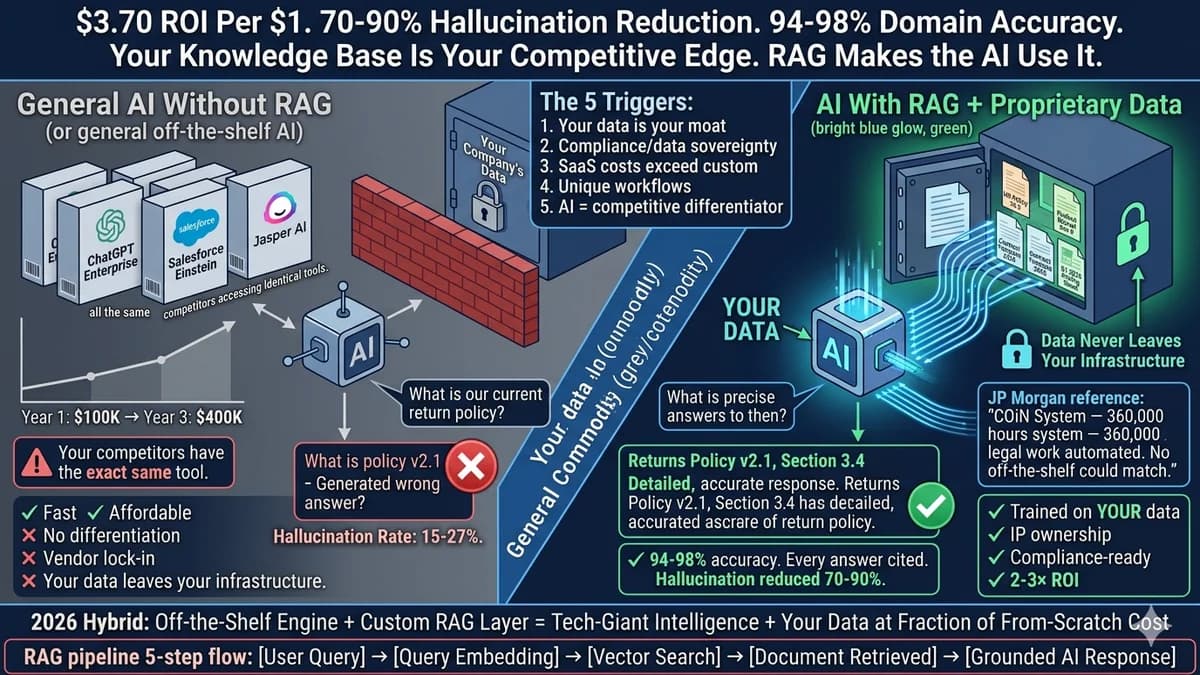
The Real Problem — Generic Tools Produce Generic Outputs
MIT research reports that 95% of organisations see no measurable return from their AI investment. The finding is worth reading carefully: it is not that 95% of organisations failed to deploy AI. Most deployed it. The failure is in the outcomes — AI that runs on standardised, vendor-managed data and produces outputs that are equally available to every competitor who pays the same subscription fee.
The fundamental tension in AI deployment in 2026 is this: your competitive advantage comes from what makes your business different — your proprietary data, your unique processes, your accumulated domain expertise, your customer relationships. Off-the-shelf AI tools are trained on generalised data. They produce generalised outputs. When your competitors have access to the same tool, it is a commodity, not a differentiator. And for most standard use cases, that is perfectly acceptable — generic AI is better than no AI. But for the 20-30% of use cases where AI could be transformational rather than incremental, off-the-shelf tools impose a ceiling that custom AI development removes.
This guide does not advocate for custom AI development as the universal answer. Off-the-shelf is the right choice for a significant majority of AI use cases, and the guide explains specifically which ones. What it does explain is the 5 triggers that signal a custom AI development company is what your situation requires — and the economics, architecture, and evaluation criteria that make that decision defensible to your CFO and board.
What Each Approach Is — Plain English
Before evaluating the build-vs-buy decision in detail, it is worth pinning down what each approach actually delivers — the advantages, the limitations, and the real trade-offs each side carries. Off-the-shelf AI and custom AI development are not competing philosophies; they are tools with different cost curves, different ownership models, and different ceilings on what they can deliver. The right choice depends on which ceiling you are running into.
Off-the-Shelf AI (Buy)
Custom AI Development (Build)
When Off-the-Shelf AI Is the Right Choice
Advocating for custom AI in every situation is intellectually dishonest and financially irresponsible. Off-the-shelf AI is the correct answer for a significant majority of AI use cases — particularly those that are standard, widely applicable, and where business differentiation does not depend on AI capability.
Off-the-shelf AI is clearly the right choice when:
- Your use case is standard. Customer-facing chatbots handling FAQ and order status, document OCR and data extraction, marketing automation and email personalisation, standard sales analytics and forecasting, HR document processing. Generic tools handle these well at lower cost and faster deployment than custom development.
- Time-to-market is the primary constraint. Off-the-shelf tools deploy in days or weeks. If you need AI in a live product within the next 30 days, custom development cannot meet that timeline — and rushing custom AI produces poor outcomes.
- You are validating a concept before committing capital. The recommended hybrid approach: use off-the-shelf tools to validate that AI can solve the problem, prove initial ROI, and understand the actual requirements — then commission custom development for the production system once the concept is validated. This avoids the most expensive custom AI failure mode: building a sophisticated custom system for a use case that turns out not to produce business value.
- Your technical team cannot maintain a custom AI system. Custom AI requires ongoing MLOps — model monitoring, drift detection, retraining cycles, version management. If you do not have the internal capability or a reliable development partner to maintain this, off-the-shelf tools with vendor support are a more sustainable choice.
- The standard tool delivers 80-90% of the value you need. Perfect is the enemy of good. For many AI use cases, the 10-20% of capability that custom development adds does not justify the cost difference. Use the standard tool, save the capital, and invest custom development effort in use cases where uniqueness actually creates competitive advantage.
The 5 Triggers That Signal Custom AI Development Is Required
These are not preferences or aspirational reasons for custom AI — they are specific, verifiable conditions where the limitations of off-the-shelf AI directly cause inadequate outcomes, and where custom AI development creates a measurable competitive or operational advantage that generic tools cannot replicate.
Your Data Is Your Moat
You have accumulated proprietary data over years that competitors do not have access to — customer transaction history, operational data from unique processes, domain-specific knowledge generated by your business, sensor data from proprietary equipment, or annotated datasets from your expert workforce. Off-the-shelf AI models cannot leverage this data as a competitive advantage because they are not trained on it. Custom AI trained on your proprietary data produces outputs that are specific to your context — and that specificity is precisely what competitors cannot replicate. The organisations with the highest long-term AI ROI are those whose AI systems improve as their proprietary data grows — a compounding advantage that generic tools can never produce.
Compliance Requires Data Sovereignty
In healthcare (HIPAA), financial services (GDPR, FCA, SEC), legal (professional confidentiality), defence, and government (data residency requirements), sensitive data often cannot leave your controlled infrastructure to be processed on vendor-managed cloud servers. Several law firms have already banned employees from using ChatGPT due to client confidentiality risks. A hospital processing patient records through a third-party AI API violates HIPAA and creates material legal liability. Custom AI deployed within your private infrastructure — on-premise or in your own cloud environment (VPC) — gives you 100% data control with no third-party processing of sensitive information. Compliance is not an optional feature of custom AI in regulated industries; it is the primary reason it is required.
SaaS Subscription Costs Are Approaching or Exceeding Custom Amortised Cost
Off-the-shelf AI feels cheaper month-to-month because it is subscription-based. The economics change at scale. A marketing agency with 500 employees using an AI writing tool paid $400,000 per year in SaaS fees. A custom Brand Bot fine-tuned on an open-source model cost $120,000 to build and $15,000 per year to maintain — ROI achieved in 5 months. The crossover point — where custom development becomes more cost-efficient than ongoing SaaS fees — varies by usage volume and user count, but for high-volume or large-team deployments, it typically arrives within 12-24 months. Think in 3-year total cost of ownership, not monthly fees. The organisation paying $400K/year in SaaS for a capability they could build once for $120K is funding their vendor's growth, not their own.
Your Workflow Has Unique Business Logic That Generic Tools Cannot Accommodate
When off-the-shelf AI forces you to adapt your business operations to the tool's limitations — rather than the tool adapting to your operations — you are creating operational inefficiency, not reducing it. Specific signals: you find yourself building extensive workarounds to make a generic tool fit your workflow; the tool's "customisation" options are insufficient for your actual requirements; you are maintaining parallel manual processes because the AI cannot handle your edge cases; or the integration between the generic AI and your legacy systems requires more maintenance effort than the AI saves. When the workflow is genuinely unique — particularly in specialised industries with industry-specific terminology, regulatory requirements, or process structures — custom AI is built around your operations from day one.
AI Is Core to Your Competitive Differentiation
If your business model, product value proposition, or market positioning depends on AI that is measurably superior to what competitors can deploy, off-the-shelf tools are structurally incapable of delivering that advantage — because your competitors can access the same tools at the same price. JP Morgan's COiN (Contract Intelligence) system processes financial contracts in seconds, saving 360,000 hours of legal work annually under strict financial compliance requirements. No off-the-shelf tool could achieve this outcome. Mayo Clinic built a custom AI diagnostic model for cardiac analysis that achieves accuracy beyond standard medical AI tools. These are not incremental improvements on generic AI — they are category-defining capabilities built on proprietary data, domain expertise, and custom development that competitors cannot simply purchase.
Which of these 5 triggers applies to your specific AI use case — and does it warrant custom development or a hybrid approach?
Automely gives an honest recommendation: custom, off-the-shelf, or hybrid — based on your actual use case and data. Free 45-minute session.
Case Studies — When Custom AI Changed the Business Outcome
The case for custom AI development is not theoretical. The organisations producing category-defining AI outcomes share a pattern: each one operated under conditions where the limitations of off-the-shelf tools were not bugs to be worked around but structural barriers to the result they needed. Four production examples — across financial services, marketing, legal, and healthcare — illustrate what custom AI delivers that no off-the-shelf alternative could replicate.
COiN — Contract Intelligence System
The problem: Financial contract review required extensive manual legal work — time-intensive, expensive, and subject to compliance requirements that prohibited sending documents to third-party AI systems.
Why custom was required: Legal compliance. Client confidentiality. Proprietary financial contract database not available to any off-the-shelf model. Required accuracy levels that generic NLP models could not achieve on financial legal terminology.
Brand Bot — Fine-Tuned Custom Writing AI
The problem: 500-person marketing agency using a SaaS AI writing tool at $400,000 per year. Content quality was generic — not trained on the agency's client brands, tone guidelines, or performance data.
Why custom was required: Trigger 3 (cost crossover) + Trigger 1 (proprietary brand data). $400K/year in SaaS fees for capability that could be custom-built and owned outright.
Self-Hosted LLM — Private Cloud Deployment
The problem: Law firm's partners were using ChatGPT for research and drafting. The firm's enterprise clients prohibited the use of any third-party AI with access to confidential matter information. ChatGPT use was banned.
Why custom was required: Trigger 2 (compliance). Zero tolerance for client data leaving the firm's controlled infrastructure. Legal professional responsibility rules governing client confidentiality.
Custom Cardiac Diagnostic AI
The problem: Standard medical AI tools produce acceptable diagnostic accuracy on common presentations. Cardiac diagnostics at Mayo Clinic's patient volume and complexity required accuracy beyond what standard tools could deliver — and HIPAA compliance meant patient data could not be processed externally.
Why custom was required: Trigger 1 (proprietary patient data moat) + Trigger 2 (HIPAA compliance) + Trigger 5 (clinical differentiation).
The Honest Cost Comparison — Total Cost of Ownership
Off-the-shelf AI is almost always cheaper than custom AI in the first 12 months. The question that decides the long-term economics is whether the SaaS option remains cheaper at year 3, at year 5, and at the scale of usage you actually expect to reach. The table below compares both approaches across the cost dimensions that determine total cost of ownership — and highlights the crossover thresholds where custom development becomes the more cost-efficient choice.
| Cost Dimension | Off-the-Shelf AI | Custom AI Development |
|---|---|---|
| Initial investment | $0-$10K setup. Subscription from day 1. | PoC: $50K-$250K. Production: $300K-$2M. Advanced: $1.5M-$10M+. |
| Ongoing costs | $99-$1,500/month (SMB). $3K-$15K/month (enterprise). Scales with usage/seats. | Annual MLOps maintenance: 15-25% of initial build. No per-seat or per-usage vendor fees. |
| 3-year total cost of ownership | $100K-$540K+ for enterprise. Hidden cost escalations with feature upgrades and seat additions. | Build + 3 years maintenance. No recurring licence. At scale: typically lower 3-year TCO than enterprise SaaS. |
| Crossover point | Cheaper upfront. Grows with usage. | Typically reaches cost parity vs enterprise SaaS within 12-24 months at significant usage volume. |
| Data preparation cost | Minimal — tool uses vendor-curated training data. | 30-40% of project budget. Cannot be skipped — determines output quality. |
| IP ownership | Zero. You rent access. Vendor owns the model. | 100% — model weights, algorithms, training pipeline, data. Asset on your balance sheet. |
| Competitive differentiation value | Zero (competitors have identical access). | High — proprietary capability competitors cannot purchase or replicate. |
| Time to deployment | Days to weeks. | 3-6 months (PoC). 6-18 months (production). 12-36 months (advanced). |
The marketing agency case illustrates the crossover economics clearly: $400,000/year SaaS vs $120,000 custom build + $15,000/year maintenance = $45,000 in years 2 and 3 combined. The SaaS option costs $1.2M over 3 years. The custom option costs $150,000 over 3 years. The ROI argument for custom AI is not about whether you can afford to build it — it is about whether you can afford not to, when the 3-year cost comparison is this stark. The trigger for this calculation: when your annual SaaS spend on a single AI capability exceeds approximately 40-50% of what a custom build would cost, the custom economics deserve a serious evaluation.
The Hybrid Approach — The Most Practical Path in 2026
Training a proprietary large language model from scratch costs millions of dollars and requires compute resources that only hyperscalers or heavily funded enterprises can sustain. The 2026 answer to "custom AI vs off-the-shelf" is not always a binary choice — it is often a hybrid architecture that captures the benefits of both approaches at a fraction of the from-scratch cost.
Off-the-Shelf LLM as the Intelligence Engine
Use a powerful foundation model — GPT-4o, Claude, Gemini, or an open-source alternative like Llama or Mistral — via API as the reasoning and generation engine. This gives you tech-giant-scale intelligence without the cost of training it from scratch. The model handles language understanding, reasoning, and generation.
Custom RAG Layer — Your Data Injected in Real Time
Build a custom retrieval layer (RAG — Retrieval-Augmented Generation) that retrieves from your specific knowledge base, documents, transaction history, and operational data before the model responds. Every response is grounded in your proprietary information, not generalised training data. The model "knows" your business because your data is injected into its context at query time.
Custom Application and Integration Layer
Build the interface, workflow logic, access controls, system integrations, audit trails, and compliance architecture that connect the AI to your existing systems and embed it into your operational workflows. This custom layer is what makes the AI system truly yours — even if the foundation model beneath it is off-the-shelf.
Business-Specific Intelligence at Fraction of From-Scratch Cost
Tech-giant-scale language understanding + your proprietary data + your workflow integration. Competitors using the same foundation model without your custom data layer produce generic outputs. Your system produces context-specific, domain-accurate responses grounded in your unique knowledge — at a build cost that is 70-90% lower than training a proprietary LLM from scratch.
This hybrid architecture is also the recommended starting strategy for most custom AI engagements: use off-the-shelf tools for quick pilot validation while parallel-tracking a custom build for long-term ownership. Validate the use case with a standard tool first. Once you confirm the AI delivers business value and you understand the real requirements, commission the custom build. This approach avoids "analysis paralysis" while ensuring you are not locked into SaaS infrastructure for use cases that justify custom development.
How to Evaluate a Custom AI Development Company
Most custom AI failures are not caused by the technology — they are caused by picking the wrong development partner. Capability claims are easy to make and difficult to verify in a sales conversation. The six criteria below are the ones that separate a competent custom AI development company from a generalist software shop bolting on an AI service line. Ask for evidence on each one before any contract is signed.
Domain-Specific Delivered Projects — Not Just Technical Claims
Ask for case studies with specific business outcomes in your industry or use case type: what was built, what data it was trained on, what accuracy or business metric was achieved, and what the client's business impact was. Generic portfolio claims ("we build AI for enterprise") are insufficient. You want evidence of delivered projects with documented outcomes.
End-to-End Capability — Data to Production
Custom AI development that stops at model training and hands off before production deployment is incomplete. Ask explicitly: do you handle data preparation and pipeline engineering? Do you build the integration layer connecting AI to our existing systems? Do you deploy with MLOps infrastructure (monitoring, drift detection, automated retraining)? Each gap in this chain is a risk you carry.
Data Assessment Before Estimate — Non-Negotiable
Any partner quoting a custom AI project cost without first assessing your actual data quality is not providing a reliable estimate. Data preparation consumes 30-40% of the project budget when data is messy — and that variable is determined by your data, not the project scope. A trustworthy development company conducts a data assessment as the first billable deliverable before any project scoping is finalised.
Honest About When Off-the-Shelf Is the Better Answer
A development partner that recommends custom AI for every enquiry regardless of use case is prioritising their revenue over your outcomes. Ask explicitly: "Is there a situation where you would tell us off-the-shelf or a hybrid approach is better for our use case?" A trustworthy partner says yes — and can articulate when. If the answer is always "you need custom," find a different partner.
MLOps and Post-Deployment Maintenance Commitment
A custom AI model without ongoing MLOps degrades within 6-18 months as real-world data diverges from training data. Ask: do you provide ongoing model monitoring and drift detection? Do you handle automated retraining when performance drops below defined thresholds? Who owns model maintenance after production — your team or the development partner? Annual maintenance costs 15-25% of the initial build — budget for it at the start, not after the model starts degrading.
IP Ownership Terms — Unambiguous from Day One
You must own 100% of the intellectual property produced by the custom AI development engagement — model weights, training code, data pipeline, inference infrastructure, and documentation — from the moment it is created, not upon project completion or final payment. Any arrangement that retains model ownership with the development company, licenses you access to your own model, or ties IP transfer to payment milestones is a partnership structure, not a clean development engagement. Require clear IP ownership terms in the contract before any work begins.
Custom AI Development with Automely
Automely is a custom AI development company building proprietary AI systems for businesses across the US, UK, and EU — covering AI agent development, generative AI applications, RAG-grounded knowledge systems, machine learning models, and NLP solutions. Every engagement starts with an honest assessment: custom, off-the-shelf, or hybrid — based on your actual use case and data.
We do not sell custom AI development to businesses whose problems are adequately solved by off-the-shelf tools. That honesty is what makes our custom AI recommendations credible when we do make them. Two production references:
Lamblight — custom AI scripture journaling application. The use case required unique theological knowledge base, personalised journaling prompts trained on specific user data, and a product experience differentiated from any off-the-shelf alternative. Build: $95,000. Outcome: 20,000+ users, $312,000 ARR. No off-the-shelf AI journaling tool could produce this application.
Cerebra Caribbean — custom agentic AI chat and voice platform for Caribbean SMBs. The use case required regional knowledge, dialect handling, and integration with Caribbean-specific operational systems that no generic AI platform could accommodate. Build: $65,000. Outcome: 10,000+ autonomous conversations, 95% CSAT. For the technical detail on what custom ML development involves, and the integration architecture that connects custom AI to existing systems, see the linked guides.
Automely builds custom AI systems — proprietary LLM solutions, fine-tuned models, custom RAG pipelines, bespoke agents, domain-specific assistants, and AI products engineered around your unique data and workflows. Custom AI projects start from $20,000. Book a free 45-minute consultation at cal.com/Automely.ai/45min.
Browse our case studies, read client testimonials, and explore our full AI services portfolio including custom AI development, AI agent development, and enterprise AI solutions.
Does your use case trigger one or more of the 5 custom AI signals — proprietary data, compliance requirements, SaaS cost crossover, unique workflows, or competitive differentiation?
Automely scopes custom AI with an honest build-vs-buy recommendation before any development commitment. Free 45-minute strategy session.