


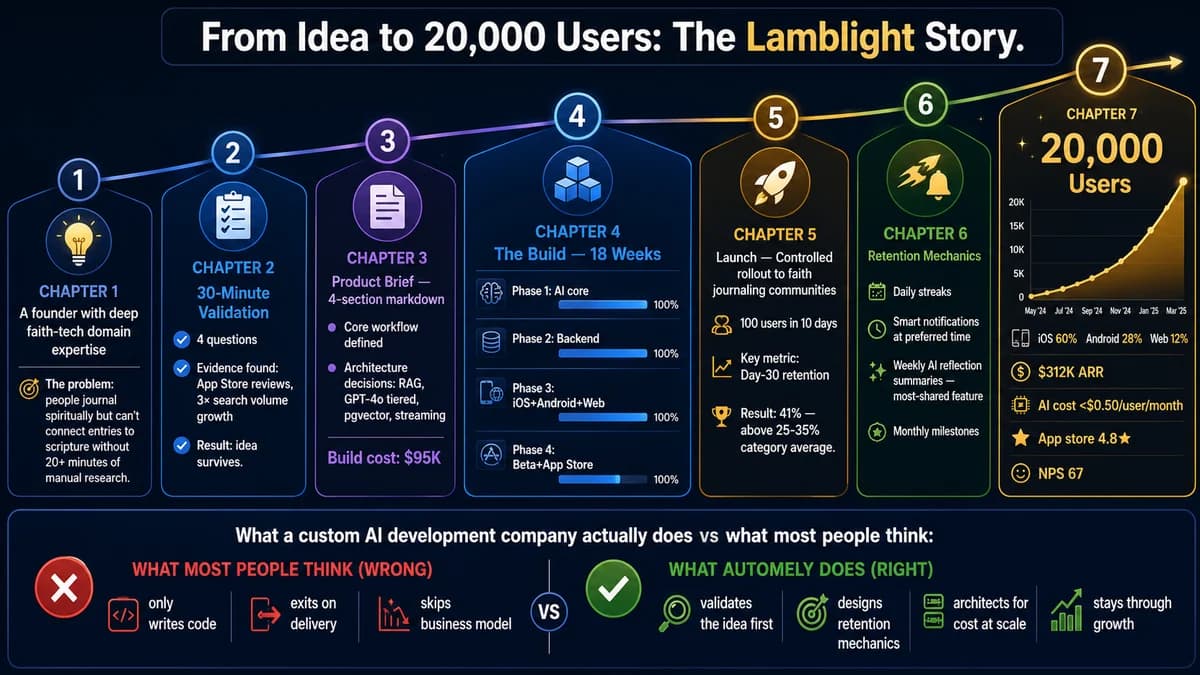
Most guides about building AI apps tell you what to do. They walk you through a stack of steps — define the problem, choose the tech, build an MVP, launch, iterate — and make it sound clean and linear. It is not. This is the story of Lamblight: a real product, a real client, and the complete journey from the first conversation about an idea to 20,000 users paying monthly for an AI journaling app. What follows is what working with a custom AI development company actually looks like — not the marketing version, but the real sequence of decisions, pivots, costs, and outcomes.
Chapter 1 — The Idea
The Lamblight founder came to us not with a technology idea but with a problem he had personally experienced. He journaled every morning as a spiritual practice. He wanted to connect what he was writing to relevant scripture — but finding the right passages for his specific entry took 20+ minutes of manual searching and cross-referencing. He had tried existing journaling apps. None of them offered AI that understood context and could surface passages that were genuinely relevant to what he was experiencing, not just keyword-matched.
The idea was clear: an app where you journal, and AI finds and reflects with you on the scriptures most relevant to what you just wrote. Not a chatbot. Not a generic Bible reader. A journaling experience where AI deepened the practice rather than replacing it. He knew the audience intimately — he was the audience. That is a better starting position than most consumer app ideas reach.
The critical question before our first conversation: is this a problem worth solving at scale, or is it a personal frustration? Domain expertise is valuable. But it can also make a founder overestimate the size of the audience for their specific use case. This question was answered before we discussed technology.
Chapter 2 — The 30-Minute Validation
The most important thing a custom AI development company does is not write code. It is ask the questions that most founders do not want to ask about their own idea — not to kill it, but to find out where it is strong and where it needs refinement. As the AI Product Builder Roadmap 2026 documents: "Most AI products fail at step zero. They start with a technology and go looking for a problem." Lamblight started with a problem. But we still needed to validate that the problem was worth solving before committing to a $95,000 build.
The 4-Question Validation Framework — Applied to Lamblight
Run before any product spec is written. If all four have evidence-backed answers, the idea is worth building.
Can you describe the problem in one observable, measurable sentence?
Not "people want better journaling apps." Something specific enough that you could walk into a coffee shop and find someone experiencing it today.
Is there evidence this problem exists at scale — not from the founder, but from data?
App Store reviews of existing solutions, search volume trends, forum discussions, or published research on the behaviour you are targeting.
Who specifically has this problem — described with enough precision to reach them?
"People interested in faith" is not a user. The more precisely you define the user, the easier the product, the marketing, and the distribution.
What do they do today — and is the workaround painful enough that they will pay to escape it?
If they do nothing, the pain is not bad enough. If they use a painful workaround, that is the market signal you need.
Lamblight passed all four questions with evidence-backed answers. The idea was worth a product spec. This is not always the outcome. We regularly tell founders after this exercise that their current hypothesis needs refinement — often one targeted pivot makes the validation picture much clearer. The 30-minute validation is the cheapest possible test. A $95,000 build is not.
Chapter 3 — The First Conversation with a Custom AI Development Company
Most founders who come to a custom AI development company for the first time expect the first conversation to be technical. Which AI model? What stack? How do we handle the data? These questions matter. But in the Lamblight discovery call, the first 20 minutes of a 60-minute session covered none of them. They covered: Who is the user, precisely? What is the core workflow — the 3-5 steps the user takes to get to value? What does the business model look like, and why?
The business model conversation is the one that most surprises founders. They come in with a product concept and expect us to get excited about the technology. We get excited about the business model because the business model determines the technology architecture. A freemium consumer app with $9.99/month tiers has completely different AI cost management requirements than a $99/month productivity tool. Getting this wrong at the architecture stage produces a product that works technically and fails economically.
For Lamblight, the business model decision — freemium with a limited free tier, $9.99 Standard, $19.99 Premium — was made before the tech spec was written. It directly shaped the tiered AI model routing strategy, the usage metering infrastructure, and the onboarding flow design. The development company that skips this conversation is setting up cost problems that surface at 10,000 users.
Have an AI consumer app idea and want to have this exact conversation — validation, business model, architecture, and realistic build timeline and cost? Automely provides this consultation free.
Free 45-minute product consultation. We validate your idea using the 4-question framework, propose the AI architecture, and give you a realistic build cost and timeline. No pressure, just the honest assessment.
Chapter 4 — The Product Brief and What It Contains
The AI product builder roadmap for 2026 makes a point that changes how most founders think about the brief: "You do not write a 20-page PRD in Google Docs. You write a product spec in markdown. A markdown spec is machine-readable. It can be fed directly into Claude or Cursor to generate functional code. A Google Doc cannot. The format of your spec determines the speed of your prototype. This is an architectural decision, not a style preference."
The Lamblight brief was a four-section markdown document covering: Problem and user — one paragraph from the validation exercise. Core workflow — five steps: user opens app and writes journal entry → AI classifies intent and emotional context → scripture retrieval returns relevant passages → AI generates personalised reflection prompt → user responds and saves. Technical architecture — which model (GPT-4o with tiered routing), retrieval strategy (RAG on scripture corpus, not fine-tuning), data structure, user isolation approach, cost model. Business model and subscription tiers — free, $9.99 standard, $19.99 premium, with specific AI usage limits per tier.
Critically: the brief explicitly listed what we were not building in Version 1. No social features. No community journaling. No video content. No AI-generated scripture commentary (beyond the reflective prompt). Scope discipline is the most underappreciated discipline in consumer AI app development. The features most founders want to add in the first version are the features that prevent the core AI experience from being excellent.
Gloriumtech's 2026 AI product guide identifies "scope creep" as the primary cause of timeline overruns in AI app development. Founders who insist on adding features before validating the core AI capability consistently extend timelines by 50-100%. For Lamblight: the "what we are not building in V1" list had 14 items on it. Every one of those 14 items has been requested by users since launch. Exactly 2 of them have been added, based on what the retention data showed mattered. The other 12 remain off the roadmap. Build the core AI experience with excellence. Let user data tell you what to add.
Chapter 5 — The Build: 18 Weeks from Brief to App Store
The build principle that differentiates an AI-first development company from a traditional agency: the AI capability is built, tested, and proven before the product shell is constructed around it. In traditional app development, the core product logic is built first and AI is added as a feature. In AI-native development, the AI is the product logic. Everything else serves it.
Phase 1 — AI Core
Scripture corpus prepared and embedded (semantic chunking, not token limits). Retrieval pipeline built and tested — 94% precision achieved before proceeding. GPT-4o tiered routing set up. Prompt design v1: temperature 0.1 for classification, 0.7 for reflection generation. Evaluation suite: 50 golden examples with expected outputs. No product code written until retrieval precision cleared the quality bar.
Phase 2 — Backend and AI Engine
Full AI journaling pipeline production build (classification → retrieval → personal context → generation → streaming). User authentication, tenant-isolated data architecture, subscription management (Stripe), usage metering per tier. LLM observability with Helicone for cost monitoring per user from day one. Admin dashboard for AI quality and cost tracking.
Phase 3 — Product Layer (overlapping)
iOS app (React Native) — daily journaling designed as a mobile-first habit. Android app. Web app (Next.js). Onboarding flow: user must complete their first AI-assisted journal entry within the first 3 minutes of downloading. Subscription tier management and payment flow. Streak mechanics and notification system built into core app.
Phase 4 — Beta, Polish, and App Store
Beta access to 50 users from the founder's network. Qualitative feedback collection. One significant UX change (onboarding reduced from 7 steps to 4 based on drop-off data). AI quality review on 200 real user entries. App Store submission — both iOS and Android. Launch ready at Week 18.
Lamblight Build Cost Breakdown — $95,000 Total
Chapter 6 — Launch and the Signal That Mattered Most
Launch was a controlled rollout, not a press release. The founder had an existing audience — a newsletter for faith-based journalers and connections in church small group communities. The initial distribution went to this audience specifically: people who were the exact user defined in the brief, who understood the concept immediately, and who had the strongest motivation to give genuine feedback rather than polite validation.
First 100 users arrived within 10 days. The metric we tracked obsessively in the first 30 days was not downloads and not revenue. It was Day-30 retention. For a consumer app built on a daily habit, the question that determines the entire business is simple: do users who come back on Day 3 also come back on Day 30? If they do, the product has the habit loop it needs to sustain word-of-mouth growth. If they do not, no amount of marketing fixes a broken retention mechanic.
Lamblight's Day-30 retention: 41%. Consumer app category average: 25-35% (DigitalOcean product lifecycle guide). The retention signal was strong enough to invest in growth. Without that signal, the right decision would have been to improve the core AI experience before spending on acquisition. This is the sequence that most consumer AI apps invert: they spend on acquisition before validating retention, then discover they are filling a leaky bucket.
Chapter 7 — The Retention Mechanics That Built the Business
For a consumer AI app, retention is the business model. Monthly subscription revenue requires users to see enough value every month to stay subscribed. For Lamblight, the retention mechanics were designed into the product from the brief — not added after launch. Each mechanic addressed a specific drop-off point in the user journey:
- Daily streaks: the most powerful habit mechanic in consumer apps. A user who has maintained a 14-day journaling streak has a powerful reason to open the app on Day 15. The streak is visible, personal, and loss-averse. Users who activated streaks in Week 1 had 3× higher 30-day retention than those who did not. This is why the onboarding flow is designed to create the first streak entry on Day 1 — not to show features, but to start the habit.
- Smart notifications: the push notification says "Your streak is at risk" not "Don't forget to journal." The difference is significant. Loss aversion beats reminder fatigue. Notifications fire at the user's historically preferred journaling time, not at a fixed schedule. A user who journals at 7 AM gets a 6:45 AM nudge, not a 10 AM one.
- Weekly reflection summaries: every Sunday, the AI generates a short summary of the user's week through their journal entries — the recurring themes, the emotional arc, and the scripture passages that appeared most often in their reflections. This became the most-shared feature within 60 days of launch. Users shared their weekly summaries with friends — who then downloaded the app. Retention mechanic became an acquisition mechanic.
- Monthly milestones: 30-day achievement unlocks a special reflection review — the AI synthesises the user's full month of journaling into a narrative reflection. 60-day, 90-day, and annual milestones follow. These milestone notifications have the highest open rate of any push notification Lamblight sends.
The most successful AI consumer apps in 2026 do not look like AI apps. Users do not want to stare at a blank chat box and figure out how to write the perfect prompt. They want a frictionless experience that delivers value without requiring them to think about the AI underneath it. Lamblight does not have a "Chat with AI" button. The AI is invisible — it appears as a reflection prompt that arrives naturally after the user finishes their entry. The product design hides the technology and shows only the value. This is the principle a good custom AI development company enforces in the product spec, before any code is written.
Chapter 8 — From 100 to 20,000 Users
The growth from 100 to 20,000 users was primarily organic — fuelled by the weekly reflection summary sharing mechanic and word-of-mouth within faith communities. The founder invested in three distribution channels that fit the audience: newsletter partnerships with faith-based content creators, church small group leaders sharing the app with their groups, and App Store optimisation that captured search intent from users already looking for scripture journaling solutions.
The infrastructure choices made in Phase 1 mattered at scale. Tiered model routing kept average monthly AI cost per active user under $0.50 — sustainable at $9.99/month subscription pricing. The evaluation suite caught two quality regressions when OpenAI updated its models, preventing them from reaching users. The pgvector index was optimised at 5,000 users and again at 15,000 users as query volume grew. None of these were rebuilds — they were adjustments to a system designed to scale from the start.
The Lamblight case study validates what articsledge's custom AI development research documents: organisations using AI development partnerships achieve a 67% project success rate versus 33% for internal-only builds. The average ROI on custom AI development is $3.70 per dollar invested. For Lamblight: $95,000 build cost, $312,000 ARR, 3.3× ROI within 12 months. The partnership model worked because the decisions at the start — problem validation, architecture, business model alignment, retention design — were right.
What a Custom AI Development Company Actually Does
Most founders who search for a custom AI development company are looking for someone to build the app. What they need is someone to make the app work — as a product, as a business, and as a sustainable technical system. These are different scopes of work.
What Founders Think They Are Hiring For
- Write the code for the app I have already designed
- Deliver a working product and exit
- Ask technical questions about the stack, not business questions about the model
- Build what the brief says without questioning scope
- Leave the retention mechanics, pricing, and growth to the founder
What a Good Custom AI Development Partner Delivers
- Validates the idea before writing a line of code — tells you if the hypothesis is worth $95,000
- Designs the retention mechanics into the brief — streaks, notifications, milestone features that determine 30-day retention
- Architects AI cost management from Week 1 — tiered routing, caching, usage tiers that determine unit economics at scale
- Questions scope discipline — builds a list of what is NOT in V1 before writing what is
- Stays engaged through the first growth phase — infrastructure optimisation, model quality monitoring, cost governance as users grow
The companies achieving the strongest returns on custom AI development invest in a partner who has done this before across multiple products and industries. Partnerships outperform solo builds significantly — 67% success rate versus 33% for internal-only development (articsledge research). The reason is institutional knowledge: a custom AI development company that has built twenty AI consumer apps brings pattern recognition about what works and what does not that no first-time founder can replicate. For the technical architecture that underpins this story, see our technical deep-dive on building Lamblight.
Have an AI consumer app idea and want to know if it passes the 4-question validation test, what the architecture would look like, and what the realistic build cost and timeline is for your specific concept?
Free 45-minute consultation. We apply the same process that took Lamblight from brief to $312K ARR — honest validation, architecture design, realistic cost estimate, and no fluff.