

The Agency Pricing Model Crisis — Why AI Creates a Revenue Problem Before It Creates a Revenue Opportunity
Here is the specific problem that no guide to AI for marketing agencies will tell you: when AI compresses the time required to produce a deliverable, agencies that continue billing by the hour destroy their own margins faster than any competitor could. A social media content package that previously required 40 hours of team time — briefing, research, copy, design iterations, approval rounds, scheduling — now requires 8 hours with AI assistance at the same quality level. If the agency still bills at $150 per hour, revenue drops from $6,000 to $1,200 per client per month for the same deliverable.
This is the operational reality that 23% of agencies who reduced junior copywriting headcount in 2025 are navigating — and getting wrong. Cutting headcount while keeping hourly billing transfers AI efficiency savings to the client, not to the agency. The agencies winning in 2026 made a different move: they restructured from hourly billing to value-based pricing first, then automated the delivery. The AI efficiency gain flows to agency margin — because the price is set by the value of the outcome, not the hours of production.
❌ Hourly Billing + AI (Margin Destruction)
✓ Value-Based Pricing + AI (Margin Expansion)
The 6 AI Automation Systems for Marketing Agencies
AI Content Production at Scale
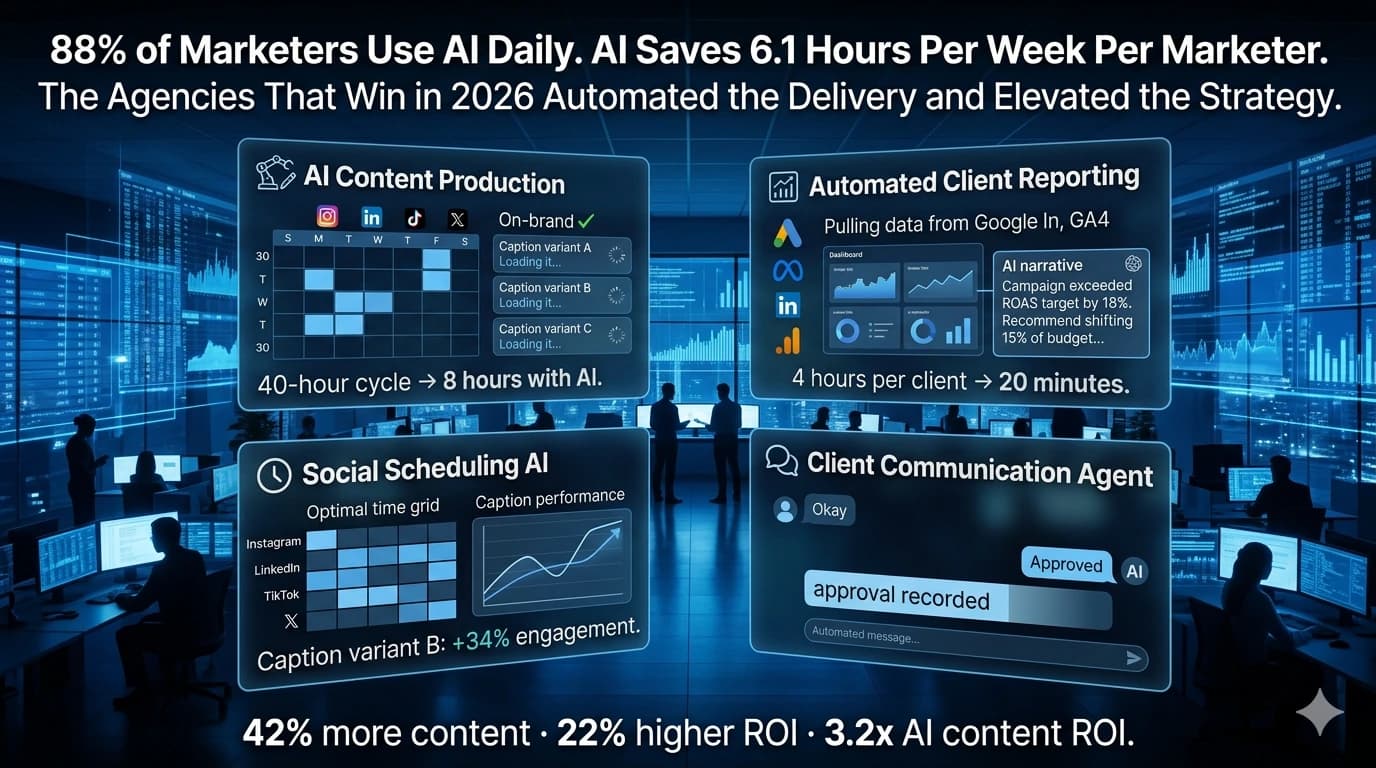
Content production is where AI delivers its largest time return for marketing agencies. An AI content production system trained on a client's brand guidelines, tone of voice, approved messaging, and audience personas generates first-draft social media captions, blog outlines and drafts, email sequences, ad copy variants, and video scripts from a brief — compressing the production phase from days to hours. Companies using AI publish 42% more content per month; 84% of marketers report AI improved the speed of content delivery.
The key design requirement is brand training, not generic prompting. An AI content system that generates from a blank context produces generic, on-brand-for-nobody output. An AI system trained on a client's existing top-performing content, brand voice documentation, competitor differentiation, and approved phrasing produces drafts that require editing, not rewriting. The agency retains full editorial control and human brand judgment — the AI eliminates the blank-page production overhead.
- Social media captions — 3–5 variants per post across platform-specific tone and format
- Blog drafts — structured outline to 1,500-word draft from keyword and brief
- Email sequences — welcome series, nurture sequences, campaign emails from campaign brief
- Ad copy variants — multiple headline/body combinations for A/B testing
- Video scripts — short-form (Reels/TikTok) and long-form (YouTube) from topic brief
- Content repurposing — blog post to 10 social posts to 3 email sections automatically
Automated Performance Reporting
Performance reporting is the highest-volume non-creative administrative task in most marketing agencies. An analyst might spend four hours per client per week pulling data from Google Analytics 4, Meta Ads Manager, Google Ads, LinkedIn Campaign Manager, and other platforms into a spreadsheet, calculating key metrics, and writing a narrative summary. Across a portfolio of 20 clients, this consumes 80+ hours of analyst time weekly — before a single insight has been generated or a single recommendation made. AI reporting agents eliminate the data assembly component entirely.
An AI reporting system connects to all data sources via API, pulls the configured metrics on a defined schedule, calculates ROAS, CPA, CTR, conversion rates, and budget pacing automatically, compares performance against targets and prior periods, generates a narrative interpretation (what improved, what declined, what to optimise, and why), formats the output to the agency's report template, and delivers it to the account manager for 20-minute review and client presentation. The account manager reviews and personalises rather than builds.
- Google Analytics 4 — traffic, conversions, revenue, channel attribution
- Google Ads — spend, impressions, clicks, conversions, ROAS, Quality Score
- Meta Ads Manager — reach, frequency, CPM, CTR, ROAS by campaign and ad set
- LinkedIn Campaign Manager — impressions, engagement, leads, CPL
- HubSpot / Salesforce — pipeline contribution, MQLs, conversion rates
- Search Console — organic impressions, clicks, average position, indexing status
Social Media Scheduling and Optimisation
Social media scheduling AI goes beyond publishing queues. It analyses historical engagement data for each client's audience across each platform — identifying optimal posting times by day and hour, content format preferences (video vs carousel vs static, long caption vs short), and the hashtag and mention patterns that correlate with higher reach. This analysis informs a publishing schedule that maximises organic reach for each piece of content without requiring manual research per client per platform.
A/B testing automation runs parallel caption and creative variants automatically — posting the same content with two different caption approaches to split audiences, measuring engagement difference within 24 hours, and surfacing the winner for full distribution. Over time, this creates a self-improving content performance model for each client: the AI learns which content angles, formats, and posting patterns drive the best results for that specific audience, informing the next content cycle's creative direction. AI-enhanced campaign personalisation consistently improves conversion rates by up to 20% across documented implementations.
- Optimal posting time identification by platform and audience segment
- Platform-specific content reformatting — Instagram square, LinkedIn landscape, TikTok vertical
- Automated A/B caption testing with winner identification and full distribution
- Hashtag research and performance tracking by tag and topic cluster
- Engagement monitoring and flagging — comments requiring human response identified
- Content performance weekly summary feeding back into next cycle's content brief
Client Communication Automation
Client communication is the operational administrative overhead that consumes a disproportionate share of account manager time without directly producing client value: weekly status update emails, approval reminder chasers, meeting summary write-ups, response to routine "what's the status on X?" queries, and project milestone notifications. These communications are largely templated — the content varies by client and project, but the format, timing, and trigger conditions are consistent enough for AI automation to handle the generation with human review.
An AI client communication agent monitors project status across the agency's project management system, generates weekly status update emails for account manager review, sends approval reminder chasers when deliverables have been awaiting client sign-off for more than a defined window, records and distributes AI-generated meeting summaries within an hour of a meeting concluding, and responds to routine client queries from the agency's knowledge base. Account managers review and send — they do not draft from scratch. At 5–10 hours recovered per account manager per week, a 10-person account management team recovers 50–100 hours weekly for client-facing strategic work.
- Weekly status update emails — project progress, upcoming deliverables, open items
- Approval reminder sequences — escalating reminders for pending client sign-offs
- Meeting summaries — action items, decisions, and owners distributed within 60 minutes
- Routine query responses — brief status answers from project management data
- Onboarding communication sequences — new client welcome and kickoff coordination
- Campaign launch notifications — automatically triggered when campaigns go live
Campaign Analytics and Attribution
Campaign analytics AI moves beyond reporting (what happened) to optimisation (what to do differently). AI multi-touch attribution models analyse the full customer journey across channels — identifying which touchpoints are genuinely driving conversions versus which receive last-click credit without contributing to the decision. AI bid management continuously adjusts keyword bids, audience targeting, and creative rotation based on real-time performance signals. AI-driven PPC bid management reduces wasted ad spend by approximately 37% and increases ad ROI by roughly 50% compared to manual or rules-based bid management.
Anomaly detection AI monitors campaign performance in real time and alerts the account team when metrics deviate significantly from expected patterns — a sudden CPM spike, an unusual drop in conversion rate, a creative that is underperforming compared to its historical baseline. These alerts surface issues in hours rather than days, when intervention can prevent budget waste rather than document it retrospectively in the end-of-month report.
- Multi-touch attribution — true path-to-conversion visibility across channels
- AI budget pacing — spend rate monitoring with auto-alerts for over/underpacing
- Creative performance scoring — ranking ad creative by conversion efficiency not just CTR
- Audience overlap detection — identifying and eliminating cannibalising audience segments
- Anomaly alerts — real-time flags for performance deviations requiring human review
- Optimisation recommendations — specific, data-supported actions ranked by projected impact
New Business and Proposal Automation
New business proposal development consumes significant senior time at most agencies — research, competitive positioning, case study selection, pricing rationale, and proposal document assembly. AI new business agents trained on the agency's case study library, service descriptions, pricing frameworks, and competitive positioning can generate first-draft proposal sections, RFP response answers, competitive analyses, and relevant case study selections in hours rather than days. The senior team reviews, personalises, and adds the strategic narrative — they do not build the document from a blank page.
Competitor monitoring AI continuously tracks competitor positioning, new service announcements, campaign launches, and content strategy changes — surfacing weekly briefings that feed both new business competitive analysis and ongoing client strategy. This intelligence, previously requiring dedicated research time, becomes automatic background intelligence that keeps account and new business teams informed without consuming their day.
- Proposal section drafts — agency overview, approach, methodology, team bios
- RFP question responses from agency knowledge base and service documentation
- Relevant case study selection and summary from results library
- Competitive positioning analysis for prospect's category and competitors
- Pricing model rationale and ROI projection from historical client data
- Weekly competitor intelligence briefing — new campaigns, messaging shifts, hiring signals
Which of these 6 systems recovers the most hours — and margin — at your agency?
Automely's agency AI consultation identifies your highest-ROI first automation, scopes the pricing model transition, and builds the business case. Free 45-minute call.
Where the Time Goes Back — The Agency Time Recovery Stack
AI saves the average marketer 6.1 hours per week (HubSpot AI Trends 2026), with senior practitioners recovering 8–10 hours and junior staff 3–4 hours. The time recovery is not evenly distributed — it concentrates in the workflows with the highest administrative-to-judgment ratio. The table below shows the specific before/after for the tasks where AI recovery is largest and most measurable.
| Task | Manual Time | With AI | Recovered |
|---|---|---|---|
| Client performance report (per client/week) | 3–4 hours | 20–30 min | ~3 hrs |
| Monthly social media content production (30 posts) | 15–20 hours | 4–6 hours | ~13 hrs |
| Email campaign copy (5-email sequence) | 6–8 hours | 1–2 hours | ~6 hrs |
| Client status update emails (weekly) | 30–45 min | 5–10 min | ~30 min |
| Meeting summary and action items | 30–45 min | 5 min review | ~35 min |
| Ad copy variants (10 headlines + 5 descriptions) | 2–3 hours | 30 min | ~2 hrs |
| New business proposal (standard sections) | 8–12 hours | 2–3 hours | ~8 hrs |
| Competitor research briefing (monthly) | 3–4 hours | Automated | ~4 hrs |
Across a typical 10-person agency team — account managers, content producers, paid media analysts — recovering 6 hours per person per week returns 60 hours weekly to the agency. At $150 blended hourly rate, that is $9,000 in weekly capacity recovered without hiring. At the agency's value-based pricing, each recovered hour can be redeployed toward more clients, more strategic work, or a better quality standard on existing client deliverables. The choice of how to redeploy recovered capacity is the strategic decision AI cannot make — and the most important one agency leaders face in 2026.
AI in Social Media — Specifically
Social media is the highest-frequency content delivery channel in most agency client portfolios and the one where AI creates the most immediate and measurable capacity return. The specific AI applications that are commercially mature for social media in 2026:
AI Caption and Copy Generation
AI generates platform-specific captions from a single content brief — longer, value-forward copy for LinkedIn; punchy, conversational copy for Instagram; trend-aligned text with hooks for TikTok; concise with context for X. The same brand asset produces five platform-specific variations in minutes. The creative director reviews for brand voice and tone compliance; they do not write five captions from scratch. Content creation is cited as the most popular AI use case by 55% of marketers in HubSpot's 2026 State of AI report, with only 7% publishing AI-generated content without any editing — the AI-first, human-edited workflow is the standard practice, not the exception.
AI Visual Generation and Creative Iteration
Approximately 75% of marketers now use AI for video and image creation (Typeface, 2026). AI image generation (Midjourney, DALL-E, Adobe Firefly) produces social graphic variations at scale — generating multiple visual treatments of the same campaign concept for A/B testing without the cost of producing each at full creative cost. Video AI tools (Runway, Kling) generate short-form social video from scripts and brand assets. The creative boundary remains with human art direction — the AI executes visual variations within the creative direction, not instead of it.
AI Social Listening and Trend Intelligence
Social listening AI monitors brand mentions, competitor activity, and emerging trend signals across platforms in real time — identifying opportunities for reactive content (joining a relevant conversation before the moment passes) and risks (early warning of brand sentiment shifts). 31% of marketers already use social listening specifically to analyse cultural trends and guide campaigns toward micro-viral opportunities. At the agency level, AI social listening turns this from a time-intensive manual monitoring task to an automated background intelligence feed that surfaces relevant signals for human editorial judgment.
AI Influencer Identification and Analysis
For agencies managing influencer campaigns, AI identifies influencers by audience match, engagement rate, and fraud detection with 27% higher selection accuracy than manual methods. AI predicts influencer performance outcomes with up to 85% accuracy based on historical campaign data from comparable collaborations — improving pre-campaign planning and client expectation setting. AI content tools automate influencer post caption drafts and video edit briefs, speeding up campaign production by up to 60%.
What Stays Human in AI-Powered Marketing Agencies
The most important — and most widely ignored — question in agency AI discussions is not what AI can do. It is what AI cannot replace, and why those are precisely the capabilities that clients pay premium fees for. Agencies that understand this build their AI automation strategy around amplifying human strengths, not replacing them.
Creative Strategy and Big Ideas
The insight that a brand should pivot from product-focused to community-focused content. The campaign concept that reframes the category and creates a new conversation. The creative direction that differentiates from every competitor doing the same thing. These require cultural intelligence, strategic pattern recognition, and the kind of lateral creative thinking that AI can assist but cannot originate. The big idea remains human. AI executes it at scale.
Client Relationships and Trust
The relationship between an account lead and a client CMO is built on accumulated trust: honest conversations about what is working and what is not, the confidence that comes from human accountability, and the personal dynamic that makes clients willing to follow recommendations even when they are difficult. AI automates the status update. It cannot replace the relationship that makes the client believe the status update.
Brand Voice and Cultural Judgment
Detecting that a piece of AI-generated content is tonally slightly off for a conservative B2B brand. Knowing that a particular trend moment is too culturally charged for the client to join. Judging that the AI-generated caption is technically on-brief but lacks the warmth that makes this brand's content feel distinctive. These micro-judgments happen continuously in content review and require the cultural intelligence and brand internalization that human editors develop through deep familiarity — not pattern matching against a style guide.
New Business Chemistry and Pitch Performance
AI can draft the proposal sections. It cannot deliver the presentation that wins the pitch — the credibility, the vision articulation, the intuitive reading of what the prospect needs to hear, and the confidence that comes from a track record of work. New business wins on human credibility, not document quality.
Crisis Communication and Sensitive Situations
When a client faces a reputational moment — a negative viral post, a product recall, a controversial public figure association — the decision about how the brand responds requires human judgment about values, risk tolerance, audience relationships, and long-term brand equity. Automated responses to crisis moments are one of the highest-risk applications of AI in marketing. These moments require the human counsel that clients pay for and that no AI system should be making independently.
The agencies winning in 2026 are not the ones that automated everything. They are the ones that automated the production layer so thoroughly that their senior team now spends proportionally more time on the work clients actually pay premium rates for: strategy, relationships, creative direction, and the judgment calls that AI cannot make. The pitch is not "we use AI." It is "because we use AI for delivery, our strategists spend their time on your strategy rather than your spreadsheets."
Implementation Sequence — Building an AI-First Agency Operation
Audit where team time currently goes before automating anything
For one week, have every team member log their time at the task level — not "account management" but "writing client status email," "pulling GA4 data," "reformatting content for Instagram," "chasing approvals." The aggregate time log reveals the highest-volume, most repetitive tasks that are the best AI automation candidates. Gut feel about where time goes is usually wrong; the time log is usually surprising. Automate what the data shows, not what you assume.
Restructure pricing before deploying AI at scale
The pricing model conversation must happen before AI compresses delivery time, not after. Identify which service lines are currently priced by the hour and which have a plausible value-based alternative. Transition one service line to value-based pricing as a pilot — monthly retainer for defined outcomes rather than defined hours. Measure margin change. Use documented margin improvement to justify and fund AI tooling investment. The pricing restructure funds the AI investment, and the AI investment makes the pricing restructure sustainable.
Deploy reporting automation first — it has the fastest payback and the least brand risk
Automated reporting is the lowest-brand-risk, highest-time-return first AI deployment for most agencies. The data is structured, the output is internal (account manager review before client delivery), and the time recovery is immediate and measurable. Connect your three highest-time reporting clients to an automated reporting tool in week one. Measure hours recovered. Use the recovery evidence to fund the next implementation (content production AI, which has higher brand risk and requires more careful training and review workflow design).
Build client-specific content AI — not a generic tool subscription
Generic AI writing tools produce generic content. Client-specific AI content systems — trained on each client's top-performing content, brand guidelines, approved messaging, audience personas, and competitor differentiation — produce client-specific drafts. The investment in brand training for each client takes 2–4 hours upfront and produces a content system that improves with each approved piece. The training investment is what separates AI content that requires 15-minute editing from AI content that requires 2-hour rewriting.
Define explicit AI governance — what requires human approval before delivery
Every piece of client-facing content generated by AI must pass through defined human review before delivery. Define this explicitly: who reviews what, at what stage, using what checklist. Crisis communications, sensitive topic content, and new campaign launches require senior human review regardless of AI confidence. Routine status updates and performance metrics require lighter review. Documented AI governance is increasingly what sophisticated clients ask about — having an answer builds rather than reduces trust.
Building Agency AI with Automely
Automely's AI agent development, generative AI development, and AI integration services cover the full stack of marketing agency AI implementation — client-specific content production pipelines trained on brand guidelines and style guides, automated reporting systems connected to GA4, Meta, Google Ads, and LinkedIn, client communication agents for status updates and approval workflows, social media scheduling and A/B testing optimisation, campaign analytics and anomaly detection, and new business proposal automation.
Our agency AI implementations start with the time audit and pricing model conversation — because the technical capability of AI is not the constraint. The constraint is building the governance and pricing structures that ensure AI efficiency gains flow to agency margin rather than eroding revenue. We have built AI-powered content and reporting systems for marketing agencies and understand both the technical requirements and the commercial model considerations that determine whether agency AI creates value or destroys it.
Browse our case studies, explore our full AI services portfolio including AI chatbot development for client-facing conversational agents, and see our customer support automation guide for the client communication automation parallel. For agencies building their own AI-powered SaaS products, our SaaS development service covers product engineering from concept to production.
Ready to recover 60 hours per week of team capacity and restructure your pricing model to capture the margin?
Book a free 45-minute agency AI consultation. We will run the time audit, scope the first automation, and map the pricing transition — before any development commitment.