


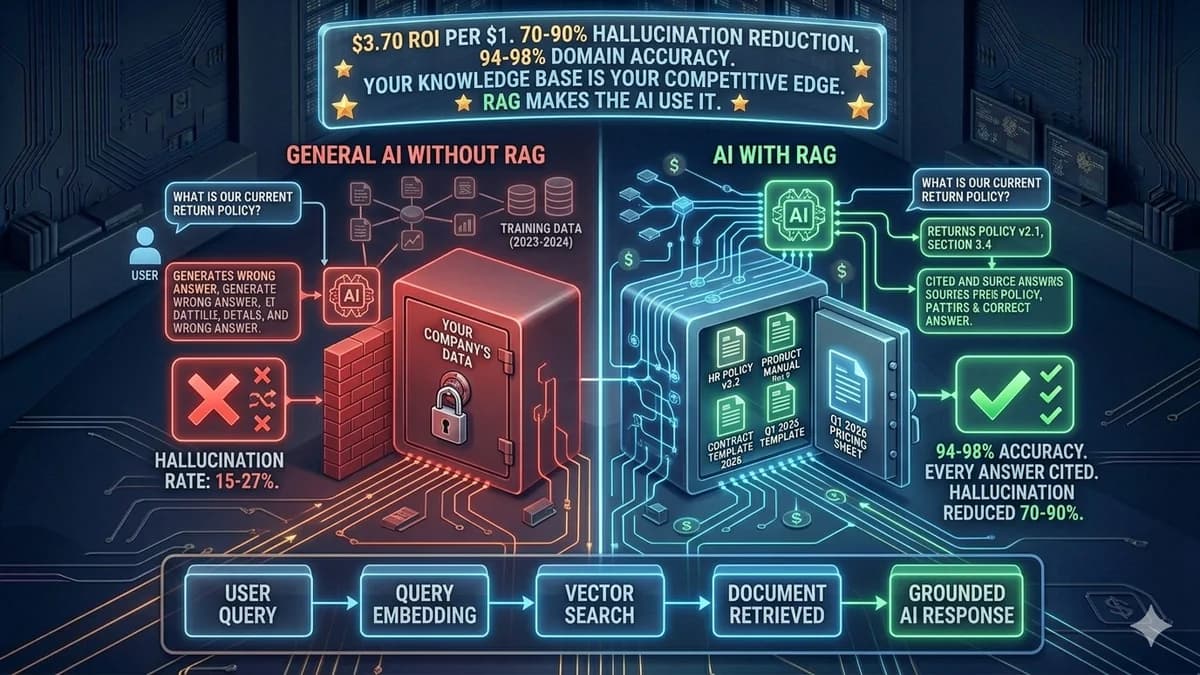
The Problem: Your Business Has Valuable Knowledge That General AI Cannot Access
Your company has accumulated knowledge over years of operation: policy documents, product manuals, support ticket history, contracts, regulatory interpretations, pricing guides, internal wikis, and the proprietary processes that differentiate how you serve customers. This knowledge is one of your most valuable business assets. It represents the accumulated decisions, expertise, and institutional memory of your organisation.
When you deploy a general-purpose AI — ChatGPT, Claude, Gemini, or any other — it cannot access any of it. The AI has been trained on data up to a certain date. Its knowledge is frozen. Your company's specific policies, product updates, pricing changes, and internal procedures are invisible to it. When a customer asks about your current return policy, or an employee asks about the updated remote work policy, or a compliance officer asks about the latest regulatory interpretation, the AI generates a statistically plausible answer based on generic training data. That answer may be confidently wrong in ways that create real business risk.
This is the gap that RAG (Retrieval-Augmented Generation) closes. It is not the only solution for this problem, and this guide will explain when it is the right one and when it is not. But for most businesses with domain-specific knowledge that changes over time — which is most businesses — RAG is the generative AI architecture that makes AI genuinely useful, rather than a liability that someone has to check behind.
What Is a RAG System? The Plain-English Definition
RAG stands for Retrieval-Augmented Generation. The name describes exactly what it does: it retrieves relevant information from an external knowledge source, then uses that retrieved information to augment the AI's generation — ensuring the AI answers from your documents rather than from generic training memory.
Here is the simplest way to understand it: imagine a research assistant who can read thousands of documents but has no memory of them the next day. Every time you ask a question, the assistant pulls out the relevant document, reads the specific section that answers your question, and gives you an answer with a direct citation to where they found it. They are not working from memory — they are working from the document in front of them. That is what a RAG system does. The AI retrieves the relevant section from your knowledge base, then generates a response grounded in that specific retrieved content.
Without RAG, the same research assistant would answer from memory — which might be accurate for general knowledge but will be wrong, outdated, or generic for anything specific to your organisation, your products, your policies, or your current regulatory environment. The difference between "the AI said so" and "the AI cited our policy document section 4.2" is the difference between a compliance risk and an audit trail. In regulated industries — financial services, healthcare, legal — that distinction is not optional.
How RAG Works — The 5-Step Pipeline Without the Jargon
Every production RAG system, regardless of vendor or stack, follows the same five-step pipeline. Each step has a specific job in the chain from raw document to grounded, cited answer — and understanding the pipeline is what lets you reason about cost, accuracy, and failure modes when you scope your own implementation.
Document Ingestion — Your Knowledge Base Goes In
Your documents are fed into the system — PDFs, Word files, web pages, wiki articles, support tickets, product manuals, policy documents. The system splits each document into manageable chunks (paragraphs or sections), ready for processing.
Embedding — Documents Become Searchable by Meaning
Each chunk is converted into a numerical vector — a long list of numbers that captures its semantic meaning. This is done by an embedding model. The key property: documents about similar topics have numerically similar vectors, enabling search by meaning rather than by keyword. "Customer complaint about delivery" finds relevant content even if the document says "shipment dispute" or "order issue."
Vector Storage — A Searchable Knowledge Index
All these embeddings are stored in a vector database — a purpose-built database optimised for similarity search. Think of it as a searchable index of your entire knowledge base, organised by meaning rather than keywords. Popular options include Pinecone, Weaviate, and pgvector (which runs inside regular PostgreSQL). No special infrastructure required.
Query Processing — The User's Question Finds the Right Document
When a user asks a question, that question is also converted into an embedding. The vector database then finds the chunks from your knowledge base that are most semantically similar — the most relevant documents for answering this specific question. This step takes milliseconds. The retrieved chunks are the evidence the AI will use to generate its response.
Grounded Generation — The AI Answers From Your Documents
The retrieved chunks are injected into the AI prompt as context — "Here are the relevant sections from our knowledge base. Answer the user's question using only this information." The AI generates a response grounded in the specific retrieved documents, typically with a citation to the source section. It cannot answer from training memory — it is instructed to answer only from what was retrieved. This is what drops hallucination rates from 15-27% to 1-5%.
One of RAG's most important properties for business: when your policies, products, pricing, or regulations change, you update the knowledge base — not the AI model. Adding a new document or updating an existing one takes minutes. The AI immediately answers from the updated content without any retraining, fine-tuning, or model update. This is why RAG is significantly more cost-effective than fine-tuning for knowledge that changes — because information change is a data pipeline operation, not an ML engineering project.
The Hallucination Numbers — Why This Matters for Your Business
Hallucination is the specific term for when an AI generates a response that is plausible-sounding but factually incorrect. The AI does not know it is wrong — it generates the most statistically likely continuation of text, and sometimes that statistically likely text is factually false. For general knowledge questions ("what year was the Eiffel Tower built?"), hallucination rates are low because there is abundant training data. For domain-specific questions about your organisation, products, policies, and regulations, hallucination rates are far higher — because the AI has no accurate training data for your specific context.
❌ General AI Without RAG
Hallucination rate for domain-specific business questions. Enterprise average ~18%. Generates answers from general training data. Every incorrect answer is a potential business, compliance, or trust risk.
✓ RAG-Grounded AI
Hallucination rate with RAG. Generates only from retrieved, verified documents. 70-90% reduction from baseline. 94-98% domain-specific accuracy (Gartner 2025). Every response cites its source.
The business implications are not abstract. A financial services company whose AI chatbot confidently cites a regulatory requirement that does not exist creates compliance exposure. A legal team whose AI invents a case citation that does not exist creates professional liability. A customer service chatbot that quotes a return policy that was updated six months ago creates disputes, escalations, and customer trust damage. In all three cases, the cost of catching the AI error after it reaches a customer or a regulator significantly exceeds the cost of implementing RAG correctly from the start.
Gartner's 2026 enterprise AI adoption data identifies hallucination risk as the primary barrier to moving AI deployments from pilot to production at scale. RAG directly addresses this barrier by replacing AI approximation with AI citation — making AI outputs verifiable, auditable, and trustworthy enough for production use in business-critical workflows.
Is your business AI grounded in your proprietary data — or generating from general training knowledge?
Automely's generative AI development services include RAG system design and implementation. Free 45-minute assessment.
The 3-Question Test — Does Your Business Need a RAG System?
RAG is not the right architecture for every generative AI application. It adds complexity that is not always justified. The following three questions separate business contexts where RAG delivers meaningful value from those where it adds cost without proportionate benefit.
Does your business have proprietary knowledge that general-purpose AI does not have access to?
Internal HR policies, product specifications, pricing guides, support documentation, regulatory interpretations specific to your jurisdiction, customer records, contract templates, and internal processes are all examples of proprietary knowledge that no general-purpose AI has access to. If your users are asking questions that require answers from this knowledge — and in most business AI applications they are — any AI without RAG will answer with guesses, not facts. If yes to this question, RAG is worth considering.
Are the consequences of an AI hallucination significant in your context?
For a creative writing tool, a hallucination is a minor inconvenience. For a compliance AI in a regulated industry, a hallucination can trigger a regulatory finding. For a customer service chatbot that quotes the wrong return policy, a hallucination generates a dispute and damages trust. For a legal research assistant that invents a case citation, a hallucination creates professional liability. The higher the stakes of a wrong answer, the more critical the case for RAG becomes. If the consequences of hallucination in your context are materially significant — financial, legal, compliance, or reputational — RAG is the architecture that makes deployment responsible.
Does your relevant information change frequently enough that model retraining would be prohibitively expensive?
If you updated your return policy this morning and want the AI chatbot to answer correctly about it this afternoon, you cannot fine-tune a model fast enough (or cheaply enough) to keep pace. If your pricing changes quarterly, your product catalogue expands monthly, or regulatory requirements update continuously, the model fine-tuning cycle is too slow and too expensive. RAG allows you to update the knowledge base as a data operation — add the new document, and the AI answers from it immediately. If yes to this question, RAG is significantly more cost-efficient than fine-tuning for maintaining accuracy over time.
Enterprises are currently choosing RAG for 30-60% of their generative AI use cases — specifically the cases that require high accuracy on proprietary knowledge, explainability and citation, and frequent knowledge updates. The use cases that benefit less from RAG: creative content generation, general market research, and tasks where the user provides all the required context in the prompt. The distinction is not about AI capability — it is about whether the task requires knowledge from a specific, proprietary, updatable source.
Business Use Cases With Verified ROI
The six use cases below are where RAG most consistently delivers measurable business outcomes in production deployments — customer service, internal knowledge, legal research, compliance monitoring, technical support, and sales enablement. Each card pairs the use case with the ROI numbers documented in the field.
🤝 Customer Service Knowledge Base
Customer-facing AI that answers questions about products, policies, returns, and account status from verified, current documentation — not from generic AI knowledge. RAG-powered chatbots achieve 94-98% accuracy on domain-specific questions vs 73-85% for general AI.
👤 Internal Employee Knowledge Assistant
Employees asking questions about HR policies, IT procedures, benefits, onboarding processes, and company guidelines get accurate, cited answers in seconds — rather than searching SharePoint or Confluence for 20 minutes.
⚖️ Legal Research and Contract Review
Legal teams retrieving relevant precedents, contract clauses, and regulatory sections before summarising, comparing, or advising. Documented case: $34K RAG implementation reduced legal research from 12-15 hours/week to under 2 hours — payback in 4 months.
📋 Compliance Monitoring
Regulatory AI that cites specific clause and document references — creating the audit trail that compliance teams and regulators require. "The AI said so" is not acceptable. "The AI cited Policy Document v4.2, Section 3" is an audit trail.
🔧 Technical Support Documentation
Support agents or customer-facing AI answering product questions from verified technical documentation. Eliminates incorrect answers that create returns, complaints, and repeated support contacts.
💰 Sales and Product Information
Sales teams or customers asking about product specifications, pricing, availability, and compatibility get answers sourced from current product documentation — not from outdated training data or inconsistent sales collateral.
RAG vs Fine-Tuning — When to Use Which
Fine-tuning involves retraining the AI model on your specific data, permanently embedding that knowledge into the model's parameters. It produces an AI that has deeply internalised your domain knowledge — responses feel fluent and natural for domain-specific content. RAG connects the AI to an external knowledge base at query time without changing the model. Understanding which to use depends on your specific knowledge characteristics and update frequency.
✓ RAG — Choose When
Fine-Tuning — Choose When
For most enterprise knowledge base use cases — policies, products, support documentation, regulatory requirements — RAG is the right choice because the information changes frequently enough that model retraining would be prohibitively expensive. Fine-tuning is more appropriate when you want the AI to adopt a specific writing style, generate content in your brand voice, or perform a narrow, well-defined task where the knowledge is stable and the quality of generation fluency matters more than citation accuracy. Many production systems combine both: RAG for factual knowledge retrieval and citation, fine-tuning for generating outputs in the organisation's specific style and format.
What RAG Implementation Looks Like — Costs, Timeline, and What You Get
Based on 89 documented production RAG deployments, implementation costs range from $8,000 to $45,000 depending on document volume, use case complexity, integration requirements, and the number of data sources. The timeline from project start to production deployment is typically 3-8 weeks.
Knowledge Base Audit and Architecture Design (Week 1-2)
Mapping all knowledge sources (where documents live, what formats, how frequently they update), defining the document structure that enables effective retrieval, identifying access control requirements (who should be able to retrieve what), and designing the chunking and embedding strategy for the specific content types. This is the most consequential design step — the quality of retrieval depends on the quality of the knowledge base architecture.
Document Ingestion Pipeline and Vector Database Setup (Week 2-4)
Building the automated pipeline that ingests documents from source systems (SharePoint, Google Drive, Confluence, S3, or direct upload), processes them into chunks, generates embeddings, and stores them in the vector database. The vector database (Pinecone, Weaviate, or pgvector) is configured with access controls so users only retrieve documents they are authorised to see.
LLM Integration and Prompt Engineering (Week 3-5)
Connecting the vector database retrieval to the LLM generation layer, engineering the prompt that instructs the AI to answer only from retrieved context and cite sources, testing retrieval accuracy across representative queries, and tuning the retrieval parameters (how many documents to retrieve, minimum relevance threshold) for the specific use case.
Interface and Integration (Week 4-7)
Building the user-facing interface — web chat, Slack bot, API endpoint, or in-product chatbot — and integrating with existing systems (CRM, helpdesk, HR platform, compliance tools). Most RAG deployments connect to at least one existing business system for context (user authentication, ticket creation, conversation history).
Quality Monitoring and Knowledge Maintenance Setup (Week 6-8)
Defining the hallucination and retrieval quality baseline metrics, setting up monitoring for response quality, and building the knowledge base maintenance workflow — the scheduled review process that ensures documents stay current, outdated content is removed, and new content is added as it is created. A RAG system is only as accurate as the knowledge base it retrieves from; the maintenance process is what keeps it accurate over time.
An AI assistant grounded in your specific, current, organisational knowledge. Every response cites the source document and section. Users can verify answers against the original document. The knowledge base can be updated without changing the AI model — new policies, updated products, revised regulations become available to the AI within minutes of upload. Access controls ensure each user only accesses documents they are authorised to see. Hallucination monitoring alerts when response quality falls below baseline. And an ongoing cost of $50-$500/month for vector database hosting plus LLM API usage — significantly less than the cost of a single compliance incident from an ungrounded AI.
Building RAG Systems with Automely
Automely's generative AI development services include RAG system design and implementation — document ingestion pipelines, vector database setup, embedding model selection, retrieval architecture, LLM integration, and the interface layer. Our AI agent development service extends RAG systems into agentic workflows: agents that retrieve from the knowledge base, take actions based on what they retrieve, and return verified, cited results.
Every Automely RAG implementation starts with the knowledge base audit — because retrieval quality is the primary determinant of output quality, and the quality of the retrieval depends on the quality of the knowledge base architecture. We have seen enough RAG systems fail at scale to know that the ingestion and architecture work is not the "boring prerequisite" — it is the engineering that determines whether the system actually works in production.
The most relevant production reference: our AI chatbot solutions guide covers RAG-grounded customer service AI in production detail — the same architecture that powers a customer service chatbot applies to any business knowledge assistant. For the enterprise deployment context, see our enterprise AI solutions guide. For the SaaS product context — adding a RAG-grounded AI feature to an existing product — see our SaaS AI development guide.
Automely builds production RAG systems — vector database integration, embedding pipelines, hybrid retrieval, hallucination prevention, knowledge base chatbots, semantic search APIs. RAG projects start from $15,000. Book a free 45-minute consultation at cal.com/Automely.ai/45min.
Browse our case studies, read client testimonials, and explore our full AI services portfolio including AI integration services. For the end-to-end engineering playbook, see our RAG system build guide. For the orchestration layer above RAG, see our AI agent framework comparison. For the broader generative AI rollout context, see our generative AI roadmap.
Ready to connect your business knowledge base to AI — with citations, access controls, and quality monitoring built in from the start?
Book a free 45-minute RAG assessment. We audit your knowledge sources, scope the architecture, and estimate the implementation cost and timeline.