


What Multimodal AI Is — The Plain-English Definition
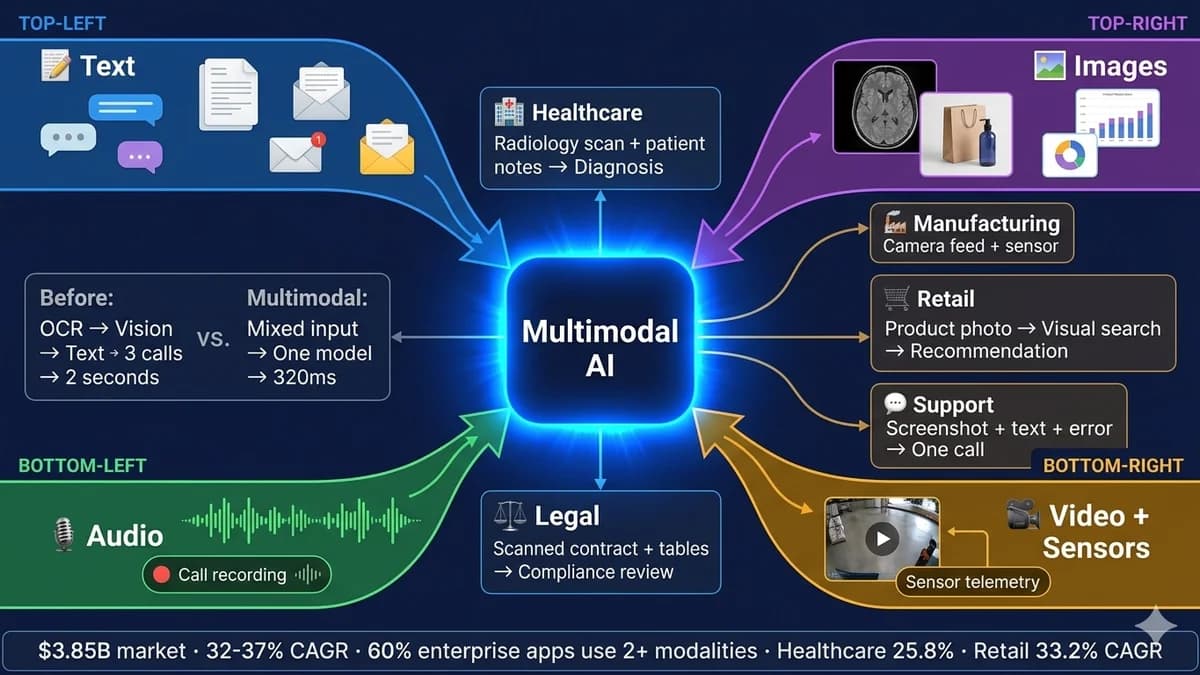
Multimodal AI is artificial intelligence that can understand and reason across multiple types of data simultaneously — text, images, audio, video, and sensor data — the way humans naturally communicate, not the way computers have traditionally processed information.
When you describe a problem to a colleague, you might show them a photo, point at a diagram, describe what you heard, and explain what you read — all in a single conversation. Your colleague understands all of it together and reasons about the relationships between the different inputs. Traditional AI could not do this. A language model processed text. An image recognition model processed images. A speech-to-text model processed audio. Three separate systems, three separate inputs, three separate outputs that a human then had to stitch into a coherent picture.
Multimodal AI eliminates those silos. A single model receives text, images, and audio together and reasons about them as a unified whole — understanding that the photo shows the same situation the text describes, or that the audio question refers to the diagram on screen. This is why every leading foundation model released since 2023 is either natively multimodal or actively adding modalities. By 2026, 60% of enterprise applications use models that combine two or more modalities.
The Four Modalities — What Each One Adds
Text
Language, documents, emails, reports, chat messages, contracts, structured data, code. Text modality is the foundation — it is the reasoning and communication layer that all other modalities typically connect to through natural language.
Images
Photos, scans, charts, diagrams, screenshots, medical imaging, product images, inspection photos. Images carry information that is expensive or impossible to capture in text — a manufacturing defect in a product photo, a lesion in a radiology scan, a layout in a UI screenshot.
Audio
Speech, voice commands, customer calls, physician dictation, environmental sounds, system alerts. Audio modality enables natural spoken interaction with AI and processes information from audio sources that would require manual transcription to become text-accessible.
Video and Sensor Data
Camera feeds, production line footage, autonomous vehicle sensor streams, IoT telemetry, temporal data from monitoring systems. This modality adds the time dimension — understanding what is changing, what sequence of events occurred, what trend the sensors are showing.
Before and After Multimodal AI — What Changed
The most direct way to understand what multimodal AI changes is to see the same real-world task handled before and after its availability.
The scenario: A telecom customer contacts support saying “my internet isn't working again” and attaches a photo of their modem showing specific LED patterns.
Before Multimodal AI
Image sent to computer vision model → LED pattern classified as “error state”
Text sent to language model → “internet not working” → customer complaint identified
Human or rule-based system stitches outputs together
Three API calls, three latency delays, no reasoning about the relationship between the LED pattern and the complaint text
Cannot understand that “again” implies a recurring issue worth escalating differently
Support ticket routed to generic queue, no contextual resolution
With Multimodal AI
Single model receives photo + text simultaneously
Reasons about both together: “The orange WAN LED indicates a failed PPPoE authentication — combined with 'again', this is a recurring connectivity drop”
Generates contextual resolution steps: reset sequence, configuration check, ISP escalation path
If pre-configured: triggers reset command via API, texts customer update, creates escalation ticket with full context
One API call. Full resolution. Customer-specific context understood.
Companies that have switched from chained unimodal pipelines to multimodal models report cutting pipeline complexity by half. Support tickets requiring three separate model calls now require one. The latency improvement alone — from 1.5–2 seconds across a three-model chain to 320ms on a single multimodal call — is the difference between a perceptible AI delay and invisible AI assistance.
How Multimodal AI Works — Three Steps, Plain English
Encoding — Converting Each Data Type into Numbers
Every AI model works with numbers, not raw data. Text is tokenised and encoded by a language encoder. Images are processed by a vision encoder (like a vision transformer) that captures spatial patterns and objects. Audio is transformed into spectral representations by an audio encoder that extracts frequency and temporal features. Video and sensor data use temporal encoders that understand sequences and change over time. Each modality produces a numerical representation (an embedding) that captures the meaning in that modality's native form.
Fusion — Combining Multiple Inputs into One Unified Understanding
This is the technically critical step. Once each modality is encoded, the model needs to combine the representations into a single understanding of "what is happening here." The mechanism that enables this is cross-modal attention — the model learns, during training, which parts of the image relate to which parts of the text, which audio segment corresponds to which visual event. The quality of this cross-modal attention is what determines whether a multimodal model actually reasons about the relationship between modalities or just processes them in parallel without connecting them.
Reasoning and Output — Generating a Response Informed by All Inputs
With a unified, cross-modal understanding, the model produces its output — which can itself be multimodal. Text output (an answer, a document, a classification). Image output (a generated or edited image). Audio output (speech, a sound response). Or an action (calling an API, triggering a workflow). What makes this output different from a unimodal model's output is that it reflects reasoning about the relationships between all inputs — the LED photo and the text complaint together, not each independently.
The Four Fusion Strategies
How modalities are combined (fused) determines how well the model understands cross-modal relationships. Four strategies are used in production multimodal AI systems:
Early Fusion
Raw inputs from each modality are combined before any encoding happens. Simple to implement, but sensitive to noise in any single modality — if the audio is poor quality, it degrades the entire fused representation.
Late Fusion
Each modality is encoded separately into its own embedding, then combined at the decision layer. More robust to noisy modalities, but potentially misses fine-grained cross-modal relationships that form earlier in processing.
Hybrid Fusion
Some modalities are processed jointly; others independently. A balanced approach that captures some cross-modal relationships while maintaining robustness. Used in many production multimodal models as a pragmatic middle ground.
Dynamic (Adaptive) Fusion
The model learns to weight each modality based on input quality at inference time. If audio is noisy, the model automatically down-weights audio and relies more on text and image. Considered best practice for production multimodal deployments as of 2026.
Which multimodal AI fusion strategy fits your use case?
Automely identifies the right foundation model and architecture for your modality requirements, compliance context, and latency needs. Free 45-minute consultation.
The Leading Multimodal AI Models in 2026
Key capabilities
- 320ms response latency — native real-time multimodal interaction
- Natively understands audio without separate speech-to-text preprocessing
- Advanced image understanding including charts, documents, screenshots
- Multi-turn conversations maintaining context across modalities
Best for
- Customer service applications requiring real-time visual + text + voice
- Document analysis: invoices, forms, charts, mixed-format reports
- General-purpose multimodal workflows
- Applications where response speed is a key user experience factor
Key capabilities
- 2 million token context window — processes entire codebases, case files, or 2 hours of video
- Gemini 3 Flash: cost-optimised enterprise variant with lower latency
- Native video understanding with temporal reasoning
- Tight integration with Google Workspace and Vertex AI
Best for
- Legal discovery: entire case files in a single context
- Video analysis and long-document processing
- Research and knowledge work with Google Workspace integration
- Enterprises requiring data residency through Vertex AI
Key capabilities
- 95%+ document extraction accuracy on forms and invoices
- Constitutional training for consistent, auditable outputs
- Predictable outputs — similar inputs produce similar responses
- Extended thinking mode for complex multi-step reasoning
Best for
- Regulated industries requiring audit trails and predictable behaviour
- Healthcare: will not diagnose conditions or recommend dosages inappropriately
- Financial and legal document analysis under compliance requirements
- Applications where reliability of output matters more than speed
Key capabilities
- Open-source: on-premise deployment without cloud dependency
- Scout and Maverick both process multiple modalities natively
- No per-token API fees for on-premise deployments
- Customisable for domain-specific fine-tuning on proprietary data
Best for
- Organisations with data sovereignty or GDPR requirements
- High-volume use cases where per-token costs are a constraint
- Organisations building proprietary multimodal systems on their data
- Regulated industries requiring full infrastructure control
How Businesses Are Using Multimodal AI — Industry by Industry
Healthcare and Life Sciences
- Fusing radiology images with patient records, clinical notes, and genomic data for higher diagnostic precision in oncology and cardiovascular care
- Physician dictation processing that understands spoken clinical language and cross-references patient history
- Drug safety review from multimodal clinical documents containing text, images, and structured lab data
Manufacturing and Industrial
- Real-time visual quality inspection from camera feeds fused with sensor telemetry from production equipment — catching defects that neither vision alone nor sensor monitoring alone would detect
- Predictive maintenance models that reason across camera feeds, acoustic sensors, and vibration data to predict failures before they occur
Retail and eCommerce
- Visual product search: customers photograph an item and search for it across a product catalogue without text keywords
- Multi-channel customer service that processes a screenshot of a website error alongside the customer's typed description and spoken frustration — resolving the query from all three inputs
- Inventory analysis from shelf images compared against stock records
Financial Services and Legal
- Loan application processing: reading scanned PDF applications, bank statements containing charts, and handwritten form fields simultaneously and extracting structured data for underwriting decisions
- Legal discovery: Gemini's 2M token context processes entire case files — finding every mention across thousands of pages, including indirect references
- Compliance automation for documents with embedded tables, signatures, and annotation marks
Customer Service
- Support tickets processed with screenshot + customer text + error code simultaneously — resolving in one model call what previously required three
- Telecom providers identify modem issues from LED status photos combined with the customer's text description
- Retail returns initiated by photographing the damaged product and describing the issue verbally — agent understands physical damage from image and context from voice
Autonomous Systems and Robotics
- Tesla Full Self-Driving processes 8 camera streams, ultrasonic sensors, and radar simultaneously — making driving decisions from fused multi-sensor understanding, not sequential single-sensor analysis
- Waymo and Boston Dynamics (partnering with Google DeepMind on Gemini Robotics, announced CES 2026) use LiDAR + camera + IMU fusion
- Physical AI — robots combining vision, language, and sensor understanding — described by Jensen Huang as the next major AI frontier
The Multimodal AI Market in 2026 — Size, Growth, and Adoption
The multimodal AI market was valued at $3.85 billion in 2026 (Mordor Intelligence), growing from $2.99 billion in 2025, with projections reaching $13.51 billion by 2031 at a 28.59% CAGR. The broader generative AI market — which includes multimodal as its fastest-growing segment — is projected at $83.3 billion in 2026 growing to $988.4 billion by 2035 at 31.6% CAGR (Global Market Insights). The multimodal segment specifically is expected to register the highest CAGR within generative AI: 56.6% through the forecast period, driven by enterprise adoption across manufacturing, healthcare, and financial services.
The differentiator in multimodal AI deployment is not which foundation model you use — GPT-4o, Gemini, Claude, and Llama 4 are all capable enough for most business use cases. The differentiator is domain-specific training data. By 2026, the model is increasingly a commodity. What your competitors cannot replicate is a multimodal system trained on your proprietary data — your product images, your customer call recordings, your manufacturing defect database, your physician dictation archive. The organisations achieving the highest multimodal AI ROI are those deploying general models with custom data layers, not those spending millions training proprietary multimodal models from scratch.
Building Multimodal AI Systems — What It Takes
Deploying multimodal AI in a business context requires more than selecting a foundation model and connecting an API. Four implementation considerations determine whether a multimodal system delivers its theoretical capability in your specific context:
Data alignment across modalities
Training data for multimodal systems must be cross-modally aligned — paired examples where the image and the text describe the same thing, where the audio and the transcript are accurately synchronised. Misaligned training data produces models that encode modalities independently rather than building cross-modal understanding. 66% of datasets contain quality flaws that affect multimodal alignment. Data preparation is typically the most time-intensive phase of multimodal AI development.
Compliance requirements by modality
Medical imaging data must be DICOM-compliant and HIPAA de-identified before it can be used for training. Audio recordings from customer calls may require consent documentation. Video from manufacturing lines may include personal data under GDPR. Each modality adds compliance considerations that must be designed into the data pipeline architecture from the start, not retrofitted after deployment.
Latency requirements by use case
GPT-4o's 320ms multimodal latency is adequate for most customer-facing applications. Autonomous vehicle systems require sub-10ms sensor fusion decisions. Manufacturing quality control at production line speed requires real-time multimodal inference at the edge, not cloud API calls. Matching the inference architecture to the latency requirement is a design decision made at architecture stage, not after deployment.
Model selection by industry and compliance context
For regulated industries (healthcare, finance, legal), Claude's constitutional training and predictable outputs are often preferred over raw capability. For high-volume, cost-sensitive applications, Gemini 3 Flash's cost-optimised architecture may be the correct choice over GPT-4o's raw performance. For data sovereignty requirements, Llama 4's open-source on-premise deployment eliminates cloud dependency entirely.
Automely's AI agent development and generative AI development services include multimodal AI architecture — connecting GPT-4o, Gemini, Claude, or domain-specific multimodal models to your existing systems, data sources, and operational workflows. Whether you need a multimodal customer service system, a document intelligence platform, or a manufacturing quality control system with vision and sensor fusion — all begin with a scoped discovery session.
Is there a workflow in your business where a model that reads images, processes text, and hears audio together could eliminate a manual step?
Automely identifies the multimodal AI opportunity in your specific context and builds the system. Free 45-minute consultation.