

Why the Question Is Usually Framed Wrong
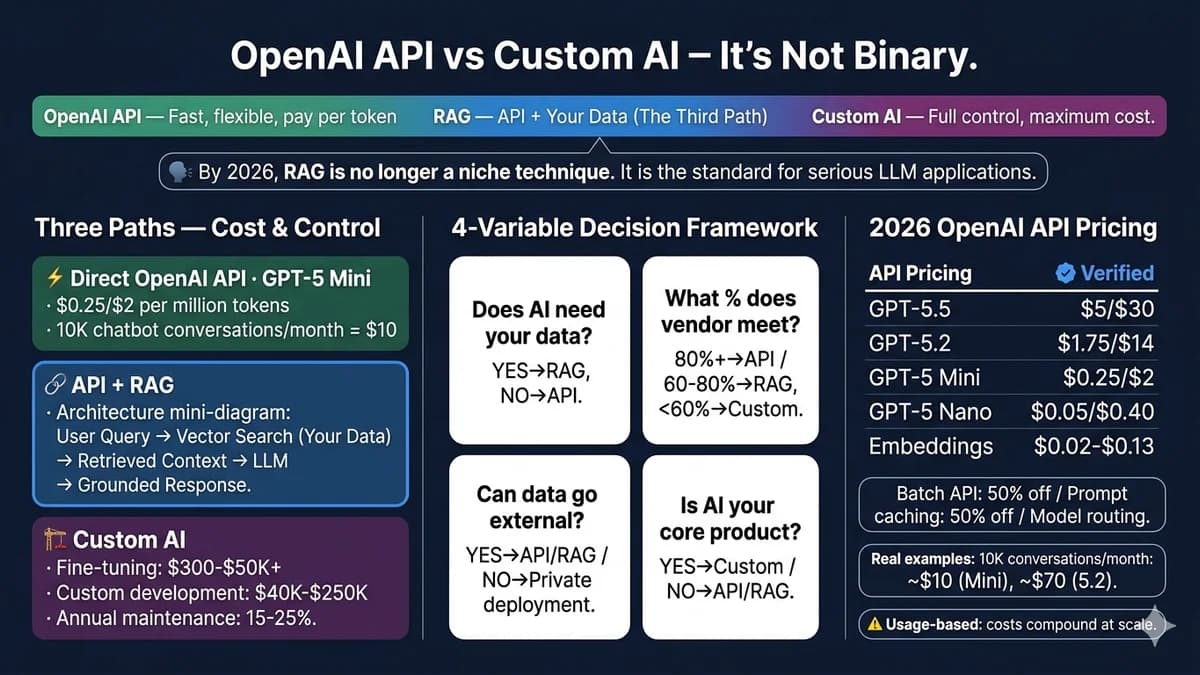
The way this decision is typically framed — “OpenAI API versus custom AI” — assumes there are two options. There are three. And the third option, which most discussions omit entirely, is the right answer for the majority of business generative AI deployments in 2026: RAG (Retrieval-Augmented Generation) — using a foundation model like GPT or Claude via API, but grounded on your specific business data so the AI knows your products, your customers, your documents, and your workflows.
The reason this framing matters: pure OpenAI API integration without data grounding produces generic outputs that often don’t serve specific business contexts. Full custom model development ($40,000-$250,000+) is expensive, slow, and only necessary for a narrow set of cases. RAG is the architecture that gives you the intelligence of a frontier model with the specificity of your proprietary data — at a cost between the two extremes. By 2026, this is no longer a niche technique. It is the standard architecture for serious business LLM applications.
The Three Actual Paths — Not Two
Direct OpenAI / Claude API
Call OpenAI, Anthropic, or Google’s API directly from your application. The model uses its pre-trained general knowledge plus whatever context you provide in the prompt. No training, no custom data pipeline, no private infrastructure.
Best for: content generation, code assistance, general text processing, summarisation, classification — tasks where general model knowledge is sufficient.
RAG: API + Your Data
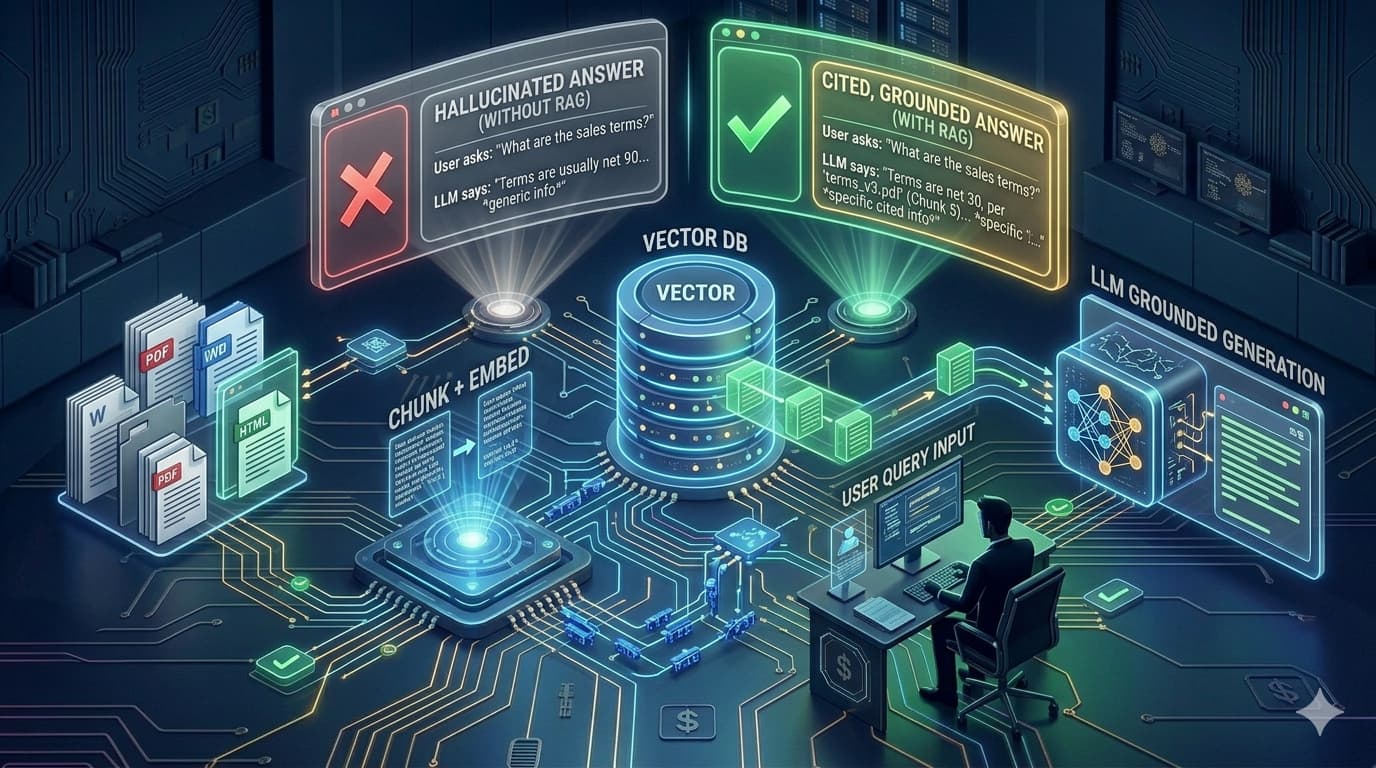
Connect the API model to your specific data sources — product catalogue, customer history, internal documents, support history, domain knowledge base. The model retrieves relevant context at query time and generates answers grounded in your actual information.
The intelligence of a frontier model. The specificity of your proprietary data. No model training required. This is the architecture for customer service AI, internal knowledge assistants, product recommendation engines, and domain-specific business tools.
Custom AI / Fine-tuned / Private Model
Train or fine-tune a model on your specific data, or deploy an open-source model (Llama, Mistral) privately within your infrastructure. The AI behaviour, output format, and data exposure are entirely within your control.
Appropriate when: compliance mandates data never leaves your servers; AI is your core product and you need to own the model roadmap; or at massive token volume where API costs exceed hosted infrastructure costs.
OpenAI API Pricing in 2026 — Real Numbers
The most common misconception about OpenAI API costs is that they are expensive. They are not — for most business use cases. GPT-5 Mini handles 80% of production use cases at $0.25 per million input tokens. A customer support chatbot processing 10,000 conversations per month with average message lengths costs approximately $10 per month on GPT-5 Mini. The cost compounds significantly only at scale, and even at scale, model selection is the primary cost management tool.
| Model | Input (per 1M tokens) | Output (per 1M tokens) | Best For | Real-World Example |
|---|---|---|---|---|
| GPT-5.5 | $5.00 | $30.00 | Complex reasoning, professional work, frontier tasks | Legal analysis, complex code, strategic research |
| GPT-5.2 | $1.75 | $14.00 | Production flagship, enterprise apps, diverse tasks | ~$70/month for 10K conversations |
| GPT-5 Mini | $0.25 | $2.00 | Handles 80% of production use cases at a fraction of flagship cost | ~$10/month for 10K conversations |
| GPT-5 Nano | $0.05 | $0.40 | Classification, extraction, simple generation, structured tasks | ~$2/month for 10K conversations |
| Embeddings (text-3-small) | $0.02 | — | RAG retrieval, search, classification vectors | 10M documents indexed for $200 |
| Embeddings (text-3-large) | $0.13 | — | High-precision RAG, complex retrieval | When recall accuracy is critical |
Batch API: 50% discount for non-real-time workloads (content generation, data processing, bulk classification). Prompt caching: 50% off on cached tokens — a support bot with a 3,000-token system prompt sending 50,000 requests/month saves 30-40% on input costs. Model routing: use Nano for classification, Mini for standard responses, 5.2 only when capability requires it. “Picking the wrong model can mean the difference between a $50/month bill and a $5,000/month bill for the same workload” (Curlscape, 2026). A SaaS product serving 10,000 daily active users can process hundreds of millions of tokens monthly — monitoring and cost governance are essential from day one, not when the bill surprises you.
Designing a generative AI application and need the architecture decision made correctly before any code is written — API, RAG, or custom, with the cost and performance implications of each for your specific use case? Automely provides this assessment free.
Free 45-minute generative AI architecture consultation. We assess your use case, recommend the right path, and outline the build requirements — with cost estimates for each option and honest reasoning for the recommendation.
RAG — The Third Path Nobody Talks About (And the One Most Businesses Need)
RAG stands for Retrieval-Augmented Generation. The architecture connects a foundation model (GPT, Claude, Gemini) to your specific data sources at the time of each query — so the model’s response is grounded in your actual information rather than just its general training data.
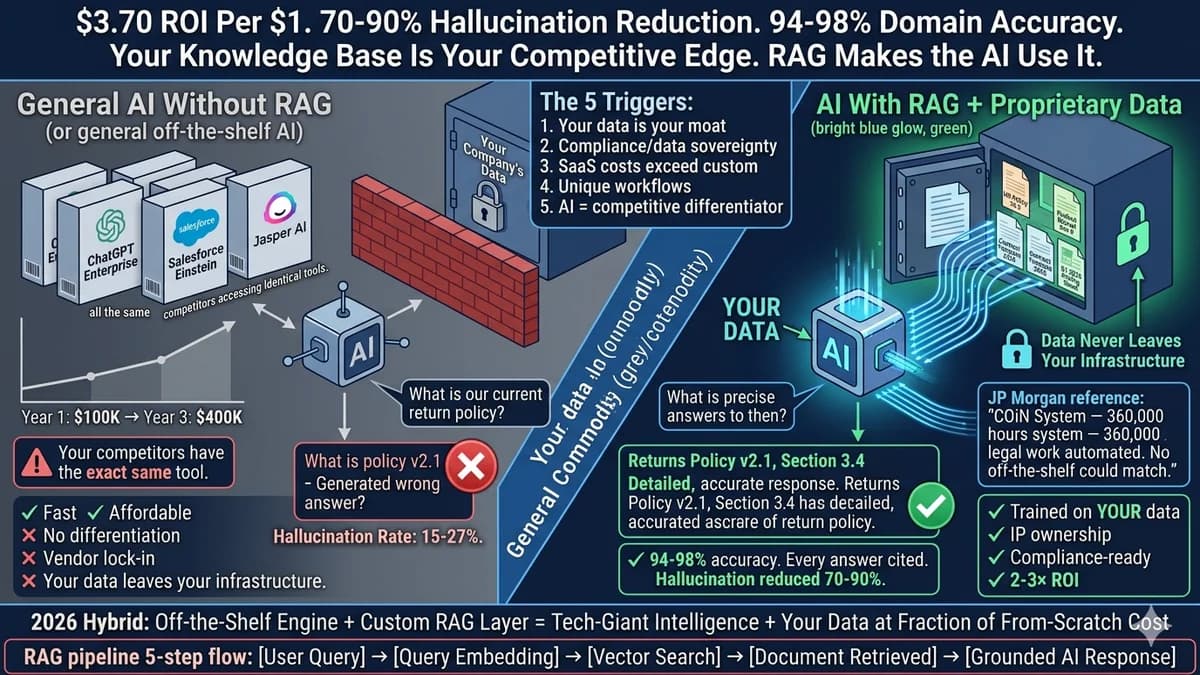
Why RAG is the right architecture for most business generative AI deployments: it gives you the reasoning capability of a frontier model (GPT-5, Claude, Gemini) combined with the specificity of your proprietary data — without the cost and complexity of training a custom model. A customer service AI built with RAG knows your actual product catalogue, your actual return policies, your actual order status systems. Without RAG, it knows general customer service principles and hallucinates your specific details. The difference is the difference between a useful business tool and an expensive demo.
RAG is also the architecture that reduces hallucination risk. By grounding the model’s response in retrieved, verified facts from your own data, you dramatically reduce the probability of the AI inventing information. This is the critical quality advantage of RAG over pure API integration for domain-specific applications.
Your customer service AI should know your specific products. Your internal knowledge assistant should draw from your actual documentation. Your sales AI should reference your real pricing and case studies. Your product recommendation engine should use your actual inventory. If your AI application needs to know things specific to your business, RAG is almost always the right architecture — and it is dramatically cheaper, faster, and lower-risk than training a custom model to encode that same knowledge.
When Custom AI Development Is Actually Necessary
Custom AI development — fine-tuning an existing model on your data, or deploying a private open-source model — is the right answer in four specific situations. Outside these four, RAG on a foundation model API is almost always the better path from both a cost and timeline perspective.
- Compliance mandates private deployment: HIPAA, certain GDPR interpretations, financial services data governance, and legal client confidentiality requirements may prevent sending data to OpenAI’s servers even in a RAG architecture. In these cases, a self-hosted model (Llama, Mistral, or a fine-tuned derivative) deployed within your own infrastructure is the only compliant path. The law firm deploying a private VPC LLM from the custom AI build decision is this scenario exactly.
- AI is your core product: If your competitive differentiation is the quality of your AI model’s outputs — in a fintech risk assessment product, a clinical decision support tool, or a specialised advisory platform — you need to own the model, control the training data, and control the roadmap. Dependency on OpenAI’s model updates and pricing changes is an existential business risk when your product is the model.
- Scale economics favour owned infrastructure: At very high token volumes — hundreds of millions per day — the per-token API cost may exceed the infrastructure cost of hosting an open-source model. This crossover point is typically far beyond the volume most businesses operate at initially, but it is a legitimate reason to move toward private infrastructure as scale grows. The optimisation path: start on API, add caching and batch discounts, build RAG, evaluate private hosting when API costs become material on P&L.
- Output format or style requires deep customisation: When RAG is insufficient because you need the model to fundamentally change how it generates — not what information it retrieves but how it writes, reasons, or formats — fine-tuning can achieve the adaptation. This requires thousands of high-quality training examples and is appropriate for producing domain-specific structured outputs that vanilla prompting cannot reliably achieve.
For most businesses reading this guide, the honest assessment is: you probably do not need to fine-tune or train a custom model. You need a well-architected RAG system. The businesses that invest $40,000-$250,000+ in custom model development when RAG would have served them equally well are the organisations contributing to the 95% AI project failure rate from the MIT GenAI Divide. Architecture decisions made before a single line of code is written determine whether an AI investment lands in the successful 5% or the failing 95%.
The 4-Variable Decision Framework — Which Path Is Right for You
No — general tasks like content generation, code help, summarisation, translation. General model knowledge is sufficient.
Yes, and the data can be retrieved at query time from a knowledge base (product docs, customer data, internal knowledge).
Yes, and the data needs to be encoded into model weights — for style/behaviour that RAG cannot achieve through retrieval alone.
80%+ — the vendor model handles your use case well without significant data grounding or customisation.
60-80% — the model is capable but needs grounding on your specific data to be accurate and business-relevant.
Below 60% — no vendor API meets your needs adequately and customisation effort exceeds the cost of building purpose-built.
Yes — no restrictions. Standard commercial API terms are acceptable. Most business data falls into this category.
Yes, but carefully. For sensitive data, Azure OpenAI (private deployment on your Azure tenant) provides strong data isolation within the API model.
No — HIPAA, certain GDPR data residency requirements, legal client confidentiality, or security policies mandate fully private deployment.
Efficiency tool — AI helps your team do their work faster and better. Model quality is good enough from standard API.
Mixed — AI is important to your product experience but not the primary differentiator. Your data and workflows provide the differentiation.
Core differentiator — your product IS the AI, and vendor model dependency creates existential roadmap and pricing risk you cannot accept.
Full Cost Comparison — The Three Paths Side by Side
Direct API Integration
API + Your Proprietary Data
Fine-tuned or Private Model
What Generative AI Development Services Actually Deliver
When businesses hire a generative AI development firm, the most important work happens before any code is written: choosing the architecture. The choice between API, RAG, and custom model development determines every downstream cost, timeline, and outcome. A development partner who jumps to building without making this decision explicitly — and testing the alternatives — is not providing generative AI development services. They are providing implementation services, which is a very different thing.
What Automely’s generative AI development services actually include:
- Architecture decision: we evaluate all three paths against your specific use case, data situation, compliance requirements, and budget before recommending an approach. We do not default to custom when RAG is sufficient, and we do not undersell custom when compliance or product differentiation genuinely requires it.
- Data pipeline: preparing your data for AI consumption — cleaning, chunking, embedding, and indexing your knowledge base for efficient retrieval in a RAG system, or structuring training data for fine-tuning.
- Prompt engineering and system design: the prompts, context management, and output formatting that make the AI reliably produce business-grade results rather than generic or unpredictable outputs.
- Integration: connecting AI to your existing systems — CRM, databases, communication channels, internal tools — so it operates within your business workflows rather than as a disconnected demo.
- Evaluation and governance: testing for accuracy, safety, cost efficiency, and edge case handling before any system is deployed to users. Rate limiting, monitoring, error handling, and human oversight triggers for the interactions AI should not handle alone.
- Cost management: designing the system to use the cheapest model that meets quality requirements, implementing caching and batching, and setting up monitoring so costs do not compound undetected at scale.
The architecture decision alone — choosing correctly between the three paths described in this guide — is worth more than any subsequent implementation work. See our build vs buy AI guide for the broader strategic context, and our guide to building a RAG knowledge base for how the recommended architecture is built in practice.
Building a generative AI application and want the architecture decision — API, RAG, or custom — made correctly before any budget is committed? Automely’s architecture assessment starts with your use case, not with our preferred solution.
Free 45-minute generative AI architecture consultation. We evaluate all three paths for your specific situation, recommend the right approach with explicit reasoning, and outline the build requirements and cost estimates for each option.