


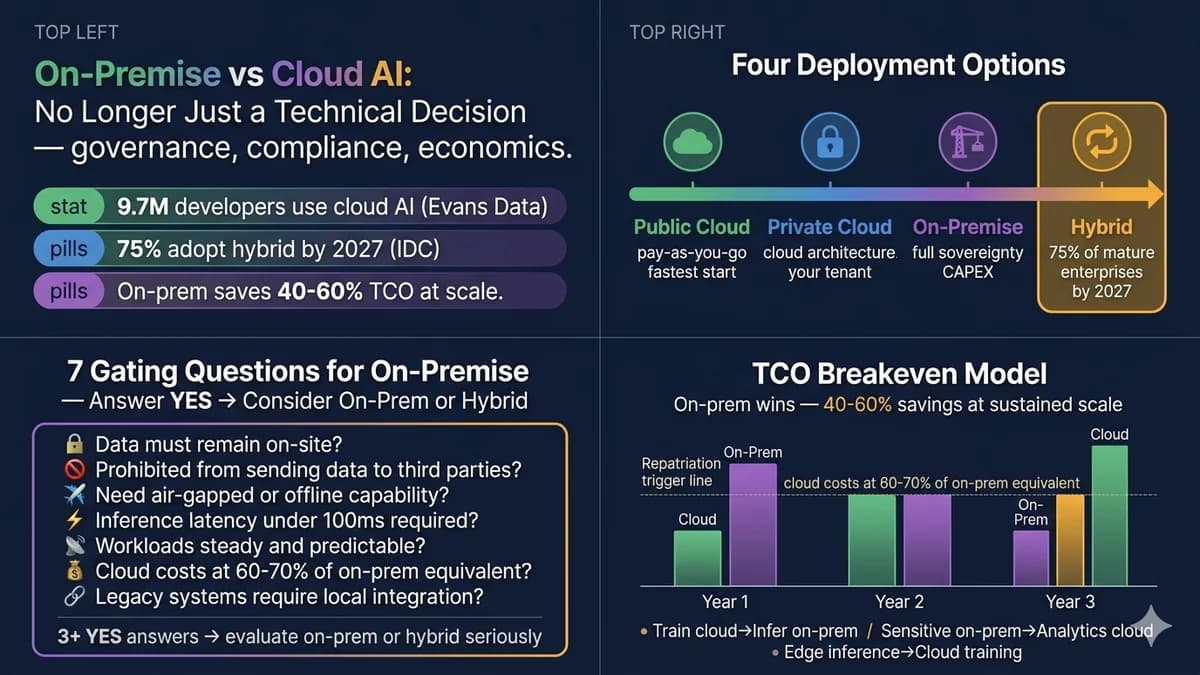
The Decision Has Changed — It Is No Longer Just Infrastructure
The on-premise vs cloud AI question used to be straightforward: cloud for startups and variable workloads, on-premise for enterprises with existing data centres and stringent security requirements. In 2026, the calculus is different. Generative AI has moved from pilots to production. AI systems now draft customer communications, summarise regulated documents, generate code in core product flows, and trigger actions across enterprise systems. These are no longer experimental deployments — they are operational dependencies where the wrong infrastructure decision creates governance risk, compliance exposure, and unpredictable costs at scale.
The framing has shifted accordingly. "Where should we run our AI?" is now a governance, compliance, and economics decision that appears in security reviews, CFO budget conversations, and board-level risk assessments — not just in IT planning meetings. And the binary framing of cloud versus on-premise is wrong for most mature organisations. IDC predicts that by 2027, 75% of enterprises will adopt hybrid AI deployment, placing different workloads in different environments based on their specific requirements for data sensitivity, latency, cost, and elasticity.
Four Deployment Options — Not Two
The binary framing of "cloud versus on-premise" obscures two important options that sit between the extremes. The complete deployment spectrum has four distinct models, each with different cost structures, control profiles, and appropriate use cases.
Public Cloud AI
AWS, Azure, GCP — hosted, managed, elastic
- Pay-as-you-go (OPEX) — no upfront hardware investment
- GPU access on demand — scale for training bursts without procurement delay
- Managed MLOps services — SageMaker, Vertex AI, Azure ML reduce operational overhead
- Fastest time to first production — days vs weeks
- Data processed on provider infrastructure — contractual protections, not architectural
- Costs unpredictable at scale without active governance
Private Cloud AI
Cloud architecture, your infrastructure or dedicated tenant
- Cloud operating model (elasticity, managed services) without public multi-tenant data exposure
- Azure Government, AWS GovCloud, or private cloud deployments within your own tenant
- Data never leaves a defined perimeter — stronger compliance posture than public cloud
- Higher cost than public cloud; lower upfront than full on-premise
- Well-suited for organisations that need cloud agility but cannot accept public cloud data handling
On-Premise AI
Your servers, your data centre, your full control
- Complete data sovereignty — data never leaves your infrastructure under any condition
- Air-gapped capability — operate without any external network connectivity
- Sub-millisecond inference latency — compute runs within your own facility
- Predictable long-term costs — CAPEX amortised over hardware lifecycle
- Requires internal ML infrastructure expertise to operate
- GPU procurement timelines measured in weeks, not minutes
Hybrid AI Deployment
Deliberate placement by workload type and data sensitivity
- Not "do everything twice" — deliberate placement of components by sensitivity and economics
- Training and experimentation in cloud (elastic GPU), inference on-premise (predictable latency and cost)
- Sensitive data on-premise, analytics and non-sensitive workloads in cloud
- Unified MLOps layer across environments for observability and governance
- Reduces risk concentration vs pure-cloud or pure-on-premise approaches
- More architectural complexity — requires disciplined orchestration
The Four AI Workload Types and Where They Belong
Not all AI workloads have the same infrastructure requirements. Before choosing a deployment model, map your specific workloads to their type — different workloads have fundamentally different compute profiles, latency requirements, and data sensitivity implications. Most enterprises run multiple workload types and benefit from placing each in the environment that best serves its specific needs.
| Workload Type | Description | Infrastructure Needs | Best Deployment |
|---|---|---|---|
| Model Training | Building AI models from scratch on large datasets. Massive compute bursts over days or weeks. | High GPU count, intermittent — weeks per training run then idle | ☁️ Cloud — elastic GPU on demand, pay only during training runs |
| Fine-Tuning | Adapting a pre-trained model on your domain data. Less intensive than training, periodic. | Moderate GPU, periodic — monthly or quarterly cycles | 🔄 Hybrid — cloud for occasional bursts, on-prem if data is sensitive |
| Production Inference | Running the trained model on real-time business data. Ongoing, latency-sensitive. | Steady GPU utilisation, low latency requirements, high volume | 🏗️ On-Prem — predictable cost at sustained utilisation, low latency |
| Sensitive Data Pipelines | Ingestion, preprocessing, and analysis of PHI, financial records, or IP-sensitive data. | Data must not transit external networks; compliance audit trail | 🏗️ On-Prem or Private Cloud — data residency and compliance certainty |
| Edge Inference | Real-time decisions at the point of data generation (manufacturing, autonomous systems). | Ultra-low latency under 10ms, often intermittent connectivity | 🏗️ Edge hardware on-site — network latency makes cloud impossible |
| Experimentation / R&D | Testing models, architectures, and datasets. Variable, experimental, low stakes. | Flexible compute, no production SLA, variable data sizes | ☁️ Cloud — spin up, test, tear down. No long-term commitment. |
AI thought leader David Linthicum (Deloitte, February 2026): "Cloud makes sense for certain things. It's like the 'easy button' for AI. But it's really about picking the right tool for the job. Companies are building systems across diverse, heterogeneous platforms, choosing whatever provides the best cost optimisation. Sometimes it's the cloud, sometimes it's on-premises, and sometimes it's the edge." The organisations that navigate this well are the ones who ask the strategic question first — what is this workload and what does it require — not the ones who default to cloud because it is easier to start.
When Cloud AI Is the Clear Right Answer
Cloud AI is not always the right answer, but it is the genuinely correct starting point for most businesses and the objectively superior choice for specific scenarios. Understanding precisely when cloud wins helps avoid the mistake of deploying on-premise infrastructure prematurely.
- Speed to start matters more than anything else. Cloud AI deploys in days. On-premise requires hardware procurement (weeks to months), facility preparation, network configuration, and security setup. If your competitive situation requires AI capability within weeks, cloud is the only viable path. "If you need to go now, cloud wins" (HBS, 2026).
- Your workloads are variable or bursty. Model training phases require massive GPU clusters for weeks at a time, then nothing. Experimentation spins up and tears down. Cloud elasticity — paying for GPU compute only during the periods you use it — is genuinely cheaper for these patterns than owning hardware that sits idle 80% of the time.
- You lack ML infrastructure expertise internally. Cloud managed services (Amazon SageMaker, Google Vertex AI, Azure ML) abstract away GPU driver management, cluster orchestration, security patching, and monitoring infrastructure. A team without dedicated ML infrastructure engineers can run production AI on cloud in ways that would require a 3-5 person infrastructure team on-premise.
- Capital for hardware investment is unavailable. On-premise requires significant CAPEX — NVIDIA A100-class server hardware at $100,000-$200,000+, plus facility costs, networking, power, and cooling. Cloud converts this to OPEX — a monthly cost that can be scaled and cancelled without stranded capital.
- Your data has no sovereignty or residency restrictions. If your data is not subject to HIPAA, GDPR data residency requirements, legal client confidentiality mandates, or sector-specific regulations that restrict third-party processing — cloud is viable and often the most cost-effective path for most workloads.
Evaluating your AI deployment model — cloud, on-premise, private cloud, or hybrid — and want a specific assessment for your workloads, compliance requirements, and budget? Automely provides this consultation free.
Free 45-minute AI deployment architecture session. We map your workloads, identify compliance constraints, run the TCO comparison for your specific volume, and recommend the right deployment architecture with explicit reasoning.
The 7 Gating Questions That Point Toward On-Premise or Hybrid
StackAI's enterprise AI deployment framework provides the clearest set of gating questions for the on-premise decision. If you answer "yes" to several of these, the on-premise or hybrid path needs to be evaluated seriously — regardless of the initial cost advantage of cloud.
Must data remain on-site due to sovereignty, residency, or contract terms?
Data sovereignty laws (EU GDPR data residency, national security frameworks, sovereign cloud mandates) frequently require that specific categories of data be processed within defined geographic boundaries. Contract terms with enterprise clients, government agencies, or regulated partners may prohibit data transiting third-party infrastructure under any circumstances.
Are you prohibited from sending prompts, documents, or embeddings to third parties?
Even in a RAG architecture, every query and its context is sent to the AI provider's servers. For businesses where client confidentiality, trade secrets, or regulatory interpretation prohibits this — financial institutions with insider information handling, law firms with client matters, defence contractors — cloud AI creates an unacceptable data exposure risk.
Do you require air-gapped operation or highly restricted network environments?
Government agencies, defence contractors, and certain industrial systems must operate on networks that are physically disconnected from the internet. Cloud AI is architecturally impossible in these environments. Edge and on-premise are the only viable options.
Do you need inference latency under 100ms P95 end-to-end?
Real-time AI applications — fraud detection on financial transactions, manufacturing quality control, autonomous vehicle response systems, real-time medical diagnostics — require latency measured in milliseconds. Network transit to and from cloud providers adds 20-100ms before any processing occurs, making cloud structurally unsuitable for sub-100ms requirements. Hospitals requiring inference under 50ms with PHI protection fine-tune in cloud then deploy locked-down inference on-premise (HBS, 2026).
Are your workloads steady and predictable enough to keep GPUs highly utilised?
Cloud's economic advantage over on-premise is largest for variable workloads where you pay only for what you use. For steady, high-volume inference workloads with consistent utilisation (70%+ GPU utilisation continuously), owned hardware reaches TCO parity with cloud in approximately 2-3 years and delivers 40-60% savings at 5 years. If your production inference is ongoing and predictable, the economics of owned infrastructure improve significantly.
Are cloud costs already exceeding 60-70% of the cost of acquiring equivalent on-premises systems?
Deloitte's 2026 AI infrastructure analysis identifies this as the financial repatriation trigger — when cloud costs reach 60-70% of the total cost of acquiring equivalent on-premises systems, capital investment becomes more attractive than continued operational expenditure. If you are already at this threshold, the economics of cloud repatriation are favourable.
Do you have legacy systems with no modern APIs that require tightly controlled local integration?
Many enterprises run core operational systems (ERPs, manufacturing control systems, legacy databases) that cannot securely expose APIs to external cloud services. AI that needs to read or write these systems in real time may require local deployment to avoid the security and latency implications of routing data through cloud infrastructure.
On-premise AI is only viable if your organisation has — or plans to build — the technical capacity to manage it: ML infrastructure engineers, GPU cluster operations, security patching, model update pipelines, and disaster recovery planning. "A poorly-maintained on-premise deployment may be less secure than a well-managed cloud deployment" (ArcaQ, 2026). If the answer to Question 1-7 is yes but internal expertise is absent, the path is private cloud or co-location — not public cloud, but not fully self-managed on-premise either.
The TCO Breakeven Model — When On-Premise Becomes Cheaper
The on-premise vs cloud AI cost comparison is not static — it changes over time and depends critically on workload utilisation levels. The practical model:
Sustained High-Volume Inference Workload
Same Sustained High-Volume Inference Workload
Training in Cloud, Inference On-Premise
Cloud wins Year 1 on absolute cost because CAPEX is absent. On-premise typically crosses breakeven at 18-24 months and delivers 40-60% TCO savings over 3-5 years at sustained high utilisation. The hybrid model often achieves the lowest 3-year TCO by using cloud only for the training workloads where elasticity is genuinely valuable and on-premise for inference where sustained utilisation justifies owned hardware. The key variable is utilisation: on-premise economics only work when GPU utilisation is consistently high. An underutilised on-premise cluster costs more, not less, than cloud.
3 Real-World Deployment Patterns That Work
Cloud Layer
- Model training and fine-tuning — bursts of GPU compute during development cycles
- Experimentation and architecture evaluation
- Managed MLOps tooling for data labelling and model evaluation
- Non-sensitive analytics workloads
On-Premise Layer
- Production inference — trained model deployed locally for low latency and cost predictability
- Real-time business data processing
- Sensitive data stays within facility perimeter throughout lifecycle
- Predictable monthly infrastructure cost as volume grows
On-Premise Layer
- Transaction data processing, patient records, legal documents
- Inference on sensitive inputs — no data leaves facility
- Compliance-governed model deployment with full audit trail
- Legacy system integration where external APIs are prohibited
Cloud Layer
- Aggregated, anonymised analytics — no PII involved
- Model training on anonymised or synthetic datasets
- Marketing, product analytics, non-regulated workloads
- Burst compute for annual model refresh cycles
Edge / On-Premise
- Sub-10ms inference at point of generation — factory floor, medical device, vehicle system
- Operates offline — no cloud connectivity required for production decisions
- Locked-down model deployment — version controlled, audit logged
- Data never leaves the facility or device
Cloud Layer
- Model training and retraining cycles — periodic, batch data upload to cloud
- Centralised model management and version control
- Aggregate performance monitoring — anonymised telemetry only
- New model evaluation before deployment to edge fleet
Decision Scorecard — Where Your Organisation Lands
Apply the following scoring approach to your specific situation. Rate each dimension based on your organisation's actual requirements. The output is not a definitive answer — it is a starting point for a more detailed architecture assessment.
- Data sovereignty requirement: None (0) → Preferred on-site (1) → Contractual requirement (2) → Legal mandate (3). Score ≥ 2 → strongly consider on-premise or private cloud.
- Latency requirement: >500ms acceptable (0) → 100-500ms (1) → <100ms required (2) → <10ms required (3). Score ≥ 2 → on-premise or edge inference required.
- Workload utilisation: Variable/bursty (0) → Mixed (1) → Mostly sustained (2) → Continuous high utilisation (3). Score ≥ 2 → on-premise economics become competitive at 18-24 months.
- Internal ML infrastructure expertise: None (0) → Some (1) → Dedicated team (2) → Specialised ML infra team (3). Score ≤ 1 → cloud or private cloud preferred; on-premise without expertise creates security and operational risk.
- Capital availability: Limited (0) → Some (1) → Available (2) → Capital budgeted for AI infrastructure (3). Score ≤ 1 → cloud OPEX model preferred regardless of other factors.
Total score 0-5: Cloud-first. Start with public cloud; add private cloud or on-premise components as specific workloads justify it. Total score 6-9: Hybrid. Evaluate which specific workloads belong on-premise and which in cloud; design the hybrid architecture from the start. Total score 10-15: On-premise-first or private cloud. Cloud may be appropriate for training and experimentation, but production inference and sensitive workloads require on-premise or private cloud deployment. For guidance on how deployment model integrates with your broader AI architecture decisions, see our build vs buy AI guide.
Ready to map your specific AI workloads to the right deployment model — cloud, on-premise, private cloud, or hybrid — with a specific TCO comparison and architecture recommendation for your situation?
Free 45-minute AI deployment architecture session. We assess your workloads, compliance requirements, and cost structure, then recommend the deployment model and architecture with explicit reasoning and realistic cost estimates.