

What Intelligent Automation Is
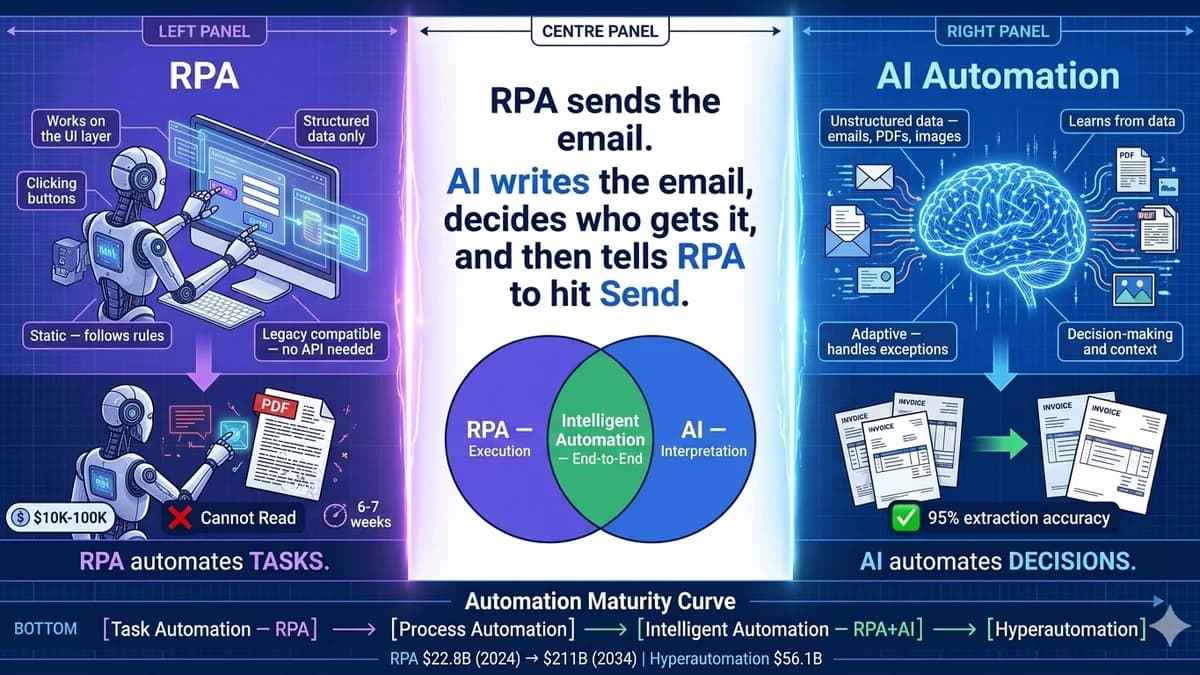
Robotic process automation executes a script. Give it structured data in a predictable format and it will complete the task without error, every time. Change the format, and it stops. That constraint is not a flaw — it is the design. RPA was built for deterministic, structured work.
Intelligent automation is what happens when you stack additional capability layers on top of that foundation. It adds the ability to read documents in any format, to make decisions based on context rather than fixed rules, and to improve its own accuracy over time as it processes more transactions. The result is an automation system that handles not just the clean, predictable work — but the messy, judgment-intensive work that represents the bulk of most operational processes.
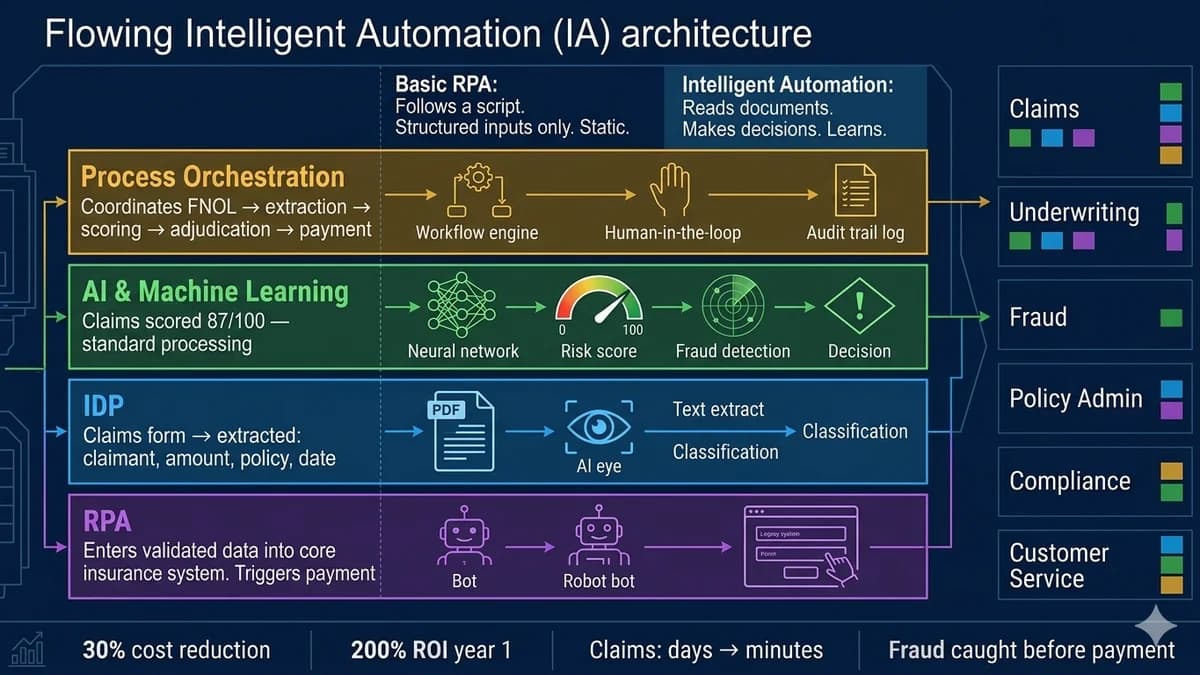
The term covers four distinct technology layers working in concert. Each layer is independently deployable, but the compound value comes from connecting them into a single orchestrated workflow.
The 4 Technology Layers
Intelligent automation is not a single product. It is an architecture. These four layers stack on top of each other — each one handling what the layer below cannot.
- Structured data entry across multiple systems
- Multi-system navigation and data transfer
- Document routing and filing workflows
- Legacy system interaction without requiring an API
- OCR and computer vision for any document format
- NLP to extract meaning from unstructured text
- Handles PDFs, emails, scanned images, and handwriting
- Classifies and routes documents automatically
- Predictive models for risk scoring and fraud detection
- Underwriting decision support with full explainability
- Renewal propensity modelling and churn prediction
- Natural language generation for customer communications
- Connects all automation layers end-to-end
- Human-in-the-loop escalation management
- Audit trail and compliance documentation
- SLA monitoring and exception handling
Where RPA Ends and Intelligent Automation Begins
The most common question from operations leaders evaluating automation is whether they need RPA or something more. The answer depends on the nature of the inputs and the complexity of the decisions involved.
| Dimension | Basic RPA | Intelligent Automation |
|---|---|---|
| Input Requirement | Structured, templated data only | Any format — structured, semi-structured, unstructured |
| Decision Capability | Rule-based: if A then B | Context-aware: reads, scores, decides, and learns |
| Document Handling | Fixed-format templates only | Any document type via the IDP layer |
| Exception Handling | Stops and alerts a human operator | Classifies the exception, routes it, and resolves autonomously |
| Learning Over Time | Static rules requiring manual updates | Improves accuracy and coverage with each transaction |
Why Insurance Is the Ideal Intelligent Automation Environment
Insurance processes have three characteristics that make them ideal for intelligent automation — and difficult for basic RPA alone.
First, the volume is high and the work is repetitive. Claims, renewals, and policy administration involve thousands of transactions following broadly similar patterns. That is exactly the environment where automation ROI compounds fastest.
Second, the inputs are unstructured. A claims submission might arrive as a structured form, a scanned PDF, an email, or a photograph. A broker submission might include a spreadsheet, a narrative description, and a loss run in three different formats. IDP handles all of these. RPA handles none of them.
Third, the decisions involve judgment. Fraud scoring, underwriting risk assessment, and coverage interpretation require contextual reasoning — not rule lookup. AI/ML models trained on historical data handle this at a scale and consistency that human reviewers cannot match.
6 Insurance Use Cases for Intelligent Automation
These are the six processes where insurers consistently see the highest return on intelligent automation investment.
Intelligent automation ingests the first notice of loss from any channel, extracts policy details, checks fraud signals, triggers the right workflow, and issues payment — all without human intervention for straightforward claims.
AI/ML models pull third-party data, score risk, flag anomalies, and return a structured recommendation. Underwriters review exceptions rather than processing every submission from scratch.
Every claim is scored against historical fraud patterns and network linkage graphs before payment is released. Suspicious claims are routed to special investigation automatically.
Standard endorsements and renewals are processed end-to-end without manual intervention. IDP reads incoming requests in any format; orchestration routes complex changes to the right team.
Every automated action is logged with a full audit trail. Regulatory reports are assembled automatically from structured process data, eliminating the quarterly scramble and reducing reporting risk.
AI understands policyholder intent, retrieves the right policy data, and responds — or escalates with full context pre-populated. Human agents handle only complex, high-empathy situations.
Implementation Maturity Model
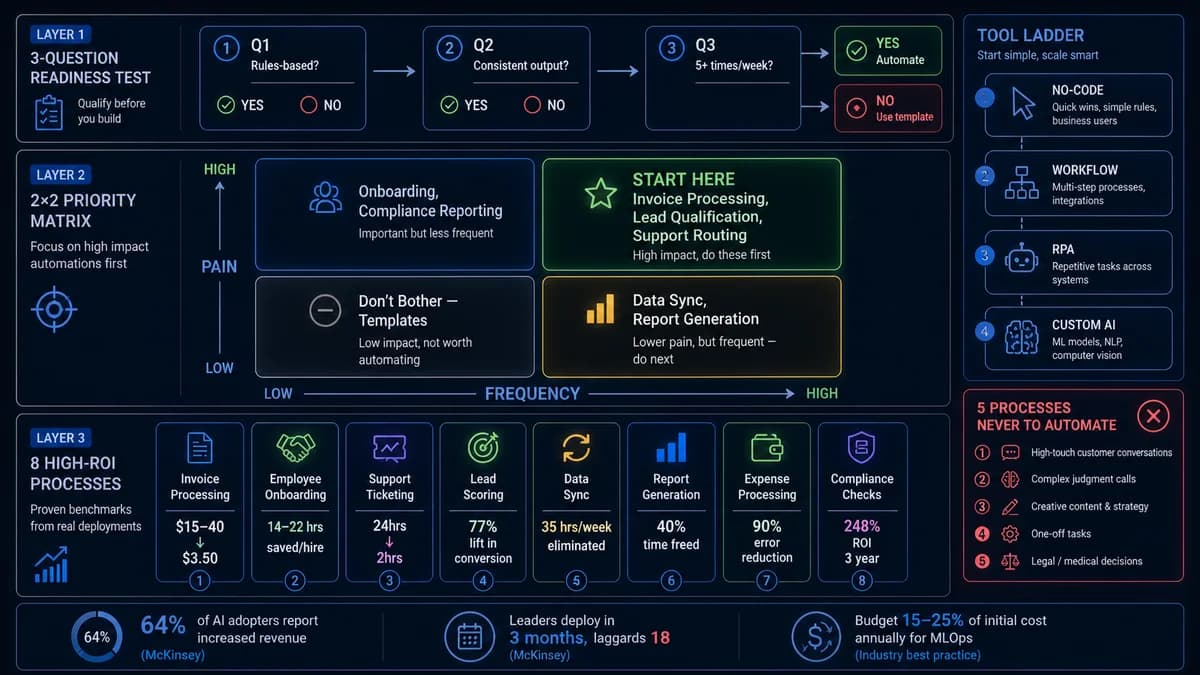
Intelligent automation is not deployed all at once. The architecture is built in stages, with each stage delivering standalone ROI while laying the foundation for the next.
Start with high-volume, rules-based processes: data entry, system updates, report generation. Build your automation team, governance model, and Centre of Excellence.
Layer intelligent document processing onto the RPA foundation. Claims forms, broker submissions, and medical reports can now be read and actioned automatically.
Train fraud, underwriting, and renewal propensity models on your historical data. Deploy with human-in-the-loop review until accuracy thresholds are met, then expand automation boundaries.
Bind RPA, IDP, and AI/ML into a single orchestrated workflow per process. Every layer hands off to the next with full context, audit trail, and escalation logic in place.
How Automely Builds Intelligent Automation
Automely designs and deploys intelligent automation architectures for insurance carriers, MGAs, and operations-heavy businesses. The engagement model follows the maturity model — starting with the highest-ROI RPA deployments and building toward full end-to-end orchestration.
What Automely Handles
Ready to move beyond basic RPA? Automely maps your current state, identifies the highest-ROI automation opportunities, and builds a phased deployment roadmap — at no cost for the initial assessment.
🤖 Get Your Automation Assessment