

Who This Guide Is Written For
You are a business owner, operations director, or product manager who has been tasked with commissioning an AI or machine learning system. You are not a data scientist. You are not a machine learning engineer. But you are responsible for evaluating vendors, approving budgets, and ensuring the project delivers what it promises.
Most AI/ML guides are written for engineers — full of jargon, academic terminology, and implementation detail that obscures rather than clarifies. This guide is written for the person who needs to make a decision: what kind of AI does my business actually need, what will it cost, what do I need to provide, and how do I avoid the vendors who will take my budget and deliver nothing useful?
By the end of this guide you will be able to decode any AI/ML proposal, have an informed conversation with any vendor, and make a grounded decision about whether a project is scoped and priced realistically.
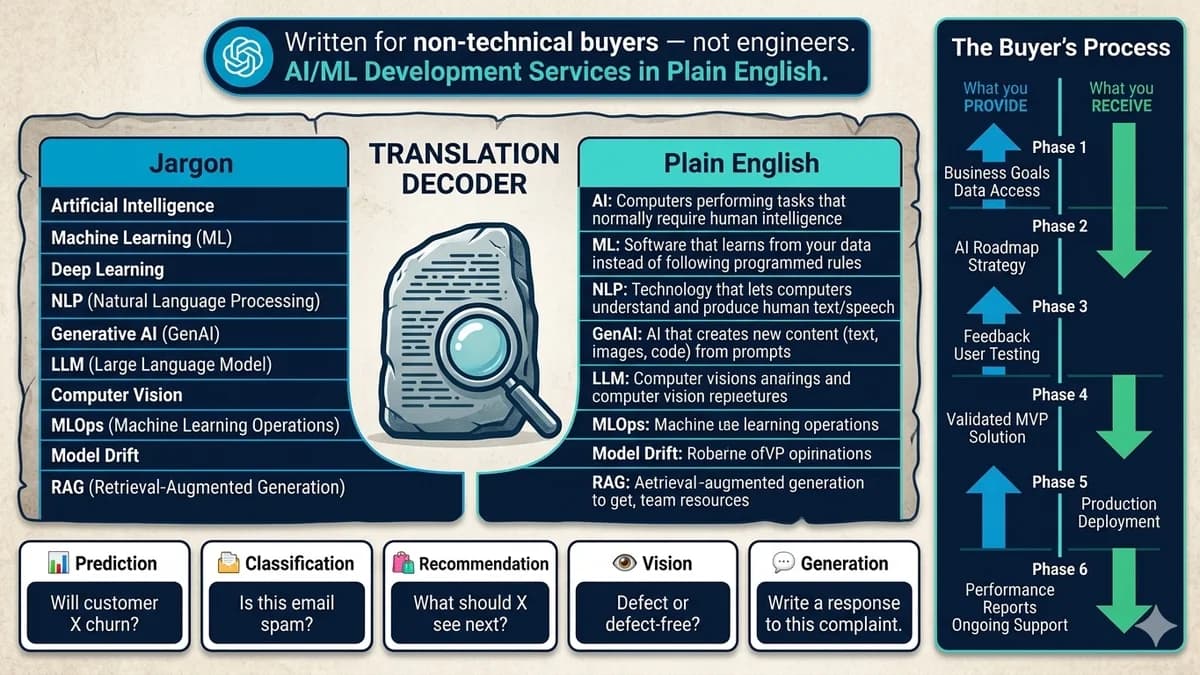
The AI/ML Jargon Decoder — 10 Terms That Matter
Before evaluating any vendor proposal, you need to understand the 10 terms that appear in almost every AI/ML engagement. The table below translates each term into plain English and flags its cost implication — because the biggest source of budget overruns is clients who approved a scope without understanding what they were agreeing to.
| Term | Plain English | Example | Cost Implication |
|---|---|---|---|
| AI (Artificial Intelligence) | Software that does things normally requiring human thought. | Email spam filter, face unlock on your phone. | Umbrella term — cost depends on the specific AI type. |
| ML (Machine Learning) | AI that learns from examples instead of following fixed rules. | A churn model trained on 3 years of your customer records. | Most custom business AI is ML. Core cost driver is data volume and quality. |
| Deep Learning | A type of ML using layers of 'neurons' — good for complex patterns. | Image defect detection on a factory line. | Needs more data and GPU compute. ~20–40% cost premium. |
| NLP (Natural Language Processing) | AI that reads, writes, or understands human text. | Analysing 10,000 support tickets to find top complaint themes. | Mid-tier cost. Pre-trained models keep it affordable. |
| Generative AI / LLM | AI that generates new text, code, images, or data (not just classifies). | GPT-4o drafting a personalised proposal from a CRM record. | API costs are low; integration and guardrails are where budget goes. |
| Training Data | The historical examples the model learns from. | 12 months of labelled invoices teaching a model to flag duplicates. | Often 30–50% of project cost. Missing or messy data is the #1 delay. |
| RAG (Retrieval-Augmented Generation) | An LLM that looks up your documents before answering — stays current and accurate. | An internal chatbot that answers from your policy manuals. | Lower than fine-tuning. Main cost is the document pipeline and vector DB. |
| Model Accuracy / Precision / Recall | How well the model performs. Precision = few false alarms. Recall = few missed cases. | Fraud model: high recall catches more fraud; high precision means fewer false blocks. | Higher accuracy targets extend testing cycles and iteration cost. |
| Model Drift | The model slowly gets worse as the real world changes after training. | A pricing model trained pre-COVID misfires on 2026 demand. | Requires ongoing monitoring and retraining budget (MLOps). |
| MLOps | DevOps for ML — the infrastructure to deploy, monitor, and retrain models reliably. | Automated alerts when accuracy drops below threshold. | $2K–$8K/month ongoing. Often omitted from initial quotes. |
The Five ML Problem Types — In Business Language
Machine learning solves five fundamental problem types. Almost every AI/ML project maps to one (or a combination) of these. Understanding which problem type you have determines which technical approach is appropriate, which data you need, and roughly what the project will cost.
Prediction
Forecast a number — revenue, demand, churn probability, lifetime value.
- Demand forecasting
- Customer lifetime value scoring
- Predictive maintenance alerts
- Dynamic pricing models
Classification
Sort items into categories — approve/reject, tag, or route automatically.
- Loan or insurance approval
- Fraud transaction flagging
- Support ticket routing by topic
- Medical image triage
Recommendation
Surface the right product, content, or action for each individual.
- E-commerce product suggestions
- Personalised email content
- Next-best-action in CRM
- Learning path recommendations
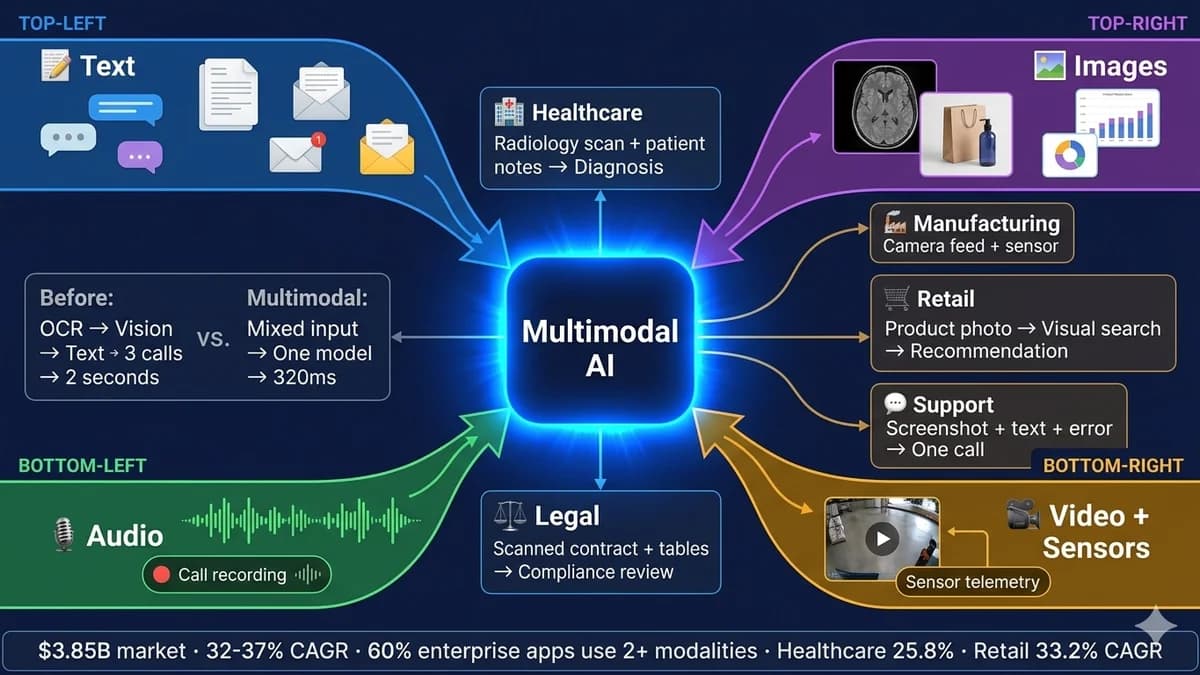
Vision / Multimodal
Understand images, video, documents, or mixed media at scale.
- Manufacturing defect detection
- Document data extraction (OCR+AI)
- Retail shelf compliance checks
- Security camera anomaly alerts
Generation
Draft, summarise, translate, or generate structured outputs from unstructured input.
- AI-assisted proposal writing
- Customer support draft replies
- Contract clause summarisation
- Automated report generation
What AI/ML Development Services Actually Include
A credible AI/ML development engagement covers seven phases. If a vendor proposal jumps straight to “model development” without addressing data preparation, deployment, or MLOps, the quote is incomplete — those costs will appear later as change requests.
Discovery & Scoping
- Map your business problem to the right ML approach
- Audit existing data sources and gaps
- Define success metrics before a line of code is written
- Feasibility report with go/no-go recommendation
Data Assessment & Preparation
- Data quality audit across sources
- Cleaning, normalisation, and feature engineering
- Labelling strategy (manual, semi-auto, or synthetic)
- Data pipeline build for ongoing ingestion
Model Development
- Baseline model benchmarking
- Iterative training and hyperparameter tuning
- Bias and fairness testing
- Model card documentation
Application Development
- API or microservice wrapping the model
- Front-end UI (dashboard, chatbot, or embedded widget)
- Integration with ERP, CRM, or existing stack
- Role-based access and audit logging
Testing & QA
- Unit and integration tests for model endpoints
- Edge-case and adversarial testing
- User acceptance testing with your team
- Performance benchmarking under load
Deployment
- Cloud or on-premise deployment
- CI/CD pipeline for model updates
- Rollback strategy
- Go-live support and hypercare period
MLOps & Ongoing
- Model performance monitoring dashboard
- Drift detection and retraining triggers
- Monthly accuracy reports
- Feature expansion roadmap
Not sure which ML problem type fits your use case?
Automely's discovery sprint maps your business problem to the right approach — before you commit to a full engagement. Free 45-minute consultation.
What You Provide vs What You Receive — Phase by Phase
One of the most common sources of project friction is a client who didn't know what was expected of them. AI/ML projects require active client participation at every phase — not just sign-off. The table below shows exactly what you will be asked to provide and what you should receive in return at each stage.
You Provide
- Access to 1–2 subject-matter experts
- Sample data (anonymised is fine)
- Description of the current manual process
- Definition of what 'success' looks like
You Receive
- Problem framing document
- Data readiness scorecard
- Recommended ML approach with rationale
- Rough cost and timeline estimate
You Provide
- Full data export or API access
- Data dictionary or schema docs
- Labelling input (if supervised learning)
- Approval to access connected systems
You Receive
- Clean, versioned dataset
- Data pipeline to production sources
- Labelling guidelines and tooling
- Data quality report with risk flags
You Provide
- Feedback on model outputs (is this realistic?)
- Edge cases from domain knowledge
- Sign-off on accuracy threshold
- Access to compute budget approval
You Receive
- Trained model with performance metrics
- Baseline vs model comparison report
- Bias/fairness audit
- Model card for compliance records
You Provide
- API credentials for existing systems
- UI/UX preferences or brand guide
- IT/security review sign-off
- UAT participants from your team
You Receive
- Working application or API endpoint
- Integration with your stack
- User documentation
- UAT sign-off checklist
You Provide
- Production environment access
- Go-live approval
- Feedback channel for anomalies
- Budget confirmation for MLOps retainer
You Receive
- Live model in production
- Monitoring dashboard
- Monthly performance report
- Retraining schedule and SLA
Honest Cost and Timeline Guide for AI/ML Projects
The ranges below reflect real-world project costs across Automely engagements and published benchmarks from Gartner, McKinsey, and independent AI development surveys. Costs vary primarily by data volume, data quality, accuracy requirements, and the number of integration points.
| ML Type | Cost Range | Timeline | Primary Cost Driver |
|---|---|---|---|
| Prediction / Regression | $15K – $60K | 6–14 weeks | Data volume, feature engineering complexity |
| Classification (binary) | $12K – $45K | 5–12 weeks | Label quality, class imbalance handling |
| Classification (multi-class) | $20K – $80K | 8–18 weeks | Number of classes, labelling cost |
| Recommendation Engine | $30K – $120K | 10–20 weeks | Catalogue size, real-time serving infra |
| Computer Vision | $40K – $150K | 12–24 weeks | Image labelling, GPU compute, edge deployment |
| NLP / Text Analysis | $15K – $70K | 6–14 weeks | Domain specificity, annotation volume |
| Generative AI / LLM App | $20K – $100K | 6–16 weeks | RAG pipeline, guardrails, fine-tuning if needed |
| End-to-End AI Platform | $150K – $500K+ | 6–18 months | Multiple models, full MLOps, change management |
| MLOps Retainer (ongoing) | $2K – $8K/month | Ongoing | Model count, retraining frequency, SLA tier |
The Three Most Common Budget Overruns
Discovering mid-project that historical data is siloed, inconsistent, or doesn't exist. Budget 15–20% of project cost for data remediation.
Supervised ML needs labelled examples. Skipping a labelling budget is the single most common cause of blown timelines.
"Can it also do X?" additions compound fast with LLM projects. Fix scope in writing before development starts.
Vendor Signals — 4 Red Flags and 1 Green Flag
How you evaluate an AI/ML vendor before signing a contract is more important than any line item in the proposal. These five signals — four that indicate risk and one that indicates a responsible vendor — will tell you more than any reference call.
Guarantees accuracy before seeing your data
Model performance depends entirely on data quality and problem difficulty. Any vendor quoting "95% accuracy" in a sales deck hasn't done discovery — they've done sales.
No mention of data preparation costs
If a proposal jumps straight to model development, the vendor either hasn't thought about your data or plans to charge for it separately once the project starts.
Proposes fine-tuning an LLM as the default solution
Fine-tuning is expensive and rarely necessary. Most business use cases are solved with RAG or prompt engineering at a fraction of the cost.
No MLOps plan after go-live
A model deployed without monitoring will drift silently. If the proposal ends at deployment, ask: "Who owns the model six months from now?"
Starts with a paid discovery sprint
The best vendors won't quote a fixed price until they've seen your data. A 1–2 week paid scoping engagement (typically $2K–$5K) is a sign the team builds responsibly — not to win the deal.
Why Non-Technical Buyers Work With Automely
Automely was built for exactly the buyer this guide is written for. We have delivered AI/ML projects for business owners, operations teams, and product managers who came to us with a business problem, not a technical specification — and we turned those problems into production systems. Our typical non-technical buyer engagement follows a predictable structure: a paid discovery sprint that produces a clear data readiness scorecard, problem framing, and a fixed-price proposal before any development begins.
We start with discovery, not a quote
We will not quote a fixed price until we have assessed your data. Every engagement begins with a 1–2 week paid discovery sprint ($2K–$5K) that produces a data readiness report, problem framing document, recommended ML approach, and a realistic cost and timeline estimate. You decide whether to proceed after you have the full picture.
You own all deliverables
Training data, trained model, code, documentation, and IP are transferred to you at project completion. No vendor lock-in, no proprietary format that requires us to maintain it.
MLOps is included by default
Every Automely deployment includes a monitoring dashboard, drift detection, and a defined retraining schedule. The model does not end at go-live. We have retainer structures ranging from $2K to $8K per month depending on model count, SLA tier, and retraining frequency.
Our AI development services cover the full ML problem spectrum — prediction, classification, recommendation, computer vision, and generative AI applications. Whether you need a single-model business tool or a full AI platform with multiple integrated models, begin with a no-obligation 45-minute consultation.
Have a business problem you think AI/ML could solve — but not sure where to start?
Automely's discovery sprint turns your business problem into a scoped, priced AI/ML project plan. Free 45-minute consultation.