

Let me be straight with you.
Most businesses trying to hire AI developers right now are going about it completely wrong. Not because they lack the budget or the intent — but because the playbook most people use to hire software engineers does not work for AI. And the bad hires in this space are expensive. We are not talking about a junior developer who writes inefficient SQL. We are talking about someone who builds a system that works perfectly in a demo, gets deployed, and then starts hallucinating responses, falling into infinite loops, or silently failing on real data while you wonder why your AI investment is not delivering.
I have seen this happen repeatedly. A founder gets excited about AI agents, posts on Upwork, gets 40 applications in 48 hours, picks the most confident-sounding proposal, pays a deposit — and eight weeks later has nothing deployable. This guide exists so that does not happen to you.
The most important shift in AI hiring for 2026: stop evaluating on credentials and start evaluating on production experience. Prioritise developers who have shipped AI systems that work under real conditions — not demos that survive a Tuesday afternoon presentation.
How AI Hiring Has Changed in 2026
Two years ago, "AI developer" mostly meant someone who could call the OpenAI API and chain a few prompts together. That bar has moved significantly.
In 2024, 78% of organisations reported using AI in some capacity — up from 55% the year before. As AI moved from pilot projects into production systems, the requirements for the developers building those systems changed completely. Today, an AI development company worth working with is not deploying chatbots that answer FAQ questions. They are building multi-agent pipelines, RAG knowledge bases, voice agents, and systems that integrate with real business workflows and have to work reliably at scale. You can see the kinds of systems we ship in our case studies.
Here is what that means for hiring:
| Dimension | Pre-2025 AI Roles | 2026 AI Roles |
|---|---|---|
| Skill Profile | Prompting + API usage | Full-stack: data engineering, model tuning, deployment, monitoring |
| Infrastructure | Local experimentation | Cloud runtimes, GPU orchestration, vector DBs, inference scaling |
| Data Handling | Light preprocessing | Structured pipelines, embeddings, retrieval layers, drift monitoring |
| Governance | Rarely considered | Privacy-first, compliance-conscious, PII protection, auditability |
| Success Definition | Working demo or proof of concept | Sustained business value: reliability, accuracy, efficiency |
The field is genuinely young. LangChain got real adoption in 2023. That means even the most experienced AI agent developers in the world have two to three years of production experience at most. Anyone claiming a decade of AI agent experience is not telling you the truth — and that alone tells you something about their judgment.
Which AI Developer Do You Actually Need?
This is where most businesses waste time — interviewing the wrong category of developer for the problem they are actually trying to solve. There are four distinct profiles and they are not interchangeable.
AI Agent Developer
Builds autonomous, multi-step systems using LangGraph, CrewAI, AutoGen. This is what most businesses actually need for workflow automation.
Generative AI Developer
Specialises in LLM integration, RAG systems, and fine-tuning. Critical for knowledge bases, document systems, and content workflows.
ML Engineer
Trains and deploys machine learning models. Handles data pipelines and MLOps. You need this for predictive systems and custom model work.
AI Integration Specialist
Connects AI to your existing business systems — CRMs, ERPs, APIs, and communication tools — without rebuilding your entire stack.
Start with the outcome you need in production in the next 90 days. Autonomous task execution → AI agent developer. Generating, summarising, or retrieving information → generative AI developer. Predictions from your data → ML engineer. Connecting AI to tools you already use → AI integration specialist.
Core Skills That Separate Real AI Developers From Demo Builders
The most expensive mistake in AI software development services hiring is evaluating developers on the wrong criteria. Here is what actually separates someone who can deliver in production from someone who can impress in a 30-minute interview.
1. Framework Depth — Not Just Awareness
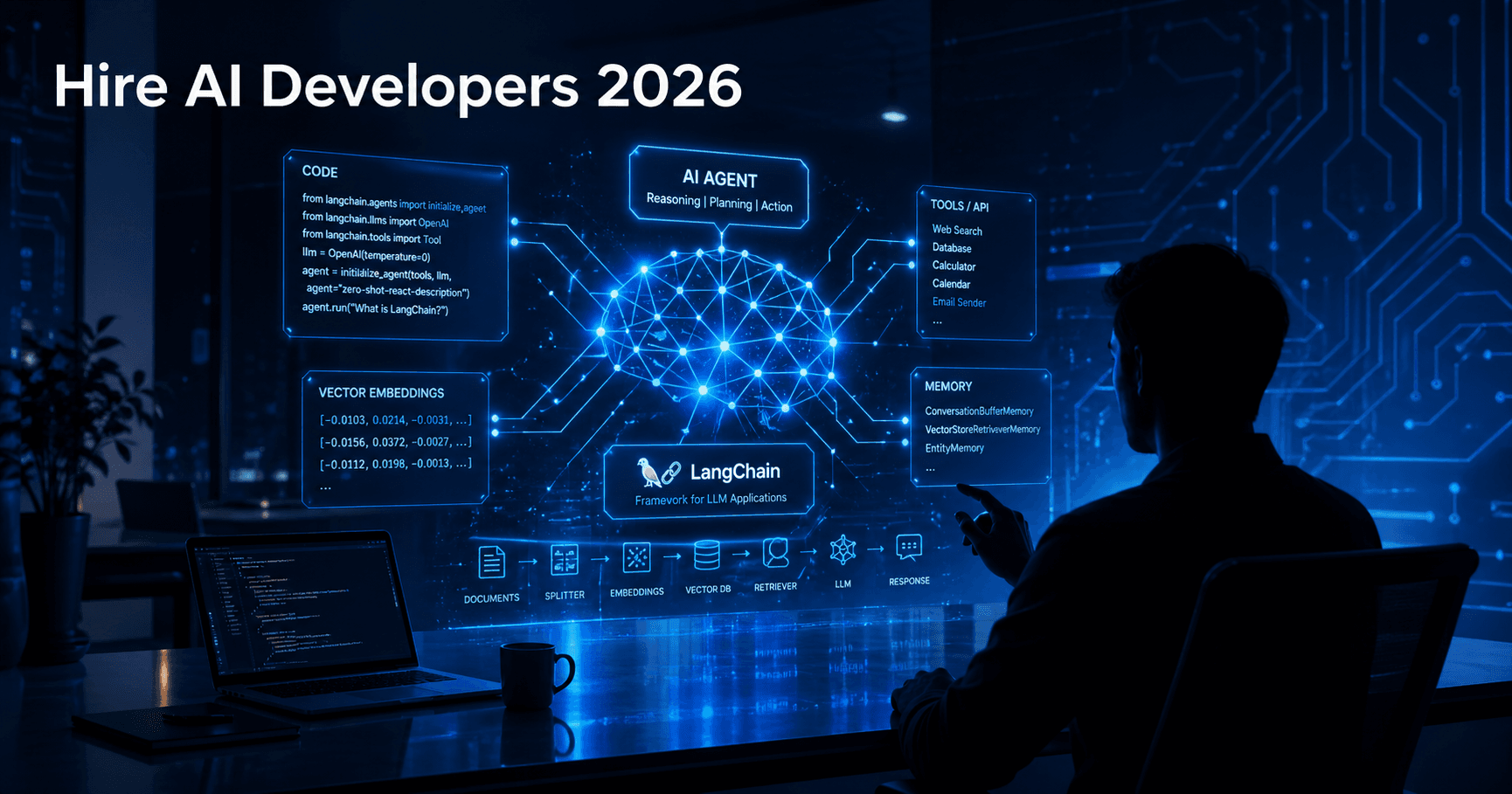
Everyone has read the LangChain documentation. That is not the same as having built and debugged a multi-agent system with LangGraph, handled memory persistence across sessions, managed vector database retrieval under real query volumes, and integrated five different business APIs into a single agent's tool ecosystem. Ask for specifics. Vague answers about "working with LLMs" are a red flag.
2. Production Experience — Not Just Demos
The single most important filter: have they shipped an AI system that real users interacted with, at real scale, with real consequences for failure? Not a proof of concept. Not a demo that works on carefully selected test data. A system that had to survive real messy inputs, unexpected user behaviour, and the edge cases that only appear when humans start using something. Review what our clients say about the systems we have delivered.
3. Failure Mode Awareness
The best AI developers are almost paranoid about what can go wrong. They will immediately bring up hallucination handling, stuck loops, escalation logic, observability, and token cost management. If a candidate only talks about what the agent can do and never mentions what happens when it does not — that is a problem. Machine learning development services that produce reliable systems are built by developers who design for failure, not just for success.
4. Integration Experience
An AI agent that cannot connect to your actual business systems is worthless. Ask specifically what integrations they have built — CRMs, ERPs, communication tools, custom APIs, webhook architectures. This is where most AI projects fail: not in the AI logic itself but in the integration layer that connects the AI to where the work actually happens.
5. Communication Clarity
Agent systems do unexpected things. You need a developer who can explain in plain language why the agent behaved the way it did and what the options are. If they cannot explain it clearly to a non-technical stakeholder, they probably do not understand it well enough to build it reliably. This matters especially for generative AI development projects where non-deterministic behaviour needs business-level explanation.
Skip the sourcing. Talk to a vetted AI developer in 48 hours.
Automely has matched 50+ businesses with dedicated AI developers. Book a free call and we will shortlist the right profile for your project today.
In-House vs Agency vs Freelancer: Pick the Right Model
Once you know what type of developer you need, the next decision is how you engage them. Most businesses pick the wrong model not because they lack information but because they do not honestly assess their own constraints.
| Hiring Model | Best For | Biggest Risk | Time to Start |
|---|---|---|---|
| In-House Team | AI is core to your product long-term and you have time to recruit | 3–6 month hiring timeline. Competitive talent market. | 3–6 months |
| Freelancer | Small, self-contained task with minimal integration requirements | Splits attention. Breaks down on anything requiring sustained iteration. | 1–2 weeks |
| AI Development Agency | Production systems, complex integrations, reliability requirements | Requires clear project scoping upfront. | 48–72 hours |
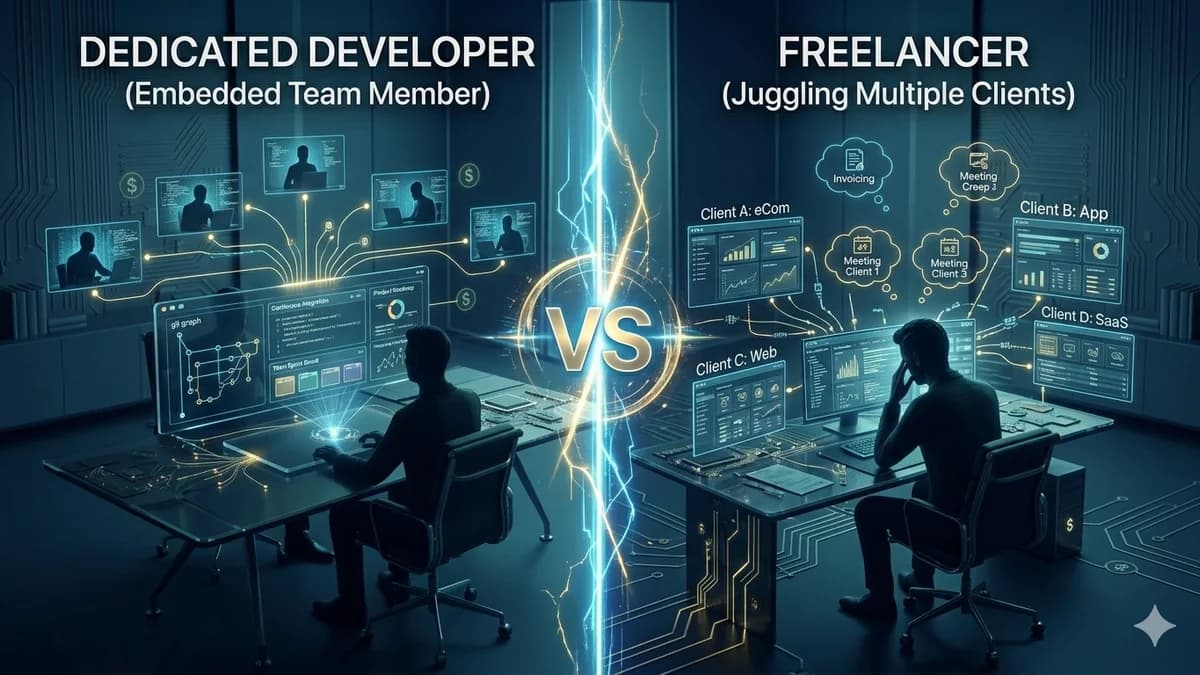
The honest case for a specialist AI development company: AI agent development requires focused iteration. Build, test against real messy data, fix the edge cases, monitor in production, fix again. That cycle breaks completely when a developer is splitting attention across three other clients. A dedicated developer embedded in your team — in your Slack, understanding your business context, making judgment calls without a 48-hour email back-and-forth — is the single biggest driver of how fast a project actually ships.
Yes, an agency costs more per month than a freelancer. But projects that take freelancers five months get finished in five weeks when someone is fully focused and accountable. You can explore our hiring options here to find the right engagement model for your project.
Interview Questions That Actually Work
Stop with the algorithm challenges and whiteboard coding sessions. Those tests were designed for a different type of engineering role. Here are the questions that reveal whether someone has actually shipped production AI systems.
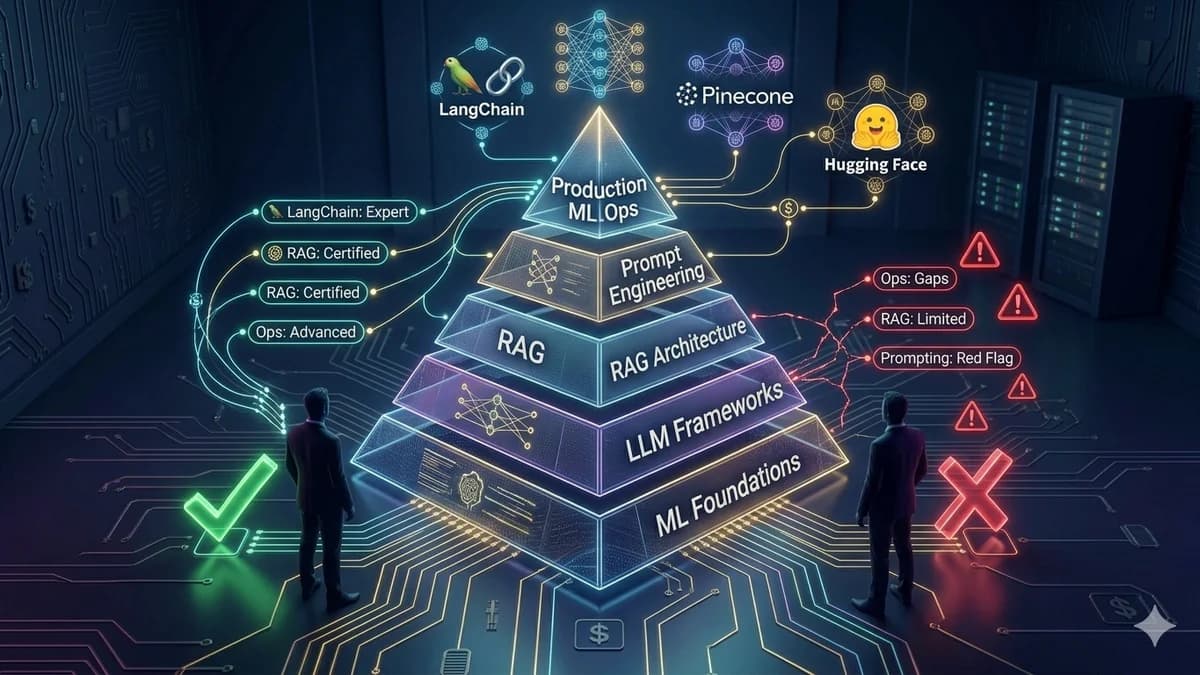
Red Flags to Walk Away From
The market for AI talent is full of people who have consumed a lot of tutorials and attended a lot of webinars. Spotting the difference between real experience and well-packaged surface knowledge saves months of wasted time and budget.
Only demo or tutorial-based experience. If every project example is a Jupyter notebook, a Hugging Face demo, or a personal project with no real users — they have not shipped production AI systems. Full stop.
Claiming a decade of AI agent experience. The field is two to three years old at meaningful production scale. Anyone claiming ten years of AI agent development is conflating unrelated work or misrepresenting their background.
Over-reliance on no-code tools without infrastructure understanding. Tools like n8n and Make.com have their place in AI workflow automation but cannot replace the engineering depth needed for serious production systems.
Cannot discuss failure modes. Every AI system fails in specific ways. If a candidate only talks about what the system can do and has nothing specific to say about what it cannot — they have not pushed one far enough to know its limits.
No references from live production deployments. Ask for actual clients or colleagues who can speak to what it was like to work with this developer on a real, shipped system. If there are none, that tells you everything.
Proposal full of buzzwords, light on specifics. If an agency's proposal is heavy on "leveraging cutting-edge AI" and light on explaining exactly what they will build, how it will work, and what the failure modes are — walk away. See what a detailed, honest proposal looks like by booking a call with our team.
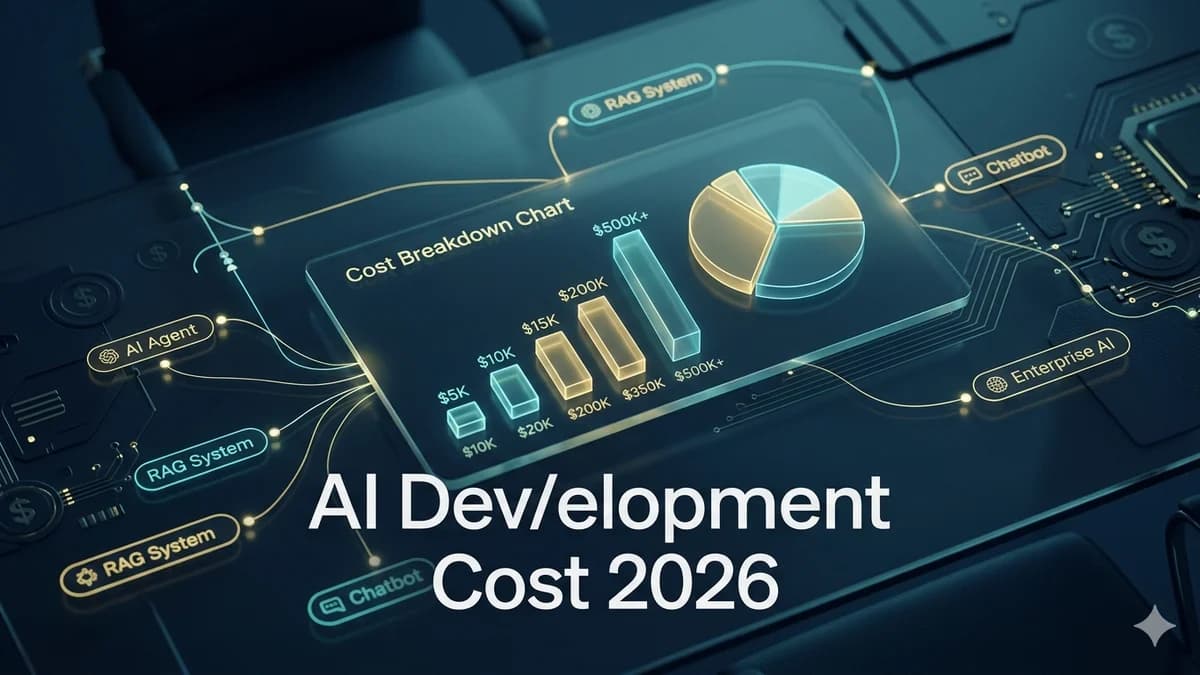
What It Actually Costs to Hire AI Developers in 2026
The honest answer is: it depends on who you hire, where they are, and whether you engage directly or through a specialist agency. Here are real market rates across different models.
Hourly Rates by Region
Full Project Cost Ranges
For businesses commissioning AI development services on a project basis, here are realistic ranges:
- Simple AI chatbot or FAQ agent: $5,000 – $15,000 — see our AI chatbot development service
- RAG knowledge base system: $10,000 – $35,000 — built using our generative AI development service
- Multi-agent pipeline with business integrations: $25,000 – $75,000
- Full AI SaaS product from MVP to launch: $50,000 – $200,000+ — see our SaaS development and MVP development services
- Ongoing dedicated developer retainer: $4,000 – $8,000/month via Hire a Developer
The most expensive number in AI hiring is not the developer's rate — it is the cost of a six-month mis-hire. If a developer builds something that does not survive production, you pay for the build, the delay, the rebuild, and the lost opportunity. Paying a higher rate for proven production experience consistently delivers better total economics.
Why Businesses Hire AI Developers Through Automely
We have matched over 50 businesses with dedicated AI developers across the US, UK, and EU. The matching takes 48 hours. You interview the shortlisted developers, you decide. If the fit is not right, we find another match. No long-term commitment before you are confident.
Our developers have shipped production AI systems across multiple industries — multi-agent pipelines that automate complete business workflows, RAG systems that give enterprise teams instant access to their knowledge base, AI voice agents that handle customer calls at scale, and full consumer AI applications with tens of thousands of real paying users. Read verified reviews from our clients on our testimonials page.
We serve businesses across a wide range of industries including healthcare, financial services, eCommerce, real estate, and management consulting. If you want to see specific work, browse our case studies.
The difference between our team and a developer you find on Upwork is not the technology stack. It is the production track record. Every system we build has to work under real conditions, with real data, and real business consequences for failure. That standard shapes every technical decision we make. If you want to understand what we offer across AI consulting, development, and dedicated hiring, our team page gives you a full picture of who builds your systems.
Ready to hire an AI developer who has shipped real systems?
Book a free 45-minute call. We will understand your project, match you with the right developer, and have you talking to candidates within 48 hours.