

The global AI agent development market hit $9 billion in 2026. Gartner projects 40% of enterprise applications will embed task-specific AI agents by year-end. US enterprises deploying AI agents are reporting an average 192% ROI. Those numbers are driving a flood of businesses into their first agentic AI project — many without a clear understanding of what the build actually involves or how long it realistically takes.
The honest answer spans from two weeks to six months depending on complexity. This guide breaks down exactly where on that range your specific project sits, why the range is so wide, and what the phase-by-phase timeline looks like at each level.
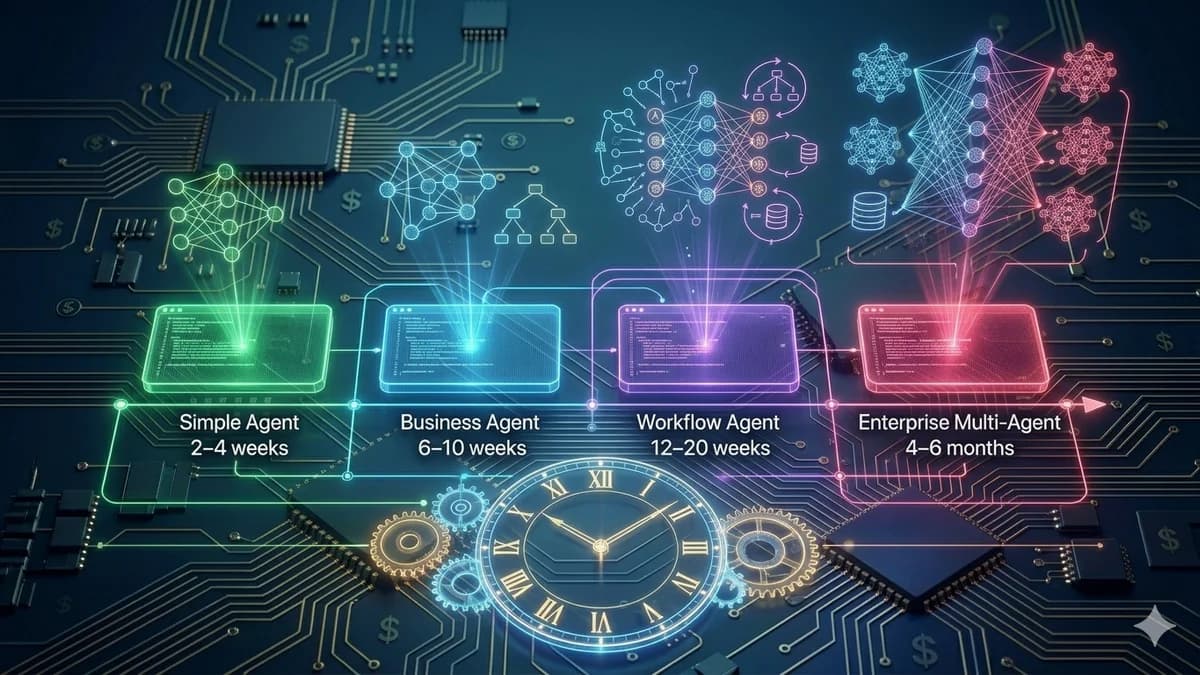
Simple single-task agent: 2–4 weeks | Business automation agent: 6–10 weeks | Complex multi-step workflow agent: 12–20 weeks | Enterprise multi-agent system: 16–28 weeks (4–7 months). The biggest variables are data quality, integration complexity, and whether a proper discovery phase runs before development begins.
First: What an AI Agent Actually Is (and Why It Takes Longer Than a Chatbot)
A chatbot answers a question. An AI agent completes a job.
The distinction matters enormously for timeline expectations. You can ask a chatbot “what is our returns policy?” and it retrieves an answer. An AI agent reads your CRM, identifies which customers have open return requests older than 7 days, drafts personalised resolution emails based on each customer's order history, sends them, logs the outcomes, and flags the ones that need human review — all without being prompted step by step.
Every AI agent has four core components that must all be designed, built, and tested to production standard before deployment:
- The reasoning core — the LLM that plans, decides, and generates. Model selection, system prompt architecture, and instruction design are engineering decisions that take time to get right.
- Memory — short-term session memory (what happened earlier in this conversation) and long-term knowledge memory (the persistent facts and context the agent needs). Both require architecture decisions and infrastructure.
- Tools — every action the agent can take (search the CRM, send an email, create a calendar event, call an API, run code). Each tool must be built, integrated, tested, and wrapped with error handling. A tool call that fails silently creates a broken agent.
- Orchestration logic — the loop that governs how the agent decides what to do next, evaluates whether it achieved its goal, and determines when to stop. This is where most of the subtle bugs live and where the majority of iteration time is spent.
For context: a basic RAG chatbot that retrieves from a knowledge base and answers questions might be built and deployed in 3–6 weeks. An AI agent with equivalent scope — but that actually takes actions rather than just generates text — adds the tool development, orchestration logic, and failure handling that chatbots do not require. Every tool integration adds 1–3 weeks. Every tool call failure mode adds testing time. Reliability at production scale adds QA time that demos never need.
AI Agent Development Timelines — Broken Down by Complexity
Tier 1 — Simple Single-Task Agent
Discovery & Architecture
Define the agent's single goal, input format, output spec, LLM selection, and the one tool it needs.
Prompt Engineering & LLM Integration
System prompt architecture, output schema enforcement, foundation model API connection and testing.
Tool Development
Build and test the single tool the agent uses (API connection, database query, or data transformation).
Testing, QA & Production Deployment
Edge case testing, failure handling, error messages, cloud deployment, monitoring setup.
Tier 2 — Business Automation Agent
Discovery & Architecture
Full workflow mapping, tool inventory, integration feasibility checks, LLM selection, memory design, state management planning.
LLM Core & Prompt Architecture
Multi-step reasoning design, tool-calling prompt structure, output validation layer, model routing for cost optimisation.
Tool & Integration Development
Build each tool: CRM connection, email/calendar API, data lookups, payment or booking systems. Error handling for each. Rate limit management.
Orchestration Logic
Multi-step decision loop, goal evaluation, human handoff triggers, graceful degradation when a tool fails.
Testing, Production Hardening & Deployment
Real-world edge case testing, production load testing, observability setup, staging, deployment, go-live monitoring.
Tier 3 — Complex Multi-Step Workflow Agent
Discovery & Architecture
Full system architecture, multi-step workflow design, data assessment and preparation plan, RAG design if applicable, integration map with feasibility per system.
Data Preparation & Knowledge Base
Data cleaning, chunking strategy, embedding, vector database setup, retrieval evaluation. This phase is often underestimated.
Agent Core & Orchestration
LangGraph or LangChain multi-step loop design, memory architecture (short + long term), tool router, goal evaluator, interruption and resumption logic.
Tool & Integration Development
Multiple business system integrations (CRM, ERP, email, calendar, data warehouse), each with error handling, rate limits, and retry logic.
Testing, QA & Hardening
End-to-end workflow testing, failure injection testing (what happens when each tool fails), performance testing, security review, compliance check.
Deployment, Monitoring & Post-Launch Optimisation
Production deployment, observability with LangSmith or Helicone, alerting, 4-week post-launch iteration cycle based on real usage data.
Tier 4 — Enterprise Multi-Agent System
Discovery, Architecture & Governance Design
Multi-agent system architecture, orchestrator design, agent specialisation map, compliance and data governance framework, security design, integration inventory.
Infrastructure & Data Foundation
Multi-tenant infrastructure setup, shared memory and state management architecture, data pipeline, vector database, compliance logging infrastructure.
Orchestrator Agent Development
Goal decomposition logic, task routing to specialist agents, inter-agent communication, shared context management, escalation and human override mechanisms.
Specialist Agent Development (parallel)
Each specialist agent built and tested independently: research agent, execution agent, quality-check agent, reporting agent. Each with its own tools and validation.
Integration, Enterprise Tooling & System Testing
6+ system integrations, end-to-end multi-agent pipeline testing, failure injection across every agent boundary, performance under concurrent load.
Staged Deployment & Production Optimisation
Phased rollout (limited users → full production), full observability suite, SLA monitoring, compliance audit, team training, post-launch iteration.
Want a specific timeline estimate for your AI agent project?
Automely scopes AI agent projects every week. Book a free 45-minute call and we will give you a phase-by-phase timeline estimate within 48 hours — no commitment required.
What Slows AI Agent Development Timelines Down
Every timeline overrun in AI agent development has a root cause. Here are the most common ones, with their typical impact in weeks.
| Delay Factor | How It Manifests | Timeline Impact |
|---|---|---|
| Poor or unstructured data | Data that looked clean turns out to have inconsistent formats, missing fields, duplicate records, or encoding issues. Data preparation can represent 30–50% of total project time when data quality is poor. | +2–6 weeks |
| Poorly documented third-party APIs | Undocumented rate limits, inconsistent error responses, unexpected data formats in production versus documentation. Every tool integration has API surprises. | +1–3 weeks per integration |
| Requirement changes mid-build | New feature requests or scope changes during development require rework of orchestration logic or prompt architecture. Mid-build changes on an agent are more expensive than mid-build changes on standard software because of how components depend on each other. | +2–4 weeks |
| Compliance and security requirements | HIPAA, GDPR, or financial regulation requirements that affect architecture from the ground up. Discovered mid-build rather than in discovery, these can require significant rework. | +2–4 weeks |
| Production reliability requirements | Building for 99%+ reliability requires significantly more engineering than building a demo that works on happy-path inputs. Failure handling, retry logic, graceful degradation, and observability all take time that is easy to underestimate. | +1–3 weeks |
| No discovery phase before development | Jumping directly to development without a proper architecture and data assessment typically doubles the iteration time. Architecture pivots mid-development are expensive. | +3–6 weeks |
| Unclear success criteria | Only 11% of AI agent pilot programs transition to full production successfully — the most common reason is that success criteria were not defined upfront, leaving no clear definition of “done.” | +2–4 weeks of iteration |
What Speeds AI Agent Development Up
The same variables that cause delays when they are in bad shape accelerate timelines when they are in good shape. The most impactful accelerators:
- Clean, well-structured data available before development begins. Organisations with clean data repositories can reduce data preparation time by up to 50%. This single factor is the most powerful timeline accelerator available.
- A completed discovery phase before any development starts. McKinsey research shows companies investing in comprehensive discovery processes are three times more likely to meet their timeline targets. A proper discovery phase (2–4 weeks) prevents the architecture pivots and scope changes that represent the majority of timeline overruns.
- Well-documented third-party APIs with reliable sandbox environments. When the APIs the agent needs to call have clear documentation, consistent error handling, and working sandbox environments — integration time drops significantly.
- An experienced AI agent development team. A team that has built similar agents before knows the failure modes, knows the common integration challenges, and has reusable architecture patterns. The difference in timeline between an experienced team and a first-time team on the same complexity level is often 30–50% of total build time.
- Stable, clearly defined requirements that do not change mid-build. The absence of scope changes is itself a timeline accelerator. The best way to achieve this is thorough discovery before development, not more discipline during development.
Real AI Agent Projects From Automely — With Actual Timelines
An AI voice agent that automatically calls existing customers when new Shopify products or discounts go live. The agent handles the complete ordering conversation, creates a Shopify order in real time, sends a Stripe payment link via SMS, and notifies the sales team on payment confirmation. Eliminated manual outbound calling across the full customer database.
A fully automated lead qualification and outreach system. The agent reads LinkedIn Sales Navigator CSV exports, verifies leads through Apollo.io, generates personalised German-language outreach messages using GPT-4, pushes qualified leads to Close CRM, and triggers automated email, SMS, and phone sequences. Replaced two full-time staff members from the qualification process.
An end-to-end communication automation system — automated assignment delivery from Zoom session transcripts, AI-reading of student email replies, appointment reminder sequences, Slack briefings for consultants before sessions, exam reminders months after program completion, and GMB review requests on graduation. Replaced four manual communication processes across the full student lifecycle.
Red Flags When an Agency Quotes Your Timeline
“We can have your AI agent live in two weeks” — for anything more complex than a single-task agent with one tool. Two-week AI agent delivery claims either describe a prototype that will not survive real usage, a template being minimally customised, or an agency that has never had to debug production failure modes. A real business automation agent needs 6–10 weeks minimum.
Timeline quote without a discovery phase. A reliable timeline cannot be produced without first assessing your data quality, integration complexity, and technical approach. Any agency giving you a confident timeline number before completing discovery is guessing — often optimistically.
No mention of post-launch iteration time. AI agents almost never work perfectly on the first production deployment. Real user inputs differ from test inputs in ways that are hard to anticipate. A timeline that ends at “go live” with no post-launch optimisation phase is not a real AI agent project timeline.
No data assessment phase for agents that depend on your data. Any agent that needs to understand your specific business data — your knowledge base, your CRM data, your product catalogue — requires a data assessment. An agency that skips this step is building on assumptions that will materialise as production problems.
Timeline has no phases for tool failure handling or edge cases. The orchestration and failure handling of an AI agent often takes as long as the core agent logic itself. A timeline without explicit phases for these — or that bundles them into “QA” as a single line — has not accounted for the work that makes agents reliable in production.
Automely's Approach to AI Agent Development Timelines
Automely's AI agent development service has delivered production AI agents from Tier 1 through Tier 3 across the US, UK, and EU. Our standard timeline approach follows four principles that consistently produce accurate estimates and on-time delivery:
Discovery is non-negotiable. Every AI agent project starts with a scoped discovery phase (1–3 weeks depending on complexity) that produces a technical architecture, integration map, data assessment, and phased timeline. No development begins before discovery is complete. This single practice has the highest return of any process investment we make — it converts vague estimate ranges into accurate phase-by-phase timelines.
Timelines are phase-specific, not project-level. We do not quote a single project completion date. We quote phase-by-phase timelines with defined acceptance criteria per phase. Each phase is completed before the next is priced. This lets us absorb the learnings from each phase into the next phase's timeline estimate rather than locking in upfront what we cannot know upfront.
Post-launch time is in every estimate. Every Automely AI agent engagement includes 2–4 weeks of post-launch optimisation time as part of the project scope. The first production deployment surfaces real user behaviours that test inputs do not capture. This iteration cycle is not a sign of failure — it is the engineering reality of production AI systems and it is in every honest timeline.
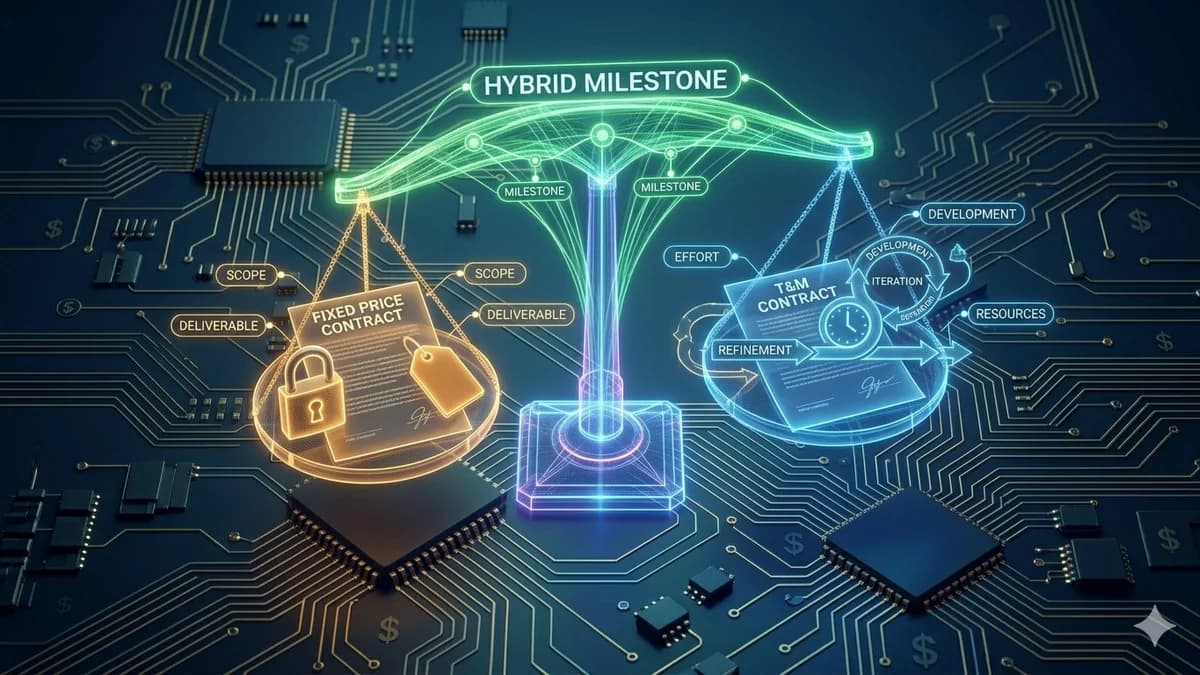
Timelines are held accountable. We set milestone-based payment terms tied to delivered, accepted phases. If a phase slips, payment does not release until delivery. This structure keeps both sides honest about timelines in a way that time-based contracts do not.
Browse our case studies, check our client testimonials, and explore our full AI agent development service. We also offer generative AI development, AI chatbot development, and AI integration services. Dedicated AI agent developers are available from $4,000/month for projects that need sustained ongoing development.
Want a realistic phase-by-phase timeline for your AI agent project?
Book a free 45-minute call. We will scope your agent, identify which tier it belongs to, and give you a detailed phase-by-phase timeline within 48 hours — no commitment required.