


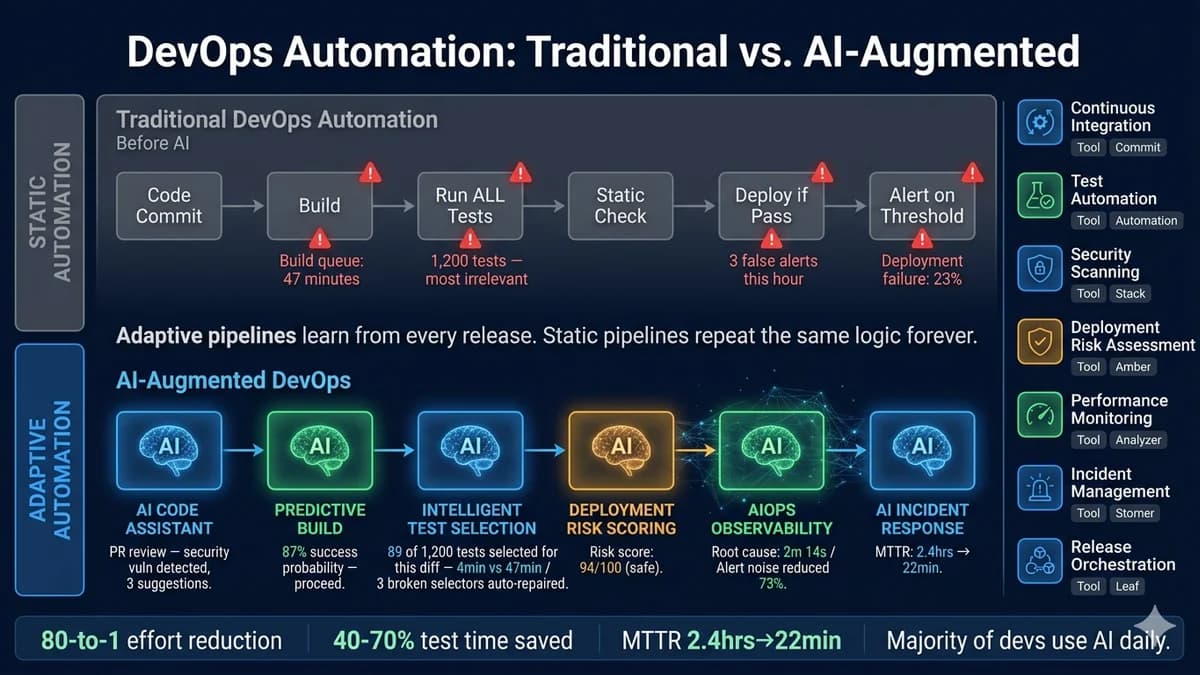
The Static Automation Problem — Why Teams Are Still Stretched Thin
Most DevOps teams arrived in 2026 with CI/CD already running. Infrastructure as code already deployed. Monitoring dashboards already live. They automated everything that explicit rules could automate — and they are still stretched thin. Incidents still happen. Cloud costs still spiral. Build queues still back up. Deployment failures still cause painful post-mortems.
The problem is not a lack of automation. The problem is that all of the existing automation is static. It executes the same predefined logic regardless of what changed, what the risk profile of this specific deployment is, or what patterns have emerged from ten thousand previous releases. Every commit triggers the full test suite — even when the change touched two CSS utility classes that have never caused a regression. Every metric threshold breach fires an alert — even when the same pattern appeared sixty times last month and resolved itself within ninety seconds each time. Every deployment follows the same approval checklist — even when the change is a one-line documentation update at 2pm on a Tuesday with 20% of normal traffic.
This is the gap that AI-augmented DevOps addresses in 2026. Not by automating more things — but by making automation contextually aware, probabilistically accurate, and continuously learning from the outputs it produces.
What AI Actually Changes in DevOps Automation
The conceptual shift from traditional DevOps automation to AI-augmented DevOps automation is the shift from static to adaptive. Static pipelines execute the same logic every time. Adaptive pipelines learn from historical outcomes and adjust their behaviour based on context, risk, and pattern.
Traditional DevOps Automation — Static
- Run all tests on every commit, regardless of what changed
- Deploy if all predefined checks pass — same criteria every time
- Alert when metric crosses a fixed threshold
- Investigate incidents manually — engineer correlates logs by hand
- Scale infrastructure on fixed rules (CPU > 80% → add instance)
- Same pipeline configuration for every type of change
- Pipeline performance is the same on day 1,000 as on day 1
AI-Augmented DevOps Automation — Adaptive
- Select the tests most likely to catch regressions given what changed
- Score deployment risk based on patterns from previous releases
- Correlate anomalies to distinguish real incidents from noise before alerting
- Surface root cause automatically within minutes of anomaly detection
- Predict resource needs based on traffic patterns and upcoming deployments
- Adjust pipeline paths based on change type, risk, and business context
- Pipeline performance improves continuously from every release outcome
The most successful teams treat AI as a co-pilot, not an autopilot. AI surfaces the signal and reduces the noise — engineers make the judgment calls where the cost of being wrong is high. The teams achieving the biggest gains are not the ones that removed humans from critical decisions. They are the ones that removed humans from the repetitive, low-signal work that made the critical decisions harder to reach and act on quickly.
CI/CD exists to give teams the confidence to ship changes without fear. Every step in a pipeline is designed to reduce the likelihood and impact of production failures. Introducing AI — which is probabilistic and non-deterministic — into an environment that requires consistent, reproducible signals raises legitimate concerns. AI adoption inside pipelines is shaped more by trust and measurable outcomes than by model capability. The right approach: start with AI at the edges (code assistance, observability), build trust through demonstrated accuracy, then extend into higher-stakes pipeline decisions with appropriate governance. Never deploy AI into a pipeline stage where a wrong decision cannot be detected and reversed quickly.
7 AI Applications in DevOps Automation — Mapped to Pipeline Stages
The seven AI applications below cover the full software delivery lifecycle — from the developer's IDE through build, test, deploy, and operate. Each one is mapped to a specific pipeline stage, has a specific operational outcome, and is supported by named tools that are production-ready in 2026. Read this as a capability matrix: which of these applications would create the most value at your current bottleneck, and what tools deliver that capability today.
What it does
AI code assistants work at every layer of the development workflow — generating boilerplate, suggesting completions, reviewing pull requests, detecting security vulnerabilities, and explaining unfamiliar code. In the pipeline context, AI-powered code review gates in CI/CD catch issues at the point of contribution rather than at integration or production.
Specific capabilities
- Context-aware code generation from natural language prompts and surrounding code
- Automated PR review with bug identification, style feedback, and security flagging
- Vulnerability detection in code and dependencies before merge
- Code explanation and documentation generation on change
- Agentic mode: multi-file refactoring and feature implementation autonomously
What it does
Instead of running the full test suite on every commit — which can take 40+ minutes for large codebases — AI analyses the diff and selects the tests most likely to catch regressions based on code change patterns, historical failure data, and test-to-code coverage maps. Self-healing test automation detects and repairs broken test scripts caused by UI changes or selector drift without manual intervention.
Specific capabilities
- Diff-aware test selection: run 89 tests instead of 1,200 based on what changed
- Parallel test distribution optimised by historical execution time
- Failure analysis pointing to specific slow steps and recurring patterns
- Self-healing selectors: AI detects broken locators and suggests fixes
- AI-generated test cases for new features from natural language descriptions
- Risk-based test prioritisation: highest-risk tests run first
What it does
ML models trained on pipeline history analyse incoming commits and predict build failure probability, estimated build time, and deployment risk before the build starts or the deployment proceeds. Teams can intervene before failures materialise — not after they have consumed pipeline capacity and delayed the release cycle.
Specific capabilities
- Build failure prediction: flag high-risk commits before they enter the build queue
- Build time estimation based on change scope, test selection, and current load
- Deployment risk scoring: patterns from previous releases in similar conditions
- Bottleneck identification: which pipeline stages are consistently causing delays
- Release readiness scoring: aggregate signal from test coverage, code quality, and change history
What it does
Traditional monitoring generates alerts when metrics cross thresholds. AIOps correlates logs, metrics, and traces across distributed systems to identify root causes, group related alerts into meaningful incidents, and distinguish genuine anomalies from the noise that monitoring systems routinely generate. The shift: from reactive alert response to proactive anomaly prediction and root cause surfacing before on-call engineers even get paged.
Specific capabilities
- Automated causal analysis: groups related symptoms into single incident context
- Business impact prioritisation: which incidents affect revenue-generating paths
- Root cause identification: minutes vs. the 45+ minutes of manual log correlation
- Alert noise reduction: 60-80% fewer alerts by correlating related signals
- Anomaly prediction: flagging patterns before they become user-visible incidents
- Full-stack correlation: infrastructure, application, and user experience together
What it does
When incidents occur, AI aggregates all relevant context — logs, metrics, recent deployments, ticket history, previous similar incidents and their resolutions — and presents it to the responding engineer with root cause hypotheses and recommended remediation steps. Instead of starting from a blank incident canvas, the engineer starts from a pre-populated investigation with AI doing the initial correlation work.
Specific capabilities
- Automated incident context assembly: relevant logs, metrics, and deployment history
- Root cause hypothesis ranking: probability-weighted candidate causes
- Runbook automation: AI executes predefined remediation steps autonomously
- Real-time communication: contextual Slack/Teams responses during incident
- Post-incident summary: AI-generated incident report with cause, fix, and prevention
- MTTD and MTTR reduction: documented cases 2.4hrs → 22min
What it does
AI-powered canary analysis monitors the performance of a partial deployment in real time — comparing error rates, latency, and business metrics between the canary and the production baseline. If the canary shows degradation beyond defined tolerance, AI triggers automatic rollback before the full release proceeds. This is the deployment equivalent of predictive anomaly detection: catching deployment failures at 5% traffic rather than 100%.
Specific capabilities
- Automated canary analysis with statistical comparison against baseline
- Real-time deployment health scoring from SLI/SLO signals
- Automatic rollback triggered by performance degradation thresholds
- Feature flag management with AI-powered experiment analysis
- Deployment risk scoring pre-release based on change context and historical patterns
- Progressive delivery orchestration with AI-managed traffic shifting
What it does
Cloud infrastructure costs spiral when scaling decisions are made on fixed rules (CPU > 80% → scale up) without learning from usage patterns. AI cost optimisation analyses actual consumption patterns, identifies over-provisioned resources, predicts capacity needs before demand spikes, and recommends or automatically executes right-sizing decisions. Netflix and Google use ML-driven resource optimisation for their Kubernetes and CI/CD infrastructure at scale.
Specific capabilities
- Right-sizing recommendations: identify over-provisioned VMs and containers
- Predictive auto-scaling: provision ahead of demand based on traffic patterns
- Spot/preemptible instance management with ML-driven availability prediction
- CI/CD resource optimisation: allocate runners based on build history
- Cost anomaly detection: flag unexpected spend increases before billing cycle
- Multi-cloud cost arbitrage: recommend workload placement by cost efficiency
What Must Stay Human in an AI-Augmented DevOps Pipeline
AI in DevOps delivers its highest value when it is positioned as a signal amplifier — reducing noise, surfacing root cause faster, and flagging risk before it materialises. The teams achieving the best outcomes are not the ones that removed human judgment from the pipeline. They are the ones that removed humans from repetitive, low-signal work so that human judgment is available for the decisions where it genuinely matters.
Production Deployment Approval for Major or High-Risk Releases
AI should score deployment risk and surface the relevant signals. For significant releases — major version bumps, database migrations, architectural changes, or deployments during peak traffic periods — a human with business context and accountability should approve. Not because AI scores are wrong, but because production incidents affecting customers require a human who understands the business consequences to be in the decision loop.
Incident Decisions with Direct Customer Impact
AI should surface root cause and recommend remediation. But the decision to take a service offline, roll back a release affecting active users, or escalate to a vendor with contractual SLA implications should be human. AI narrows the decision space dramatically — it should not make the final call when the outcome has irreversible customer or revenue consequences.
Security Vulnerability Remediation Review
AI can detect vulnerabilities and suggest patches. Merging security fixes into production without human review introduces a category of risk that the fix is designed to prevent. The review time for an AI-suggested security patch should be the minimum required to validate it is correct and complete — not skipped entirely in the name of automation speed.
Architecture and Pipeline Design Decisions
AI can generate infrastructure as code, pipeline configurations, and architecture diagrams. The decisions about how systems should scale, fail, recover, and connect — the architectural choices that determine how your team operates under load and incident conditions for the next three years — should be reviewed and owned by experienced engineers who understand the full context of the system and the team operating it.
Building AI-augmented DevOps capabilities — custom pipeline intelligence, AIOps integration, or AI-assisted development workflows — for your engineering team?
Automely designs and builds the custom AI layers that standard DevOps tooling doesn't cover: pipeline intelligence models, AIOps integrations, and AI-assisted development workflows. Free 45-minute consultation.
The Governance Question — How to Build Trust in AI Pipeline Decisions
The most practically important question that AI-augmented DevOps raises in 2026 is not technical. It is: how do you build the governance mechanisms that give teams the confidence to trust AI pipeline decisions — and how do you maintain accountability when AI makes a mistake?
CI/CD exists to give teams the confidence to ship changes without fear. Introducing AI into that confidence-building system requires a governance framework that answers three questions. First: can you explain why the AI made a specific decision? (Explainability.) Second: can you detect when the AI makes a wrong decision before it causes a production incident? (Observability.) Third: can you reverse the decision quickly if it turns out to be wrong? (Reversibility.) Any AI application in a DevOps pipeline that cannot satisfy all three conditions should not be deployed autonomously. It should operate in recommend-only mode until sufficient evidence of accuracy is established to justify autonomous action.
The practical implementation: build AI governance features directly into pipelines. Every automated AI action should be logged with the decision context: what data was used, what model version was applied, what confidence score was produced, and what alternative actions were considered. This audit trail is the foundation of both regulatory compliance (where applicable) and team trust — engineers who can see why AI made a decision are far more likely to adopt AI-augmented workflows than those operating a black box.
Implementation Sequence — Where to Start for Fastest Value
The implementation sequence below mirrors the trust-building arc that successful teams follow: start with low-risk AI at the edges of the pipeline, validate accuracy, then extend into higher-stakes decisions only after the team has established confidence in the tooling. Each phase compounds on the data and trust generated by the previous one — which is why sequencing matters as much as tool selection.
Start at the Edges: Code Assistance and Observability Intelligence
Deploy AI code assistants (GitHub Copilot, Cursor) to all developers and enable AIOps alert correlation in your monitoring stack. Both applications are low-risk, immediately valuable, and build team trust in AI tooling without touching the critical path of the delivery pipeline. Code assistants operate in the IDE where mistakes are cheap. AIOps operates on monitoring data where wrong correlations are visible and reviewable before action is taken.
Intelligent Test Selection and Build Analytics
Once the team has confidence in AI tooling from Phase 1, introduce intelligent test selection into the CI pipeline. Start in recommend mode — the AI recommends which tests to skip, but still runs the full suite — and validate accuracy against actual failure rates for 3-4 weeks before switching to automatic test selection. Simultaneously deploy build failure prediction in monitoring mode.
AI-Assisted Incident Response and Deployment Risk Scoring
Layer in AI incident response — building the context assembly and root cause hypothesis generation from your now-established observability data. Deploy deployment risk scoring in advisory mode: AI surface the score and its reasoning, but humans make the deployment decision. Track accuracy of risk scores against actual deployment outcomes for 6-8 weeks before extending AI to autonomous gating decisions.
Autonomous Deployment Decisions and Cost Optimisation
With established trust from Phases 1-3, extend AI to autonomous canary analysis and rollback for standard deployment types. Deploy cloud cost optimisation with weekly review cycles. These phases benefit from the historical pipeline data generated in earlier phases — AI models improve with more outcome data, and the team benefits from demonstrated accuracy before extending autonomy.
How Automely Builds AI-Augmented DevOps Capabilities
Automely builds custom AI systems for development and operations workflows — the intelligence layers that sit on top of existing DevOps tooling and extend what standard tools provide. Our DevOps-adjacent work covers AI-assisted code generation workflows, custom pipeline intelligence models, AIOps observability integrations, and AI-powered developer experience tooling.
We built Lamblight (20K+ users, $312K ARR) and Cerebra Caribbean (10K+ conversations, 95% CSAT) using AI-augmented development workflows — practices we apply to every engagement to compress delivery timelines without compressing quality. Our broader thinking on AI in software development is reflected in our custom AI development guide and our AI agent development services.
Automely builds AI-powered DevOps systems — AIOps pipelines, self-healing infrastructure, AI code review, predictive monitoring, intelligent incident response, and AI-enhanced CI/CD. DevOps automation projects start from $15,000. Book a free 45-minute consultation at cal.com/Automely.ai/45min.
Browse our case studies, read client testimonials, and explore our full AI services portfolio including custom AI development, AI agent development, and enterprise AI solutions.
Looking to build custom pipeline intelligence, AI-assisted development workflows, or AIOps integrations that go beyond what off-the-shelf DevOps tools offer?
Free 45-minute consultation. We assess your current DevOps stack, identify the highest-ROI AI augmentation, and recommend the specific technical approach.