


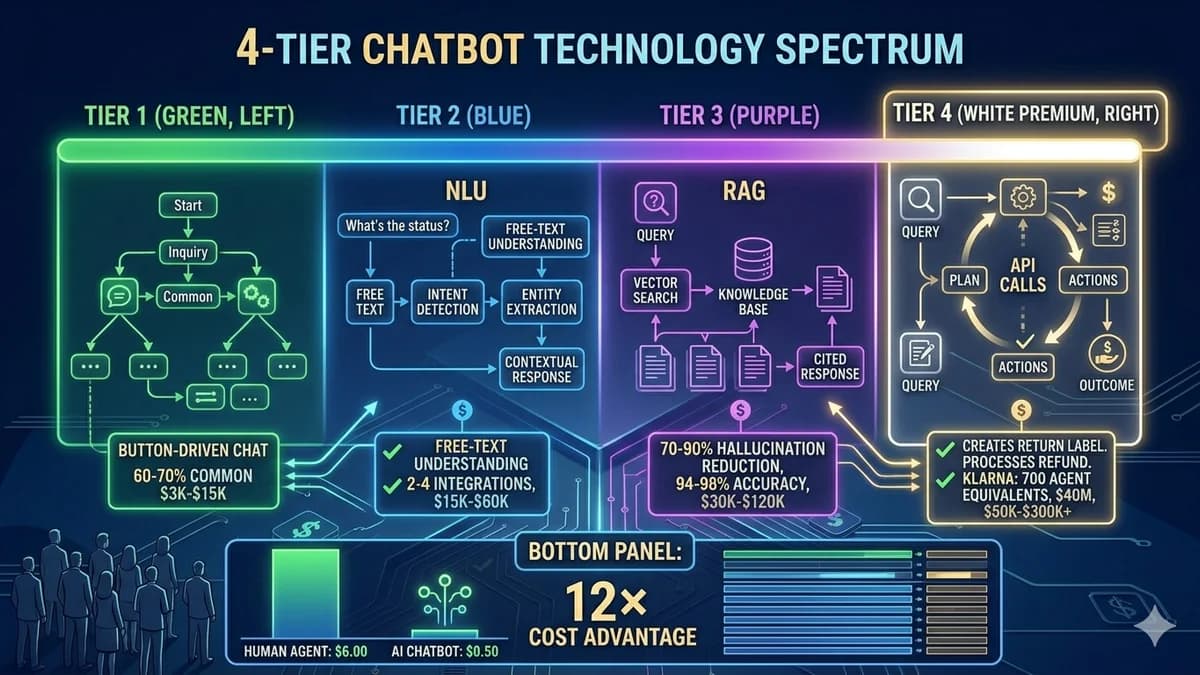
The Economics — $0.50 vs $6.00, and Why That Gap Is Real
A human customer service agent costs approximately $6.00 per customer interaction — including wages, training, management overhead, and benefits. An AI chatbot handles the same interaction for $0.50. That 12× cost advantage is the financial foundation behind every serious chatbot investment in 2026, and it is real: documented at Klarna (700 agent equivalents, $40 million in estimated profit improvement), Vodafone (70% cost reduction per chat), and across Gartner's $80 billion contact-centre savings projection for the year.
But here is the qualifier no chatbot vendor puts in the headline: this 12× advantage only materialises when the right chatbot technology is matched to the right use case. A rule-based FAQ bot at $10,000 handles 60-70% of common queries effectively when the question set is narrow and predictable — and generates ROI within months. An agentic AI system at $150,000 that can autonomously process returns, update orders, and resolve account changes generates ROI on a different scale, but only justifies its cost when the use case is high-volume, transactional, and previously absorbed by human agents working at scale. This guide makes the tiers explicit, draws the line between a chatbot and an AI agent, surfaces the hidden costs that double or triple advertised prices, and gives you the 5-question scope test that identifies your tier before any vendor conversation.
❌ Human Agent
Per customer interaction including wages, training, management, and benefits. Limited to working hours. Cannot handle 100+ simultaneous conversations.
✓ AI Chatbot
Per AI-handled interaction. 24/7 availability. Unlimited simultaneous conversations. Klarna: 700 human equivalents. Chatbots reduce customer service costs 40-60%.
The Most Important Distinction: Chatbot vs AI Agent
Before technology tier, before budget, before vendor selection: you need to understand the difference between a chatbot and an AI agent, because it determines your cost tier and your ROI trajectory.
A chatbot answers questions. It receives input, understands the query, and returns a response. A sophisticated chatbot understands free-form natural language, retrieves from a knowledge base, cites sources, and handles nuanced follow-up questions. But at the end of every conversation, it has produced text. Nothing has changed in your systems.
An AI agent takes actions. It does not just answer "Where is my package?" — it queries your order management system, checks the carrier's API, detects the delivery exception, creates a return label, updates the delivery address, and triggers a refund — autonomously, without human intervention at each step. It interacts with your systems, not just your customer. Klarna's $40 million profit improvement came from an AI agent, not a chatbot. The distinction between the two is where the majority of the ROI lives in high-volume, transactional customer interactions.
The practical question for your business: does your most frequent customer interaction require your systems to do something, or just say something? If it is answering FAQs, explaining policies, and providing information — a chatbot serves this well, at Tier 1-2 cost. If it is processing transactions, updating records, making changes to accounts, and executing workflows — you need an agentic AI system, at Tier 3-4 cost. The ROI at Tier 4 is higher precisely because the AI is doing more than answering.
The 4 Chatbot Technology Tiers — Cost, Capability, and When to Use Each
The four tiers below map the chatbot technology landscape in 2026 — from rule-based FAQ bots through to agentic AI that takes actions across connected systems. Each tier comes with a price band, a build timeline, a capability ceiling, and a set of use cases the tier is designed to serve. Match your use case to the right tier before any vendor conversation.
Rule-Based Chatbot
What it does
- Button-driven conversation flows
- Keyword-triggered FAQ matching
- Basic lead capture and qualification
- Integration with one platform (web or WhatsApp)
- Simple analytics and completion tracking
Best for
- Startups validating chatbot ROI
- Businesses with under 50 unique customer questions
- Simple lead qualification on landing pages
- Internal HR FAQ and IT help desk triage
- Basic appointment booking flows
NLU AI Chatbot (Natural Language Understanding)
What it does
- Processes free-text customer input
- Identifies intent and extracts entities (dates, order numbers)
- Contextual multi-turn conversation handling
- Integration with 2-4 business systems (CRM, helpdesk, order system)
- Sentiment detection and escalation routing
Best for
- Growing businesses with 500-5,000 monthly conversations
- Customer service with varied inquiry types
- eCommerce order tracking, returns, product questions
- Appointment booking with calendar integration
- SaaS product in-app support
RAG-Grounded Generative AI Chatbot
What it does
- LLM-powered responses (GPT-4o, Claude, Gemini)
- RAG retrieval from curated knowledge base before generation
- Every response cites source document and section
- 70-90% hallucination reduction vs ungrounded AI
- 94-98% accuracy on domain-specific questions
- Multi-turn, contextually sophisticated conversation
Best for
- Businesses with large or frequently-updated knowledge bases
- Compliance-sensitive industries requiring citations
- Customer service AI where accuracy is non-negotiable
- In-product chatbot/copilot in SaaS applications
- Legal, healthcare, and financial services Q&A
Agentic AI — Takes Actions, Not Just Answers
What it does
- Plans and executes multi-step tasks autonomously
- Calls external APIs and updates records in live systems
- Creates tickets, processes refunds, updates accounts
- Orchestrates across multiple connected systems
- Defined guardrails for human approval above thresholds
- Comprehensive audit trail for every action taken
Best for
- High-volume transactional customer service
- eCommerce: returns, order changes, refunds at scale
- Banking: account queries, fraud alerts, card management
- SaaS: automated user onboarding and support workflows
- Any context where chatbot ROI is limited by "can't take action"
A startup that builds Tier 3 when Tier 2 would suffice wastes $30,000-$70,000 and 6 extra weeks. An enterprise that builds Tier 2 when Tier 3 is required rebuilds from scratch within 12 months. Match your tier to your use case before any development begins. The 5-question scope test in Section 6 identifies your tier in under 10 minutes.
Platform vs Custom Build — The Decision Framework
Two routes to a deployed chatbot in 2026: SaaS chatbot platforms (Intercom, Tidio, Zendesk, Freshchat, ManyChat) or custom development by a chatbot development company. The decision is not about which is technically superior — it is about which is economically appropriate for your specific conversation volume, integration requirements, and long-term cost trajectory.
📦 SaaS Platform — Choose When
Monthly conversation volume under 1,000
You need a basic chatbot deployed within 2 weeks
Budget is under $500/month ongoing
You do not need custom AI model or proprietary data integration
You are validating chatbot ROI before committing to custom build
Your workflows fit standard platform conversation templates
⚙️ Custom Build — Choose When
Proprietary systems or data that platforms cannot integrate with
HIPAA, SOC 2, GDPR, or equivalent compliance with full data control
Building the chatbot as a core product feature — not just support
Monthly conversations exceed 5,000 and platform costs hit $3,000-$5,000/month
You need full control over AI model, RAG knowledge base, escalation design
Your conversation flows are unique enough that platforms cannot accommodate them
The crossover economics: at 5,000 monthly conversations with 10 support agents on a major SaaS platform, you pay $3,000-$5,000/month in recurring fees — $36,000-$60,000 per year, with ongoing increases as you add AI features, additional channels, and agent seats. A custom AI chatbot at that conversation volume typically pays back against its $30,000-$60,000 build cost within 8-12 months — and eliminates per-seat recurring fees from the cost structure permanently. Below 1,000 conversations/month, platforms are cheaper. Above 5,000, custom builds win on 12-month total cost. Between them is the band where it depends on integration depth, compliance, and product strategy.
Which chatbot tier and build model delivers the fastest ROI for your specific conversation volume and use case?
Automely scopes chatbot development with tier identification and ROI projection before any cost commitment. Free 45-minute session.
Hidden Costs That Double or Triple the Advertised Price
The headline tier price almost never represents the full chatbot total cost of ownership. The seven line items below are the ones that most consistently appear after deployment — and the ones vendors most consistently under-quote or omit at scoping time. Build them into your estimate from week one, and request a separate line-item figure for each from any chatbot development partner you evaluate.
Platform Add-On Stacking
SaaS chatbot platforms advertise entry prices that rarely reflect what you will actually pay once you add AI features (often a separate tier), remove the platform's branding, enable additional channels, and unlock advanced analytics. The entry price is the floor, not the ceiling.
Human Agent Seats for Escalations
35-50% of chatbot conversations require human escalation — meaning you still need human agents, their management software, and their seats ($29-$169/seat/month on most platforms). These costs continue growing with team size and are separate from chatbot fees.
Integration Work — Often the Largest Line Item
Connecting a chatbot to your CRM, order management system, helpdesk, payment processor, and email adds 20-50% to custom build costs and significant setup time on SaaS platforms. Developing APIs for each system connection costs $5,000-$25,000 each. Budget this separately.
LLM API Inference Costs at Scale
Generative AI chatbots (Tier 3-4) pay LLM API costs per conversation: $0.001-$0.015 per 1,000 tokens. At low volume, this is negligible. At 50,000 monthly conversations, this becomes $50-$300/month or more depending on conversation length and model choice. Model routing (using cheap models for simple intents) reduces this 50-70%.
Ongoing Maintenance — 15-20% of Build Cost Annually
Custom chatbots require ongoing maintenance: security patches, AI model updates, knowledge base content reviews, integration updates when connected systems change, and conversation quality monitoring. Budget 15-20% of initial build cost per year. RAG systems are cheaper to maintain (update documents, not models). Fine-tuned models require periodic retraining.
WhatsApp and Channel-Specific Fees
WhatsApp Business API charges per conversation: marketing messages ~$0.11/conversation, utility messages ~$0.045, service messages free within 24-hour window. For 10,000 marketing messages, that is $1,100 in Meta fees alone — regardless of your chatbot platform or build cost. Budget for channel-specific fees as a separate line item from development costs.
Industry Compliance Premium
Healthcare chatbots require HIPAA compliance architecture: $50,000-$100,000+ additional cost. Financial services chatbots require fraud detection and regulatory compliance: $75,000+ additional. Legal chatbots with professional liability considerations: specialist legal review for any AI-generated content. Factor compliance costs in at scoping, not after deployment.
The 5-Question Scope Test — Identify Your Tier Before Talking to Vendors
The five questions below map your specific business situation to the chatbot technology tier your project actually needs. Answer honestly. Most businesses significantly over-scope their first chatbot — and the over-engineering is what stalls budgets, delays deployment, and burns credibility for follow-on AI investments.
Does your most frequent customer interaction require your systems to do something — or just say something?
If "say something" (answer FAQ, explain policy, provide information): Tier 1-2 is appropriate. If "do something" (process transaction, update record, trigger workflow): you need Tier 4 agentic AI. Choosing the wrong answer here is the single most expensive scoping mistake in chatbot development.
How many unique customer questions does your chatbot need to handle?
Under 50 predictable, structured questions: Tier 1 (rule-based) handles this efficiently. 50-200 questions with free-text variation: Tier 2 (NLU). Unlimited questions requiring knowledge base retrieval: Tier 3 (RAG). Questions that require live system lookups before answering: Tier 3-4.
How many existing systems does the chatbot need to connect to?
One system (your website or WhatsApp): Tier 1 or platform. Two to four systems (CRM + helpdesk + order system): Tier 2. Five or more systems, or systems with complex proprietary APIs: Tier 3-4 custom build. Each integration adds development time and ongoing maintenance cost — budget $5,000-$25,000 per significant API integration.
What is your monthly conversation volume and growth trajectory?
Under 1,000 conversations/month: SaaS platform. 1,000-5,000 conversations/month: evaluate platform vs Tier 2 custom on 12-month cost. Over 5,000 conversations/month: custom build is typically more cost-effective by month 12. Over 10,000 conversations/month: custom build pays back in under 8 months compared to enterprise SaaS pricing.
Do you operate in a regulated industry or have strict data sovereignty requirements?
Healthcare (HIPAA), financial services (GDPR, FCA, SEC), legal (professional liability), and government (data residency) contexts require custom builds with compliance architecture built in from the start. SaaS platforms generally cannot guarantee the data sovereignty, audit trail specificity, and compliance documentation that regulated industries require. Factor compliance costs (20-100% of base build) into your total budget at scope definition.
AI Chatbot Development by Industry — What Works and What It Costs
Chatbot ROI is not industry-agnostic. The six industries below have the highest documented chatbot ROI in 2026 — each with a tier band, a price band, and the specific use cases that drive payback in that vertical. Use the cards to sanity-check the tier and budget your industry typically requires before committing to a vendor scope.
🛒 eCommerce
Product discovery, order tracking, cart recovery (25% cart abandonment reduction), returns processing, 24/7 support. Integrates with Shopify, WooCommerce, Stripe, Klaviyo. ROI example: 1,000 carts recovered/week at $80 AOV = $80K/week recovered revenue.
🏥 Healthcare
Patient intake, appointment scheduling, symptom checking, medication reminders, care instructions. HIPAA compliance required — adds $50K-$100K to build cost. Must maintain human-in-the-loop for diagnosis and clinical decisions.
🏦 Financial Services
Account queries, balance checks, card management, fraud alerts, loan pre-qualification, policy Q&A. Regulatory compliance (GDPR, FCA, FINRA) mandatory for advice-adjacent content. AI citation of source policies is the audit trail regulators require.
👥 HR / Internal
HR policy questions, leave requests, onboarding workflows, IT help desk triage, benefits queries, payroll FAQs. High ROI because HR admin queries are high-volume, predictable, and currently answered by expensive HR professionals.
⚖️ Legal
Client intake, appointment scheduling, contract Q&A, document status, preliminary case information. RAG grounding essential — hallucinated legal citations create professional liability. Human-in-the-loop for any advice content.
💻 SaaS / Tech
In-product support, onboarding, feature documentation, troubleshooting. RAG-grounded from product documentation. Agent assist for support team. Reduces support ticket volume 32-40%, increases user activation rates.
Chatbot Development Services from Automely
Automely's chatbot development services and AI agent development cover all four technology tiers — rule-based FAQ bots, NLU chatbots, RAG-grounded generative AI chatbots, and agentic AI systems that take actions across connected systems. We deploy across web, WhatsApp, email, voice, and in-product channels, integrating with existing CRM, helpdesk, ERP, and payment systems.
Our most documented chatbot reference: Cerebra Caribbean — an agentic AI chat and voice agent platform for Caribbean SMBs delivering 10,000+ autonomous conversations with 95% CSAT. The architecture: Tier 3 RAG-grounded knowledge base combined with Tier 4 agentic action capabilities for transaction workflows, built with full escalation design and conversation quality monitoring.
Every Automely chatbot engagement starts with the 5-question scope test above — tier identification, conversation volume analysis, integration mapping, and ROI projection — before any development estimate. We do not recommend Tier 4 to businesses whose use case is Tier 2. We do not sell platforms when a custom build pays back faster. For the technical architecture detail on RAG-grounded chatbots, see our RAG system guide. For real chatbot cost numbers by type and build model, see our chatbot development cost guide. For chatbot conversion design — not just deflection — see our chatbot conversion playbook.
Automely builds AI chatbots — NLP and LLM-powered, RAG-enabled, multilingual, omnichannel (web/Slack/WhatsApp/SMS), CRM-integrated, with human handoff. Chatbot projects start from $15,000. Book a free 45-minute consultation at cal.com/Automely.ai/45min.
Browse our case studies, read client testimonials, and explore our full AI services portfolio including AI agent development, generative AI development, and enterprise AI solutions.
Ready to get a transparent chatbot development estimate — with tier identification, ROI projection, and integration scope — before any development commitment?
Book a free 45-minute chatbot strategy session. Scope definition, cost estimate, and build model recommendation in one call.