

The Consulting Pyramid Shift — Why the 60-Year Business Model Is Restructuring Now
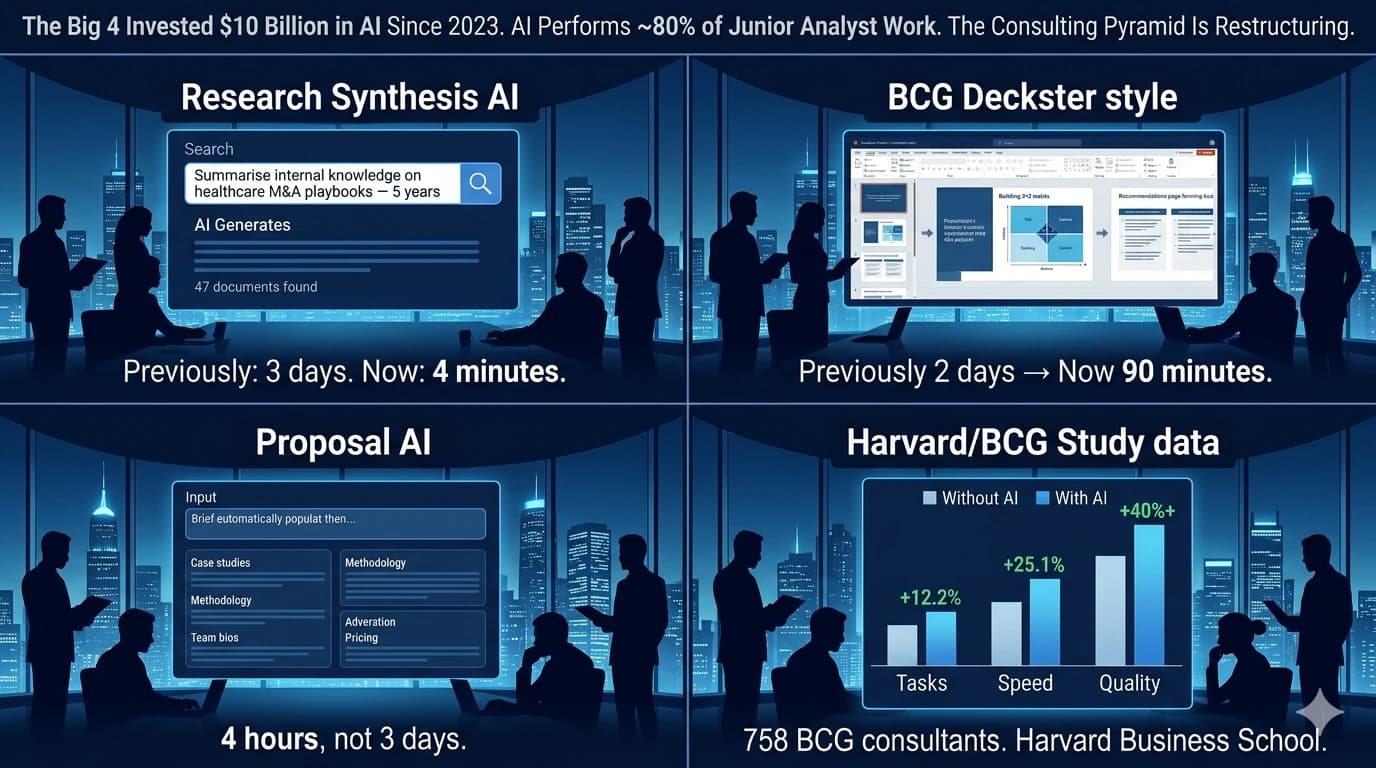
Bloomberg reported in 2025 that approximately 150 former consultants from McKinsey, Bain, and BCG were contracted to train AI models to perform entry-level consulting tasks. One analysis of McKinsey's Lilli and BCG's Deckster concluded that these AI systems could already perform roughly 80% of a junior analyst's typical research and slide-generation work — and do it in seconds rather than days. McKinsey reduced its workforce from approximately 45,000 in 2022 to 40,000 by mid-2025, with a further 10% reduction announced in December 2025.
This is not a distant disruption. It is the restructuring that is already happening to the staffing model that has defined the management consulting industry for six decades. The consulting pyramid — a small number of partners and principals at the top, economically sustained by a large base of junior analysts billing their research, data processing, and slide-production time at rates that fund the leverage ratio — is narrowing at the base because AI can now perform most of what the base has historically done.
The firms winning in this environment are not those that waited for the disruption to reach their specific tier. They are those that made the same move the Big 4 made: treat AI as a delivery infrastructure investment, not a technology experiment. IBM's research found that 86% of consulting buyers now actively seek AI-enabled services, and 66% say they would stop working with firms that fail to incorporate AI. That is not a preference. It is a procurement requirement.
What the Biggest Consulting Firms Actually Built — The $10 Billion AI Investment
The Big 4 and leading strategy houses collectively invested over $10 billion in AI since 2023. Each built or deployed proprietary AI systems trained on their specific internal knowledge — because a consulting firm's knowledge base (past project outputs, methodologies, frameworks, client analyses, industry research) is its most valuable intellectual asset, and generic AI tools cannot access it.
Scans 100,000+ internal documents in seconds. Saves 30% of research and synthesis time. Deployed to 7,000+ consultants; 72% of all 45,000 employees actively use it. Auto-generates slide decks and reports from simple prompts.
GENE (GPT-4o-based chatbot for knowledge synthesis). Deckster (AI presentation tool). BCG employees have built 6,000+ custom AI agents for specific use cases. AI contributed ~20% of BCG's total revenue in 2024.
Zora AI — a fleet of AI agents replacing ChatGPT. Built in partnership with NVIDIA. PairD — internal assistant for document analysis, proposal drafting, and code generation. Deloitte AI Academy trains all employees.
$1 billion AI investment over three years. OpenAI's largest enterprise customer and first reseller. Training all 75,000+ US employees. Junior accountants repositioned as strategic managers while AI handles manual tasks.
Conversational AI assistant across all functions. Expanded with NVIDIA partnership in 2025. Covers audit, tax, and advisory workflows. Internal deployment before client-facing rollout.
Built on GPT-4o, customised for Bain's internal knowledge base. Client-facing AI implementations include OpenAI and Anthropic partnerships for specific client AI strategy engagements.
The reason every major consulting firm built proprietary AI rather than subscribing to generic tools is the same: a consulting firm's competitive differentiation is its accumulated knowledge — the methodologies, frameworks, past project outputs, and sector intelligence that no generic AI model can access. Generic AI produces generic outputs. A proprietary AI trained on 20 years of the firm's consulting work produces outputs that reflect the firm's specific intellectual capital. This is equally true for mid-market and boutique firms — a custom AI trained on your firm's case studies, frameworks, and client work produces better outputs than any subscription tool.
The 6 AI Systems for Consulting Firm Delivery
Research Synthesis and Knowledge Retrieval AI
Research synthesis is the highest-volume, lowest-judgment analytical task in consulting engagements — and historically the primary function of junior analyst teams. A new engagement requires: What has our firm done in this sector? What does the relevant literature say? What are the competitor dynamics? What regulatory developments are relevant? These questions previously required days of internal document searches, literature reviews, and market scanning. AI knowledge retrieval systems perform this work in minutes.
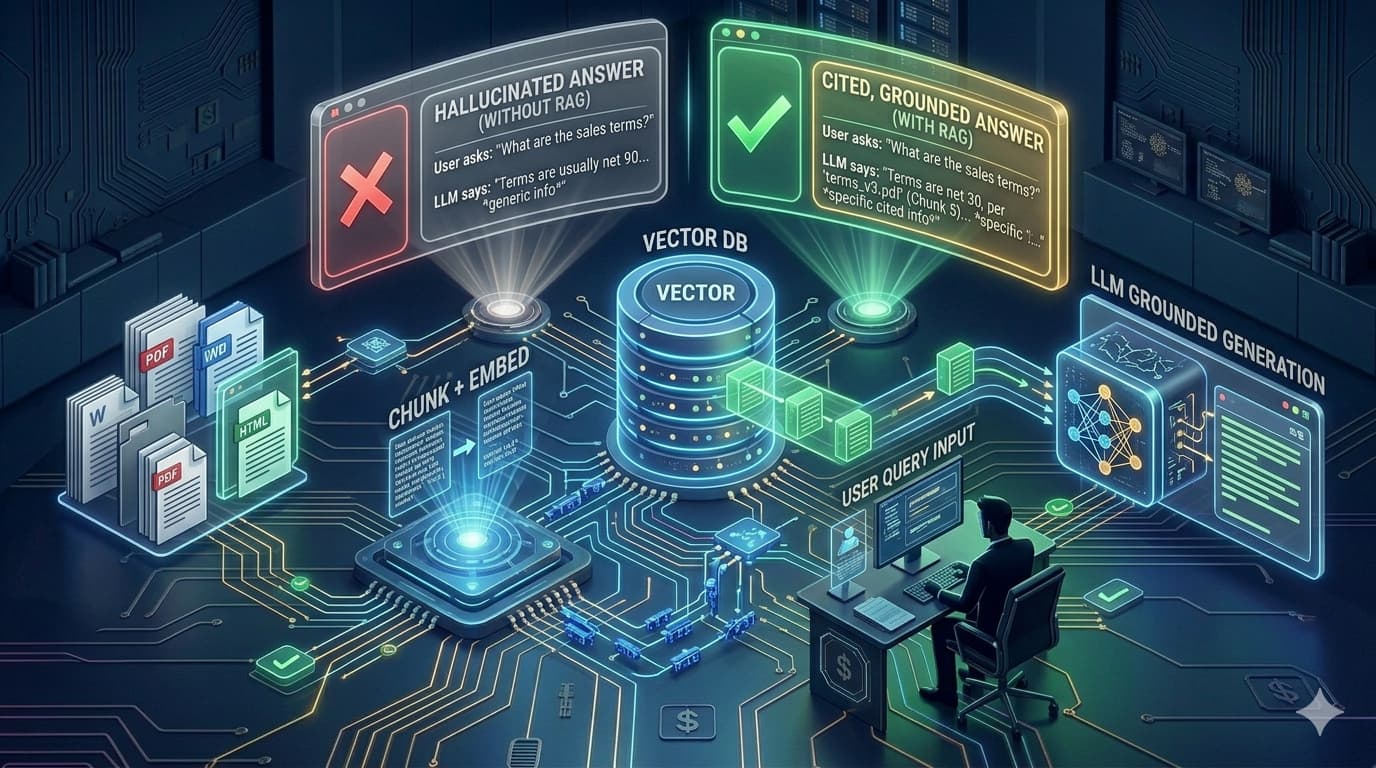
McKinsey's Lilli is the most documented example: it searches 100,000+ internal documents instantly and generates synthesis outputs from simple natural language queries, saving 30% of research time per consultant. The key architecture requirement is RAG (Retrieval-Augmented Generation) — the AI retrieves actual documents from the firm's knowledge base before generating synthesis outputs, ensuring every cited insight traces back to a verifiable source. Without RAG, the AI generates plausible-sounding synthesis from model training data — indistinguishable from hallucination to the consultant relying on it.
- Internal past project outputs — relevant methodologies, frameworks, exhibits, and findings
- Industry and market research — sector reports, analyst research, regulatory filings
- Competitor intelligence — strategic moves, financial performance, public positioning
- Academic and grey literature — relevant research papers, industry body publications
- Client-specific data — prior engagement outputs, client documentation, meeting notes
- News and media synthesis — recent developments in the client's industry and competitive context
AI Data Analysis and Insight Generation
Data analysis in consulting engagements involves processing structured datasets to identify patterns, build models, run benchmarks, and generate insights that support strategic recommendations. AI data analysis tools accelerate this workflow at every stage: ingesting client operational, financial, and market data; running automated diagnostic analyses; identifying anomalies and patterns that manual review would miss; building preliminary financial models and scenario analyses; and generating first-draft data exhibits for consulting decks. The Harvard/BCG study's finding that AI-using consultants produced 40%+ higher quality output is most pronounced in data-intensive analytical tasks.
- Financial model population from client data inputs and public market data
- Benchmarking analysis — client metrics against peer set with automatic data pull
- Diagnostic pattern identification — surfacing correlations and anomalies in operational data
- Scenario modelling — running multiple scenarios across key assumption ranges
- Survey analysis — thematic coding and quantitative analysis of qualitative data
- Market sizing — bottom-up and top-down market calculations from public data sources
Deliverable Generation — Slides, Reports, and Memos
BCG's Deckster — the firm's AI presentation tool — represents the most commercially deployed consulting deliverable AI in the industry. It automatically structures and formats PowerPoint presentations from structured inputs, dramatically reducing the time staff spend on formatting, consistency, and exhibit production. What previously required a junior analyst's full day of deck formatting now takes the AI 30 minutes. The consultant reviews and personalises — they do not build from a blank template.
Beyond formatting, AI deliverable generation produces draft content for report sections, executive summary narratives, recommendation pages, and working session materials from structured inputs. The first draft comes from AI; the strategic judgement, client-specific adaptation, and professional narrative come from the consulting team. This workflow compresses the deliverable production phase of an engagement from days to hours.
- PowerPoint deck structure and first-draft content from research and analysis inputs
- Executive summary narratives from full engagement outputs
- Report chapter sections from analytical findings and framework templates
- Exhibit and visualisation suggestions from datasets
- Working session materials — agendas, pre-reads, structured discussion guides
- Client communication drafts — email updates, meeting follow-ups, progress reports
Proposal and RFP Automation
Proposal development is a high-cost new business activity for consulting firms — typically consuming 2–3 days of senior and junior team time to produce a competitive response. AI proposal systems trained on the firm's past proposals, case study library, team biographies, methodological frameworks, and pricing rationale can generate first-draft proposal sections in hours, leaving the team to personalise the strategic narrative, customise the approach to the specific client context, and refine the commercial terms. The time recovery on proposal development has direct revenue implications: faster proposals enable firms to compete for more opportunities simultaneously.
- Relevant case study selection and summary from the firm's results library
- Methodology and approach section from the firm's framework documentation
- Team biography synthesis — relevant experience matching to the client's sector and challenge
- Pricing structure rationale from comparable past engagement pricing
- Executive summary and strategic framing from client brief and publicly available intelligence
- RFP response answers from the firm's structured knowledge base
Client Intelligence and Relationship AI
Senior consulting relationships are differentiated by the partner's deep knowledge of the client's business, industry dynamics, and competitive context — the "they understand our world" factor that drives repeat engagement. AI client intelligence systems automate the continuous monitoring that historically required either dedicated research staff or accepting that partners arrive at client meetings with outdated context. AI monitors client industry news, regulatory changes, competitive moves, earnings releases, M&A activity, and public signals from the client's senior leadership — delivering structured briefings before each client interaction.
- Client company news — earnings, announcements, executive changes, strategic moves
- Client industry regulatory changes — new rules, consultations, enforcement actions
- Competitor dynamics — competitor strategy moves, M&A, financial performance
- Macro signals — economic indicators, sector trends relevant to the client's business
- Opportunity signals — evidence that the client may be facing a challenge the firm can address
- Relationship health tracking — engagement frequency, sentiment, upcoming relationship milestones
AI Strategy Delivery — For Firms Advising Clients on AI
As AI strategy becomes the fastest-growing consulting service line, firms advising clients on AI adoption need AI tools specifically designed to structure and accelerate the AI strategy delivery workflow. AI readiness assessment tools systematically evaluate a client organisation's data maturity, technical infrastructure, talent capabilities, and process documentation against a structured framework — producing a baseline that would previously require a week of discovery workshops and document review.
BCG's AI contributed approximately 20% of the firm's total revenue in 2024 — and BCG estimates AI agents will account for 29% of total AI value by 2028. The consulting firms that deploy AI tools internally and develop AI strategy service lines simultaneously are building the most defensible competitive position: they can credibly advise clients on AI adoption because they have demonstrably done it themselves.
- AI readiness assessment — data maturity, infrastructure, talent, and process evaluation
- Use case identification and scoring — ROI potential, complexity, data availability ranking
- Implementation roadmap generation — phased plan from current state to target architecture
- Vendor evaluation framework — structured assessment of AI platform and tool options
- Business case development — cost-benefit modelling for client AI investment decisions
- Governance framework — AI ethics, explainability, and risk management structure
Which of these 6 systems recovers the most delivery capacity in your consulting firm?
Automely's consulting AI consultation maps your highest-ROI first system and scopes the knowledge base architecture. Free 45-minute call.
The ROI Evidence — What AI Is Actually Delivering in Consulting
The most important data point for consulting firm AI adoption is the Harvard Business School study of 758 BCG consultants — the most rigorously controlled study of AI productivity effects in professional services. The results: AI users completed 12.2% more tasks, completed tasks 25.1% faster, and produced output rated 40%+ higher quality by independent evaluators. Critically, the quality improvement was most pronounced for the lower-performing consultants — bottom-half performers saw 43% quality improvement — suggesting AI raises the floor of consulting output quality more than it raises the ceiling.
Beyond the Harvard/BCG study, documented outcomes from firm-level deployments:
- McKinsey Lilli: 30% time savings on research and knowledge synthesis per consultant. Applied to a 2,000-hour consultant year, this recovers 600 hours annually — equivalent to roughly one additional junior analyst's productive output per senior consultant.
- BCG AI contribution: approximately 20% of BCG's total revenue in 2024 came from AI-related service lines — demonstrating that internal AI deployment and AI strategy advisory are commercially linked.
- 79% of UK consulting firms report meaningful time savings from AI deployment (Management Consulting Association, 2025).
- Early GenAI adopters report $3.70 in value for every $1 invested, with top performers achieving $10.30 per dollar (Gartner research, 2025).
- Gartner early adopter firms: 15.8% revenue increase and 15.2% cost savings on average from AI deployment across operations.
- 74% of organisations say their advanced AI initiatives are meeting or exceeding ROI expectations (Deloitte Q4 2024 State of Gen AI report).
What Stays Human — The Consulting Work AI Cannot Do
The Harvard/BCG study found something important in its data: AI-using consultants performed significantly worse on tasks involving political judgment, stakeholder navigation, and contextual interpretation of ambiguous situations — the tasks that require understanding not just what the data says but what the organisation will accept, what the CEO is actually afraid of, and which recommendation will get implemented versus which will be filed away. These are the tasks that define the value of the best consulting partners — and they remain irreversibly human.
Stakeholder Management and C-Suite Trust
The relationship between a senior consulting partner and a Chief Executive or Board is built on personal credibility, accumulated trust across multiple engagements, and the human accountability that comes with a named professional standing behind a recommendation. AI can provide the analysis. It cannot substitute for the relationship that makes the client act on it.
Strategic Judgment on Ambiguous Problems
Strategy consulting's hardest problems are not analytically underdetermined — they are politically, organisationally, and contextually ambiguous. The right recommendation for this client, at this moment, given these power dynamics, this leadership team's risk tolerance, and this board's priorities, requires the kind of judgment that comes from experience across many organisations and many cycles — not pattern matching against historical data.
Change Management and Organisational Navigation
Helping a client organisation implement a strategic recommendation requires managing resistance, building coalitions, adapting the programme to evolving leadership dynamics, and maintaining the trust of stakeholders who did not initially support the direction. This is relationship-intensive, context-dependent human work that AI tools can support administratively but cannot execute.
Creative Hypothesis Generation
The lateral insight that reframes the problem — "this isn't a growth problem, it's a distribution model problem" — comes from the kind of cross-domain, pattern-breaking thinking that emerges from experienced consultants drawing on diverse client histories, sector knowledge, and the intuition that develops over decades of problem-solving. AI can test hypotheses at speed. It cannot originate the right one from first principles on a genuinely novel problem.
Ethical Judgment on Consequential Recommendations
Recommendations that affect thousands of employees, that shape the competitive landscape, that influence how essential services are structured — these carry professional and ethical weight that consulting partners accept as a condition of their authority to advise. AI can model outcomes. It cannot accept the accountability that makes the recommendation trustworthy.
The Mid-Market Consulting Firm Gap — Why This Matters Beyond the Big 4
The Big 4 and top strategy houses have resources to invest $1–2 billion in proprietary AI platforms, hire dedicated AI engineering teams, and train 75,000 employees on new AI workflows. Boutique and mid-market consulting firms — the regional specialists, the functional experts, the industry boutiques — cannot replicate that investment. But they face the same competitive dynamics: clients expecting AI-enabled delivery, competitors deploying AI to compress timelines, and an increasingly difficult argument for why research that takes the junior team three days should not have been done in three hours.
❌ Traditional Pyramid (Pre-AI)
✓ AI-Augmented Model (2026)
The mid-market opportunity is not building McKinsey Lilli. It is building a firm-specific AI system — trained on the boutique firm's 15 years of sector research, 200 past engagement outputs, methodological frameworks, and client work — that gives a 25-person specialist firm the research synthesis and deliverable production capability that previously required a 75-person team. The investment is a fraction of what the Big 4 have spent. The competitive differentiation it creates is substantial: a mid-market firm delivering at AI-augmented speed can price its expert access, not its analyst hours — and compete with larger firms on quality without needing their headcount.
Implementation Sequence for Consulting Firms
Audit and catalogue your existing knowledge assets before building
The quality of your consulting AI is directly proportional to the quality and organisation of the knowledge you train it on. Before building anything, catalogue your existing intellectual assets: past engagement outputs (what is organised vs scattered), methodological frameworks (what is documented vs tacit), research and sector intelligence (what is findable vs buried), and case study results (what is formatted vs raw). This audit usually reveals that the biggest bottleneck is not AI capability — it is the state of the firm's internal knowledge management. Fix the knowledge organisation first; the AI training compounds on top of it.
Start with research synthesis — the highest-volume, lowest-judgment task
Research synthesis and knowledge retrieval is the right first AI system for most consulting firms: it is the task with the highest analyst time consumption, the clearest output quality metric (did the AI find the relevant prior work?), and the lowest risk if imperfect (the consultant reviews before using). Build a RAG-based system that searches your internal document repository and surfaces relevant past work, frameworks, and sector research in response to natural language queries. Measure time-to-first-answer before and after. Use the documented time saving to build the business case for the next system.
Train deliverable generation AI on your firm's templates and style
Deliverable generation AI that produces BCG-style outputs from an IDEO-style firm creates more editorial work than it saves. The AI must be trained on your firm's specific deliverable templates, formatting conventions, communication style, and the structural patterns that characterise your best past work. This training investment — typically 2–4 weeks of curating and uploading past high-quality deliverables — is what converts generic AI output into firm-specific output that requires editing, not rewriting.
Build client intelligence before every major client meeting
The simplest and fastest ROI AI system for consulting firms is client intelligence monitoring — automated briefing generation before client meetings. Set up AI monitoring of each major client's industry news, regulatory environment, and competitive dynamics. Set it to deliver a 1-page briefing 24 hours before each meeting. The partner who arrives at a client meeting demonstrably updated on the latest dynamics in the client's world is consistently rated more valuable than one who arrives with stale context.
Reposition AI as a service offering — not just an internal tool
Every consulting firm that has deployed AI internally has the credibility to advise clients on AI strategy — because they have done it themselves. The firms capturing the highest revenue growth from AI are those that turned internal AI deployment into a demonstration case that anchors a new AI strategy advisory service line. Build the internal capability first; convert the documented outcomes into the case study that sells the client-facing AI strategy work. BCG's 20% AI revenue contribution came from this exact sequence.
Building Consulting AI with Automely
Automely's AI agent development, generative AI development, and AI integration services cover the full stack of consulting firm AI systems — internal knowledge search and research synthesis AI built on RAG architecture (the mid-market equivalent of McKinsey Lilli), deliverable generation AI trained on firm-specific templates and past work, proposal and RFP automation from the firm's knowledge base, client intelligence monitoring systems, and AI strategy delivery tools for firms advising clients on AI adoption.
Our consulting AI implementations start with the knowledge asset audit — because the AI capability is not the bottleneck. For most consulting firms, the bottleneck is the organisation of their internal intellectual capital: past engagement outputs scattered across individual consultants' drives, methodological frameworks documented in inconsistent formats, sector research stored in systems nobody searches effectively. The knowledge organisation investment preceding the AI build is itself a strategic asset that improves firm delivery even before the AI is trained on it.
Browse our case studies and our RAG system guide — the technical architecture behind consulting firm research synthesis AI. For the marketing agency AI parallel (similar knowledge-base-trained content and proposal AI), see our AI for marketing agencies guide.
Ready to build the mid-market equivalent of McKinsey Lilli — trained on your firm's 15 years of sector expertise?
Book a free 45-minute consulting AI consultation. We will run the knowledge asset audit, scope the first system, and map the ROI case — before any development commitment.