

The AI consulting market reached an estimated $8.75 billion in 2025 and is growing fast. Behind that number is a wide range of services — some genuinely valuable, some essentially overpriced reports, and some that sit somewhere between consultants who have never built a production AI system telling businesses how to adopt AI.
This guide cuts through the noise. It explains exactly what AI consulting services include when done correctly, what they cost across different engagement types, when they are worth the investment, and — critically — when you should skip them entirely and go straight to building.
AI consulting adds value when you need to figure out what to build before committing to building it. It does not add value when you already know the specific problem you want to solve — in that case, a scoped development engagement with a discovery phase built in delivers the same strategic value without the separate invoice.
What AI Consulting Services Actually Are — and What They Are Not
AI consulting is the strategy and planning layer of AI adoption. It is the work that happens before any system is built — helping a business understand where AI can create value, what data and infrastructure is already in place, what the realistic implementation path looks like, and what the specific risks and dependencies are.
What AI consulting is not: it is not AI development. An AI consultant does not typically write code, train models, or build the systems they recommend. Their output is advice, strategy, and roadmaps — not working software. This distinction matters enormously for budgeting. When you hire an AI consulting service, you are paying for analysis and recommendations. When you hire an AI development company, you are paying for a delivered system.
The best AI consulting engagements bridge this gap — the consulting firm has deep hands-on development experience and can evaluate what is actually feasible to build, at what cost, and in what timeframe. The worst AI consulting engagements produce impressive slide decks that no development team can actually execute because the consultant had no idea what production AI systems actually require.
The AI consulting market is also home to some extremely expensive generalism masquerading as AI expertise. Many of the largest consulting firms — McKinsey, Accenture, Deloitte, BCG — have built AI consulting practices staffed primarily by strategy generalists who learned AI terminology in the last two years. Their work product is polished and professionally presented. Its translation to working AI systems is often poor.
What You Actually Get From an AI Consulting Engagement
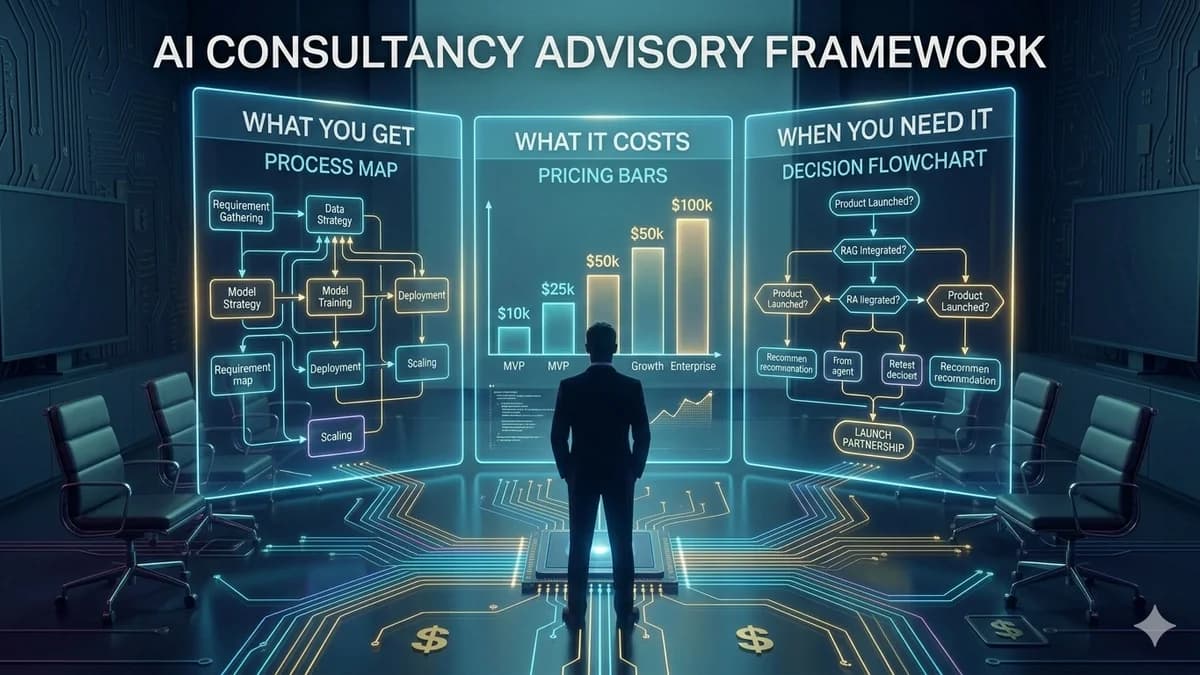
A credible AI consulting engagement — whether standalone or as part of a development project — should produce the following specific deliverables. Use this list to evaluate any proposal you receive: if these are not explicitly included in the scope, ask why.
| Phase | What It Covers | Output Document |
|---|---|---|
| AI Readiness Assessment | Evaluation of your existing data quality and availability, technology infrastructure, team capability, and data governance practices. Identifies gaps between your current state and what successful AI adoption requires. | Readiness Report with gap analysis and prerequisite recommendations |
| Use Case Identification | Structured discovery of AI opportunities within your specific business. Prioritises candidates by feasibility, data availability, estimated ROI, and strategic alignment. Separates quick wins from longer-term initiatives. | Prioritised Use Case Matrix with ROI estimates and data requirements per use case |
| Data Assessment | Inventory of your data — what you have, where it lives, what format it is in, how complete it is, and what data is missing that your priority use cases require. Includes a data preparation plan. | Data Inventory and Preparation Plan with labelled gaps and collection recommendations |
| Technology Selection | Recommendation of the specific AI approach for each priority use case — foundation model API vs fine-tuning vs custom training; specific framework recommendations; build vs buy vs partner decisions. | Technology Recommendations with rationale and tradeoff analysis for each decision |
| Risk Assessment | Identification of data privacy risks, regulatory compliance requirements (GDPR, HIPAA, sector-specific), model bias risks, operational dependencies, and the failure modes specific to your use case context. | Risk Register with severity ratings and mitigation recommendations |
| Implementation Roadmap | Phased implementation plan for priority use cases — sequenced by dependencies, with timeline estimates, resource requirements, budget ranges, and defined success metrics for each phase. | AI Implementation Roadmap with phased milestones, investment estimates, and KPIs |
Not all of these are required for every engagement. A small business with one specific AI project may only need use case scoping and technology selection. An enterprise planning broad AI adoption across multiple functions needs the full stack. The scope should match the complexity of the decision you are trying to make — not the size of the consulting firm's standard template.
Not sure what scope of AI consulting you actually need?
Book a free 45-minute strategy call. We will tell you honestly whether you need a formal consulting engagement or whether a scoped discovery conversation is sufficient to get your project started.
When You Actually Need AI Consulting Services — and When You Don't
This is the question most articles avoid because the honest answer is not always good for consulting firms. AI consulting is not always the right first step. Sometimes the most efficient path is to go straight to a development engagement with a discovery phase built in. Here is how to tell the difference.
✓ You Probably Need AI Consulting When...
- You have AI ambitions but no clear picture of where to start across multiple business functions
- You need to build an internal business case or board-level presentation before any budget is approved
- You have multiple competing AI project ideas and need prioritisation against limited budget
- Your industry has complex compliance requirements (HIPAA, GDPR, financial regulation) you need to understand before committing to an architecture
- Your executive team has no shared understanding of AI's realistic capabilities and limitations
- You have significant legacy systems and need to understand integration feasibility before committing to a build
- You are evaluating whether to build AI in-house or use external AI development services
✗ You Probably Don't Need AI Consulting When...
- You already have a specific, clearly defined business problem you want AI to solve
- You just need to know whether something is technically feasible — a good development agency can answer that in a scoping conversation
- Your project scope is small enough that a built-in discovery phase covers the strategic work
- You have already done an assessment and just need someone to build what the assessment recommended
- You want someone to validate a decision you have already made — that is not consulting, that is confirmation bias at invoice-level pricing
- Your main question is “how much will this cost?” — that is a development scoping question, not a consulting question
The practical heuristic: if your primary question is what should we build?, you likely need some form of AI consulting. If your primary question is can you build this for us?, you need an AI development company. Many businesses arrive at a development agency with the first question and get a combined answer that includes strategic guidance as part of the scoping process — this is often more efficient than a separate consulting engagement.
What AI Consulting Services Actually Cost in 2026
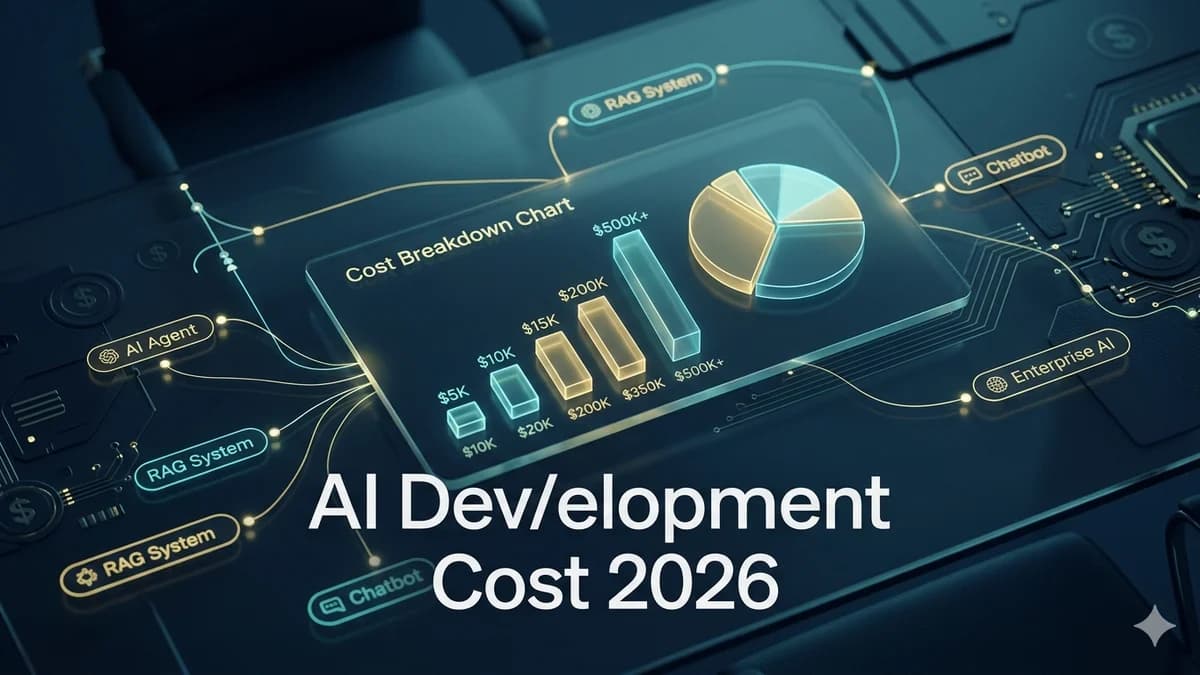
The range in AI consulting pricing is genuinely enormous. Here is an honest breakdown of what different engagement types cost across different provider categories — and what drives the differences.
| Engagement Type | Who Provides It | Typical Cost | Duration |
|---|---|---|---|
| Hourly AI Advisory | Independent AI consultants, fractional CTOs | $150–$350/hr | As-needed |
| AI Readiness Assessment | Specialist AI development agencies | $5,000–$15,000 | 2–4 weeks |
| AI Strategy Engagement | Mid-tier consulting firms, specialist agencies | $15,000–$50,000 | 4–12 weeks |
| Enterprise AI Strategy | Big Four consulting (McKinsey, Accenture, Deloitte) | $50,000–$500,000+ | 3–12 months |
| Ongoing AI Advisory Retainer | Specialist AI firms, independent advisors | $3,000–$15,000/month | Rolling monthly |
| Discovery Phase (included in development) | Specialist AI development agencies like Automely | $0 (included in project) | 2–4 weeks |
What drives the price variation
Brand premium. McKinsey's AI consulting rates are not 10x Automely's because their work is 10x better. They are 10x higher because the McKinsey brand provides internal political cover — a CFO who signs off on a $300,000 McKinsey AI strategy is easier to justify than a $30,000 engagement with a specialist agency that delivered the same quality of analysis. If you need internal political cover, the big firm premium may be worth it. If you need accurate, actionable AI strategy, it usually is not.
Breadth vs depth. A generalist consulting firm covering AI transformation across your entire organisation costs more than a specialist AI development agency scoping a specific use case. The broader the scope, the higher the cost — and the less likely the work will be executed exactly as recommended when development begins.
Development capability. Consulting firms that also build AI systems — and therefore know what is technically feasible and what a realistic implementation requires — deliver more actionable strategy than pure consultants. Their recommendations are grounded in build reality, not theoretical best practice.
The most common waste of AI consulting budget: paying $30,000–$100,000 for an AI strategy document that gets filed and never executed. This happens when consulting and development are fully separated, when the consultant has no relationship with the development team, or when the consulting deliverable is too abstract to hand to an engineering team and say “build this.” The most efficient model is a consulting phase that feeds directly into a development engagement with the same team.
AI Consulting vs AI Development: Understanding the Boundary
Understanding where consulting ends and development begins is essential for budgeting and sequencing your AI investment correctly.
Consulting vs Development — Side by Side
The most efficient path for most businesses — particularly those with a specific problem in mind — is to engage a development agency that conducts a formal discovery phase as the first step of the development engagement. This discovery phase covers the strategic questions a consulting engagement would address, but it is scoped to your specific project, produces a technical architecture as well as a strategy, and feeds directly into a development team that will actually build what was planned.
Our AI consulting service is structured this way. Every engagement starts with a scoped discovery phase — problem definition, data assessment, technical architecture, risk identification, implementation roadmapping. If you decide not to proceed with development, you leave with a complete AI strategy for your specific use case. If you proceed, the discovery phase has already designed the system the development team will build.
Watchouts Before You Hire an AI Consulting Firm
Consultants who have never built a production AI system. An AI strategy built by people who have never shipped production AI will consistently recommend architectures that look logical on paper but have unrealistic data requirements, underestimated integration complexity, or compliance issues that only surface during implementation. Always ask your consultant whether they have personally built and deployed the type of system they are recommending.
Consulting that does not connect to execution. A strategy document that sits in a shared drive is not an asset — it is an expensive exercise. If the consulting firm cannot also build the systems they recommend (or connect you to a development team that can), ask how they plan to ensure the strategy actually gets executed. Many consulting firms have a structural incentive to make recommendations complex enough to require additional engagement.
Generic AI strategy that is not tailored to your data and systems. A meaningful AI strategy for your business is specific to your data quality, your existing technology stack, your team's capabilities, and your specific operational context. If the consulting deliverable reads like it could be reused for any business in your industry with minor edits — it probably was.
Consulting that creates dependency rather than capability. Good AI consulting should leave you better able to evaluate, commission, and manage AI work independently. Bad AI consulting creates ongoing dependency — every question requires another consulting invoice. Ask how the engagement is designed to transfer knowledge to your team, not just deliver a document.
ROI projections not grounded in your specific baseline. Any AI consulting firm that projects specific ROI figures without first establishing your current baseline — how your process works today, what it costs, what the error rate is — is providing analysis that cannot be verified or held accountable. Push for conservative projections with explicitly stated assumptions, not headline numbers without methodology.
Automely's AI Consulting Approach
Automely is fundamentally an AI development company — but every engagement starts with a consulting and discovery phase that we treat as seriously as any deliverable. We do this because we have learned, across 120+ projects, that the single biggest driver of project failure is insufficient scoping before development begins.
Our AI consulting service operates in two modes.
Integrated discovery (included in all development projects). Every development engagement starts with a 2–4 week discovery phase covering: problem definition, success metric identification, data assessment, technical architecture design, integration mapping, risk identification, and phased implementation planning. This is not a separate invoice — it is built into every project. The output is a technical scope document that the development team builds from directly.
Standalone AI strategy (for businesses not yet ready to build). For businesses that need strategic clarity before committing to development, we offer standalone AI consulting starting from $5,000 for a focused use case assessment and $15,000–$40,000 for a comprehensive multi-function AI strategy. These engagements are conducted by the same team that builds the systems — not by generalist consultants who hand off to a different delivery team.
The practical advantage: when your AI strategy is developed by the team that will build it, the recommendations are constrained by build reality. You will not receive a roadmap that requires data you do not have, proposes integrations that would take a year to complete, or recommends an architecture that will cost four times the stated budget to actually implement.
We serve clients across healthcare, fintech, eCommerce, real estate, and consulting. You can view production systems we have delivered at our case studies page and read client feedback at our testimonials page. Our full service offering — from AI agents to generative AI development to full SaaS products — is built on the same production-first philosophy that informs our consulting work.
Want an honest AI strategy conversation before committing to anything?
Book a free 45-minute strategy call. We will tell you what AI can and cannot do for your specific situation — and whether you need consulting, development, or both.