

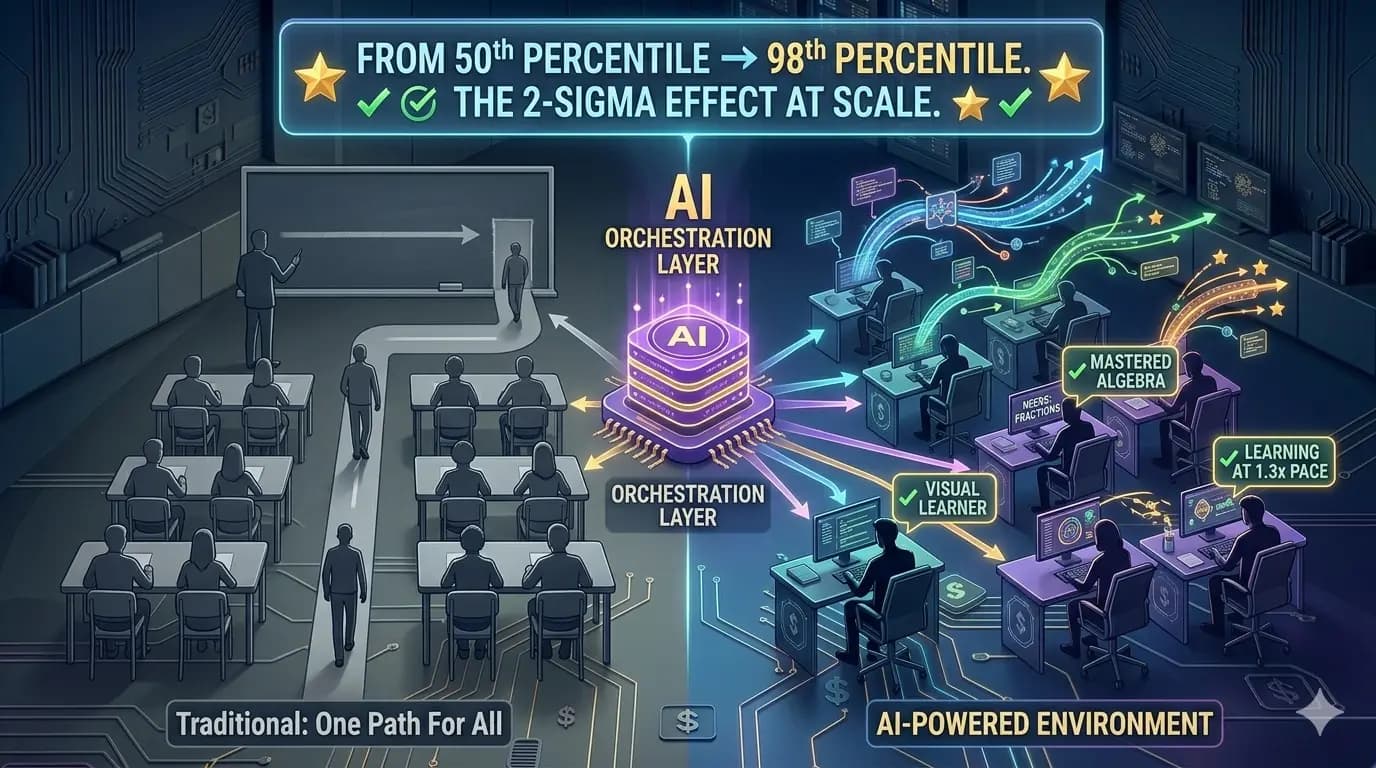
In 1984, educational researcher Benjamin Bloom published a finding that should have changed everything about how we teach. Students who received individualised, one-on-one tutoring performed two standard deviations better than students in conventional classrooms — the equivalent of moving a student from the 50th percentile to the 98th percentile. He called it the 2-sigma problem: the benefits of personalised instruction were proven and massive, but the cost of scaling it was prohibitive. One teacher per student is not an education system. It is a luxury.
For four decades, that problem remained unsolved. Mass education continued to move in one direction, delivering the same content at the same pace to students with profoundly different starting points, learning speeds, and cognitive patterns. The students who thrived were the ones whose pace and style happened to match the classroom's. The others adapted, or they did not.
AI in education is the first credible solution to Bloom's 2-sigma problem. Research from Dartmouth, published in 2025, confirmed what practitioners have been observing in deployment: well-designed AI tutoring systems can deliver the learning outcomes of 1-on-1 human tutoring at institutional scale. Not to a cohort of ten. To a university of 50,000. To a national school system of 10 million.
The 2-Sigma Problem — Why Mass Education Has Always Underperformed Its Potential
The fundamental constraint of mass education is not teacher quality or curriculum design — it is the ratio of instruction to learner. A classroom of 30 students with one teacher means each student receives approximately 2 minutes of individualised attention per hour of class time. The rest of the time, the teacher is addressing the room at a pace and level that is, at best, appropriate for the median student. Students ahead of that median are bored and disengaged. Students behind are lost and falling further behind.
This is the problem that AI personalised learning addresses — not the design of curriculum, not the quality of the teacher, but the fundamental 1-to-30 ratio constraint that makes genuine individualisation economically impossible under any human staffing model. An AI system has no ratio constraint. It is simultaneously 1-to-1 with every learner in the platform at the same moment, with the same patience and the same attention.
This guide is written for institutional decision-makers — K-12 administrators, university technology officers, corporate L&D leaders, and EdTech entrepreneurs — evaluating or building AI personalised learning at scale. It covers the seven AI mechanisms that drive personalisation outcomes, the data flywheel that creates compounding advantage, and the implementation sequence for institutions deploying AI education for the first time.
The 7 AI Personalisation Mechanisms — How It Actually Works
AI personalised learning is not a single technology. It is seven distinct mechanisms that work together to create an adaptive system. Understanding each mechanism — what it does, how it differs from traditional approaches, and what institutional impact it generates — is the foundation for evaluating or building an AI education system.
AI Diagnostic Assessment — Mapping Every Learner's Starting Point
Before personalisation can begin, the system must understand where each learner stands: knowledge gaps, strengths, cognitive patterns, learning pace, and preferred content format. AI diagnostic assessments build this learner profile within minutes — not through a single test, but through a dynamic assessment that adjusts its questions based on responses, probing gaps with increasing precision until it has a comprehensive map of what the learner knows and does not know. This profile is updated continuously with every subsequent interaction, becoming more accurate with every session.
Adaptive Learning Pathways — The Curriculum Bends to the Learner
In a traditional curriculum, the sequence is fixed: Chapter 1, then Chapter 2, regardless of whether the learner has mastered Chapter 1 or was ready to skip it entirely. Adaptive learning pathways adjust the sequence, difficulty, pacing, and depth of content in real time based on learner performance. A learner who masters a concept in two attempts gets accelerated past it to more advanced material. A learner who struggles gets additional practice at a simpler level, alternative explanations from a different angle, and prerequisite content they may have missed earlier. The path optimises continuously toward the learning objective — and no two learners follow exactly the same route.
Intelligent Tutoring Systems — Always Available, Infinitely Patient
Modern intelligent tutoring systems, powered by large language models, provide conversational 1-on-1 instruction that was previously only possible with a human tutor. A student can ask a question in natural language, receive a patient and detailed explanation, ask follow-up questions, and have the AI walk through problems step by step — available at 10 PM on a Sunday before an exam, or at 6 AM before school. The AI never loses patience, never shows frustration, never makes a student feel judged for not understanding, and never teaches a concept differently for the tenth student who needs it explained a different way.
Multimodal Content Personalisation — Right Format for Each Learner
Not every learner processes content the same way. Some learn best from structured text. Others need visual representations — diagrams, animations, spatial models. Others learn by doing — simulations, interactive problem-solving, hands-on experimentation. AI content personalisation systems track how each learner engages with different content formats and weight future content delivery toward the formats that produce the highest retention for that individual. Over time, the system learns not just what a learner knows but how they learn most effectively.
Predictive Early Intervention — Catching Struggle Before It Becomes Crisis
In conventional education, at-risk students are identified when they fail a test, miss an assignment, or are flagged by a teacher who notices disengagement. By this point, the learner is already significantly behind. AI predictive analytics identify the patterns that precede failure 4–8 weeks earlier than these traditional signals — engagement decay, pacing deceleration, increasing error rate in specific concept areas, session length decline — and surface at-risk students to educators in time for a proactive conversation rather than a remediation programme.
Automated Assessment and Instant Feedback — Collapsing the Feedback Cycle
Feedback is most effective the moment an error occurs — not 3 days later when the teacher returns graded work. AI assessment systems provide instant, detailed feedback that does not just mark an answer as right or wrong, but explains why an answer is wrong, identifies the specific misconception driving the error, and provides targeted practice to address that misconception before the learner moves on. At scale, a class of 300 students in an online course can each receive personalised, detailed feedback on an essay or complex problem within seconds, without a human grader.
Learning Pathway Recommendations — From Curriculum to Career
Beyond the immediate learning objective, AI in education builds a longitudinal model of each learner's skills, competencies, and learning trajectory — and uses this to recommend next courses, identify skill gaps relevant to stated career goals, surface learning resources aligned to where the learner is heading, and alert to opportunities (certifications, electives, specialisations) that match their demonstrated strengths. This transforms an educational platform from a content delivery system into a learning intelligence system that actively guides learners toward their goals.
The Data Flywheel — Why AI in Education Compounds Over Time
The most strategically significant property of AI in education for institutions and EdTech platforms is the data flywheel — the self-reinforcing cycle where more learner interactions generate better AI performance, which generates better learning outcomes, which attracts more learners, which generates more data. Unlike a human teacher whose expertise does not compound with institutional scale, an AI learning system becomes measurably better as more learners use it.
Learner interactions generate data
Every question answered, every hint requested, every content format engaged, every minute spent — each is a data point the AI uses to refine its model of how different learner profiles respond to different pedagogical approaches.
More data improves personalisation accuracy
An AI with 10 million learner interaction data points builds more accurate learner models and more effective adaptive pathways than one with 100,000. Early-moving platforms accumulate this advantage faster — the data moat compounds with scale.
Better personalisation improves learning outcomes
Improved learning outcomes are measurable in time-to-mastery, assessment scores, course completion rates, and learner-reported satisfaction. These metrics improve with each generation of the AI model trained on the accumulated data.
Better outcomes attract more learners
Institutions and EdTech platforms with documented outcome improvements grow their learner base, generating more data, which further improves the model. The flywheel accelerates.
Educational institutions and EdTech platforms that deploy AI personalisation early accumulate a data advantage that is not easily replicated by later entrants. The institution that has been tracking learner interaction patterns for 3 years has a fundamentally better personalisation system than one launching today with no data — regardless of the quality of the algorithm. This is the strategic argument for implementing AI personalised learning now rather than waiting for the technology to mature further. The technology is mature. The data advantage accrues from deployment date.
Building an AI personalised learning platform for your institution or EdTech startup?
Automely builds adaptive learning systems, intelligent tutoring platforms, and student analytics dashboards. Book a free 45-minute consultation.
The 4 Education Contexts Where AI Personalisation Delivers the Most Value
AI personalised learning applies differently across education contexts. The mechanisms are the same; the implementation, the compliance requirements, and the specific value delivered vary significantly.
🏫 K-12 Schools
- Adaptive maths and reading platforms (DreamBox, IXL-style)
- Predictive at-risk identification for early intervention
- AI tutors for homework support outside school hours
- Teacher analytics dashboards showing class-level and individual gaps
- Personalised reading level progression
🎓 Higher Education
- Large course AI teaching assistants at scale (500+ student lectures)
- Adaptive assessments replacing fixed-difficulty exams
- AI writing feedback on essays and research papers
- Personalised degree pathway recommendations
- Early warning systems for dropout risk
🏢 Corporate L&D
- Adaptive skill gap analysis and training path generation
- AI role-play simulations for sales and customer service training
- Personalised compliance training that skips what employees already know
- On-demand AI coaching for leadership development
- Performance analytics tied to learning investments
💡 EdTech Platforms
- Adaptive learning engines as the core product differentiator
- AI tutoring as a premium tier feature
- Learner analytics as a B2B institutional offering
- Personalised recommendation engines for course discovery
- AI-powered exam preparation systems
Institutional Implementation — How to Deploy AI Personalised Learning
Educational institutions that try to deploy AI personalisation across the entire curriculum simultaneously consistently underdeliver on both technology and pedagogy. The right sequence builds internal capability, validates outcomes with measurable data, and earns the institutional trust required to expand.
- Define the learning outcome you are personalising toward. "Better learning" is not a definition. "Increase the percentage of Year 8 students achieving grade-level proficiency in algebra from 52% to 70% within the academic year" is a definition — and it is what lets you evaluate whether the AI is working. The specificity of this outcome statement determines whether you can scope, build, and evaluate the personalisation system.
- Build or integrate the learning data infrastructure first. AI personalisation requires data — learner interactions, assessment results, engagement patterns, time-on-task. If your institution's current LMS does not capture this data in an AI-accessible format, data infrastructure investment comes before personalisation layer investment. The best AI personalisation engine on top of no learner data produces no personalisation.
- Start with one subject, year group, or course — not the whole curriculum. A focused first implementation in a single context (Year 7 Maths, Introductory Statistics, Sales Onboarding) generates baseline versus outcome data that is clean, attributable, and actionable. A broad simultaneous rollout generates complex, confounded data that is difficult to interpret and act on.
- Define the teacher's new role in the AI-augmented environment before deployment. Teachers and instructors who learn about an AI personalisation rollout without understanding their new role in it experience it as a replacement threat. Teachers who are involved in designing the AI deployment as a tool that expands their impact become its most effective advocates. Define — and communicate — the specific new responsibilities: using AI analytics for targeted intervention, facilitating social learning that AI cannot replicate, and mentoring learners whose challenges are not academic but motivational or social.
- Measure, report, and expand based on demonstrated outcomes. At 30, 60, and 90 days post-deployment, measure the learning outcome you defined in Step 1 against the baseline. Produce a transparent report. If outcomes are improving, the data is your institutional case for expanding to the next subject or year group. If they are not improving, the data tells you specifically where to adjust before expanding.
The Equity Case — Why AI Personalised Learning Is Also a Justice Issue
The economic argument for AI in education is straightforward. The equity argument is more important. The gap between what a wealthy student can access — private tutors, test preparation courses, individual attention from well-resourced teachers — and what a student in an under-resourced school can access has always been the most durable source of educational inequality. It is not primarily a content gap. It is an attention and personalisation gap. The wealthy student gets their gaps addressed quickly. The less-wealthy student's gaps compound.
AI equalises access to 1-on-1 instruction quality
A student in a rural school with one overextended teacher and a student at a well-funded private school with a full-time academic advisor both have access to the same AI tutoring quality at the same moment. The equalisation is not of resources — it is of individualised attention, which is what produced the 2-sigma effect in the first place.
AI eliminates the language barrier in multilingual contexts
AI tutoring systems can deliver instruction in a learner's first language, explain the same concept in multiple linguistic registers, and adapt to the vocabulary level of the individual learner — removing the comprehension barriers that compound disadvantage for non-native speakers in instruction delivered only in the dominant language.
AI adapts for diverse learning needs at scale
Learners with dyslexia, ADHD, autism spectrum characteristics, and other neurodivergent profiles often require pedagogical approaches that standard classroom instruction cannot provide consistently. AI systems that adapt content format, pacing, and presentation style deliver appropriate instruction for these learners without requiring specialist staffing for every student who benefits from differentiated instruction.
AI is available when institutional support is not
Students who work after school, care for family members, or live in households where academic support is unavailable benefit disproportionately from AI tutors available at any hour. The equity value of 24/7 learning support is highest for the students whose life circumstances most limit their access to daytime institutional support.
What AI in Education Does Not Replace — The Human Elements That Still Matter Most
The institutions that use AI in education most effectively are those that are honest about what it does and does not do well. Over-promising the capabilities of AI in education damages institutional trust and produces implementations that disappoint. These are the dimensions of learning where human educators remain irreplaceable:
The motivational relationship between learner and educator. Research consistently shows that the relationship between a learner and a trusted mentor — a teacher who believes in them specifically — is a stronger predictor of long-term educational attainment than any academic intervention. AI can provide excellent instruction. It cannot provide the specific human experience of being believed in by a person whose opinion you respect.
Social and collaborative learning. Significant learning outcomes emerge from peer interaction — debate, collaborative problem-solving, teaching other students, and navigating group dynamics. These are not AI-replicable. The best AI-integrated classrooms are those where AI handles individualised content delivery and practice, freeing class time for the collaborative, social, and discussion-based learning that develops capabilities AI cannot teach or assess.
Character, values, and ethical development. Education is not only about knowledge and skills — it is about developing the human being who will use those capabilities. The formation of values, the navigation of ethical complexity, the development of resilience and self-awareness — these emerge from human relationships, modelled behaviour, and mentorship. They are not deliverable by adaptive algorithms.
The creative, discursive, and generative dimensions of learning. AI is excellent at helping a student master established knowledge and skill. It is not a substitute for the teacher who challenges students to create something genuinely new, to take positions and defend them in discussion, or to produce work that demonstrates not just knowledge retrieval but original thinking. These dimensions of learning are where the human teacher, freed from routine instruction overhead by AI, can invest the most meaningful additional time.
Building AI Personalised Learning Systems with Automely
Automely's AI development services and generative AI development cover the full stack for EdTech and educational institution AI projects — adaptive learning engines, intelligent tutoring systems built on LLM APIs, student analytics dashboards, AI assessment and feedback platforms, and learning pathway recommendation systems. We have built AI SaaS products that achieved 20,000+ users and $312K ARR — including AI-powered consumer applications with personalisation layers that adapt to individual user patterns.
For EdTech entrepreneurs building AI personalised learning products, our SaaS development service covers the complete product — from adaptive learning engine through subscription infrastructure through the data analytics layer that powers the data flywheel. For educational institutions evaluating or building AI personalisation, our AI consulting service can produce a scoped implementation roadmap as a standalone deliverable before any development commitment.
The AI education opportunity is specifically well-suited to the Automely engagement model: a focused first implementation (one use case, one audience, one measurable outcome) delivered in 8–14 weeks with documented ROI — generating the institutional evidence and the data flywheel foundation that justifies and funds the expansion. Browse our case studies, read client testimonials, and explore our full AI services portfolio including AI agent development, AI chatbot development, and AI integration services.
Building an AI education product or personalised learning platform?
Book a free 45-minute consultation. We will scope the adaptive learning architecture, data flywheel strategy, and build timeline — before you commit to any development.