


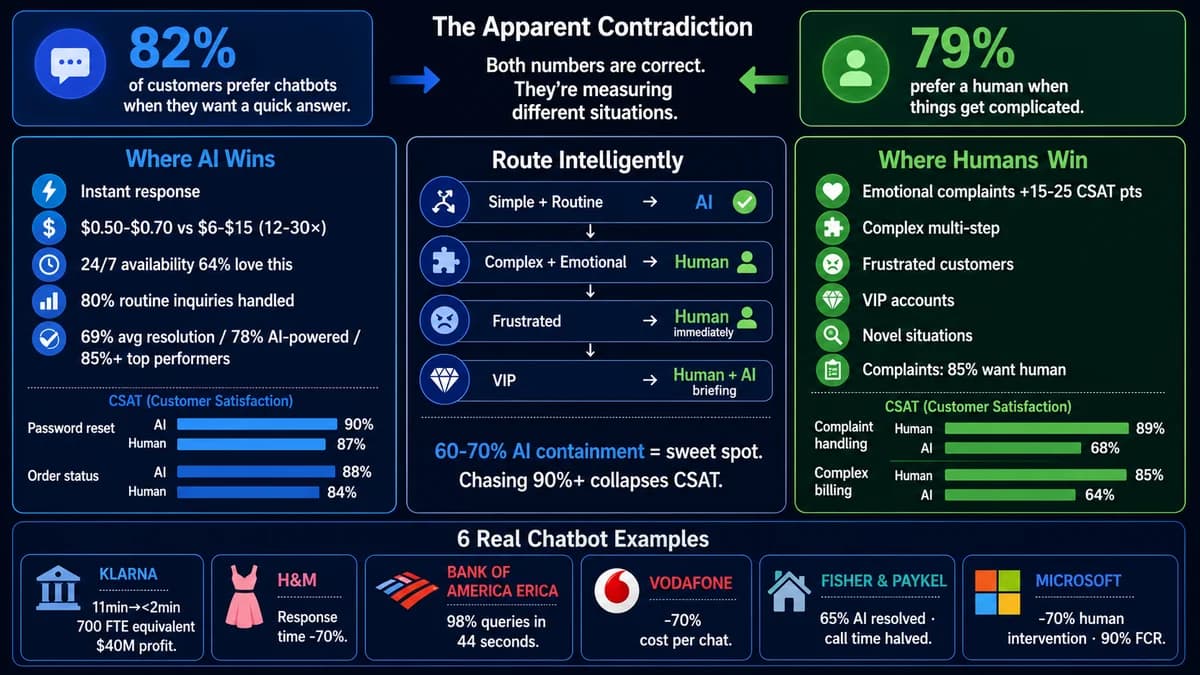
The Data That Seems Contradictory — And Why It Isn't
Two statistics dominate every AI chatbot vs human support discussion in 2026, and they appear to directly contradict each other. The first: 82% of customers prefer chatbots over waiting for a human agent when they want a quick answer — a 20% rise since 2022. The second: 79% of Americans strongly prefer interacting with a human when things get complicated. Both numbers are from credible 2026 research. Both are accurate. The contradiction dissolves when you understand that they are measuring different situations — and the businesses that understand this distinction are the ones delivering the highest CSAT at the lowest cost.
The same customer who is delighted by a chatbot resolving their order status inquiry in 30 seconds is the customer who will abandon your brand if a chatbot tries to handle their billing dispute with a pre-scripted loop. The question is not "chatbot or human?" It is "which interaction type belongs to which channel?" Getting this routing right is the entire competitive game in customer service AI in 2026.
The Cost Comparison — The Numbers That Drive Every Business Decision
The economic case for AI chatbots is unambiguous. AI chatbot interactions cost $0.50-$0.70 per conversation compared to $6-$15 for human agent interactions — a 12-30× cost advantage per interaction. Gartner estimates conversational AI will reduce contact center labor costs by $80 billion by 2026. Juniper Research puts total annual savings at $11 billion across businesses globally and 2.5 billion working hours recovered.
What the economics look like at scale: for a team handling 3,000 tickets per month at $10 per live agent interaction, that is $30,000 per month in interaction costs before salaries. If 60% of those tickets are routine enough for AI to handle autonomously, the AI-handled portion costs $900-$1,260 versus $18,000 for human handling — a saving of roughly $17,000 per month on that volume alone. Organisations with mature chatbot deployments see aggregate cost reductions of 30-40% (eCorpIT 2026 analysis).
The cost advantage holds only if the AI is resolving, not deflecting. A chatbot that sends customers to a FAQ article they already read, loops them through the same questions twice, or fails to offer a human escalation path is not saving cost — it is generating callback volume, churn, and negative reviews. The economic case for chatbots is real. It requires correctly-scoped AI, not maximum automation.
Where AI Chatbots Win — The Interactions Where AI Is the Better Choice
Five categories of customer interactions consistently favour AI on every measurable dimension — cost per interaction, response time, availability, scaling, and CSAT. These are the interactions where deploying AI is not a tradeoff against human quality; it is an upgrade over what a human team can economically deliver. The mirror set — interactions where humans win by significant CSAT margins — is in the next section.
Deploy AI For:
- Routine, high-volume queries — order status, account balance, password reset, shipping tracking, store hours, return policy, FAQ. AI resolves 80% of routine inquiries autonomously (IBM). Instant response at $0.50-$0.70.
- 24/7 coverage — 64% of customers say 24/7 availability is the best chatbot feature. Peak chatbot usage is 5-9 PM local time — precisely when human agents are unavailable. AI captures queries that would otherwise go unanswered.
- Simultaneous high volume — AI handles unlimited concurrent conversations with zero wait time. Human agents handle one at a time. At scale, chatbots provide a service level that staffing cannot match economically.
- First-response triage — AI now handles 74% of initial customer queries before any human involvement (2026 Omnichannel Support Benchmark). Even for queries that ultimately need a human, AI can gather context, classify the issue, and route with full conversation history preserved.
- Consistent, accurate information delivery — AI delivers the same correct answer every time on well-defined topics. Human agents vary in knowledge and communication quality. For knowledge-heavy domains (compliance, product specifications, policy), AI consistency is an advantage.
Prioritise Humans For:
- Emotional complaints and disputes — human agents outperform AI by 15-25 CSAT percentage points in scenarios involving emotional complaints, escalated disputes, and sentiment recovery. 85% of customers want a human for complaints specifically.
- Complex, multi-step issues — issues requiring judgment, creative problem-solving, or access to systems and data that the chatbot cannot reach. 79% of Americans prefer humans for complicated issues. 72% prefer humans for complex issues overall.
- High-value customer relationships — VIP accounts, large enterprise customers, and renewal conversations require the relationship sensitivity and business judgment that AI cannot replicate. The cost of a poor interaction with a $50,000/year account exceeds any chatbot cost saving.
- Novel situations without clear answers — when the customer's question has no documented answer, AI loops, escalates unnecessarily, or hallucinates. Human agents exercise judgment. Novel edge cases belong to humans until AI is specifically trained on them.
- Situations requiring accountability — compensation decisions, policy exceptions, legal or compliance-adjacent issues. These require human judgment, authority, and accountability that AI cannot carry.
Evaluating whether to deploy an AI chatbot for your specific business and want a realistic assessment of what percentage of your query volume is suitable for AI vs what requires human handling? Automely provides this assessment free.
Free 45-minute chatbot strategy consultation. We map your query types, estimate your AI-suitable volume, and outline the routing architecture that maximises cost saving without sacrificing CSAT.
The Consumer Sentiment Data — What Customers Actually Think
The customer preference data contains a tension that most chatbot content either ignores or misrepresents. On one side: 62% of consumers prefer interacting with a chatbot rather than waiting for a human agent. 74% prefer chatbots for simple, quick questions. On the other side: 79% of Americans strongly prefer humans when things get complicated. 64% of customers would prefer companies didn't use AI at all. 89% believe companies should always offer the option to speak with a human. 81% of people believe AI in customer service is used primarily to save money, not to improve service.
Both sides of this data are real. The resolution: customers prefer the channel that solves their problem fastest with the least effort — regardless of whether that is AI or human. When AI delivers instant resolution, CSAT matches or exceeds human baselines. When AI deflects, loops, or blocks access to humans, CSAT collapses and brand trust erodes. The businesses getting this right are not choosing AI or humans universally — they are routing intelligently, maintaining human access as a guaranteed option, and being transparent about when customers are talking to AI.
CSAT by Interaction Type — The Numbers That Guide Routing Decisions
The CSAT story is not "chatbots are worse than humans" — it is "chatbots are worse than humans on some interaction types and better on others." The table below is the most actionable summary of the data: it tells you, query type by query type, where the deploy decision is obvious, where it is contested, and where AI causes measurable CSAT damage. Use this as the foundation for your routing logic, not as a generic argument about whether AI is "good enough."
| Interaction Type | AI Chatbot CSAT | Human Agent CSAT | Verdict |
|---|---|---|---|
| Password reset / account access | ~90% | 87% | ✓ AI wins — instant, accurate, no wait |
| Order status / shipping tracking | ~88% | 84% | ✓ AI wins — real-time data access, immediate |
| FAQ / product information | ~85% | 83% | ✓ AI wins — consistent, always available |
| Returns / standard refunds | ~80% | 82% | ~ Tie — AI handles process; human for exceptions |
| Appointment scheduling | ~82% | 79% | ✓ AI wins — 24/7 availability critical here |
| Billing queries (simple) | ~75% | 80% | ~ Mixed — AI works if escalation easy |
| Complex billing disputes | ~60% | 84% | ✓ Human wins — judgment and authority needed |
| Complaint handling | ~55-65% | 85-90% | ✓ Human wins by 15-25 points |
| Emotionally charged escalation | ~48% | 88% | ✓ Human essential — empathy irreplaceable |
| VIP / enterprise account issues | ~62% | 91% | ✓ Human wins — relationship stakes too high |
AI CSAT consistently exceeds human baselines when AI resolves issues rather than deflecting them. The aggregate Notch AI agent score is 4.87/5, representing a 15-20% lift over typical human performance on well-scoped interactions. People don't inherently prefer human agents — they prefer getting problems solved quickly and completely. When AI delivers that, CSAT is equal to or better than human baselines. The CSAT gap between chatbots and humans is not an AI capability gap — it is a scoping gap. AI deployed on the right queries performs as well as or better than humans.
6 Real Chatbot Examples — Verified Results From Production Deployments
The case for AI chatbots in customer service is no longer speculative. The six deployments below are publicly documented production systems with measured outcomes — spanning fintech, retail, banking, telecoms, appliances, and enterprise internal IT. The common thread is not the AI technology; it is the scoping discipline. Every one of these deployments focused AI on well-defined, high-volume query types and built clean escalation paths to humans for the complex cases.
The Common Failure Modes — Why Chatbots Damage CSAT
64% of customers would prefer companies didn't use AI at all. 41% of consumers feel customer service has worsened due to AI. 38% have abandoned a purchase due to a poor chatbot experience. These are not arguments against chatbots — they are arguments against poorly deployed chatbots. Understanding the specific failure modes is what separates chatbot deployments that build trust from those that erode it.
Looping Without Resolution
Chatbots that cycle through the same menu options when they cannot resolve a query produce frustration disproportionate to the initial inconvenience. When a customer states the same problem three times and receives the same scripted response, the interaction actively damages trust more than if they had simply waited for a human agent. Every loop without a clear escalation path is a brand damage event.
Blocking Human Access
89% of customers believe companies should always offer the option to speak with a human. Only 15% of consumers experience a seamless handoff from AI to human agents (Twilio 2026). When chatbots are used to reduce human contact rather than route intelligently to it, the resulting experience — particularly for customers who have a real problem — produces the worst CSAT outcomes in the data. Human escalation must be clearly available, not hidden.
Context Loss at Handoff
85% of escalations feel disjointed — the customer has to repeat their issue to a human agent who lacks the context from the chatbot conversation. When customers repeat themselves after already explaining their issue to an AI, the cumulative experience is worse than if the chatbot had never been deployed. Context-preserving handoffs — where the human agent receives the full conversation history before the first word — are not optional; they are the minimum requirement for a functional hybrid model.
Automating Too Much — Chasing 90%+ Containment
The evidence points to 60-70% containment as the sweet spot for mature deployments. Chasing 90%+ typically means the bot is handling tickets it should escalate — and customers who needed a human keep hitting an AI wall. The teams that see the worst outcomes are those that automate indiscriminately, pushing everything through the bot and watching CSAT fall as customers who needed empathy, judgment, or authority hit a system that cannot provide any of those things.
Undisclosed AI — Trust Erosion When Discovered
54% of consumers feel they can confidently identify when they are interacting with a chatbot. When customers discover they were speaking to an AI without disclosure — particularly on sensitive topics — trust damage is significant. Transparency about AI involvement is both an ethical requirement in most jurisdictions and a strategic choice: customers who know they are talking to an AI and get good service are satisfied; customers who felt deceived are not.
The Routing Framework — How to Decide What Goes to AI vs Human
The routing decision reduces to three variables: complexity, emotional intensity, and business value. Every query can be mapped against these three axes, and the mapping determines the channel.
Route to AI when: low complexity + low emotional intensity + low account value
Password resets, order status, FAQ lookups, appointment scheduling, standard refund requests, shipping tracking, account balance, store hours. These are the interactions where AI resolves 85%+ of the time with CSAT that matches or exceeds human baselines. They represent 60-70% of query volume in most businesses.
Use AI to gather context, then route to human with full brief
Complex but emotionally neutral queries where AI can gather structured information (issue type, account details, what has already been tried) before routing to a human agent with complete context. This reduces human handling time and eliminates the context-loss problem at handoff. The customer does not repeat themselves; the human agent arrives prepared.
Route immediately to human when: high complexity OR high emotional intensity OR high account value
Complaints, billing disputes, escalated issues, frustrated customers (detected by language signals), VIP accounts, any interaction where the customer explicitly requests a human. These interactions produce 15-25 CSAT point differences between AI and human handling. No cost saving justifies the brand damage from routing them to AI.
Never route to AI: explicit human requests, legal/compliance issues, compensation decisions
89% of customers believe companies should always offer the option to speak with a human. Any customer who explicitly requests a human should be transferred immediately — the attempt to handle this with AI produces the highest churn and review damage of any chatbot failure mode. Set hard rules for automatic human routing on these trigger phrases and conversation signals.
The right implementation of this framework requires a custom chatbot built with your specific query taxonomy, your customer data, and your escalation thresholds — not a generic tool configured with default routing. The businesses achieving 85%+ AI resolution rates with maintained or improved CSAT are those that invested in correct scope definition and routing logic before deployment. For the broader context on when custom AI development is the right choice over off-the-shelf tools, see our build vs buy AI guide.
Ready to deploy an AI chatbot that achieves 60-70% autonomous resolution without sacrificing CSAT — with the routing architecture, escalation paths, and context-preserving handoffs that the data says separate successful deployments from failures?
Free 45-minute chatbot strategy session. We map your query volume, recommend the routing architecture, and outline the custom chatbot build that fits your business — with the honest assessment of where AI will produce ROI and where human handling remains essential.