


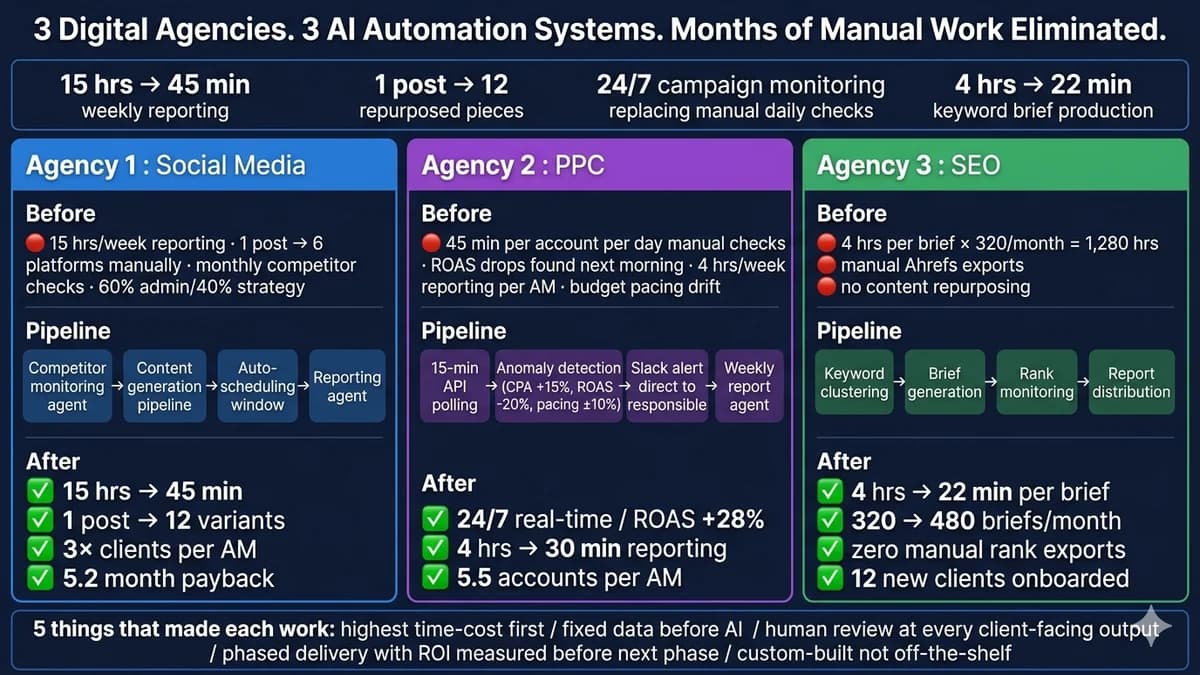
The Digital Agency Operations Problem — Why Manual Work Is Killing Margins
Every digital agency has the same structural problem. They sell strategic work — expertise, creative thinking, data-driven decision-making — but their operations are dominated by administrative and production tasks that require intelligence but produce no strategic value. Client reports that take 15 hours per week to compile manually. Content that needs to be reformatted for six platforms by hand every time a new piece is published. Ad campaigns monitored by account managers who spend 45 minutes per account per day checking the same dashboards manually. These tasks are not margin-accretive. They are margin-destroyers.
The challenge is not finding better humans to do the manual work faster. The challenge is removing the manual work from the system entirely. In 2026, 78% of organisations are using AI in at least one business function — but most digital agencies are still performing their highest-volume recurring tasks manually. The agencies that have automated these operations are operating at a structural cost advantage that compounds over time: they can handle more clients without proportional headcount growth, they can respond to campaign performance changes faster, and their senior talent spends its time on strategy rather than spreadsheet formatting.
This article documents three specific Automely custom AI development service engagements with digital agencies — a social media marketing agency, a PPC performance agency, and an SEO content agency. Each case study includes the exact operations we automated, how the systems work technically, and the measurable outcomes achieved.
Agency 1: Social Media Marketing Agency — Content Pipeline and Reporting Automation
Social Media Marketing Agency
15 clients · 3 account managers · 900+ posts/month · 12+ platform accounts per client · US-based boutique agency
The Manual Operations Before Automation
- Client reporting: 15 hours per week spent pulling data from Meta Ads, Google Analytics, Instagram, LinkedIn — formatting into Google Slides, writing narrative commentary, and distributing to 15 clients
- Content repurposing: a single long-form blog post required manual adaptation for Instagram, LinkedIn, Facebook, Twitter/X, TikTok, and YouTube Shorts — taking 2-3 hours per piece per platform
- Competitor monitoring: no consistent process. Account managers would check competitor accounts manually when they had time — roughly monthly
- Scheduling coordination: content calendars managed in spreadsheets, scheduling done manually in platform native tools, client approval via email chains with no tracking
- Account manager capacity: 60% of their time on production and reporting, 40% on strategy and client communication
What Automely Built
- Competitor monitoring agent: daily scrape of 3 designated competitors per client across Meta, LinkedIn, Instagram. Outputs a weekly digest of competitor content themes, posting frequency, engagement rates — automatically delivered to the account manager every Monday morning
- Content generation pipeline: account manager inputs a brief (topic, tone, CTA). Agent generates platform-native variants for all 6 required platforms, trained on the client's brand voice using a historical content library. Output: all 12 pieces in a structured review document
- Approval workflow and auto-scheduling: client receives a formatted review document on the 25th of each month with 5-day approval window. On approval, content queues automatically to all platform scheduling tools. Auto-published on the 1st
- Reporting agent: pulls from all 4 connected APIs nightly. On report day (typically Friday), generates narrative commentary comparing week-over-week and month-over-month performance. Formats to agency template and emails directly to client and internal team
Outcomes After 90 Days
- Weekly reporting time across 15 clients: from 15 hours to 45 minutes (review and send only — all data pulling, formatting, and narrative writing automated)
- Monthly content output per client: from approximately 60 posts (manual capacity) to 180 posts across all platforms (pipeline handles repurposing)
- Account manager client capacity: from 5 clients per AM to 15 clients per AM — same team, 3× the accounts
- Competitor insights delivered weekly vs monthly — account managers now surface competitive opportunities to clients consistently
Running a digital agency with the same manual reporting and content operations as Agency 1? We have built these systems three times now. The build pattern is established. The timeline is 8-10 weeks.
Free 45-minute consultation. We audit your current manual operations, identify the three highest-ROI automation opportunities for your agency, and give you a realistic build timeline and cost estimate.
Agency 2: PPC Performance Agency — Campaign Monitoring and Alert Automation
PPC Performance Marketing Agency
22 ad accounts · 4 account managers · $2.1M monthly spend under management · UK-based mid-market agency
The Manual Operations Before Automation
- Morning check routine: each account manager spent 45 minutes per account checking performance metrics each morning — across 5-6 accounts each, this consumed the first 3.5-4.5 hours of every working day just on surveillance
- ROAS drops and CPA spikes discovered hours or the morning after they occurred — by which time client budget had already been spent inefficiently and the client was asking questions
- Budget pacing drift: manual monitoring meant overspend or underspend was often not caught until end of week, making pacing corrections late and reactive
- Weekly client reports: 4 hours per account manager per week spent pulling performance data, writing commentary, and formatting reports — 16 hours per week across the team on administration
- The agency could not take new clients without hiring — account manager time was already fully consumed by monitoring and reporting on existing accounts
What Automely Built
- Multi-account monitoring agent: queries all 22 Google Ads and Meta Ads accounts via API every 15 minutes. Calculates rolling performance metrics against each account's target CPA, ROAS, and budget pacing thresholds set during onboarding
- Anomaly detection logic: CPA spike above 15% vs 7-day rolling average, ROAS drop above 20% vs target, budget pacing deviation above 10% above or below expected — each triggers a specific alert type with severity level
- Slack alert routing: alert fires directly to the account manager responsible for that account with specific context: which campaign, which metric, magnitude of deviation, timestamp, and a suggested first diagnostic action. No alert goes into a general channel — direct to the responsible person
- Weekly performance report agent: aggregates 7-day performance data for each account, generates narrative comparison to prior week and to account goal targets, formats to agency report template, distributes to client and internal team automatically every Monday morning
- Monthly executive summary agent: synthesises monthly performance across all accounts for the agency's management team — top performers, underperformers, accounts at risk, budget utilisation summary
Outcomes After 90 Days
- Issue detection: ROAS and CPA anomalies now detected within 15 minutes of occurrence rather than the following morning — budget waste window dramatically reduced
- Morning routine: account managers no longer spend the first 4 hours checking accounts. They review their overnight alert digest (2 minutes) and start their day on optimisation work
- ROAS improvement: 28% improvement across the portfolio — faster anomaly intervention directly translates to better performance outcomes for clients
- Weekly reporting time: from 4 hours per AM per week to 30 minutes (review and approve generated report). 14 hours per week recovered across the team
- Account capacity: each AM now manages 5.5 accounts versus 3.5 before — 57% capacity increase without additional headcount
Agency 3: SEO Content Agency — Research, Brief Production, and Rank Reporting Automation
SEO Content Agency
40 retainer clients · 8 content strategists · 320 briefs/month · EU-based agency serving UK and European markets
The Manual Operations Before Automation
- Brief production: each content brief required manual keyword research in Semrush, competitor URL analysis, SERP intent classification, LSI keyword identification, H2/H3 outline construction — 3-4 hours per brief. At 320 briefs per month: 960-1,280 hours of strategist time monthly
- Rank tracking: manual pulls from Ahrefs or Semrush for each client, exported to spreadsheet, formatted into client report template — taking 2-3 hours per client per month. Across 40 clients: 80-120 hours per month on rank reporting
- Content repurposing: no consistent process — blog posts were delivered to clients but secondary repurposing (social clips, email summaries, LinkedIn posts from articles) was done ad-hoc or not at all
- Strategists were spending 70% of their time on research and production and 30% on actual strategy — the ratio should have been reversed
What Automely Built
- Keyword clustering and prioritisation agent: ingests the client's Semrush keyword export. Applies semantic clustering to group related keywords by topic and intent. Scores each cluster by volume, difficulty, and existing content gap. Outputs a prioritised brief queue for the strategist's review — what to brief next, in order of opportunity
- Brief generation pipeline: strategist selects a keyword cluster and triggers the brief agent. Agent pulls top-ranking URLs for target keyword, analyses their H2/H3 structure, identifies content gaps, extracts LSI terms, and generates a structured brief: primary keyword, secondary keywords, target intent, suggested outline with H2/H3 suggestions, content gap notes, internal linking recommendations
- Rank monitoring agent: connects to Ahrefs API. Runs weekly automated rank checks for each client's tracked keyword set. Compares to prior week and flags movements above 5 positions (up or down). Generates a client-ready rank report narrative with trend commentary
- Client report distribution: rank report + traffic estimate + content calendar progress assembled automatically, formatted to agency template, and distributed to client contacts on a scheduled cadence — no manual assembly required
Outcomes After 90 Days
- Brief production time: from 4 hours per brief to 22 minutes (strategist reviews and refines AI-generated brief rather than building from scratch). At 320 briefs per month: saves approximately 1,160 hours per month of strategist time
- Brief output capacity: same team now produces 480 briefs per month versus 320 — 50% more output with no additional hires
- Rank reporting: fully automated — zero manual Ahrefs exports. 80-120 hours per month recovered across the team
- Strategist time allocation: from 70% production / 30% strategy to 25% production / 75% strategy — the ratio clients are actually paying for
- New client capacity: agency onboarded 12 new clients within 6 months of the automation going live — capacity that would have required 3-4 additional strategist hires under the manual system
The Automation Stack Across All Three Agencies
Despite serving three different agency types with three different operational problems, the technical patterns across all three engagements share a common architecture. Understanding this stack helps any agency owner evaluate what a custom AI development services engagement would involve for their specific operations.
| Automation Layer | Social Media Agency | PPC Agency | SEO Agency |
|---|---|---|---|
| Data Ingestion | Meta Graph API, Google Analytics 4, Instagram API, LinkedIn API | Google Ads API, Meta Ads API — 15-minute polling cycle | Semrush API, Ahrefs API — weekly scheduled pulls |
| AI Model Layer | GPT-4o for content generation (tiered: Mini for classification, 4o for production) | Statistical anomaly detection + GPT-4o for report narrative | GPT-4o for brief generation and report narrative |
| Orchestration | Custom agent pipeline (Automely-built) — triggers on schedule and on demand | Event-driven architecture — alert triggers on threshold breach | Schedule-based + on-demand brief generation |
| Output Distribution | Email (client reports), review document (content approval), auto-scheduling API | Slack direct message (alerts), email (weekly reports) | Email (rank reports), internal dashboard (brief queue) |
| Human Review Points | Content approval (5-day window), report review (1 hour/week) | Alert response (immediate), weekly report approval (30 min) | Brief refinement (20 min/brief), report approval (1 hour/client/month) |
| Integration Complexity | Medium — 4 platform APIs + scheduling tools | High — 22 ad accounts, real-time polling, alert routing | Medium — 2 SEO tool APIs + report templating |
| Build Timeline | 8 weeks | 10 weeks | 7 weeks |
What Made Each Automation Actually Work
These three engagements were not the first times we have seen agency automation attempted. They are notable because they worked — the systems are in production, generating measurable ROI, and the agencies are operating at higher capacity. The pattern that determined success across all three:
- We started with the highest time-cost operation, not the most technically interesting one. In every case, the first automation target was the task that consumed the most account manager hours per week. Client reporting consumed 15 hours per week for Agency 1 — not because it was exciting to automate, but because it was the largest quantifiable drain on high-cost time. Automating the highest-cost manual task first produces payback fastest and builds the business case for subsequent automations.
- We fixed the data quality problem before adding AI. As AI Fire's 2026 automation agency analysis documents: “When we audited their system, the real issue wasn't AI at all — it was broken ticket tagging and messy CRM routing. We fixed that foundation first. Only then did AI actually reduce support time and costs.” In Agency 2's case, two of the 22 ad accounts had inconsistent campaign naming conventions that would have made anomaly detection unreliable. We normalised the data structure before deploying the monitoring agent. Garbage in, garbage out.
- Every client-facing output is reviewed by a human before delivery. The content approval window, the report review step, the brief refinement step — these are not bureaucratic overhead. They are the quality gate that keeps the AI-generated output from damaging client relationships. The automation handles data pulling, analysis, formatting, and narrative generation. A human reviews and approves before anything reaches a client. This structure preserved trust while dramatically reducing the time required.
- Each automation delivered measurable ROI before the next one started. We do not propose all automations simultaneously. Agency 1's reporting agent was live and saving 13+ hours per week before we started the content pipeline. Agency 3's brief generation pipeline was live and measured before we built the rank reporting agent. Phased delivery means the agency is recovering value during the build, not waiting for a complete system that takes 6 months to deploy.
What We See Go Wrong in Agency AI Automation
Most agency AI automation failures we encounter share a small set of common patterns. The mirror set — what consistently works — is what defined the three engagements above. Both sides matter: avoiding the failure modes is at least as important as adopting the right patterns.
Common Agency AI Automation Failures
- Buying a generic AI platform subscription and expecting it to fit the agency's specific workflows and integrations without custom configuration
- Automating the most exciting process first rather than the most time-costly one — building AI content generation before fixing the reporting that consumes 15 hours per week
- Deploying AI-generated content or reports to clients without a human review step — one poor output damages a client relationship that took months to build
- Adding AI on top of broken data pipelines and messy systems — AI amplifies inconsistency, it does not fix it
- Attempting to automate everything at once — large system that takes months to deliver, no ROI during the build period, high project failure risk
Agency AI Automation That Delivers
- Custom AI development services built specifically for the agency's tools, workflows, clients, and approval processes — not generic off-the-shelf subscriptions
- Starting with the single highest-cost manual operation, automating it completely, measuring the ROI, then moving to the next one
- Maintaining human review at every client-facing output stage — the automation reduces time, not oversight
- Data audit and cleaning before automation — ensuring the inputs to the AI system are clean and consistently structured
- Phased delivery with each phase measured against the pre-automation baseline — payback proven before the next phase begins
AI workflow automation delivers 30-50% faster workflow execution, 20-40% cost reduction, and up to 70% fewer errors (cflowapps 2026). For digital agencies specifically, where the highest-cost resources are account managers and strategists doing administrative work, the ROI is more direct: hours recovered × fully loaded hourly rate = annual savings. The three agencies documented here recovered between 800 and 1,400 hours per year per account manager from manual reporting and production work — hours now spent on strategy, new client acquisition, and delivering outcomes that justify higher retainers. For the broader ROI framework behind these numbers, see our AI automation vs manual process cost calculation guide.
Running a digital agency and spending more than 10 hours per week on manual reporting, content production, or account monitoring? These are the three automations we have built for agencies like yours — and the payback is typically under 6 months.
Free 45-minute agency operations audit. We identify your three highest-ROI automation opportunities, give you realistic build timelines and cost estimates, and tell you honestly if off-the-shelf tools would serve your needs before you commission custom development.