


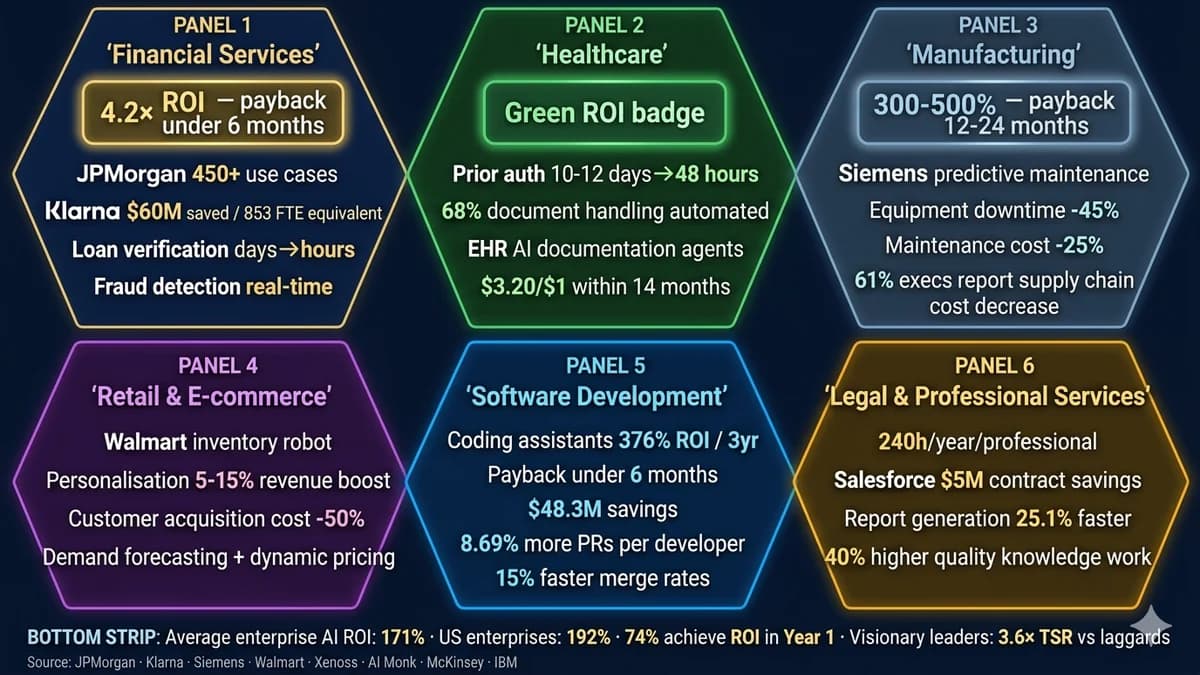
The ROI Benchmark Context — What the Cross-Industry Data Shows
Two numbers define the enterprise AI ROI picture in 2026. The first: companies report an average ROI of 171% from agentic AI deployments, with US enterprises specifically achieving 192% — exceeding traditional automation ROI by 3×. 74% of executives report achieving ROI within the first year of AI agent deployment; 39% see productivity at least double. Visionary AI leaders achieve 1.7× revenue growth, 3.6× three-year total shareholder return, and 2.7× return on invested capital versus laggards.
The second: only 5% of enterprises see real returns at enterprise-wide scale. The organisations achieving these headline figures are not representative of the broader enterprise AI adoption landscape — they are the disciplined minority who defined success metrics before build, invested in data foundations first, and deployed in focused use cases rather than enterprise-wide pilots. Understanding both numbers is what makes these case studies useful rather than merely inspiring.
What follows is a cross-industry analysis of verified AI automation deployments — where possible, with named organisations, specific before-and-after numbers, payback timelines, and the AI application type that produced the result. The goal is to give you a realistic benchmark against which to evaluate your own AI investment decisions: what returns are genuinely achievable in your industry, for your use case, in what timeframe.
Industry 1: Financial Services — The Highest AI ROI of Any Sector
Financial services leads every cross-industry AI ROI benchmark in 2026 — documented at 4.2× ROI in Automely's partner research — because the sector combines three characteristics that maximise AI returns: high-volume structured transactions, significant regulatory documentation burden, and large cost differentials between manual and automated error rates. The financial services sector spends an average of $3,200 per employee on AI — 2.6× the cross-industry average — and the documented outcomes justify the investment.
- JPMorgan: AI investment banking agents generate M&A memos and presentations in 30 seconds vs hours for junior analysts. Fraud detection in real time across millions of daily transactions. 450+ active AI use cases across trading, compliance, customer service, and operations.
- Klarna: AI customer service agent handles the equivalent workload of 853 full-time employees. Annual labour savings: $60M. Resolution time: 11 minutes → 2 minutes (82% faster). Customer satisfaction maintained at comparable levels to human agents.
- Salesforce: Contract automation AI reduced legal costs by $5 million. Document review time reduced by 2-3× across procurement and legal workflows.
- US banking sector: AI loan document verification reduced processing from multiple days and multiple teams to a few hours. Cost reduction and faster approvals within the first six months of deployment.
- Transaction volume: high-volume, structured, rule-governed transactions are the most automatable workflow category available.
- Error cost: a 1% error rate in financial document processing carries compliance and financial liability that AI's consistency eliminates.
- Regulatory reporting: PwC estimates the average banking institution submits 67 annual reports spanning 340,000 data points — a documentation burden that AI handles dramatically faster.
- Fraud detection: real-time AI analysis of transaction patterns catches fraud in milliseconds vs the hours of manual pattern analysis it replaced.
- 24/7 customer service: AI handles the structured query volume (balance enquiries, payment status, account access) that previously required around-the-clock staffing.
Industry 2: Healthcare — $3.20 Return per $1 Invested Within 14 Months
Healthcare AI automation produces the most consistent documented return rate of any sector studied: $3.20 returned for every $1 invested within 14 months (Vellum, 2025-2026). The primary applications driving this return are clinical documentation automation, prior authorisation processing, and administrative workflow AI — not diagnostic AI, which carries significantly longer implementation timelines and different risk profiles. The healthcare AI bottleneck is not clinical — it is administrative, and administrative healthcare AI is producing some of the clearest measurable ROI in enterprise deployments.
- AI documentation agents: automatic note-taking from clinician dictation, EHR updating, and cross-checking against payer policies. Outcome: improved productivity, reduced burnout, and better patient care delivery by freeing clinician time from administrative work.
- Prior authorisation automation: AI agents extract key data from clinician notes, cross-reference payer policies, and submit claims automatically — cutting turnaround times from 10-12 days to 48 hours and reducing denial rates.
- Patient scheduling and triage: AI scheduling systems reduce administrative burden and no-show rates through automated reminders and intelligent slot management.
- Operations teams report automating up to 68% of document handling — recovering significant manual capacity and redeploying staff from data entry to exception management and patient-facing work.
- Administrative documentation: clinical documentation is the highest-volume and most time-intensive administrative burden per clinician — AI automation produces immediate capacity recovery.
- Claims and prior authorisation: structured, rules-based decisions with clear policy documents make this highly automatable with low hallucination risk and high accuracy.
- Scheduling optimisation: AI scheduling agents reduce the coordination overhead that consumes significant staff time across most healthcare organisations.
- Slower return areas: diagnostic AI and clinical decision support require longer data pipeline setup, model validation, regulatory clearance, and clinician trust-building before measurable ROI materialises.
Evaluating AI automation for your specific industry and want a realistic ROI projection for your use case — not generic industry benchmarks but specific to your processes, your data, and your team? Automely provides this assessment free.
Free 45-minute AI ROI assessment. We map your specific use case against the industry benchmarks in this guide and give you a realistic projection with the assumptions made explicit.
Industry 3: Manufacturing — 300-500% ROI from Predictive Maintenance
Manufacturing AI delivers some of the highest percentage ROI of any industry when deployed correctly — but also has the longest implementation timelines due to the sensor infrastructure and historical data requirements. Predictive maintenance is the application with the clearest before-after metrics and the most consistent published results across documented deployments. 61% of manufacturing executives report decreased costs as a direct result of AI in supply chain — the widest adoption in manufacturing after quality control.
- Siemens: Deployed an AI predictive maintenance agent that analysed sensor data to forecast machine failures before they occurred. Outcome: improved asset utilisation and smoother production cycles. Equipment failure rates and unplanned downtime measurably reduced within the first year of deployment.
- Quality control AI: computer vision systems automate visual inspection — identifying defects, surface anomalies, and dimensional tolerances at machine speed with greater consistency than human inspection. Waste reduction and improved first-pass yield documented across discrete manufacturing deployments.
- Supply chain AI agents: simulation of disruptions, automatic shipment re-routing, proactive ETA updates to customers. Supplier performance tracking and inventory buffer management without manual intervention.
- Production scheduling AI: 40%+ of manufacturers adopting AI scheduling systems by end of 2026 (IDC). Real-time scheduling based on machine status, workforce availability, and supply variability.
- Predictive maintenance requires 6-12 months of sensor data before the model achieves production accuracy. The infrastructure investment precedes the ROI materialisation.
- Quality control AI can be deployed faster (3-6 months) when labelled defect datasets exist. Building those datasets from scratch adds to the timeline.
- Supply chain AI requires integration with ERP, WMS, and supplier data systems — the integration complexity determines the deployment timeline more than the AI capability itself.
- The 300-500% ROI figure applies to mature deployments that have cleared the data accumulation and integration phases. First-year returns are typically lower; the compound return builds over 2-3 years.
Industry 4: Retail and E-commerce — AI Personalisation at Enterprise Scale
Retail and e-commerce AI automation produces the most visible consumer-facing outcomes — but the highest-ROI applications are operational rather than customer-facing. AI demand forecasting, inventory optimisation, and supply chain AI produce consistent measurable returns on investment, while AI personalisation and recommendation engines produce revenue impacts that are often attributed partly to other factors. Both are producing documented results in 2026 deployments.
- Walmart: AI-powered inventory management robot that scans shelves and automatically triggers restocking decisions. Outcome: lower inventory costs and improved customer experience from reduced stockouts. The system operates continuously across thousands of store locations.
- DHL: AI logistics agent deployed to forecast demand, optimise delivery routes, and schedule shipments dynamically. Outcome: reduced delivery delays and logistics costs, improved customer satisfaction from more accurate ETAs.
- AI personalisation at scale: McKinsey documents that personalised marketing — product recommendations, dynamic content, targeted offers based on purchase and browsing history — reduces customer acquisition costs by up to 50% and boosts revenues 5-15% over baseline.
- Dynamic pricing AI: real-time competitive price adaptation in e-commerce, continuously adjusting to demand signals, competitor pricing, and inventory levels without manual intervention.
- Demand forecasting and inventory optimisation: most consistent ROI, directly measurable through inventory carrying cost and stockout rate. Applicable at all retail scales from SMB to enterprise.
- Customer service AI: same economics as general customer service — $0.50 vs $6.00 per interaction. For high-volume retail customer service (returns, order status, product questions), the cost advantage is substantial.
- AI personalisation: 5-15% revenue impact is real but requires clean customer data, integration with e-commerce platform, and A/B testing to attribute accurately. Higher investment and longer measurement cycle than operations AI.
- Dynamic pricing: highest complexity and requires competitor data integration. Clearest ROI in e-commerce vs physical retail.
Industry 5: Software Development — 376% ROI in Three Years, Payback Under 6 Months
AI coding assistance produces the fastest payback of any enterprise AI category and the clearest, most measurable ROI. Enterprises record a 376% ROI lift over three years from coding assistants, with payback in under 6 months. The leading enterprise deployments have saved $48.3M in developer productivity gains and generated $18.4M in revenue impact from accelerated product development cycles. This is the application category where AI ROI is the most unambiguous — because every minute of developer time has a direct dollar value and productivity is measurable in pull requests, code review time, and deployment frequency.
- Anthropic Claude Code enterprise deployment: 30,000+ employees trained on Claude Code in the largest enterprise-scale Claude deployment. Internal telemetry showed 8.69% increase in pull requests per developer and 15% increase in merge rates. Engineers reported higher job satisfaction — higher than a comparison group without AI tools.
- GitHub Copilot enterprise data: 90% of developers who used Copilot for more than three days felt more fulfilled at work. 95% said they enjoyed coding more with AI assistance. Productivity gains concentrated in standard feature development, debugging, and documentation generation.
- ChatGPT Enterprise: users saving 40-60 minutes per active day on automating reporting tasks. Consulting teams using generative AI for report generation achieving 25.1% faster completion and 40% higher quality on day-to-day knowledge work.
- Three-year productivity model: leading deployments saved $48.3M in developer productivity gains and generated $18.4M in revenue impact from accelerated time-to-market for product features.
- Developer time has an immediate, measurable dollar value — every hour of productivity gain translates directly to project timeline or capacity for additional work.
- AI coding tools integrate into existing workflows (IDE, terminal) without disrupting the development process — adoption friction is lower than almost any other AI application category.
- The benefit distribution is broad — junior developers see the largest absolute gains (26-39% productivity improvement), but senior developers benefit from faster code review, documentation, and context switching.
- The compound effect: faster development cycles → earlier time-to-market for products → revenue acceleration that exceeds the productivity gain value alone. The $18.4M revenue impact figure reflects this compound.
Industry 6: Legal and Professional Services — 240 Hours Saved per Professional per Year
Legal and professional services AI produces consistent returns across document review, research, contract analysis, and knowledge work — but the application of AI is narrower than in other industries due to the liability and judgment requirements of legal and advisory work. The highest- confidence AI applications are those that assist professionals with research, document analysis, and drafting — not those that replace professional judgment in high-stakes decisions. The returns are real and substantial; the scope is specific.
- Salesforce: AI contract automation reduced legal costs by $5 million. Contracting workflows that previously required manual review and negotiation tracking were automated, with AI handling document review, clause identification, and change tracking.
- Legal document review: AI tools cut time required for large-scale document review — due diligence, discovery, compliance audits — by 60-80%. Legal professionals save 240 hours per year from automating routine tasks (document review, legal research, standard contract analysis).
- Consulting report generation: teams using gen AI for report generation achieve 25.1% faster completion and 40% higher quality ratings on day-to-day knowledge work. ChatGPT Enterprise users save 40-60 minutes per active day from reporting automation.
- Compliance reporting: AI agents analyse regulatory requirements, mine relevant data, generate reports, and route to human reviewers. Banking institutions submitting 67+ annual reports across 340,000 data points achieve significant throughput improvement.
- High-volume document review: the clearest ROI in legal AI. When the task is reading and categorising large volumes of documents (due diligence, discovery, audit), AI speed advantage is unambiguous and measurable.
- Contract management and tracking: AI tracks clause variations, flags non-standard terms, and maintains contract metadata — systematically better than manual spreadsheet tracking at any volume above a few hundred contracts.
- Legal research: AI research tools reduce the time to find precedent, statute, and regulatory guidance — meaningful for any legal team handling research-intensive matters.
- Where human judgment remains essential: client counsel, negotiation strategy, litigation judgment, novel legal questions, and any advisory work where the professional's reputation and judgment is the product.
Cross-Industry AI ROI Benchmark — Where Your Investment Stands
The cross-industry table below consolidates the documented ROI, typical payback timeline, top-ROI application category, and the key risk factor for each of the six industries covered in this guide. Use it as a calibration tool: locate your industry row, compare the headline ROI and payback against your internal projection, and use the key risk column to pressure-test whether your governance, data foundations, and use-case scoping are sized to that industry's specific failure modes.
| Industry | Documented ROI | Payback Timeline | Top Application | Key Risk |
|---|---|---|---|---|
| Financial Services | 4.2× ROI | Under 6 months | Process automation, fraud detection, customer service | Regulatory compliance in AI outputs |
| Healthcare | $3.20 per $1 invested | 12-18 months | Administrative documentation, prior auth, scheduling | Data pipeline setup; HIPAA compliance |
| Manufacturing | 300-500% (predictive maintenance) | 12-24 months | Predictive maintenance, quality control, supply chain | Sensor data infrastructure required |
| Retail / E-commerce | 5-15% revenue + cost savings | 6-12 months | Demand forecasting, inventory, personalisation | Customer data quality and privacy |
| Software Development | 376% over 3 years | Under 6 months | AI coding tools, agentic coding, DevOps automation | Code review discipline on AI output |
| Legal / Professional Services | 240h/yr/professional | 6-12 months | Document review, contract management, research | Judgment-dependent work remains human |
Across every industry in this analysis, one factor predicts ROI more than the specific use case or industry: whether success metrics were defined before the AI project was approved. Organisations that define quantified success criteria pre-approval achieve a 54% project success rate versus 12% without defined metrics (RAND). The industry ROI benchmarks in this guide are achievable — but only with the governance discipline that the successful minority apply. For the complete framework on what the 20% who succeed do differently, see our AI project failure and success guide.
Building an AI automation business case for your industry and want a partner who has built production AI systems across financial services, healthcare, manufacturing, retail, software, and professional services contexts?
Free 45-minute AI ROI assessment. We map your specific use case against these industry benchmarks and build a realistic ROI projection — with the assumptions, timeline, and governance requirements made explicit. No generic advice.