


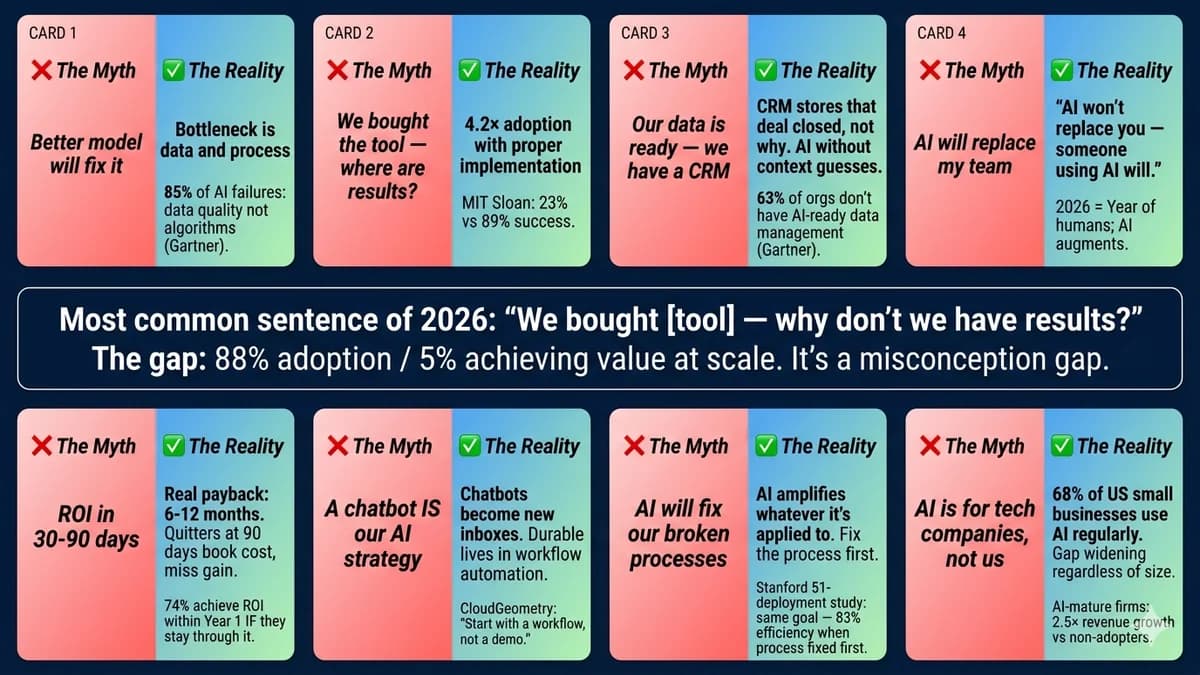
The Most Common Sentence of 2026 — and What It Reveals
CloudGeometry published a prediction for 2026 that I keep coming back to: "I'm willing to bet a cup of coffee that the most common sentence we hear in 2026 will be 'We bought [tool], so why don't we have results?'" Having worked with businesses across the US, UK, and EU on AI strategy and implementation, I will take that bet and raise the stakes. It will be the most common sentence, the most expensive sentence, and the most preventable sentence.
The gap between AI adoption and AI impact in 2026 is not a technology gap. 88% of organisations use AI in at least one function. Only 5% are achieving AI value at scale (BCG). The models are not the problem — they are broadly accessible, increasingly capable, and rapidly commoditising. The gap is a misconception gap. Business owners are making decisions based on assumptions about AI that the data consistently contradicts, and those assumptions are costing real money in failed tools, abandoned projects, and missed competitive ground.
This guide is written for the business owner or senior leader who is not technical — who does not write code, does not manage data infrastructure, and does not follow AI research — but who is responsible for AI decisions in their organisation. Eight misconceptions. Each corrected with the evidence. Each with the specific decision it should change.
The 8 Misconceptions — Each Corrected With the Evidence
Each of the eight misconceptions below follows the same structure: the myth as it is commonly stated, the reality grounded in practitioner experience, the evidence from research, and the specific decision change it should produce. Read them in order — the misconceptions compound. Resolving one without resolving the others produces the same outcome: AI investment that does not convert into business value.
The bottleneck is almost never the model. The model is the 20-minute conversation with the genius — but if you cannot tell the genius what problem to solve, what context applies, and what good output looks like, the genius is useless. The companies waiting for a smarter GPT release before investing in AI strategy are burning time on the wrong constraint. Softeta's Chief Innovation Officer states it plainly: "Businesses that are waiting for 'smarter AI' to solve their problems are running out of time. The real bottleneck is not better models."
85% of AI project failures trace to poor data quality or lack of relevant data — not algorithmic shortcomings (Gartner). MIT Project NANDA found 95% of GenAI pilots fail to reach production or deliver ROI. The cause is consistently upstream of the model: data readiness, workflow integration, and the absence of a defined outcome before build starts. "The failure is almost never the model" is not a product claim — it is the consistent finding across RAND, MIT, Gartner, and McKinsey research on why AI projects fail.
Stop evaluating AI model options. Start evaluating your data quality and problem definition. The question is not "which AI?" — it is "what specifically do we want AI to do, for what business outcome, using what data?" Answer those first.
Buying an AI tool is the beginning of the work, not the completion of it. An AI tool deployed without process redesign, change management, staff training, and defined success metrics produces the same result as a gym membership bought without going to the gym: you own an asset you are not using effectively. The correct framing from CloudGeometry: "If you want a fast demo, build a chatbot. If you want durable ROI, start with a workflow." The tool is not the strategy. The tool is an input to the strategy.
Organisations that invest in proper AI implementation — including change management, customisation, and training — see 4.2× higher adoption rates and 3.7× better ROI compared to those treating AI as plug-and-play (MIT Sloan Management Review, 2025). The success rate difference is stark: organisations budgeting adequate time, resources, and patience for proper implementation achieve 89% AI project success rates versus only 23% for those expecting instant, effortless deployment.
Before buying any AI tool, budget for what comes after the purchase: process redesign time (weeks), staff training (days to weeks), integration testing (days to weeks), and success metric tracking (months). The tool is 20% of the investment. The surrounding work is 80%.
Having data is not the same as having AI-ready data. Softeta's Chief Business Development Officer describes the problem precisely: "Your CRM stores that a deal closed. What it doesn't store is that you were the second choice. Or that the winner already had one key feature you're only shipping in six months. Without that history, the system is just guessing. And an AI that guesses is worse than no AI at all, because at least a human would have figured it out." The issue is not data quantity — it is data quality, completeness, structure, and contextual richness. Most CRMs store outcomes. AI needs context.
63% of organisations do not have or are unsure if they have the right data management practices for AI (Gartner, 2024 survey of 1,203 data management leaders). Gartner predicts 60% of AI projects unsupported by AI-ready data will be abandoned through 2026. Poor data quality costs organisations an average of 15% of revenue per year (Gartner). The practical implication: your database containing your customer records is almost certainly not AI-ready without a data quality investment first.
Before any AI project, conduct an honest data audit: is this data complete, consistently structured, and does it contain the contextual information the AI needs — not just the outcome, but the inputs and reasoning that produced it? If the audit reveals gaps, fix the data before building the AI.
The framing of "replace vs protect" produces bad decisions on both sides. The accurate framing is: AI changes what your team does, not whether your team is needed. TechCrunch describes 2026 as "the year of humans" — AI handles the repetitive and analytical layers, freeing professionals for contextual, relational, and judgment-intensive work. The genuine competitive risk is not that AI replaces your team. It is that a competitor deploying AI with their same-sized team produces dramatically more output at lower cost and outcompetes you. The statement is not "AI will replace people" — it is "people using AI will outperform people not using AI."
63% of companies plan to reskill existing employees rather than hire AI specialists externally (World Economic Forum). Allianz's Chief People Officer publicly framed AI to their team as "how can you use AI to reduce your workload by at least four hours a week?" — not as a replacement threat. User-centred AI design approaches drive 64% higher adoption rates (Stanford Enterprise AI Playbook). 31% of workers actively undermine AI when it is framed as a replacement threat. The framing of AI adoption is not just a communication issue — it is a strategy issue that determines adoption rates.
Frame AI to your team as a tool that eliminates the work they find least engaging and amplifies the work they find most valuable. "AI will handle the research so you can focus on the conversations" lands differently than "AI will do part of your job." The framing determines whether your team helps your AI succeed or quietly undermines it.
The 30-90 day ROI expectation is the most expensive misconception in this list because it causes organisations to abandon AI projects just before the returns materialise — booking the investment cost without ever capturing the benefit. The research is consistent: real enterprise AI payback typically takes 6-12 months or longer. The organisations abandoning at 90 days are not experiencing AI failure. They are experiencing normal AI project maturation that they mistakenly classify as failure because their expectations were wrong. As Unosquare describes: "AI implementation is a significant organisational change initiative — not a software rollout."
74% of executives achieve ROI within the first year of proper AI agent deployment — meaning many see returns between months 6 and 12. 40% of enterprises expect positive yields within 1-3 years for more complex deployments. The fastest payback applications (coding assistants, customer service AI) achieve payback in under 6 months. More complex AI (manufacturing predictive maintenance, healthcare administrative AI) requires 12-24 months. The RAND research shows the average sunk cost per abandoned AI project is $4.2 million — at a median abandonment time of 11 months. Organisations that stick through the investment phase but set realistic timelines consistently capture returns; those that exit early do not.
Before starting any AI project, define the realistic ROI timeline for your specific application type. Customer service AI: expect payback in 3-6 months. Sales AI: 6-12 months. Custom AI development: 12-24 months. Build this timeline into your approval process so the project is not evaluated against the wrong clock.
A chatbot is the most visible form of AI, which is why it is the most common first AI investment for non-technical business owners. It is easy to demo, easy to show to stakeholders, and it looks like AI to people who are not familiar with AI. The problem: chatbots frequently become "a new inbox" — they add a channel without reducing workload, and they struggle with anything outside their script. CloudGeometry's observation is precise: "The companies that struggle will still be arguing about whether the assistant is accurate. Meanwhile the companies getting value will quietly be reducing cycle time in core processes." The durable AI ROI is in workflow automation, not conversation interfaces.
AI customer service chatbots produce strong ROI (340% first-year average, $0.50 vs $6.00 per interaction) — but only when designed correctly with clear workflow boundaries, proper escalation paths, and the right interaction types assigned to AI vs human agents. The CSAT data by interaction type (Zendesk 2026) shows that chatbots produce 4.41/5 CSAT on password resets and 3.34/5 on complaint handling — the difference between a well-designed AI workflow boundary and a chatbot deployed without strategic thought. The technology is fine; the strategy around it is what determines whether it produces ROI or becomes another cost centre.
If you are evaluating a chatbot, ask: which specific query types will this handle, what is the baseline cost of handling those queries today, and how will we measure whether the chatbot reduces that cost? If you cannot answer those questions, you are buying visibility rather than ROI.
AI amplifies whatever process it is applied to. If the process is efficient, AI makes it faster. If the process is inefficient, AI makes it faster and more inefficient — producing more wrong outputs at greater speed. The Stanford Enterprise AI Playbook (51 enterprise AI deployments) documents this with a stark before-after: the same company, the same function, the same goal — first attempt failed; second attempt succeeded with 83% efficiency gains. The difference between the two attempts was that the second team fixed the underlying process before applying AI to it. "Fix the process before applying AI" is the consistent recommendation from every practitioner who has worked through enough AI implementations to see the pattern.
McKinsey research confirms that high-performing AI organisations are three times more likely to fundamentally redesign workflows as part of their AI efforts — 55% of high performers redesigned workflows vs only 20% of others. PwC's 2026 AI predictions state: "Technology delivers only about 20% of an initiative's value. The other 80% comes from redesigning work — so agents can handle routine tasks and people can focus on what truly drives impact." The AI tool is the accelerant. The process redesign is the fuel. Without the fuel, the accelerant does nothing.
Before deploying any AI tool into an existing process, map the current process step by step. Identify which steps are slow or error-prone due to structural issues (wrong sequence, missing information, unclear handoffs) and fix those first. Then deploy AI to the process that is already clean. AI deployed on a fixed process: transformative. AI deployed on a broken process: an expensive lesson.
This misconception was plausible in 2020. It is not defensible in 2026. The accessibility, cost, and practicality of AI tools for non-technical businesses have changed so fundamentally that most small and mid-size businesses already use AI without realising it — through AI features in their email, CRM, accounting software, and communication tools. The competitive gap is not between large companies using AI and small companies not using it. It is between businesses of all sizes that are deploying AI strategically and those that are not. As LinkedIn's Director of Research states: "AI has moved from a tool to a strategic asset for small businesses aiming to stay resilient and grow in 2026." The gap between AI leaders and laggards is widening in every sector — and it does not respect company size.
68% of US small businesses now use AI regularly — up from 48% mid-2024 (QuickBooks 2026). AI-mature firms grow revenue at approximately 2.5× the rate of less-automated competitors, regardless of company size. 83% of growing SMBs are experimenting with AI, and 78% plan to increase their AI investment (Salesforce). 74% of SMBs are already using AI indirectly through embedded features in their existing software without recognising it as AI. The accessible starting point: the AI features already in your current software stack cost nothing additional to activate.
Start by auditing what AI you are already paying for and not using. List every piece of software your business uses and check whether it has AI features in the settings or documentation. Most businesses discover they have 3-5 AI capabilities already available at no additional cost. Activating these is the highest-ROI AI action available to any non-technical business owner.
Every misconception in this list has the same underlying structure: the expectation is about the technology, and the reality is about the business. Better models won't fix business problems. Tools don't produce outcomes — processes do. Data readiness is a business investment. Team framing is a business decision. ROI timelines are a business planning issue. Chatbots are a business design question. Process quality is a business responsibility. And AI accessibility is a business awareness gap. None of these corrections require technical expertise. They require business owner attention applied to the right questions. For the structural companion — the 6 failure patterns and 7 success practices that decide which side of the 80%/20% AI project outcome your business lands on — see why most AI projects fail and what successful ones do differently.
You have read the 8 misconceptions. Now you know what not to do. The next step is understanding what to do first for your specific business — which starts with a 45-minute conversation, not a tool purchase.
Free AI strategy consultation for business owners. We assess where your business stands, identify your highest-ROI first AI application, and outline the specific data and process steps required before any tool is purchased.