


The Failure Numbers — Why They Are More Alarming Than They Sound
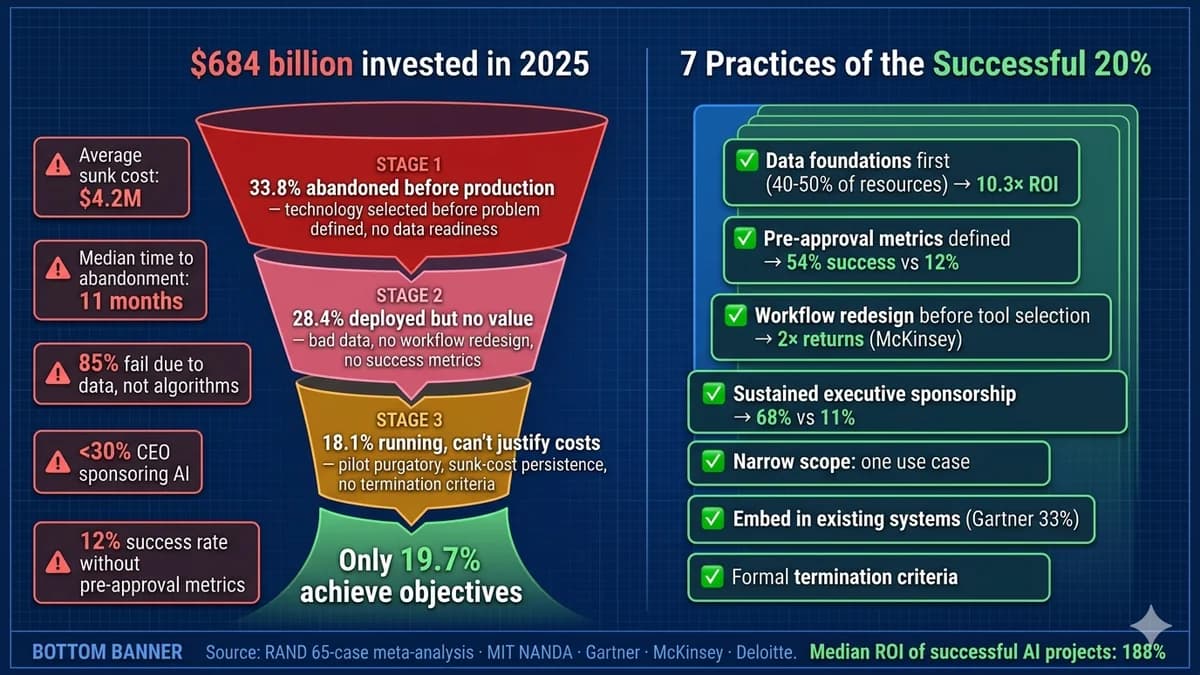
In 2025, global enterprises invested $684 billion in AI initiatives. By year end, more than $547 billion of that investment — over 80% — had failed to deliver intended business value. RAND Corporation's meta-analysis of 65 documented enterprise AI projects produced the clearest breakdown of exactly what failure looks like. The headline figure is 80.3% failing to deliver business value, but the structure of the failure is more revealing than the number:
Abandoned before production — never reached live deployment
Completed and deployed but deliver no measurable business value
Running in production but cannot justify their costs
Achieve their stated business objectives — the only group that counts
These are not the numbers of an immature technology hitting growing pains. They are the numbers of a structural mismatch between how organisations approach AI projects and what AI projects actually require. The same failure rates appeared in 2023. They appeared in 2024. They appear in 2025 despite dramatically better tooling, larger language models, more experienced engineering teams, and the most expensive enterprise AI spending in recorded history. The failure rate is consistent because the failures are not technical — they are structural, organisational, and methodological.
The 6 Failure Patterns That RAND, Gartner, MIT, and McKinsey All Identify
RAND's closing chapter of their meta-analysis contains one of the most uncomfortable findings: "Most failed projects should have stopped earlier. Not after 24 months, but after three, six, or nine. The problem was not money — it was the discipline to admit that the chosen path was the wrong one." Before understanding what distinguishes success, it is necessary to understand the failure patterns specifically — because the most dangerous ones are invisible from inside the project.
Data Problems — The Root Cause 85% of the Time
Gartner's finding is consistent and repeated: 85% of AI projects fail due to poor data quality or lack of relevant data — not algorithmic shortcomings. 70-85% of all AI failures link to data problems (Gartner, Deloitte, McKinsey). Poor data quality costs organisations an average of 15% of revenue per year. 63% of organisations do not have or are unsure if they have the right data management practices for AI. RAND's field observation is more specific: "Nobody is accountable for a single, consistent customer ID across ERP, CRM, and ticketing systems." It is not a data problem — it is a roles and accountability problem that manifests as a data problem.
Wrong Problem Definition — Technology Selected Before the Problem Is Clear
Only 15% of US employees say their workplace communicated a clear AI strategy (Gallup). S&P Global found that the average organisation scrapped 46% of AI proofs-of-concept before reaching production. The most common reason: the project was defined around an AI capability ("we want to build a chatbot") rather than a business problem ("we want to reduce our customer enquiry handling time from 4 minutes to 90 seconds"). These produce fundamentally different projects — one starts with technology and finds a use for it; the other starts with a quantified business problem and selects the technology that addresses it. RAND describes the failure mode as "use-case drift" — the project begins with clarity, but six months later the original problem no longer comes up in any meeting.
Lack of Executive Sponsorship — Delegation Is Not Leadership
Fewer than 30% of companies have CEOs directly sponsoring their AI agenda (McKinsey). 73% of failed AI projects lack clear executive alignment on success metrics (RAND). McKinsey's AI high performers are 3× more likely to have senior leaders who actively demonstrate ownership of AI initiatives — not passive endorsement but active involvement in defining what success looks like and removing blockers. Deloitte documents this precisely: "Enterprises where senior leadership actively shapes AI governance achieve significantly greater business value than those delegating the work to technical teams alone." The failure pattern is teams working on problems that leadership never prioritised, lacking access to the data they need, and unable to get the cross-functional collaboration required to deploy in production.
No Pre-Defined Success Metrics — Building Without a Finish Line
Projects with clear, pre-approval success metrics achieve a 54% success rate. Projects without them achieve 12% (RAND/Pertama Partners). The 4.5× difference in success rate from one practice — defining what success looks like before approving any budget — is the single most impactful governance decision available to business leaders considering AI investment. MIT Project NANDA traces the zero-return finding directly to organisations that skipped lag metrics: when budget reviews arrived, they had nothing measurable to present. The failure is not that the AI didn't work — it is that nobody defined what "working" meant before starting.
Change Management Neglect — Ignoring the People Who Have to Change Their Work
31% of workers admit to undermining their company's AI efforts — refusing tools, inputting poor data, or slow-rolling projects (Writer/Workplace Intelligence). User-centred design approaches drive 64% higher adoption, and aligned incentive structures produce 3.4× adoption rates. McKinsey documents that 30-50% of a team's innovation time with gen AI is spent either ensuring solutions meet compliance standards or waiting for organisational policies to catch up. "Teams that could be solving valuable problems are stuck re-creating experiments or waiting on compliance teams." The failure pattern: technology deployed without the behavioural change infrastructure — training, workflow redesign, incentive alignment — that makes adoption happen.
No Exit Discipline — Sunk Cost Persistence Through Failure
The median time to AI project abandonment is 11 months — significantly longer than the 3-6 month point at which most projects show the signals that predict eventual failure. RAND: "Most failed projects should have stopped earlier. The problem was not money — it was the discipline to admit that the chosen path was the wrong one. AI projects need formal termination criteria. Without them, the sunk-cost effect devours every good instinct." The most expensive AI projects are not the ones that fail quickly. They are the ones that fail slowly, accumulating $4.2M in average sunk costs before anyone acknowledges the failure is irreversible.
Evaluating an AI project and want an honest assessment of whether it has the structural foundations that put it in the 19.7% that succeed — or the patterns that put it in the 80% that fail? Automely provides this assessment free.
Free 45-minute AI project review. We map your proposed project against the 6 failure patterns and 7 success practices from RAND, Gartner, MIT, and McKinsey — and give you an honest recommendation.
7 Practices That Separate the 19.7% Who Succeed
The research on what separates successful AI projects from failing ones converges on a consistent set of practices. They are not technology practices — they are governance, sequencing, and organisational practices. This is the most important finding: the model is not what separates success from failure. The process before and around the model is.
Successful organisations do not start by selecting an AI model. They start by conducting an honest data readiness assessment: what data do they have, what quality is it, who is accountable for it, and does it meet the use-case requirements for AI training or grounding? Companies with strong data integration achieve 10.3× ROI versus 3.7× for those with poor data connectivity — a nearly threefold difference (Integrate.io). The practical implication: budget 40-50% of total AI project resources for data work before any model development begins. This feels disproportionate to organisations that have been thinking about AI as a technology purchase. It is the correct proportion for organisations that want AI projects to succeed.
The RAND/Pertama Partners finding is unambiguous: projects with clear pre-approval metrics achieve a 54% success rate. Projects without them achieve 12%. This single practice produces a 4.5× improvement in success rates. The discipline required: refuse to approve any AI project without defining, in advance and in writing, what measurable business outcome it will deliver, how that will be measured, what the baseline is today, and what the target is at 30, 90, and 180 days. "Better customer experience" is not a metric. "Reduce average handle time from 4 minutes to 90 seconds and increase CSAT from 3.8/5 to 4.2/5 within 90 days" is a metric. If a proposed project cannot be specified to this level of precision, it is not ready to be approved.
McKinsey's research shows that organisations reporting significant financial returns from AI are 2× more likely to have redesigned end-to-end workflows before selecting AI tools. This inverts the typical implementation sequence — most organisations select the AI tool first and then figure out how to fit it into their existing workflows. The correct sequence: map the current workflow, identify which steps require human judgment and which require structured execution, redesign the workflow for AI execution, then select the tool that fits the redesigned workflow. "Layering AI onto legacy processes" — Deloitte's phrase for the wrong approach — produces incremental improvement at best. Workflow redesign before tool selection produces structural capability improvement.
Sustained executive sponsorship produces a 68% project success rate versus 11% without it (RAND/Pertama Partners). The critical word is "sustained" — not the executive presentation at kickoff, but active leadership involvement through the mid-project challenges that are inevitable in every AI initiative. This means leaders who are actively removing organisational blockers, ensuring cross-functional collaboration between IT, data, and business teams, maintaining budget commitment through the 3-6 month period before ROI is visible, and role-modelling AI adoption within their own workflows. The failure mode is leadership that endorses AI projects enthusiastically and then delegates execution entirely to technical teams — producing the 80% who fail despite significant investment.
The most consistently successful approach to AI project initiation is a narrow scope: one specific, high-value use case with clearly bounded data requirements, a well-understood workflow, and a measurable outcome. Gartner's AI failure analysis shows that "organisations that chase flashy demos or deploy GenAI everywhere simultaneously dilute resources across low-impact initiatives." The pilot approach — one use case, measured outcomes, expansion only after measurable success — is not cautious. It is the fastest path to enterprise-wide AI deployment with durable ROI, because each successful deployment builds the data infrastructure, governance discipline, and organisational confidence that enables the next one.
Gartner's I&O research: 33% of I&O leaders with AI success embed it into the systems and processes people already use daily. As AI becomes part of day-to-day operations, it boosts adoption and creates visible impact. The failure pattern is standalone AI tools that require users to change their workflow to access AI features — producing the 31% who actively undermine company AI efforts. AI that surfaces inside the CRM tool the sales team already uses, the ticketing system support agents already work in, or the IDE developers already have open achieves adoption because the friction of behaviour change is eliminated. The tool goes where the workflow already is, not the other way around.
The practice that distinguishes the most disciplined AI organisations: before approving any project, define the specific conditions under which it will be stopped. If the lead metrics have not moved by week 6, the project is paused. If the 90-day outcome target is not met, the project is reviewed for continuation or cancellation. If the data quality issues surface at assessment are not resolved within a defined timeframe, the project does not start. This is not pessimism — it is the discipline that prevents the $4.2M average sunk cost that accumulates when failing projects persist. RAND: "The organisation has lost focus without realising it, because every intermediate step sounded perfectly reasonable." Formal termination criteria make the decision automatic rather than political.
Fail vs Succeed — The Side-by-Side Decision Comparison
The fail-vs-succeed pattern is most visible when set against one another at each decision point. Below is the side-by-side comparison built from the converging research — what the 80% who fail do at each decision point in an AI project versus what the 19.7% who succeed do. Each row is a decision that is made in every AI project. The cumulative effect of choosing the right column at every row is the difference between landing in the 80% and landing in the 19.7%.
| Decision Point | The 80% That Fail | The 20% That Succeed |
|---|---|---|
| Starting sequence | Select AI tool → find a use case → address data after | Define business problem → assess data readiness → select tool to fit redesigned workflow |
| Data investment | Minimal upfront data work; plan to clean during project | 40-50% of total resources allocated to data foundations before model development |
| Success definition | "Better outcomes," "improved efficiency," general improvement goals | Quantified metrics defined pre-approval: baseline, target, measurement method, timeline |
| Executive role | Endorsed at launch; delegated to technical teams afterward | Active sponsorship throughout: blocker removal, cross-functional facilitation, sustained commitment |
| Scope | Multiple simultaneous initiatives; enterprise-wide ambition | One well-defined use case; measured success before expansion |
| Workflow approach | Layer AI onto existing processes; maintain current workflow | Redesign workflow for AI execution; then select tool to fit the redesigned workflow |
| Termination | No formal criteria; sunk-cost persistence; 11-month average failure duration | Termination criteria defined pre-approval; stop signals treated as data, not failure |
| Result | $4.2M average sunk cost per abandoned project; 12% success rate without pre-approval metrics | 188% median ROI; 54% success rate with pre-approval metrics; 10.3× ROI with strong data integration |
For Business Leaders Evaluating AI Projects — Three Questions That Predict Outcome
The research from RAND, MIT, Gartner, and McKinsey reduces to three questions that any business leader can ask before approving or commissioning AI development. Each maps to one of the structural failure patterns. The answers determine which 80% or 20% group the project will likely join.
Question 1: Can you state the business problem — not the AI solution — in one sentence, with a specific measurable outcome? If the answer is "we want to use AI to improve our customer service," the project is not ready. If the answer is "we want to reduce our average query resolution time from 4 minutes to under 90 seconds while maintaining 4.2+ CSAT," the project has a foundation to build on. This maps to failure patterns 2 and 4 — wrong problem definition and no pre-defined success metrics.
Question 2: Has someone conducted an honest data readiness assessment — and was data quality acceptable before the project was approved? Not "we think our data is okay" or "we'll clean it as we go," but a documented assessment of the specific data required for the use case, its current quality, who is accountable for it, and what the remediation plan is for the gaps. This maps to failure pattern 1 — data problems that 85% of AI project failures trace to.
Question 3: Is the executive sponsor actively committed through 6-12 months, not just at launch — and are termination criteria defined? The sponsor who approves the project and then checks in at 6 months asking for ROI results is not sustaining sponsorship. The sponsor who is in the 30-day review, the 90-day evaluation, the mid-project unblocking conversations — and who has agreed in advance that if the 90-day metrics are not met, the project will be evaluated for termination — is. This maps to failure patterns 3 and 6.
Automely applies these three questions to every AI project we build. They are not screening questions — they are the design standards that put projects in the 19.7% that succeed rather than the 80% that do not. For the context on what the successful deployments look like in practice, see our case studies and our custom AI development guide.
Planning an AI project and want a partner who starts with data readiness assessment, pre-defines success metrics, and builds with the 7 practices of the successful 20% — rather than the 6 patterns of the failing 80%?
Automely builds AI systems that are designed to succeed from day one — with the sequencing, governance, and measurement discipline that the RAND, Gartner, and McKinsey research identifies as the differentiator. Free 45-minute project assessment.